Pastor. Civic organizer. Political leader. Presidential candidate.
Maxo Joseph represents a less conventional current in Haitian politics: a political project built around Christian leadership, citizen mobilization, education, national discipline and reconstruction from within.
He was an approved presidential candidate in 2015 for the Rassemblement des Nationaux Démocrates Volontaires pour l’Unité Salvatrice (RNDVUS), commonly presented politically as RANDEVOUS. Contemporary reporting on his 2015 campaign says Joseph centered his program on four priorities: education, the army, agriculture and tourism.
He returned to the presidential contest in 2016. In a notable development, fellow pastor and presidential contender Jean-Chavannes Jeune withdrew and endorsed Joseph as part of an effort to consolidate part of Haiti’s Protestant political electorate.
Today, Joseph’s public-facing civic movement again emphasizes public safety, economic opportunity, diaspora participation and community organization. But those are aspirations.
HaitiPolitic wants to examine the harder question: Where is the governing machinery behind them?
🔎 WHO IS MAXO JOSEPH?
The first important distinction is between what can be independently established and what remains part of Joseph’s own political biography.
Reliable contemporary election reporting establishes that Joseph was a presidential candidate associated with RNDVUS/RANDEVOUS in both the 2015 and 2016 electoral cycles.
His 2015 campaign was explicitly connected to Haiti’s Protestant political movement. His launch at Sarthe 55 included church members as well as political supporters, while that year’s broader Protestant effort debated whether Haiti’s evangelical sector should rally behind a single presidential candidate.
Joseph nevertheless remained a relatively minor electoral candidate nationally.
Published 2015 results report 8,914 votes, approximately 0.57% of valid votes for Joseph. A later election database reports 5,336 votes for him in the 2016 rerun.
That produces the first major question:
Can Maxo Joseph transform a movement into a national governing coalition?
1️⃣ THE VOLUNTEER REPUBLIC: POWERFUL IDEA OR UNFUNDED PROMISE?
The very name of Joseph’s political organization places voluntary national participation near the center of its identity.
The concept has appeal.
Haiti possesses enormous human resources that the formal economy and political system have failed to organize productively—particularly young people and the diaspora.
Joseph’s current civic messaging similarly stresses organizing communities, training youth, encouraging diaspora investment and rebuilding local economies. His movement says it wants citizen organization rather than dependence on one political personality.
But volunteerism cannot substitute for an economy.
HaitiPolitic would ask Maxo Joseph:
🔴 How do unemployed Haitians volunteer when they cannot afford food or transportation?
🔴 Would national service participants receive salaries or stipends?
🔴 Would participation provide vocational certification?
🔴 Could young Haitians receive tuition assistance in exchange for national service?
🔴 Would engineers, nurses, teachers and tradespeople receive incentives for working in underserved departments?
🔴 Most importantly: what would all of this cost?
A serious national-service proposal needs a budget, not simply patriotic language.
2️⃣ 💰 WHERE DOES THE MONEY COME FROM?
This is where every presidential promise eventually arrives.
The Treasury.
Joseph’s 2015 platform promised major initiatives involving education, agriculture, tourism and the armed forces.
All four require substantial investment.
So show voters the numbers.
If Joseph wants Haiti to rebuild itself from within:
How much additional domestic revenue can Haiti realistically collect?
Would his administration:
• digitize customs?
• audit major importers?
• reform property taxation?
• eliminate unjustified tax exemptions?
• publish government contracts?
• prosecute customs fraud?
• decentralize revenue to communes?
• create diaspora infrastructure bonds?
There is a major difference between saying “Haiti must become independent of foreign aid” and demonstrating how Haiti replaces that money.
3️⃣ ✝️ FAITH AND THE REPUBLIC
Joseph’s evangelical identity cannot simply be ignored in evaluating his political project.
Nor should it automatically disqualify him.
The appropriate question isn’t whether a pastor can become president.
The question is whether a pastor-president can govern equally for citizens of every belief.
Haiti’s religious landscape includes Protestants, Catholics, Vodou practitioners and citizens with other beliefs or none.
Joseph should therefore answer:
🔴 Would Vodou institutions receive exactly the same constitutional protection as evangelical churches?
🔴 Would religious organizations receiving government money undergo the same audits as secular organizations?
🔴 Would pastors or churches be permitted to use state-funded programs for evangelization?
🔴 Would religious affiliation ever influence appointments?
🔴 Where does Maxo Joseph the pastor end and Maxo Joseph the president of a pluralistic republic begin?
These aren’t anti-religious questions.
They are democratic ones.
4️⃣ 🏛️ EXPERIENCE: WHAT HAS HE ACTUALLY ADMINISTERED?
This is an area where additional documentation is needed.
Some profiles surrounding Joseph attribute governmental, ministerial and international religious experience to him. But the sources reviewed for this investigation do not provide enough independent primary documentation for HaitiPolitic to confidently verify every claim in the biography supplied to us, including the precise nature and dates of his alleged senior administrative role involving Haiti’s Ministry of Culture/Worship.
That distinction matters.
Political profiles should separate:
documented accomplishment
from
campaign biography
from
political promise.
Joseph should therefore voluntarily publish a comprehensive professional résumé specifying:
Position → Institution → Dates → Responsibilities → Budget managed → Employees supervised → Measurable results.
Haiti doesn’t need another résumé based on titles.
It needs evidence of execution.
5️⃣ 🌾 AGRICULTURE: A PROMISE FROM 2015 THAT STILL MATTERS
Agriculture was explicitly one of Joseph’s four major campaign priorities in 2015.
More than a decade later, the question becomes stronger:
What exactly is the agricultural doctrine?
Would President Joseph support:
🔴 tariffs protecting Haitian rice and poultry?
🔴 agricultural credit?
🔴 irrigation rehabilitation?
🔴 crop insurance?
🔴 agricultural machinery cooperatives?
🔴 regional cold-storage facilities?
🔴 food-processing factories?
🔴 restrictions on subsidized foreign agricultural imports?
And there is a difficult tradeoff.
Protecting Haitian agriculture can increase domestic production over time—but abruptly restricting cheaper imports can increase food prices immediately.
What happens to poor urban families during that transition?
That’s the kind of policy dilemma presidential candidates must answer.
6️⃣ 🪖 JOSEPH WANTED AN ARMY. WHAT WOULD IT ACTUALLY DO?
The restoration or strengthening of Haiti’s armed capacity was another explicit element of Joseph’s 2015 campaign.
Today that question has enormous relevance.
But “build the army” isn’t a security strategy.
HaitiPolitic would ask:
How many soldiers?
At what annual cost?
Who trains them?
Who supplies their weapons?
What is their relationship with the PNH?
Who exercises civilian oversight?
What prevents political leaders from turning the armed forces into a presidential instrument?
Haiti’s history makes that final question unavoidable.
A national security institution must defend the republic—not the politician controlling the National Palace.
7️⃣ 🚨 GANGS: MORAL RECONSTRUCTION ISN’T A SECURITY OPERATION
Joseph’s current public messaging emphasizes restoring security through firm but ethical action.
Good.
Now comes the operational test.
🔴 How many additional police officers does Haiti need?
🔴 How would they be vetted?
🔴 What intelligence architecture would identify gang financing?
🔴 Would Joseph negotiate with armed groups?
🔴 What happens to child recruits?
🔴 What happens to communities liberated from gang control?
🔴 Would major financiers and political sponsors face asset seizures?
🔴 What role should foreign security forces play?
Military operations can reclaim a neighborhood.
Only government can keep it reclaimed.
Police must be followed by courts, schools, sanitation, electricity, jobs and legitimate municipal authority.
Otherwise another armed organization fills the vacuum.
8️⃣ 👦🏿 THE CHILDREN INSIDE THE GANG ECONOMY
This could be where Joseph’s faith and community background becomes practically relevant.
Not everyone inside an armed neighborhood structure occupies the same moral or criminal category.
Some are hardened commanders.
Others are children recruited into an environment where carrying a weapon offers food, protection, status or survival.
A serious government therefore needs two strategies simultaneously:
JUSTICE FOR ORGANIZERS.
EXIT ROUTES FOR RECRUITED YOUTH.
Joseph should present a national program combining:
disarmament + psychological treatment + education + vocational training + family reunification + employment + community supervision.
Mercy without security fails.
Security without reintegration can manufacture tomorrow’s gang recruits.
9️⃣ 🌎 FOREIGN POLICY: WHAT DOES “HAITI FIRST” ACTUALLY MEAN?
This is perhaps the least developed portion of Joseph’s publicly documented political identity.
Yet Haiti’s next president will inherit enormously difficult relationships with the United States, Canada, France, CARICOM, the Dominican Republic, international financial institutions and security partners.
Joseph has previously argued that Haitians living in the Dominican Republic should participate in finding solutions to Haiti’s crisis, demonstrating at least some recognition of the diaspora’s diplomatic and economic importance.
But Haiti needs considerably more than diaspora engagement.
HaitiPolitic would ask:
🔴 What should Haiti demand from Washington?
🔴 What should Haiti offer in return?
🔴 What is Joseph’s policy toward the Dominican Republic on migration, trade and border security?
🔴 Should Haiti deepen CARICOM integration?
🔴 What is his position on Haiti’s relationship with Taiwan and China?
🔴 Would he accept foreign security assistance?
🔴 Should foreign NGOs continue operating independently of Haitian ministries?
🔴 Would his government seek new relationships in Africa and Latin America?
Foreign policy cannot remain:
“What will the international community do for Haiti?”
The question must become:
“What does Haiti want from the world—and what does Haiti bring to the negotiating table?”
🔟 THE EVANGELICAL UNITY EXPERIMENT
The 2015–2016 elections offer an interesting lesson.
Haiti’s Protestant political sector struggled to consolidate around a single candidate in 2015. A gathering of Protestant leaders initially rallied around Jean-Chavannes Jeune, while Maxo Joseph continued his own candidacy.
Then the dynamic reversed.
In August 2016, Jeune withdrew and endorsed Joseph, saying he wanted greater unity within the Protestant political sector.
That was politically significant.
But it also exposes a structural problem:
Even religious unity isn’t necessarily national unity.
Haiti’s president must govern people far beyond the evangelical electorate.
A Joseph campaign therefore needs to demonstrate support among:
farmers, workers, entrepreneurs, women’s organizations, universities, professionals, unions, diaspora communities, Catholics, Vodou practitioners, secular voters and young people with no religious political identity.
Without that expansion, RNDVUS risks remaining a sectoral movement rather than a national governing alternative.
📊 HAITI POLITIC ASSESSMENT
| AREA | POTENTIAL STRENGTH | QUESTION TO ANSWER |
|---|---|---|
| Civic Mobilization | Community-oriented philosophy emphasizing citizen participation | Can volunteerism become a financially sustainable national-service system? |
| Faith Network | Potential organizational reach through Protestant communities | Can Joseph convincingly govern a religiously pluralistic republic? |
| Education | A documented pillar of his 2015 platform | Where is the financing and implementation blueprint? |
| Agriculture | Long-standing campaign priority | What specific policies increase domestic production without worsening food inflation? |
| Security | Historically supported stronger national defense | How would military and police power remain accountable to civilian institutions? |
| Diaspora | Current messaging treats Haitians abroad as strategic partners | What institutions would convert remittances into productive investment? |
| Foreign Policy | Opportunity to articulate a sovereignty-centered doctrine | A detailed geopolitical strategy remains necessary |
| Electoral Strength | Demonstrated ability to qualify and compete nationally | Past vote totals show the challenge of expanding into a mass coalition |
⚖️ THE QUESTION OF ACCOMPLISHMENTS
This investigation reveals an important distinction.
Maxo Joseph has demonstrated political persistence, religious/community organizing and the ability to repeatedly enter national political competition. He also articulated education, agriculture, tourism and national defense as identifiable policy priorities rather than running solely on personality.
But voters should demand something more.
What did he build?
How much did it cost?
How many people benefited?
What organization did he successfully administer?
What measurable outcome can be independently audited?
And:
What has changed since his first presidential campaign?
Those answers would allow Haitians to distinguish a visionary from a candidate with a vision.
There is a difference.
🔥 HAITI POLITIC VERDICT: NO VERDICT.
Maxo Joseph presents an intriguing political proposition:
mobilize citizens instead of political machines.
mobilize youth instead of abandoning them.
mobilize the diaspora instead of treating it simply as a remittance source.
rebuild morality alongside institutions.
But Haiti has heard compelling visions before.
The next standard should be higher:
Show the budget.
Show the team.
Show the security doctrine.
Show the foreign-policy doctrine.
Show the audited accomplishments.
Show how religious conviction coexists with absolute religious equality.
Show how volunteers become skilled workers.
Show how diaspora money becomes Haitian productive capital.
And show how RNDVUS becomes a national coalition rather than another presidential vehicle.
Then Haitians can judge.
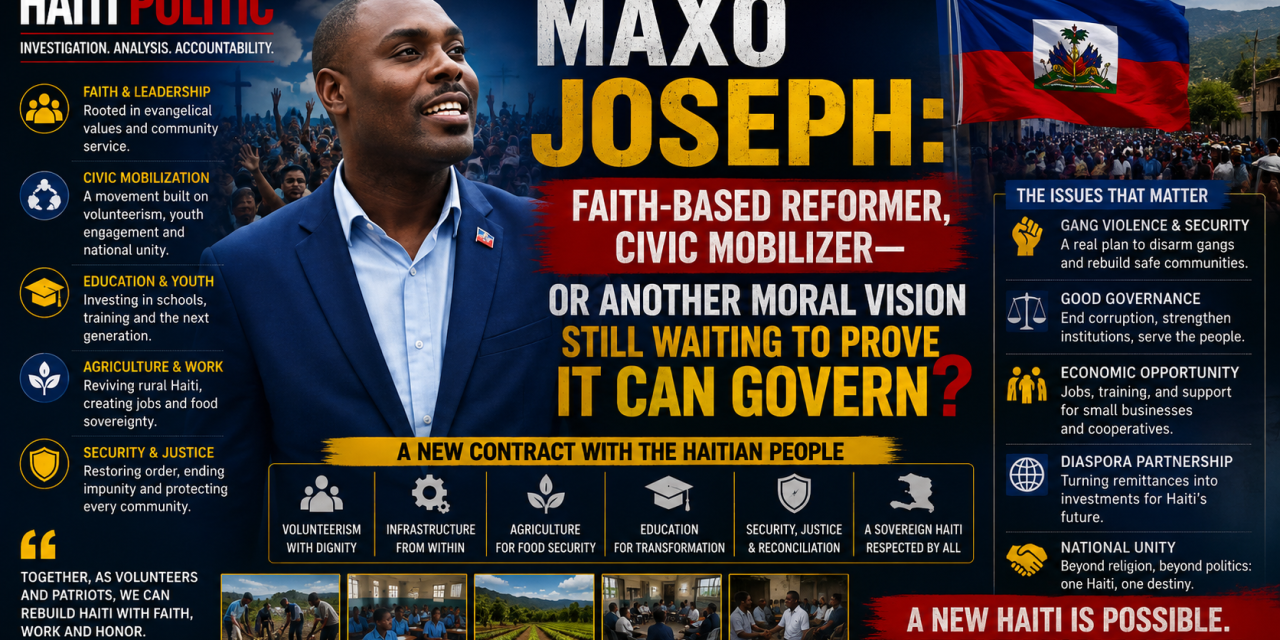
🇭🇹 MAXO JOSEPH: FAITH-BASED REFORMER, CIVIC MOBILIZER—OR ANOTHER MORAL VISION STILL WAITING TO PROVE IT CAN GOVERN?
The candidate should provide the evidence.
The people should make the decision.
HAITI POLITIC — Investigation. Analysis. Accountability.
#HaitiPolitic #MaxoJoseph #RNDVUS #Randevous #Haiti #HaitiPolitics #HaitiElections #HaitiSecurity #ForeignPolicy #Diaspora #Agriculture #Governance #Accountability #Democracy