HAITI POLITIC | SPECIAL INVESTIGATION
November 14, 2026
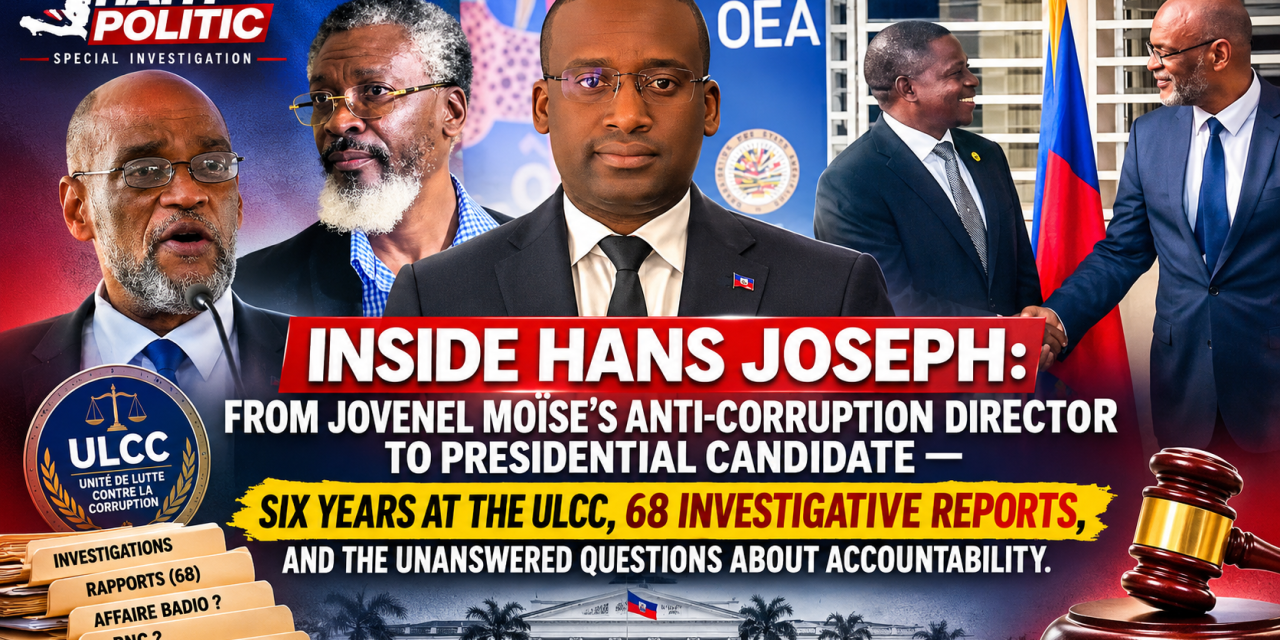
From Rockfeller Vincent’s inner circle to the leadership of Haiti’s anti-corruption agency, Hans Joseph spent six years navigating successive governments. His presidential ambitions now invite closer examination of his institutional record, the dismissal of Joseph Félix Badio before Jovenel Moïse’s assassination, Vincent’s July 20, 2021 appearance with Ariel Henry, and the unresolved judicial outcomes of dozens of corruption investigations.
A PRESIDENTIAL CANDIDATE PROMISING TO END IMPUNITY
On November 13, 2026, former Haitian anti-corruption director Hans Jacques Ludwig Joseph announced his candidacy for president of Haiti.
His message was straightforward:
“An end to impunity. Time for accountability.”
Joseph presented himself as a public official prepared to transform his experience fighting corruption into a national political program.
His candidacy follows approximately six years as director general of the Unité de Lutte Contre la Corruption (ULCC), the Haitian government’s principal administrative anti-corruption investigative institution.
Appointed during President Jovenel Moïse’s administration in July 2020, Joseph remained in office through Moïse’s assassination, Ariel Henry’s premiership, and the subsequent transitional period.
He was removed from office in July 2026.
Now running under the banner of Effort et Solidarité pour Construire une Alternative Nationale Populaire (ESKANP), Joseph proposes a presidency centered on security, judicial independence, public accountability, and economic reform.
His political message is closely tied to his record as a government official.
But that record contains questions requiring documentary answers.
How did Joseph rise to the leadership of the ULCC?
What was his relationship with former justice minister Rockfeller Vincent?
What happened to the disciplinary complaint against Joseph Félix Badio, an employee dismissed from the ULCC shortly before Moïse’s assassination?
What did the agency do during the political crisis surrounding Prime Minister Ariel Henry in September 2021?
And how many of the 68 investigative reports attributed to Joseph’s leadership produced measurable judicial results?
These are questions about institutional responsibility and public accountability.
They are not accusations that Joseph participated in the assassination or engaged in criminal misconduct.
1. HANS JOSEPH’S RISE THROUGH HAITI’S ANTI-CORRUPTION INSTITUTION
Hans Joseph is a Haitian attorney associated with the Port-au-Prince Bar.
Biographical accounts identify him as originally from Haiti’s Northeast Department.
Before becoming ULCC director general, he served as chief of staff to Rockfeller Vincent, who previously headed the institution.
Vincent was appointed ULCC director general in January 2020.
Several months later, President Jovenel Moïse appointed Vincent minister of justice and public security.
Prime Minister Joseph Jouthe installed Vincent in July 2020, replacing Lucmane Délille.
Hans Joseph subsequently assumed leadership of the ULCC.
The succession placed two former colleagues in influential positions within Haiti’s justice and anti-corruption institutions.
Vincent became responsible for the Ministry of Justice.
Joseph directed an institution empowered to investigate suspected corruption involving public officials and government resources.
Their professional relationship is documented.
However, the available records do not establish whether Vincent personally recommended Joseph’s appointment or exercised influence over his subsequent investigations.
Those distinctions are important when evaluating Joseph’s institutional independence.
Questions about the appointment
Who recommended Hans Joseph for the position?
What role did President Jovenel Moïse play in his selection?
Did Rockfeller Vincent support his appointment?
And what institutional safeguards prevented political authorities from influencing ULCC investigations?
Joseph’s presidential candidacy provides an opportunity to address these questions publicly.
2. ROCKFELLER VINCENT AND THE JOVENEL MOÏSE ADMINISTRATION
Rockfeller Vincent’s political history is relevant to understanding Joseph’s administrative background.
Vincent served as ULCC director general before becoming minister of justice under Jovenel Moïse.
He subsequently played a visible role in the government’s response to the assassination.
Vincent has also publicly expressed support for Moïse’s political legacy.
In a social media post dated July 20, 2021, Vincent wrote:
« Les forces obscurantistes ont détruit le corps du Président, mais l’idéal jovenelien perdure ! »
The statement translates as:
“Obscurantist forces destroyed the President’s body, but the Jovenelist ideal lives on!”
Vincent also recalled Moïse’s emphasis on public service and urged an end to political divisions.
The statement demonstrates Vincent’s publicly expressed identification with Moïse’s legacy.
It does not establish that Hans Joseph shared Vincent’s political views.
Nor does Joseph’s previous employment under Vincent establish political allegiance.
Nevertheless, Joseph’s professional relationship with Vincent deserves examination because his presidential campaign emphasizes independence from political interference.
Was Joseph’s relationship with Vincent exclusively professional, or did they share a broader political vision?
Only Joseph and relevant documentary evidence can establish the answer.
3. JULY 7, 2021: THE ASSASSINATION AND THE INSTITUTIONS RESPONSIBLE FOR ACCOUNTABILITY
President Jovenel Moïse was assassinated on July 7, 2021.
At the time, Rockfeller Vincent was minister of justice.
Hans Joseph was director general of the ULCC.
The assassination triggered investigations in Haiti and the United States and exposed major concerns about presidential security, political influence, and the justice system.
Vincent became involved in the institutional response to the investigation.
Joseph continued directing the anti-corruption agency.
Although the ULCC was not the principal authority responsible for investigating the assassination, its jurisdiction over suspected corruption and financial misconduct could become relevant if investigators identified matters within its legal mandate.
The available material does not establish that the ULCC conducted a financial investigation directly related to the assassination.
Nor does it establish that Joseph personally possessed information about the conspiracy.
However, the agency’s personnel history contains an important connection to the case.
Joseph Félix Badio, subsequently identified as a suspect, had worked at the ULCC.
4. JOSEPH FÉLIX BADIO: THE ULCC EMPLOYEE DISMISSED BEFORE JULY 7
Joseph Félix Badio previously worked for Haiti’s Ministry of Justice.
He joined the ULCC in March 2013.
His employment continued through several administrations and changes in the agency’s leadership.
According to contemporaneous reporting based on an official ULCC statement, Badio was dismissed on May 17, 2021.
The agency cited serious violations of professional ethics.
The ULCC also reported filing a complaint against him.
CNN subsequently identified May 20, 2021, as the date of that complaint.
These developments occurred while Hans Joseph was director general.
The chronology
| Date | Development |
|---|---|
| March 2013 | Joseph Félix Badio joins the ULCC. |
| January 2020 | Rockfeller Vincent becomes ULCC director general. |
| July 2020 | Hans Joseph succeeds Vincent. |
| May 17, 2021 | Badio is reportedly dismissed for serious ethical violations. |
| May 20, 2021 | The ULCC reportedly files a complaint against Badio. |
| July 7, 2021 | President Jovenel Moïse is assassinated. |
| July 2021 | Badio is publicly identified as a suspect in the assassination investigation. |
| October 2023 | Haitian authorities arrest Badio. |
The chronology establishes that Badio’s disciplinary proceedings occurred during Joseph’s leadership.
It does not establish that Joseph personally authorized the dismissal.
It also does not establish that the alleged ethical violations were connected to the assassination.
The unanswered questions
What were the specific allegations against Badio?
Who conducted the internal investigation?
Who signed the dismissal decision?
Who authorized the complaint?
Was the complaint submitted to a prosecutor?
And what happened after it was filed?
These questions cannot be answered conclusively without examining the original ULCC records.
5. THE MAY 20 COMPLAINT: A MISSING PIECE OF THE INSTITUTIONAL RECORD
The reported complaint against Badio deserves particular attention.
The public reporting reviewed for this investigation does not establish its complete contents.
The original document has not been obtained.
That means several important facts remain unresolved.
The complaint may have concerned administrative misconduct, alleged criminal conduct, or another disciplinary matter.
Without examining it, the precise nature of the allegations cannot be established.
The available reporting also does not establish whether the complaint resulted in a prosecution.
Why the document matters
The complaint could clarify what the ULCC knew about Badio before the assassination.
It could identify the officials responsible for the disciplinary proceedings.
It could establish whether prosecutors received the allegations.
And it could reveal whether additional investigative steps were recommended.
None of those possibilities establishes that the ULCC had advance knowledge of the assassination conspiracy.
The purpose of obtaining the complaint is to establish the agency’s documented actions, not to infer a connection that the available evidence does not demonstrate.
6. JULY 20, 2021: ROCKFELLER VINCENT, ARIEL HENRY AND THE TRANSITION AFTER MOÏSE’S ASSASSINATION
A newly examined social media post provides additional historical context for the relationship between Rockfeller Vincent and Ariel Henry immediately after President Moïse’s assassination.
On July 20, 2021, just 13 days after the assassination, Vincent published photographs showing him shaking hands with Ariel Henry.
The post was timestamped 9:47 p.m.
The date is significant.
July 20 was the day Ariel Henry formally assumed office as Haiti’s prime minister.
Vincent remained minister of justice during the transition.
In the accompanying message, Vincent invoked Moïse’s political legacy and called for an end to divisions.
The photographs show a public encounter between the two officials during the formation of Henry’s government.
They also establish that Vincent publicly participated in the transition while expressing support for Moïse’s legacy.
What the photographs do not establish
A public handshake is not evidence of a secret agreement.
The photographs do not establish that Vincent knew about Henry’s reported communications with Joseph Félix Badio.
They do not establish that Vincent and Henry coordinated activities relating to the assassination investigation.
And they do not establish that Hans Joseph participated in any arrangement involving the two men.
Nevertheless, the photographs provide a useful chronological reference.
They document a public encounter between Vincent and Henry approximately eight weeks before their political confrontation in September 2021.
Why this matters for the Hans Joseph investigation
The institutional relationships during this period were distinct.
Rockfeller Vincent headed the Ministry of Justice.
Hans Joseph directed the ULCC.
Ariel Henry had become prime minister.
Joseph Félix Badio, a former ULCC employee, was being sought in connection with the assassination.
The intersection of these institutional histories creates legitimate questions about information sharing, disciplinary records, and the independence of government investigations.
Did the ULCC provide Badio’s May 2021 disciplinary file to the Ministry of Justice or investigators after July 7?
If so, when?
Who authorized the transfer?
And did the information become part of the assassination investigation?
Those questions require records.
The photographs alone cannot answer them.
7. SEPTEMBER 2021: ARIEL HENRY DISMISSES ROCKFELLER VINCENT
The relationship between Ariel Henry and Rockfeller Vincent became publicly contentious in September 2021.
The crisis developed after Port-au-Prince prosecutor Bed-Ford Claude sought to question Henry concerning reported telephone communications with Joseph Félix Badio.
The prosecutor requested judicial examination of Henry’s possible involvement in the assassination case.
Henry denied involvement.
The confrontation escalated when Henry moved to remove Claude.
On September 15, 2021, Henry dismissed Rockfeller Vincent as minister of justice.
Vincent was replaced by Liszt Quitel.
The dismissal occurred amid a broader institutional crisis.
Rénald Lubérice, then secretary-general of the Council of Ministers, resigned and accused Henry of obstructing justice.
Those accusations were contested and did not constitute findings of criminal guilt.
The significance of the July 20 photographs
The July 20 photographs and September dismissal establish two distinct moments in the relationship between Vincent and Henry.
In July, Vincent publicly appeared with Henry during the formation of the new government.
In September, Henry removed Vincent amid controversy surrounding the assassination investigation.
The photographs do not establish the nature of their private relationship.
However, they help document the political chronology.
Where was Hans Joseph during this crisis?
Joseph remained director general of the ULCC.
His former superior, Vincent, had been dismissed from the Ministry of Justice.
The government was experiencing a serious confrontation over the direction of the assassination investigation.
The ULCC continued operating under Joseph’s leadership.
This raises questions about how the agency maintained its independence during the crisis.
Did Joseph receive instructions concerning politically sensitive investigations?
Did investigators request information about Badio?
Did the ULCC cooperate with judicial authorities?
And did Joseph document any attempts at interference?
The available materials do not establish that Joseph obstructed an investigation or engaged in misconduct.
These questions concern institutional transparency.
8. THE PROFESSIONAL NETWORK: VINCENT, JOSEPH, BADIO AND HENRY
The available evidence establishes several separate relationships.
Rockfeller Vincent and Hans Joseph: Joseph previously served as Vincent’s chief of staff at the ULCC before succeeding him as director general.
Hans Joseph and Joseph Félix Badio: Badio was employed by the ULCC and dismissed during Joseph’s leadership.
Rockfeller Vincent and Ariel Henry: Vincent served as justice minister during Henry’s early administration and was dismissed in September 2021.
Ariel Henry and Joseph Félix Badio: Investigators examined reported telephone communications involving Henry and Badio.
These connections are relevant to understanding the institutions and individuals involved in the political crisis.
But they must not be combined into an unsupported allegation of coordinated wrongdoing.
Professional association, employment history, public photographs, and reported telephone communications are different forms of evidence.
Each requires independent examination.
For Hans Joseph, the principal question concerns his documented responsibilities as ULCC director general.
9. SIX YEARS AT THE ULCC: THE 68 INVESTIGATIVE REPORTS
Joseph’s most substantial public-service record comes from his leadership of the ULCC between July 2020 and July 2026.
According to figures he has publicly presented, the institution produced approximately 68 investigative reports during his administration.
He has also cited more than 120 matters involving public officials who allegedly failed to comply with asset-declaration requirements.
These figures describe investigative activity.
They do not automatically establish successful prosecutions.
The ULCC investigates suspected corruption and transmits relevant findings to judicial authorities.
It does not independently convict defendants.
The difference between investigations and accountability
| Measure | Question |
|---|---|
| Investigative reports | How many were completed and formally transmitted? |
| Prosecutorial referrals | How many were accepted for prosecution? |
| Criminal charges | How many defendants were formally charged? |
| Judicial outcomes | How many cases resulted in final decisions? |
| Convictions | How many defendants were found guilty? |
| Asset recovery | How much public money was recovered? |
| Institutional reform | Which improvements survived Joseph’s departure? |
Joseph has argued that weaknesses within Haiti’s justice system prevented many investigations from producing results.
That explanation deserves examination.
Judicial insecurity, limited resources, political pressure, and procedural delays can undermine anti-corruption enforcement.
However, the public should be able to distinguish between the ULCC’s investigative output and the justice system’s subsequent actions.
Sixty-eight investigative reports represent a measurable administrative record. Their judicial outcomes require a separate accounting.
10. THE BNC INVESTIGATION AND THE TRANSITIONAL PRESIDENTIAL COUNCIL
One of the most politically significant investigations conducted during Joseph’s tenure concerned allegations involving the Banque Nationale de Crédit.
In October 2024, the ULCC released findings concerning allegations involving three members of Haiti’s Transitional Presidential Council:
Smith Augustin, Emmanuel Vertilaire, and Louis Gérald Gilles.
The investigation examined allegations that the officials had sought financial benefits connected to the continued employment of a senior BNC official.
The individuals implicated denied the allegations.
The ULCC recommended judicial action.
The investigation demonstrated that Joseph’s agency examined allegations involving senior political figures.
However, the report did not constitute a criminal conviction.
The subsequent judicial history must be examined separately.
For an assessment of Joseph’s record, the relevant questions are whether the case proceeded, what evidence was examined, and what decisions were issued by the courts.
11. INVESTIGATIONS INVOLVING MICHEL MARTELLY
During Joseph’s leadership, the ULCC also examined allegations involving former President Michel Joseph Martelly.
Reporting from December 2025 identified investigations concerning Martelly among politically sensitive matters addressed by the agency.
One reported issue concerned asset-declaration obligations.
The existence of an investigation does not establish guilt.
The relevant questions concern the investigative findings, the evidence obtained, the recommendations transmitted to judicial authorities, and the subsequent legal outcomes.
These are the standards that should apply to every individual investigated by the ULCC.
12. JULY 2026: THE DISMISSAL OF HANS JOSEPH
Joseph was removed as ULCC director general in July 2026.
His dismissal followed public disagreements over legal changes affecting accountability for senior government officials.
Joseph criticized provisions governing the Haute Cour de justice, arguing that they could weaken mechanisms for holding powerful officials accountable.
He subsequently linked his dismissal to his criticism of the legal framework.
That was his interpretation of the events.
The government’s precise motivation requires examination of the dismissal order and any official explanation.
On July 7, 2026, Joseph reported filing his end-of-service asset declaration.
The declaration is relevant to his public commitment to transparency.
However, the contents have not been independently examined for this investigation.
A complete assessment would require the legally accessible declaration records and any relevant supporting documentation.
13. THE PRESIDENTIAL CAMPAIGN: SECURITY, JUSTICE AND ANTI-CORRUPTION
Joseph’s November 2026 presidential announcement emphasizes three principal priorities:
Security.
The rule of law.
The fight against corruption.
His proposals include strengthening Haiti’s police and armed forces, improving judicial institutions, expanding economic opportunities, supporting displaced families, and addressing public-finance weaknesses.
These proposals address major challenges facing Haiti.
However, their feasibility depends on implementation plans, budgets, legal reforms, and institutional capacity.
Security
How would Joseph finance the modernization of the police and armed forces?
What would be his strategy for recovering territory controlled by armed groups?
How would he protect civilians and ensure accountability for security personnel?
Justice
Would Joseph support stronger guarantees of judicial independence?
How would he prevent political interference in prosecutions?
Would he support legal protections for ULCC investigators examining members of his own administration?
Corruption
How would Joseph ensure that investigative reports result in timely judicial consideration?
What reforms would improve asset recovery?
Would he support public reporting on the outcomes of corruption investigations?
The answers would provide a basis for evaluating the practical content of his campaign proposals.
14. ESKANP AND CAMPAIGN FINANCING
Joseph is running under the banner of Effort et Solidarité pour Construire une Alternative Nationale Populaire (ESKANP).
The organization’s complete leadership and financing structure have not been established in the materials reviewed.
Several questions therefore remain relevant.
Who founded the party?
Who serves on its executive committee?
Which political organizations support Joseph?
Who finances the campaign?
And what financial disclosures will the party provide?
These questions are especially relevant because Joseph’s campaign emphasizes transparency and accountability.
His public announcement of candidacy should also be distinguished from final approval by Haiti’s Provisional Electoral Council.
15. FIFTEEN QUESTIONS FOR HANS JOSEPH
1. Who recommended your appointment as ULCC director general in July 2020?
What role did Rockfeller Vincent play?
2. Did you maintain a professional relationship with Vincent after he became justice minister?
Did that relationship involve discussions of ULCC investigations?
3. Did you personally authorize Joseph Félix Badio’s dismissal in May 2021?
If not, who signed the decision?
4. What specific ethical violations led to Badio’s dismissal?
Can the relevant records be released to the extent permitted by law?
5. What happened to the May 20, 2021 complaint against Badio?
Which authority received it, and what action followed?
6. Did the ULCC provide Badio’s employment and disciplinary records to investigators after July 7, 2021?
If so, when and to whom?
7. Did the ULCC investigate financial matters involving individuals implicated in the assassination investigation?
If not, was the matter outside its jurisdiction?
8. Did Ariel Henry’s administration ever attempt to influence an ULCC investigation?
Can any such incidents be documented?
9. Of the 68 investigative reports attributed to your administration, how many resulted in criminal charges?
How many resulted in final judicial decisions?
10. How much public money was recovered as a result of ULCC investigations during your tenure?
Can the figures be independently verified?
11. What became of the BNC investigation involving members of the Transitional Presidential Council?
What was its subsequent judicial history?
12. Why were you dismissed in July 2026?
Can you provide the official correspondence?
13. Will you make your legally disclosable asset declarations available for independent examination?
Will you disclose relevant business interests?
14. Who finances ESKANP and your presidential campaign?
Will you publish campaign contributions and expenditures?
15. If elected president, what legal safeguards would you establish to prevent presidential interference in the ULCC?
Would those safeguards apply when investigators examine members of your own administration?
CONCLUSION: FROM INVESTIGATING CORRUPTION TO SEEKING THE PRESIDENCY
Hans Joseph’s presidential campaign rests heavily on his experience leading Haiti’s anti-corruption agency.
His six years at the ULCC included investigations involving powerful political figures and periods of significant institutional instability.
His professional relationship with Rockfeller Vincent connects his administrative career to the Jovenel Moïse government.
The dismissal of Joseph Félix Badio during his leadership raises questions about the ULCC’s disciplinary procedures and subsequent cooperation with investigators.
Vincent’s July 20, 2021 appearance with Ariel Henry provides additional historical context for the transition following Moïse’s assassination and the political confrontation that developed two months later.
None of these facts establishes that Hans Joseph participated in the assassination conspiracy or obstructed its investigation.
They do, however, identify records that could clarify how Haiti’s anti-corruption institution operated during a critical period.
The reported 68 investigative reports also require closer examination.
How many cases proceeded to prosecution?
How many produced final judicial decisions?
How much public money was recovered?
And what institutional reforms would Joseph implement differently as president?
The central issue is whether Joseph’s administrative record, supported by independently verifiable documents, demonstrates how he would translate his campaign commitments into institutional practice.
His presidential candidacy provides an opportunity to answer those questions.
For a candidate promising an end to impunity, public examination of his own government record is an appropriate part of the democratic process.
HAITI POLITIC — SPECIAL INVESTIGATION
Updated November 14, 2026.
Editorial disclosure: This investigation distinguishes documented government appointments, reported disciplinary proceedings, public statements, and political events from allegations that have not been independently established. The July 20, 2021 photographs are evidence of a public encounter between Rockfeller Vincent and Ariel Henry, not evidence of criminal coordination. Nothing presented here establishes that Hans Joseph participated in, facilitated, or concealed the assassination of President Jovenel Moïse.