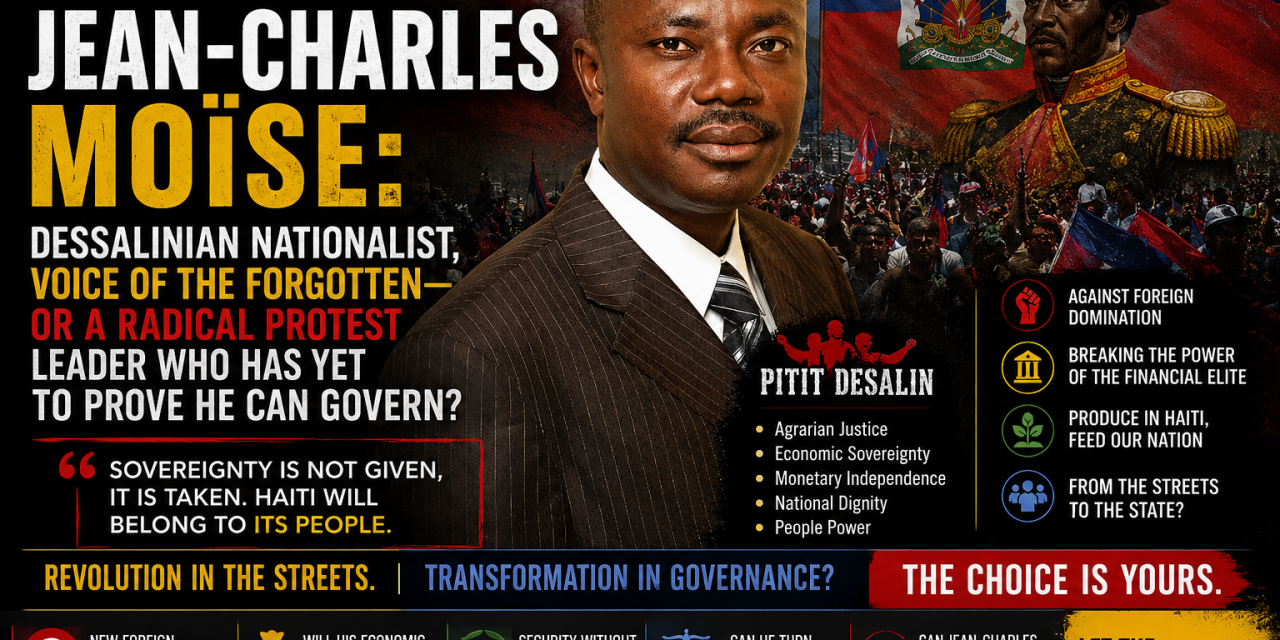
🇭🇹 Former mayor. Former senator. Two-time presidential candidate. Founder and leader of Pitit Desalin. Agrarian populist. Anti-intervention nationalist. Persistent opponent of Haiti’s political establishment.
For years, Jean-Charles Moïse has delivered one of the clearest and most confrontational messages in Haitian politics:
Haiti must recover its sovereignty.
Political sovereignty.
Economic sovereignty.
Agricultural sovereignty.
Monetary sovereignty.
And, above all, freedom from a political system he argues has been captured by wealthy domestic interests and foreign powers.
Unlike politicians who reinvent themselves every electoral cycle, Jean-Charles has maintained a remarkably recognizable political identity.
But consistency is not the same thing as feasibility.
And opposition is not governance.
That leads to the question Haiti Politic wants voters to examine:
CAN JEAN-CHARLES MOÏSE TRANSFORM DESSALINIAN NATIONALISM FROM A PROTEST MOVEMENT INTO A FUNCTIONING MODERN STATE?
This is neither an endorsement nor a condemnation.
It is a test of the record—and of the promises.
Then let Haitians decide.
👤 WHO IS JEAN-CHARLES MOÏSE?
Jean-Charles was born in Milot in Haiti’s Nord Department. His political roots are unusually local.
Before becoming a national opposition figure, he served three terms as mayor of Milot. He later represented the Nord in Haiti’s Senate, beginning in 2009.
That matters.
He did not enter politics exclusively through Port-au-Prince’s business networks or diplomatic establishment.
His political identity emerged from the North.
From municipal government, he moved into the Senate and eventually national presidential politics.
And over time, one name increasingly defined his movement:
DESSALINES.
🇭🇹 PITIT DESALIN: MORE THAN A PARTY NAME
The symbolism is deliberate.
Jean-Jacques Dessalines represents for many Haitians something much larger than independence in 1804.
He symbolizes:
national sovereignty;
Black political independence;
economic autonomy;
resistance to foreign domination;
and the unresolved question of who should own Haiti’s wealth.
Jean-Charles describes himself as a “restorative socialist” and has identified Dessalines and Fidel Castro as major ideological influences.
That gives voters something many Haitian politicians lack:
an identifiable ideology.
But ideology produces another obligation.
SHOW US THE NUMBERS.
🗳️ TEST #1 — HE HAS ALREADY FACED THE VOTERS
Jean-Charles is not a hypothetical presidential candidate.
He has already competed nationally.
In the disputed 2015 presidential election, UN reporting on the preliminary count placed him third with approximately 14.27%, behind Jovenel Moïse and Jude Célestin.
The 2015 process was ultimately abandoned and the presidential election rerun.
In November 2016, Jean-Charles again finished third.
Final results gave:
Jovenel Moïse — 55.60%
Jude Célestin — 19.57%
Jean-Charles Moïse — 11.04%
Maryse Narcisse — 9.01%.
So one description in the proposed profile needs correcting:
Jean-Charles was not the runner-up in either presidential contest.
He finished third in both.
Accuracy matters—even when investigating someone whose political significance extends well beyond his electoral percentage.
🌾 TEST #2 — CAN DESSALINIAN ECONOMICS ACTUALLY WORK?
Jean-Charles’ political appeal is strongly associated with marginalized communities, peasants, workers and citizens who believe Haiti’s economy was designed to benefit importers and entrenched elites rather than producers.
The diagnosis deserves attention.
Haiti cannot indefinitely consume what it does not produce while exporting insufficient goods to pay for those imports.
But saying:
“PRODUCE NATIONAL”
is much easier than actually restructuring an economy.
So President Jean-Charles:
What exactly happens during Year One?
🍚 THE RICE TEST
Suppose a Jean-Charles administration substantially increases tariffs on imported rice tomorrow.
Haitian farmers could eventually benefit from reduced foreign competition.
But urban families still need to eat tomorrow.
If domestic production cannot immediately meet demand, prices could rise.
So what comes first?
Irrigation rehabilitation?
Seed distribution?
Fertilizer?
Mechanization?
Agricultural credit?
Warehouses?
Crop insurance?
Roads?
Electricity?
Milling capacity?
Guaranteed government purchasing?
Tariffs?
The sequence matters.
FOOD SOVEREIGNTY CANNOT MEAN FOOD SCARCITY.
🚜 TEST #3 — THE ARTIBONITE CHALLENGE
If Jean-Charles wants to make agricultural sovereignty central to government, he should publish measurable targets.
For example:
How many hectares of irrigated land restored?
How much rice production after 24 months?
How much corn?
How much sorghum?
How many agricultural cooperatives financed?
How many refrigerated warehouses?
How many processing plants?
How much food imported in Year One versus Year Five?
How much would this cost?
A revolution becomes public policy when slogans acquire budgets, deadlines and measurable outcomes.
🏞️ TEST #4 — LAND REDISTRIBUTION
Then comes one of the most politically explosive questions:
WHO OWNS HAITI?
If Pitit Desalin believes land should increasingly serve those who cultivate it, what does that mean legally?
Would unused state lands be distributed?
Would large private estates be subject to compulsory purchase?
Would compensation be paid?
At market value?
Would maximum holdings be established?
Would land go to individuals or cooperatives?
Would beneficiaries receive legally enforceable titles?
Could they sell those titles?
Could they mortgage them?
Who adjudicates competing claims?
Without answers, agrarian reform can become another source of conflict.
⚖️ DESSALINES AND THE CONSTITUTION
There is another fundamental test.
A modern Haitian president cannot simply declare:
“This land is not being used, therefore the state will take it.”
Property rights exist.
Due process exists.
Courts must exist.
So Jean-Charles needs to reconcile revolutionary economic rhetoric with constitutional government.
That may be one of the most important questions of his entire platform:
WHEN DESSALINIAN IDEOLOGY COLLIDES WITH CONSTITUTIONAL PROPERTY RIGHTS, WHICH ONE WINS?
💵 TEST #5 — THE GOURDE
Jean-Charles’ economic nationalism also raises a more complicated question:
Can Haiti restore monetary sovereignty?
Haiti’s economy operates with substantial dependence on the U.S. dollar.
Families save in dollars.
Businesses price goods using dollar reference points.
Importers need dollars.
International commerce runs through dollars.
Diaspora remittances arrive overwhelmingly in foreign currency.
Simply ordering Haitians to stop using dollars does not create confidence in the gourde.
Confidence must be earned.
🏦 HOW DO YOU DE-DOLLARIZE WITHOUT DESTROYING SAVINGS?
President Jean-Charles:
Would government contracts be gourde-only?
Taxes?
Rent?
Retail prices?
Bank deposits?
Would dollar accounts remain legal?
Would businesses be required to display prices in gourdes?
Would the BRH intervene more aggressively?
Would capital controls be imposed?
Would currency conversions be regulated?
What inflation target would the BRH pursue?
And critically:
Would the central bank remain independent?
Because there is a dangerous historical temptation available to governments everywhere:
When revenue is insufficient—
print money.
That can destroy the very working-class purchasing power a populist government claims to protect.
💸 TEST #6 — DIASPORA REMITTANCES
Jean-Charles has another enormous economic constituency to consider:
THE HAITIAN DIASPORA.
Diaspora transfers sustain millions of households.
But Haiti’s strategic objective should be larger than consuming remittances.
How do you transform a portion of diaspora capital into:
farms;
factories;
renewable energy;
housing;
SMEs;
roads;
technology;
and productive infrastructure?
A Pitit Desalin government could consider:
diaspora bonds;
diaspora investment accounts;
cooperative investment funds;
agricultural bonds;
municipal infrastructure bonds;
and transparent digital investment platforms.
But diaspora investors need something revolutionary rhetoric cannot provide:
TRUST.
🏦 TEST #7 — BANKS AND THE ECONOMIC ELITE
Jean-Charles has repeatedly directed his politics against concentrated economic power.
That resonates with Haitians who believe the economy is dominated by a small number of wealthy families and corporate interests.
But a president must distinguish between:
competition policy
and
political punishment.
Would Jean-Charles:
strengthen antitrust law?
require beneficial-ownership disclosure?
investigate customs privileges?
publish tax exemptions?
break exclusive import arrangements?
expand credit unions?
create a public development bank?
tax excessive concentration?
Or would government pressure private firms through discretionary executive power?
The distinction is enormous.
HAITI NEEDS TO BREAK MONOPOLIES WITHOUT BREAKING MARKETS.
📉 TEST #8 — CAPITAL FLIGHT
Imagine Jean-Charles wins.
His supporters celebrate.
But wealthy Haitians immediately transfer money abroad.
Importers delay purchases.
Investors suspend projects.
Banks increase dollar reserves.
The gourde falls.
What does President Jean-Charles do on Monday morning?
Threaten them?
Impose capital controls?
Negotiate?
Offer investment guarantees?
Stabilize the currency?
Seek emergency reserves?
Radical economic transformation requires a transition strategy.
Otherwise the people who suffer first may be precisely the poor citizens the revolution intended to help.
🔥 TEST #9 — FROM PROTEST TO GOVERNMENT
This may be the defining political question.
Jean-Charles has spent years mastering opposition politics.
Marches.
Demonstrations.
Mass mobilization.
Confrontational rhetoric.
Calls for systemic change.
That can be enormously powerful when challenging government.
But imagine the roles reverse.
JEAN-CHARLES IS NOW PRESIDENT.
Opposition protesters surround the National Palace.
Roads are barricaded.
Businesses close.
Fuel cannot move.
His opponents demand his resignation.
What happens?
🚨 DOES PRESIDENT JEAN-CHARLES DEFEND THE SAME RIGHT TO PROTEST THAT OPPOSITION LEADER JEAN-CHARLES USED?
Would police clear barricades?
When?
Would protesters be arrested?
Under what law?
Could opponents demand his resignation?
Could radio stations attack him?
Could business organizations finance opposition campaigns?
Could newspapers investigate his ministers?
Could unions strike?
Could students occupy universities?
Could opposition parties organize nationwide demonstrations?
THE TRUE TEST OF A REVOLUTIONARY DEMOCRAT IS HOW HE TREATS HIS OWN OPPOSITION.
🏛️ TEST #10 — CAN HE BUILD A COALITION?
Presidents do not govern Haiti alone.
They need:
Parliament;
municipal authorities;
civil servants;
judges;
police;
businesses;
farmers;
unions;
civil society;
diaspora organizations;
and international partners.
Jean-Charles’ uncompromising image is politically useful when mobilizing a base.
But governing requires compromise.
And there is evidence that he can engage in transactional coalition politics when circumstances demand it.
During the complicated 2024 Transitional Presidential Council negotiations, reporting described Pitit Dessalines working with EDE and other factions in efforts to assemble a majority within the transition.
That complicates the image of the uncompromising outsider.
And that is worth examining.
🤝 TEST #11 — THE COALITION CONTRADICTION
Jean-Charles:
When is compromise patriotic?
When is compromise betrayal?
Which parties could participate in your government?
Fanmi Lavalas?
EDE?
PHTK-associated figures?
Private-sector representatives?
Social democrats?
Christian democrats?
Former Martelly officials?
Former Moïse officials?
Would ministers have to subscribe to Dessalinian ideology?
Or would competence matter more than ideology?
Haiti cannot rebuild a state with one political tribe.
So where are Pitit Desalin’s coalition boundaries?
🔫 TEST #12 — SECURITY CHANGES EVERYTHING
No economic revolution survives if armed groups control strategic territory.
No agrarian program works if trucks cannot transport food.
No monetary policy works if businesses are extorted.
No foreign policy works if diplomats cannot safely travel.
No election works if voters cannot enter polling stations.
So Jean-Charles’ sovereignty doctrine ultimately confronts one unavoidable question:
WHO CONTROLS THE GUNS?
🇭🇹 TEST #13 — IF FOREIGN FORCES LEAVE, WHO REPLACES THEM?
The Kenya-led Multinational Security Support mission was authorized internationally to assist Haitian police in restoring security around critical infrastructure and gang-controlled areas. It also encountered opposition rooted partly in Haiti’s painful history with previous foreign interventions.
Jean-Charles’ broader nationalist politics make this a crucial test.
If his government rejects foreign security deployments:
What happens the next morning?
How many operational PNH officers are required?
How many FAd’H personnel?
Who commands joint operations?
How many armored vehicles?
How many helicopters?
What intelligence capabilities?
What coast-guard capacity?
What border surveillance?
Where does ammunition come from?
Who trains specialized units?
How much does it cost?
⏱️ GIVE US THE FIRST 100 DAYS
President Jean-Charles should publish an operational security map.
Days 1–30: What?
Days 31–60: What?
Days 61–100: What?
Which highways are reopened?
Which ports?
Which neighborhoods?
Which police stations?
Which courts?
Which prisons?
How are civilians protected?
How are captured gang members processed?
“Haitians will solve Haiti’s problems” is a sovereignty principle.
It is not yet an operational plan.
💰 TEST #14 — FOLLOW THE MONEY, NOT ONLY THE GUNMEN
Gang power does not exist simply because impoverished young men possess rifles.
Someone imports the weapons.
Someone purchases ammunition.
Someone moves money.
Someone launders kidnapping proceeds.
Someone supplies fuel.
Someone provides political protection.
Someone benefits economically.
So would a Jean-Charles administration investigate:
wealthy businessmen?
politicians?
customs officials?
police commanders?
members of Pitit Desalin?
diaspora financiers?
foreign arms suppliers?
Even allies?
That last word matters.
ANTI-OLIGARCHY POLITICS IS CREDIBLE ONLY IF ACCOUNTABILITY ALSO REACHES YOUR OWN CAMP.
👦🏾 TEST #15 — WHAT HAPPENS TO GANG-RECRUITED YOUTH?
Haiti cannot imprison its way out of the crisis.
Thousands of young people have grown up in communities where gangs became:
employers;
security providers;
political structures;
and sometimes the only functioning source of authority.
What happens after territory is recovered?
DDR?
Vocational programs?
Public works?
Psychological services?
Education?
Conditional amnesty for lower-level recruits?
No amnesty for murder, kidnapping and rape?
Witness protection?
Community policing?
The difference between reclaiming territory and keeping territory is governance.
🌎 THEN COMES JEAN-CHARLES’ MOST DISRUPTIVE IDEA:
REWRITE HAITI’S FOREIGN POLICY.
For decades, Haitian governments have maintained overwhelming diplomatic and economic dependence on:
the United States;
Canada;
France;
the European Union;
international financial institutions;
and multilateral organizations.
Jean-Charles’ politics challenges that architecture.
That challenge deserves serious consideration.
But replacing one dependency with another would not constitute sovereignty.
🇺🇸 TEST #16 — WHAT EXACTLY IS THE PROBLEM WITH WASHINGTON?
A mature nationalist foreign policy should distinguish between:
the United States government;
American corporations;
Haitian-Americans;
Congress;
diaspora organizations;
universities;
NGOs;
and financial institutions.
They are not one entity.
So President Jean-Charles:
What precisely would change in U.S.–Haiti relations?
Security cooperation?
Migration agreements?
Trade?
HOPE/HELP preferences?
Weapons interdiction?
Banking?
Development assistance?
Diplomatic relations?
Would Haiti remain strategically aligned with Washington where interests coincide?
Or would Pitit Desalin seek a fundamental geopolitical rupture?
Be specific.
🇻🇪 TEST #17 — VENEZUELA
Jean-Charles’ political worldview has historically been associated with solidarity toward leftist Latin American governments.
Venezuela therefore presents a critical test.
PetroCaribe demonstrated that South-South cooperation can provide Haiti with alternatives to traditional Western financing.
But Haiti also learned something painful:
CHEAP FINANCING DOES NOT GUARANTEE GOOD GOVERNANCE.
If Venezuela offered another major energy agreement, would Jean-Charles accept?
Under what conditions?
Would every contract be public?
Would Parliament approve borrowing?
Would spending appear online?
Would the CSCCA audit projects?
Would citizens track every dollar?
A new geopolitical partner cannot become a new opaque patron.
🇨🇳 TEST #18 — CHINA
One of the biggest geopolitical questions facing Haiti concerns the People’s Republic of China and Taiwan.
Haiti currently maintains diplomatic relations with Taiwan.
If a Jean-Charles government pursued closer relations with Beijing, would it switch diplomatic recognition?
If yes:
What would Haiti receive?
Infrastructure?
Ports?
Electricity?
Hospitals?
Rail?
Industrial parks?
Loans?
Grants?
And what would China receive?
Diplomatic recognition?
Mining rights?
Port concessions?
Telecommunications contracts?
Publish the terms before signing.
That should be Haiti’s rule with every country.
China included.
America included.
🌐 TEST #19 — BRICS
The idea of expanding Haiti’s relationships with BRICS countries deserves analysis—but not romanticism.
Brazil, Russia, India, China and South Africa do not constitute a charity organization.
They pursue national interests.
So should Haiti.
Could Haiti seek:
Brazilian agricultural expertise?
Indian pharmaceuticals and digital infrastructure?
Chinese infrastructure financing?
South African mining expertise?
Development financing through the New Development Bank where institutionally possible?
Potentially.
But Haiti should never replace:
“WASHINGTON WILL SAVE US”
with
“BEIJING OR MOSCOW WILL SAVE US.”
No foreign capital has Haiti’s interests at heart by default.
🇷🇺 TEST #20 — RUSSIA AND IRAN
The same applies to Russia and Iran.
Jean-Charles should answer:
Would Haiti pursue security agreements?
Weapons purchases?
Oil agreements?
Military training?
Technology transfers?
At what cost?
Would agreements expose Haitian banks to sanctions risk?
Would Haiti lose access to correspondent banking?
How would exporters be protected?
How would remittances continue?
Sovereignty means understanding consequences before making symbolic geopolitical moves.
🚨 AND ONE CLAIM NEEDS PARTICULAR CAUTION
The proposed questions assume that Washington would automatically impose “devastating economic sanctions” if Haiti shifted toward BRICS, Russia, China or Iran.
That should not be presented as established fact.
Foreign-policy consequences would depend on the specific agreements, sanctioned entities involved, U.S. law and geopolitical circumstances.
A rigorous investigation asks:
What sanctions exposure could specific agreements create?
It should not announce the punishment before the policy exists.
🌎 TEST #21 — WHAT DOES “ANTI-IMPERIALISM” ACTUALLY PRODUCE?
This is where Jean-Charles can potentially make an important contribution to Haiti’s foreign-policy debate.
Anti-imperialism should not simply mean:
“No to America.”
It should mean:
“YES TO HAITIAN STRATEGIC AUTONOMY.”
That could mean:
multiple trading partners;
multiple sources of investment;
strong CARICOM relations;
strong African relations;
Latin American partnerships;
U.S. commercial ties;
European markets;
Asian infrastructure;
diaspora investment;
and no single foreign government capable of dictating Haitian policy.
That is not isolation.
That is diversification.
🌍 TEST #22 — AFRICA
A Dessalinian foreign policy has an obvious unexplored frontier:
AFRICA.
Haiti’s historical relationship with Africa is enormous.
Its modern economic relationship is tiny.
Why?
Could a Jean-Charles government build:
Haiti–Africa business councils?
university exchanges?
agricultural partnerships?
direct air links eventually?
pharmaceutical cooperation?
technology exchanges?
cultural industries?
tourism?
African Union diplomatic initiatives?
A sovereignty-focused Haitian foreign policy should be capable of producing new relationships, not simply terminating old ones.
🇩🇴 TEST #23 — THE DOMINICAN REPUBLIC
Nationalism becomes especially complicated at the border.
The Dominican Republic is not an abstract geopolitical adversary.
It is Haiti’s neighbor.
Trade partner.
Migration counterpart.
Security counterpart.
Shared-island environmental partner.
Jean-Charles therefore needs an operational Dominican policy covering:
migration;
deportations;
border markets;
weapons trafficking;
agriculture;
water;
labor rights;
customs;
and national security.
National dignity matters.
So does functioning cross-border commerce.
A president needs both.
📜 TEST #24 — THE CORE GROUP
Jean-Charles’ criticism of external diplomatic influence resonates because many Haitians believe foreign governments have exercised disproportionate influence over Haitian political outcomes.
But eliminating outside influence requires more than telling ambassadors to leave Haitian politics.
Haiti must make foreign intervention unnecessary.
That means:
credible elections;
functioning courts;
constitutional succession;
legitimate Parliament;
professional police;
transparent public finances;
and stable political parties.
THE MOST POWERFUL ANTI-CORE-GROUP POLICY IS A FUNCTIONING HAITIAN STATE.
🏛️ TEST #25 — CAN PITIT DESALIN BUILD THAT STATE?
This is the decisive question.
Pitit Desalin has demonstrated an ability to mobilize.
But can it administer?
Can it recruit:
economists?
engineers?
judges?
diplomats?
cybersecurity specialists?
agronomists?
police reformers?
hospital administrators?
central bankers?
tax experts?
municipal managers?
A movement can win the street with passion.
A government needs thousands of competent people.
Where is the bench?
📊 THE JEAN-CHARLES MOÏSE TEST
| AREA | POLITICAL ASSET | QUESTION TO RESOLVE |
|---|---|---|
| Local Government | Three terms as Milot mayor | What measurable municipal results can be scaled nationally? |
| Legislative Experience | Former Nord senator | What major legislative accomplishments define his Senate record? |
| Electoral Base | Third nationally in both 2015 and 2016 | Can Pitit Desalin expand beyond its committed base? |
| Ideology | Clear Dessalinian/socialist political identity | Can ideology become costed legislation? |
| Agriculture | Strong rural-populist positioning | How will protectionism avoid raising food prices? |
| Monetary Sovereignty | Challenges dependence on foreign currency | How can Haiti de-dollarize without destabilization? |
| Anti-Establishment Politics | Longstanding opposition identity | Can a protest leader become a coalition-builder? |
| Coalitions | Has participated in complex transitional alliance-making | Where does pragmatic compromise end and ideological contradiction begin? |
| Security Sovereignty | Skepticism toward foreign intervention fits his nationalist doctrine | What funded domestic force replaces external security assistance? |
| Foreign Policy | Potential to diversify Haiti’s alliances | How does Haiti diversify without replacing one dependency with another? |
⚖️ THE CASE HIS SUPPORTERS CAN MAKE
Jean-Charles’ supporters can make a powerful argument.
He has not suddenly discovered sovereignty because an election is approaching.
His political identity has been remarkably consistent.
He came from municipal government.
Served in the Senate.
Built a national political movement.
Competed twice for the presidency.
He openly identifies with a political philosophy rather than presenting himself merely as a manager.
And he speaks to something deeply rooted in Haitian history:
WHY DOES THE COUNTRY THAT DEFEATED COLONIALISM STILL HAVE SO LITTLE CONTROL OVER ITS OWN DESTINY?
That question resonates for a reason.
Supporters may argue that Haiti has spent decades trying internationally approved governments, technocrats, business-friendly governments and foreign-supported transitions—
and still reached institutional collapse.
So why not attempt something fundamentally different?
That argument deserves debate.
🚨 THE CASE HIS CRITICS CAN MAKE
Critics can make an equally serious case.
Opposition mobilization does not prove executive competence.
Nationalism does not stabilize a currency.
Anti-imperialism does not finance police salaries.
Agrarian rhetoric does not immediately feed millions of urban consumers.
Breaking monopolies does not automatically create competitive markets.
Rejecting foreign intervention does not automatically produce Haitian security capacity.
And replacing Western dependence with dependence on another geopolitical bloc would merely change the address of Haiti’s dependency.
Critics can therefore ask:
DOES JEAN-CHARLES HAVE A GOVERNMENT PROGRAM—OR A POWERFUL THEORY OF WHAT HAITI SHOULD OPPOSE?
That question deserves an answer.
🔥 30 QUESTIONS JEAN-CHARLES MOÏSE SHOULD ANSWER
1. What are the three greatest measurable accomplishments from your three terms as mayor of Milot?
2. What legislation from your Senate career are you most proud of?
3. Why did you finish third in both presidential contests, and what has Pitit Desalin learned?
4. What would your first national budget prioritize?
5. What is your five-year agricultural production target?
6. Which food imports would receive tariffs first?
7. How would you prevent those tariffs from increasing hunger?
8. What exact land-redistribution legislation would you propose?
9. Would private owners receive compensation for expropriated property?
10. Would an independent judiciary adjudicate disputes?
11. What is your plan for reducing dollarization?
12. Would the BRH remain institutionally independent?
13. Would you impose capital controls?
14. How would you prevent capital flight?
15. How would diaspora remittances become productive investment without government coercion?
16. What is your policy toward private banks and large importers?
17. Would Pitit Desalin publish its major donors and audited finances?
18. Would opposition parties retain complete freedom to demonstrate against your government?
19. Under what conditions could police remove road barricades?
20. Which political parties could participate in your governing coalition?
21. What is your 100-day security plan?
22. How many additional police officers and soldiers would it require?
23. How much would it cost?
24. If foreign security forces leave, what immediately replaces their capabilities?
25. Would businessmen and politicians implicated in gang financing be prosecuted regardless of party affiliation?
26. Would Haiti maintain diplomatic recognition of Taiwan or recognize Beijing?
27. What concrete benefits would Haiti seek from BRICS countries?
28. What parts of the relationship with Washington would you preserve?
29. How would you prevent geopolitical diversification from becoming dependency on China, Russia, Venezuela or anyone else?
And finally:
30. YOU HAVE PROVEN THAT YOU CAN MOBILIZE PEOPLE AGAINST A GOVERNMENT. WHAT EVIDENCE SHOWS THAT YOU CAN BUILD AND MANAGE ONE?
🇭🇹 THE CENTRAL QUESTION
Jean-Charles Moïse represents something important in Haitian politics.
He forces Haiti to discuss power.
Who controls the land?
Who controls banks?
Who controls imports?
Who controls the gourde?
Who controls diplomacy?
Who controls security?
Who determines Haiti’s political future?
Those questions should not disappear merely because they make powerful people uncomfortable.
But there is another side to Dessalines’ legacy.
Dessalines did not only destroy an old order.
He had to create a country afterward.
And that is ultimately Jean-Charles Moïse’s challenge.
DESTROYING DEPENDENCY IS ONLY HALF A PROGRAM.
What replaces it?
If foreign troops leave—
what replaces them?
If imports decline—
what produces the food?
If dollars become less important—
what creates confidence in the gourde?
If traditional elites lose monopolies—
what competitive businesses replace them?
If the Core Group loses influence—
what Haitian institutions gain authority?
If Jean-Charles dismantles the old political order—
WHAT EXACTLY DOES HE BUILD THE MORNING AFTER?
That is where revolutionary politics meets governing reality.
So don’t merely ask whether Jean-Charles Moïse is anti-American.
Ask whether he is pro-Haitian enough to negotiate intelligently with America, China, Brazil, Africa, Europe, CARICOM and everyone else according to Haiti’s interests.
Don’t merely ask whether he wants food sovereignty.
Ask for the production targets.
Don’t merely ask whether he opposes foreign troops.
Ask for the security budget.
Don’t merely ask whether he represents the poor.
Ask whether his economic policies would actually make poor families richer.
And don’t merely ask whether he can bring people into the streets.
ASK WHETHER HE CAN BRING HAITI BACK INTO FUNCTIONING INSTITUTIONS.
Pa sèlman mande si Jean-Charles ka fè revolisyon.
Mande kijan li pral dirije peyi a apre revolisyon an.
Pa sèlman mande si li kont entèvansyon etranje.
Mande ki kapasite ayisyen li pral mete nan plas li.
Pa sèlman mande si li vle kraze sistèm nan.
Mande ki sistèm li pral bati apre sa.
Then—
🇭🇹 LET THE HAITIAN PEOPLE DECIDE.
HAITI POLITIC — Investigation. Accountability. Debate.