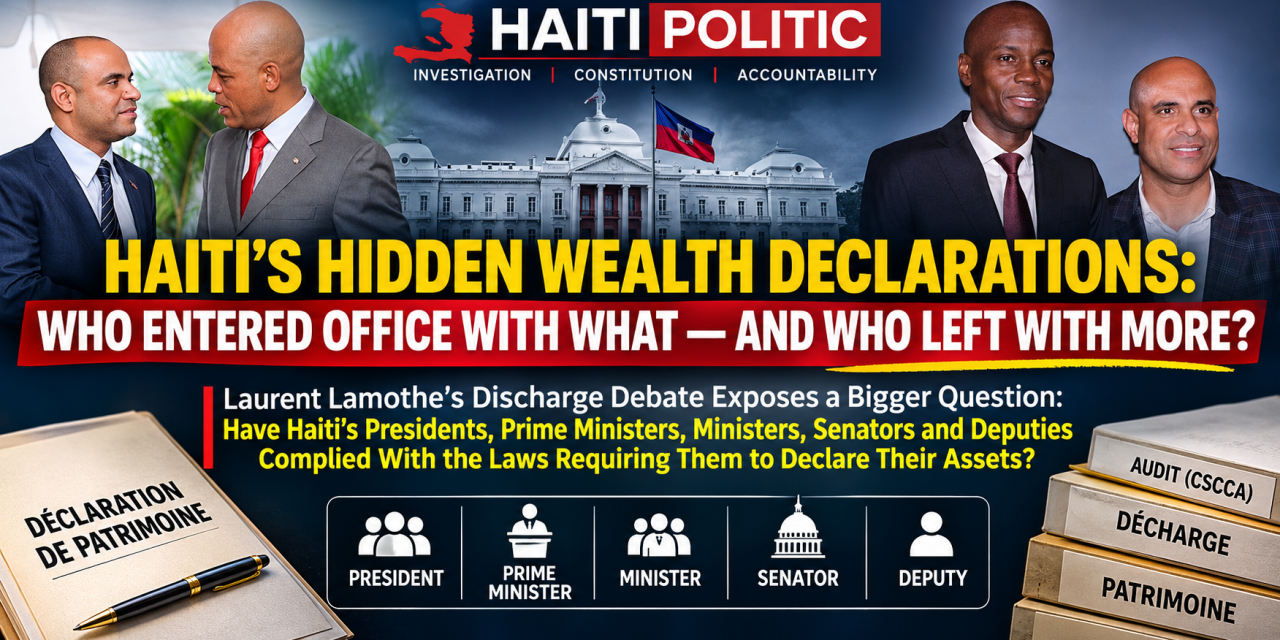
Laurent Lamothe’s Discharge Debate Exposes a Bigger Question: Have Haiti’s Presidents, Prime Ministers, Ministers, Senators and Deputies Complied With the Laws Requiring Them to Declare Their Assets?
HAITI POLITIC | SPECIAL INVESTIGATION & CONSTITUTIONAL ANALYSIS
November 12, 2026
Haiti’s Constitution requires financial accountability from public officials. A 2008 law requires designated officials to declare their assets when entering and leaving office. Yet the declarations remain largely inaccessible to the public, compliance has been weak, and the absence of Parliament has complicated the discharge process. As former Prime Minister Laurent Lamothe calls for another executive decree, Haiti Politic examines what the law actually requires, what the public can demand, and what must change.
INTRODUCTION: LAURENT LAMOTHE HAS OPENED A MUCH BIGGER DEBATE
Former Haitian Prime Minister Laurent Lamothe has publicly challenged the constitutional difficulties surrounding the issuance of décharge, or discharge, to former government officials.
In a November 12, 2026, statement on his verified X account, Lamothe argued that Haiti’s Superior Court of Auditors and Administrative Disputes (CSCCA) conducts audits, while Parliament has the constitutional authority to grant discharge.
He pointed to the absence of a functioning Parliament and cited executive decrees issued during earlier political transitions, including a 2021 decree under President Jovenel Moïse.
Lamothe also claimed that he benefited from the 2021 mechanism because he had received four favorable audit reports concerning his management of public resources.
His proposal is straightforward: because Parliament is absent, the government should issue another decree granting discharge to former ministers and prime ministers who have favorable audit reports and wish to participate in elections.
But this proposal raises questions that extend far beyond Lamothe’s political future.
Before discussing whether former officials should receive discharge, shouldn’t Haitians first establish whether those officials complied with the laws requiring them to declare their personal assets when entering and leaving public office?
What property did they own before taking office?
What businesses, investments, bank accounts and financial interests did they report?
What did they declare when their mandates ended?
Did their wealth increase significantly?
If so, was the increase supported by legitimate income and other lawful financial activity?
And perhaps most importantly:
Why does Haitian law require these declarations while generally preventing ordinary citizens from examining their contents?
The answers reveal an accountability system that exists in law but has struggled to deliver meaningful public transparency.
I. HAITI’S CONSTITUTION ALREADY REQUIRES FINANCIAL ACCOUNTABILITY
The Haitian Constitution of March 29, 1987, as amended, establishes important obligations concerning public finances and personal assets.
Three constitutional provisions are particularly relevant.
Article 238: Public officials must declare their assets
Article 238 requires public officials designated by law to declare their assets at the registry of the competent civil court within 30 days of entering office.
It also assigns responsibility to the Government Commissioner to take appropriate measures to verify the accuracy of declarations.
This provision establishes a constitutional foundation for asset disclosure.
Article 279: The president must declare assets
Article 279 specifically requires the president to deposit a notarized inventory of movable and immovable property within 30 days after election.
The same obligation applies at the end of the presidential mandate.
In other words, the Constitution provides for two financial snapshots: one at the beginning of the presidency and another at its conclusion.
Article 279-1: Prime ministers and ministers face similar obligations
Article 279-1 extends the obligation to the prime minister, ministers and secretaries of state.
These officials must submit the required declarations within 30 days after installation and within 30 days after leaving office.
The constitutional text therefore recognizes that financial transparency is not merely a voluntary political gesture.
It is a legal obligation attached to public office.
Legal reference: Constitution of Haiti, Articles 238, 279 and 279-1.
II. THE 2008 LAW GOES FURTHER: SENATORS AND DEPUTIES MUST ALSO DECLARE THEIR ASSETS
On February 12, 2008, Haiti adopted legislation establishing a broader asset-declaration framework.
The law was published in Le Moniteur on February 20, 2008.
Its purpose was to help prevent corruption, detect illicit enrichment and strengthen accountability among public officials.
Article 7 identifies the categories of individuals required to declare their assets.
They include:
-
The president of the Republic.
-
The prime minister.
-
Ministers and secretaries of state.
-
Senators and deputies.
-
Certain judges and judicial officials.
-
Directors general and other senior public administrators.
-
Members of the electoral administration.
-
Mayors and designated local officials.
-
Public accountants and other officials responsible for public funds.
-
Certain officials of state-owned institutions, including public financial institutions.
Articles 8 and 8.1 establish the filing deadlines for the five principal political offices examined in this investigation.
| Public office | Entry declaration | Exit declaration |
|---|---|---|
| President | Within 30 days after election | Within 30 days after mandate |
| Prime minister | Within 30 days after installation | Within 30 days after leaving office |
| Minister | Within 30 days after installation | Within 30 days after leaving office |
| Senator | Within 30 days after entering office | Within 30 days after mandate |
| Deputy | Within 30 days after entering office | Within 30 days after mandate |
The declarations must be notarized and filed with the registry of the competent Court of First Instance.
The Anti-Corruption Unit, known as the ULCC, is responsible for collecting, processing and examining the information under the statutory framework.
These requirements apply independently of whether an official has received parliamentary discharge.
Legal reference: Law of February 12, 2008, Articles 2–9.
III. WHAT EXACTLY MUST A PUBLIC OFFICIAL DECLARE?
The 2008 law does not limit declarations to houses or land.
Articles 11 through 12 establish a much broader financial disclosure framework.
Officials must report covered assets and liabilities, including relevant holdings in Haiti and abroad.
Real estate
The declaration includes residential properties, commercial buildings, undeveloped land and other real estate interests.
The law requires information concerning the properties, including their estimated values and supporting details.
Bank accounts and financial investments
Covered financial interests include bank accounts, securities, shares in commercial companies and certain other financial assets.
Businesses and commercial interests
The law requires disclosure of covered ownership interests and commercial assets.
This matters because public officials may have financial interests in companies that conduct business with the government.
Vehicles and valuable personal property
Covered property includes vehicles, valuable collections, jewelry, precious stones and other specified movable assets.
Debts and financial obligations
The declaration also includes liabilities, including mortgages and personal debts.
Certain family-related interests
The law addresses assets belonging to specified related persons, subject to exclusions and conditions, including provisions concerning adult children and certain marital property arrangements.
Assets held through nominees
Article 12 also requires the declarant to indicate whether nominees are used.
This is a particularly significant provision because ownership arrangements can complicate investigations into the true beneficiaries of property and commercial interests.
Haiti’s asset-declaration law was designed to capture a broad picture of an official’s financial situation, not merely a list of residential properties.
Legal reference: Law of February 12, 2008, Articles 11, 11.1, 11.2, 11.3 and 12.
IV. WHAT HAPPENS WHEN AN OFFICIAL’S WEALTH INCREASES WHILE IN OFFICE?
The 2008 law provides an additional safeguard.
Under Article 10, covered officials must report changes in their assets exceeding 40% of their annual taxable income while exercising their functions.
Article 14 assigns the ULCC responsibility for assessing changes in declared assets.
Under Article 14.1, when the ULCC identifies a significant and unjustified increase, it may require the official to provide explanations.
If the official fails to respond within the prescribed period, the ULCC may transmit the file to the competent prosecutorial authority.
This framework recognizes a fundamental principle:
A substantial increase in wealth may justify investigation, but an increase alone does not establish corruption.
Inheritance, legitimate business income, property appreciation, investments and other lawful sources can explain changes in wealth.
The purpose of verification is to distinguish legitimate financial activity from potentially unlawful enrichment.
Haiti’s Constitution also addresses illicit enrichment.
Article 242 recognizes that a marked disproportion between an official’s accumulated wealth and lawful compensation may constitute relevant evidence.
But determining criminal responsibility requires an appropriate legal process.
The public interest is not served by treating every wealthy former official as corrupt.
It is served by requiring consistent verification and evidence.
V. THE BIGGEST PROBLEM: THE PUBLIC CANNOT AUTOMATICALLY SEE THE DECLARATIONS
Here is one of the most consequential contradictions in Haiti’s financial-accountability framework.
The law requires designated officials to declare their assets.
But it also protects the confidentiality of those declarations.
Article 5 requires the ULCC and court registries to safeguard the information they collect.
The law permits communication to specified authorities under defined conditions.
Article 19 establishes penalties for unauthorized disclosure by covered officials handling the declarations.
Those penalties include imprisonment and financial sanctions.
Consequently, a journalist or citizen cannot simply demand a former president’s complete asset declaration and assume the institution must provide it.
The documents are official records, but their contents are not automatically open to public inspection.
This creates an important distinction.
Citizens may request information concerning compliance, filing procedures and available public reports.
However, the legal framework does not establish an unrestricted public right to obtain the complete financial declarations.
Even individual filing-status information may require institutional confirmation and may not be automatically disclosed.
The accountability dilemma
If the public cannot inspect the declarations, how can voters independently compare an official’s financial situation before and after holding office?
The ULCC has legal authority to examine the information.
But public oversight depends heavily on the institution’s ability and willingness to enforce the law and publish information that can legally be disclosed.
Confidentiality protects legitimate privacy interests.
At the same time, excessive secrecy can make independent scrutiny more difficult.
The challenge is to protect sensitive personal information without turning financial accountability into an entirely closed administrative process.
VI. THE ULCC’S OWN FIGURES REVEAL A SERIOUS COMPLIANCE PROBLEM
The strongest evidence that Haiti’s asset-declaration system needs reform comes from the country’s own anti-corruption institution.
In a 2023 diagnostic report examining the 2008 law, the ULCC reported collecting 3,458 asset declarations between March 2008 and May 2022.
Of those declarations:
| Type of declaration | Number collected |
|---|---|
| Entry declarations | 3,179 |
| Exit declarations | 279 |
| Total | 3,458 |
Only approximately 8.1% of the collected declarations were exit declarations.
That figure is not itself an exit-compliance rate, because the number of officials legally required to file exit declarations during the same period must also be established.
Nevertheless, the difference between entry and exit filings raises serious questions about compliance and enforcement.
The ULCC also calculated an entry-declaration compliance rate of approximately 28.82% for 2008–2020.
These figures concern the broader population of officials subject to the law, not exclusively presidents, prime ministers, senators, deputies or ministers.
The report identified several weaknesses, including insufficiently effective sanctions, inadequate digital filing systems, difficulties implementing the asset-update mechanism and restrictions associated with confidentiality.
The diagnostic also documented salary deductions imposed on certain noncompliant officials.
These findings demonstrate that the problem extends beyond any single administration.
The question is not simply whether Haiti has an asset-declaration law. It is whether the institutions responsible for enforcing that law have the resources, authority and procedures necessary to make it effective.
Source: ULCC, 2023 Diagnostic of the February 12, 2008 Asset Declaration Law.
VII. WHAT ARE THE CONSEQUENCES FOR FAILING TO DECLARE ASSETS?
The law establishes consequences for noncompliance.
Article 16 provides for withholding one-quarter of an official’s compensation after the applicable deadline and formal notification procedures have been satisfied.
Article 17 addresses knowingly incomplete, inaccurate or false declarations.
Article 18 establishes consequences for failure to file after leaving office, referring to provisions of the Penal Code.
These provisions are important because they demonstrate that asset declarations are mandatory rather than optional.
However, enforcement must follow the legal procedures.
An official should not automatically be described as having violated the law merely because a journalist cannot locate a declaration.
The relevant institution must first establish whether the document was filed, whether the applicable deadline passed, and whether the statutory conditions for sanctions were met.
The absence of publicly available evidence is not necessarily proof that a declaration was never submitted.
That distinction should guide every investigation.
VIII. DISCHARGE IS NOT THE SAME THING AS AN ASSET DECLARATION
This brings the investigation back to Laurent Lamothe.
Haiti’s political debate frequently treats financial accountability as a single issue.
In reality, the Constitution and legislation establish different mechanisms.
Asset declaration
A declaration of assets concerns an official’s personal financial position.
It helps establish what assets and liabilities were reported at the beginning and end of public service.
The ULCC has a central role in examining this information.
Financial audit
A CSCCA audit examines aspects of public financial management within the institution’s jurisdiction.
It may address the administration of public resources, accounting records and compliance with applicable rules.
A favorable audit does not necessarily establish that every possible financial question has been resolved.
Its significance depends on the audit’s scope, findings and limitations.
Parliamentary discharge
Article 233 establishes a parliamentary procedure concerning ministers’ management.
It provides for a 15-member parliamentary commission composed of nine deputies and six senators.
The commission reports to the two legislative chambers, which have the constitutional responsibility to decide on discharge.
Article 229 also provides that the legislative chambers must refuse discharge when the submitted accounts and supporting documents do not provide the information necessary for verification and evaluation.
These provisions demonstrate that discharge is not intended to be an automatic administrative formality.
A favorable audit, an asset declaration and a parliamentary discharge are three different instruments. None should be presented as a substitute for the others without a valid legal basis.
IX. LAURENT LAMOTHE’S PROPOSAL: CAN THE EXECUTIVE REPLACE PARLIAMENT?
Lamothe’s November 12 statement identifies a genuine institutional difficulty.
Haiti lacks a functioning Parliament capable of implementing the ordinary procedure established by Article 233.
He argues that previous governments used decrees to address similar circumstances.
He cites the 2006 transition and a 2021 decree issued under President Jovenel Moïse.
He further states that he benefited from the 2021 decree after receiving four favorable audit reports.
Those are Lamothe’s publicly stated claims.
Haiti Politic has not independently examined the four audit reports or the complete legal record concerning his claimed discharge.
The central constitutional question remains:
Does the absence of Parliament authorize the executive branch to exercise a responsibility expressly assigned to Parliament?
Article 233 does not expressly establish such a transfer of authority.
The fact that a previous executive issued a decree does not, by itself, establish that the decree was constitutional.
At the same time, the legal effect of an existing decree cannot be determined responsibly without examining its text, the circumstances of its adoption and any relevant judicial decisions.
Lamothe’s argument therefore deserves examination rather than automatic acceptance or dismissal.
But it also raises a broader institutional concern.
If a transitional government can grant discharge through executive decrees, what safeguards prevent selective treatment of former officials seeking elected office?
Could one administration approve some candidates while denying others?
Could political considerations influence the process?
These are questions about institutional design, not accusations that any particular official has acted improperly.
A discharge mechanism should not become an instrument through which the executive exercises discretionary control over electoral competition.
X. WHAT MUST A PRESIDENT, PRIME MINISTER, SENATOR, DEPUTY OR MINISTER DO BEFORE ENTERING OFFICE?
Haiti’s constitutional eligibility requirements differ according to the office.
The following summarizes major requirements under the amended constitutional framework.
| Office | Minimum age | Principal constitutional requirements |
|---|---|---|
| President | 35 | Haitian nationality requirements, civil and political rights, residence and property conditions, and discharge for prior management of public funds where applicable |
| Prime minister | 30 | Nationality, civil and political rights, residence, property and professional conditions, and applicable discharge requirements |
| Senator | 30 | Nationality, civil and political rights, departmental residence and property or professional conditions, and applicable discharge requirements |
| Deputy | 25 | Nationality, civil and political rights, constituency residence and property or professional conditions, and applicable discharge requirements |
| Minister | 30 | Nationality, civil and political rights, applicable property and fiscal conditions, and discharge where required |
These are summaries, not complete reproductions of every constitutional qualification.
The relevant provisions include Articles 91, 96, 135, 157 and 172-1.
A person who previously managed public funds may face a discharge requirement when seeking a particular public office.
However, not every former official automatically requires parliamentary discharge merely because that person previously held a political position.
The nature of the former responsibilities and the constitutional requirements for the office being sought must be examined.
The applicable electoral framework may also establish documentary requirements for candidacies.
This is why the CEP must distinguish between verifying eligibility and attempting to exercise powers reserved for other institutions.
XI. CAN THE GENERAL PUBLIC REQUEST THE FINANCIAL RECORDS?
Yes, citizens and journalists can submit requests to the relevant institutions.
But the nature of the requested information matters.
A request for the complete contents of a confidential asset declaration is different from a request for confirmation that the declaration was filed.
A request for a published CSCCA audit is different from a request for confidential banking information.
Haiti Politic identifies several possible avenues for lawful investigation.
The ULCC
Citizens can request available information concerning the implementation of the asset-declaration law.
They can ask whether compliance statistics, institutional reports or legally releasable filing-status information are available.
They can also request clarification concerning the procedures for obtaining a declarant’s authorization to disclose information.
The competent court registry
Citizens can seek information concerning filing procedures and whether particular categories of administrative confirmation may lawfully be provided.
The confidentiality provisions must still be respected.
The CSCCA
Journalists can seek publicly available audit reports, decisions and financial-accountability documents within the institution’s jurisdiction.
The CEP
During an electoral process, citizens can request information about the documentary requirements applicable to candidates and the procedures used to verify eligibility.
Former officials themselves
A former official can be asked to voluntarily authorize lawful disclosure of relevant financial declarations.
Such a request can be made consistently across political parties and administrations.
A refusal to authorize public disclosure does not establish corruption.
The existing law provides confidentiality protections, and individuals may legitimately rely on them.
Nevertheless, voluntary disclosure can provide additional information for public scrutiny when undertaken lawfully.
XII. FIVE QUESTIONS LAURENT LAMOTHE SHOULD ANSWER
In light of his public statement, Haiti Politic submits five questions to former Prime Minister Laurent Lamothe.
1. Will you publish the four favorable CSCCA audit reports you say you received?
The public should be able to examine their dates, scope, conclusions and any qualifications.
2. Will you publish the specific 2021 decree and accompanying documentation establishing the discharge you say you received?
This would allow independent legal examination of the mechanism.
3. Did you file the asset declarations required when you entered and left your ministerial and prime-ministerial functions?
If so, would you authorize lawful disclosure of the relevant filing confirmations?
4. Would you voluntarily authorize publication of an appropriately redacted summary of your entry and exit asset declarations?
Such a summary could protect sensitive personal information while providing greater transparency.
5. What constitutional provision, legal interpretation or judicial decision supports allowing the executive to grant discharge in place of Parliament?
A historical precedent is relevant, but it does not automatically resolve the constitutional question.
These questions do not presume wrongdoing.
They seek documentary evidence supporting claims that Lamothe has made publicly.
XIII. THE SAME QUESTIONS MUST APPLY TO EVERY FORMER ADMINISTRATION
Financial accountability cannot be credible if it is applied only to political opponents.
The same standards should apply to former presidents, prime ministers, ministers, senators, deputies and other officials covered by the law.
Haiti Politic proposes that investigations examine five areas consistently:
Entry declarations: Was the legally required declaration filed when the official entered office?
Exit declarations: Was the second declaration filed within the prescribed period?
Changes in assets: Were significant changes examined by the competent authorities?
Management of public funds: What do the relevant audit reports establish?
Discharge and legal responsibility: Was discharge required, was it lawfully granted, and are there unresolved financial-accountability proceedings?
The investigation should distinguish documented noncompliance from unavailable records.
It should also distinguish legitimate increases in wealth from evidence of illicit enrichment.
Public officials should have an opportunity to respond to questions concerning their records before conclusions are published.
XIV. THE REAL SOLUTION: REFORM FINANCIAL TRANSPARENCY AND RESTORE PARLIAMENT
Haiti faces two related but distinct institutional challenges.
The first concerns the absence of Parliament and the resulting difficulties surrounding discharge.
The second concerns the limited effectiveness and public transparency of the asset-declaration system.
Neither problem can be fully resolved by another executive decree.
A credible reform agenda would require several measures.
1. Publish aggregate and legally releasable compliance information
The ULCC should maintain reliable records of entry and exit declarations.
Subject to applicable law, it should publish updated statistics showing compliance by institution, category of office and reporting period.
Where legally permissible, it should also make filing-status information accessible through a standardized process.
2. Modernize the declaration system
A secure electronic filing system could improve compliance monitoring, record preservation and administrative efficiency.
The system should include safeguards against unauthorized access.
3. Establish limited public financial disclosure
Haiti could amend the 2008 law to require public summaries of certain financial interests.
These could include broad asset categories, business ownership, significant liabilities and changes in declared net worth.
Sensitive details, including bank account numbers and information creating personal-security risks, could remain protected.
4. Strengthen independent verification
The ULCC should have the institutional capacity to examine unexplained changes in wealth and refer appropriate cases to competent authorities.
Verification should follow consistent standards and due process.
5. Restore a functioning Parliament
Haiti must reestablish the legislative institutions necessary to exercise constitutional oversight.
Once restored, Parliament should address outstanding discharge matters through legally established procedures.
6. Resolve interim eligibility disputes through lawful mechanisms
Until Parliament returns, the competent electoral and judicial authorities must apply the existing legal framework.
They should not treat the absence of Parliament as automatic authorization to disregard constitutional requirements.
If an interim solution is proposed, its legal basis must be established and subject to independent review.
7. Apply the same rules to all political actors
Financial accountability must not depend on whether an official belongs to the governing coalition, the opposition or a former administration.
The law must operate consistently.
XV. A PROPOSAL FOR HAITI: TWO DECLARATIONS AND ONE PUBLIC ACCOUNTABILITY RECORD
Haiti Politic proposes consideration of a reform built around three elements.
First: An entry declaration.
Before or shortly after assuming office, as the applicable law requires, an official files a comprehensive declaration with the competent authority.
Second: An exit declaration.
After leaving office, the official files a second declaration documenting the relevant financial position.
Third: A public accountability record.
The responsible institution publishes a legally authorized summary indicating whether both declarations were filed, whether verification occurred, and whether any final findings or sanctions may lawfully be disclosed.
This would not require exposing every private bank transaction.
It would provide citizens with meaningful information while preserving legitimate privacy and due-process protections.
Importantly, this is a proposed reform, not a description of a public-disclosure right already guaranteed by Haitian law.
The existing confidentiality provisions would need to be addressed through appropriate legislation.
XVI. THE UNANSWERED QUESTIONS
The available legal framework and ULCC findings leave several important questions requiring further investigation.
How many former presidents, prime ministers, ministers, senators and deputies have submitted both required asset declarations?
How many failed to file?
How many received formal notices of noncompliance?
How many were sanctioned?
How many declarations were examined for significant unexplained increases in wealth?
How many files were referred for prosecution?
How many former ministers received discharge through Parliament?
How many received discharge through executive decrees?
And how many of those decree-based decisions have been examined by a competent court?
The ULCC’s published aggregate figures do not answer these questions for each individual official.
Haiti Politic has not established that Laurent Lamothe or any other named former official failed to file an asset declaration. Such findings require documentary verification.
CONCLUSION: THE QUESTION IS BIGGER THAN LAURENT LAMOTHE
Laurent Lamothe’s November 12 statement has reopened an important debate about discharge and the absence of Parliament.
But the controversy exposes a larger issue.
Haiti already has constitutional provisions requiring financial accountability.
It already has a law requiring designated officials to declare their assets when entering and leaving office.
It already has an anti-corruption institution empowered to examine those declarations.
It already has a Superior Court of Auditors responsible for important aspects of public financial oversight.
And its Constitution already establishes a parliamentary mechanism for discharge.
The central challenge is whether these mechanisms function effectively, independently and consistently.
A former minister’s favorable audit report may be relevant to financial accountability.
A discharge may have legal consequences under the applicable framework.
An asset declaration may help investigators examine changes in personal wealth.
But none of these instruments should be confused with the others.
The public deserves a system in which officials’ financial obligations are verified, legal responsibilities are enforced, and reliable information is available without compromising legitimate privacy rights.
That system must apply to every administration.
Not only to Laurent Lamothe.
Not only to former presidents.
Not only to political opponents.
But to every public official covered by the law.
HAITI POLITIC’S CENTRAL QUESTION
If Haitian law requires public officials to declare what they own when entering and leaving office, why has the country struggled to establish an effective system for verifying compliance and informing citizens about the results?
Restoring Parliament would address a major part of the discharge crisis.
Reforming the asset-declaration system would address another.
Together, those measures could strengthen constitutional accountability without relying indefinitely on exceptional executive powers.
Haiti does not merely need more declarations, more audits or more discharge certificates. It needs institutions capable of verifying the records, enforcing the law and reporting meaningful results to the public.
DOCUMENTARY SOURCES AND LEGAL REFERENCES
1. Constitution of the Republic of Haiti, March 29, 1987, as amended.
Relevant provisions: Articles 91, 96, 135, 157, 172-1, 229, 233, 238, 241, 242, 279 and 279-1.
2. Law of February 12, 2008, concerning asset declarations by political personalities, public officials and other public agents.
Published in Le Moniteur, February 20, 2008, No. 17. Relevant provisions: Articles 2–5, 7–12, 14 and 16–19.
3. ULCC, 2023, Diagnostic of the February 12, 2008 Asset Declaration Law.
Institutional findings concerning compliance, enforcement and weaknesses in the existing framework.
4. ULCC, 2023, Public Information Brochure on Asset Declarations.
Explanation of filing obligations, deadlines, confidentiality and statutory sanctions.
5. Laurent Lamothe, public X statement, November 12, 2026.
Statements concerning CSCCA audits, the absence of Parliament, historical decree-based discharge mechanisms and his claimed 2021 discharge.
6. CSCCA, November 12, 2026, notice addressed to former prime ministers and ministers.
The first page supplied to Haiti Politic addresses constitutional institutional responsibilities and references Article 233. The complete notice should be examined before attributing additional conclusions to the Court.
Editorial note: This article distinguishes established constitutional and statutory obligations from allegations, individual claims and proposed reforms. It does not assert that any named official committed corruption, failed to declare assets or obtained an unlawful discharge without supporting evidence.
© 2026 HAITI POLITIC — SPECIAL INVESTIGATION