Analysis | October 28, 2026
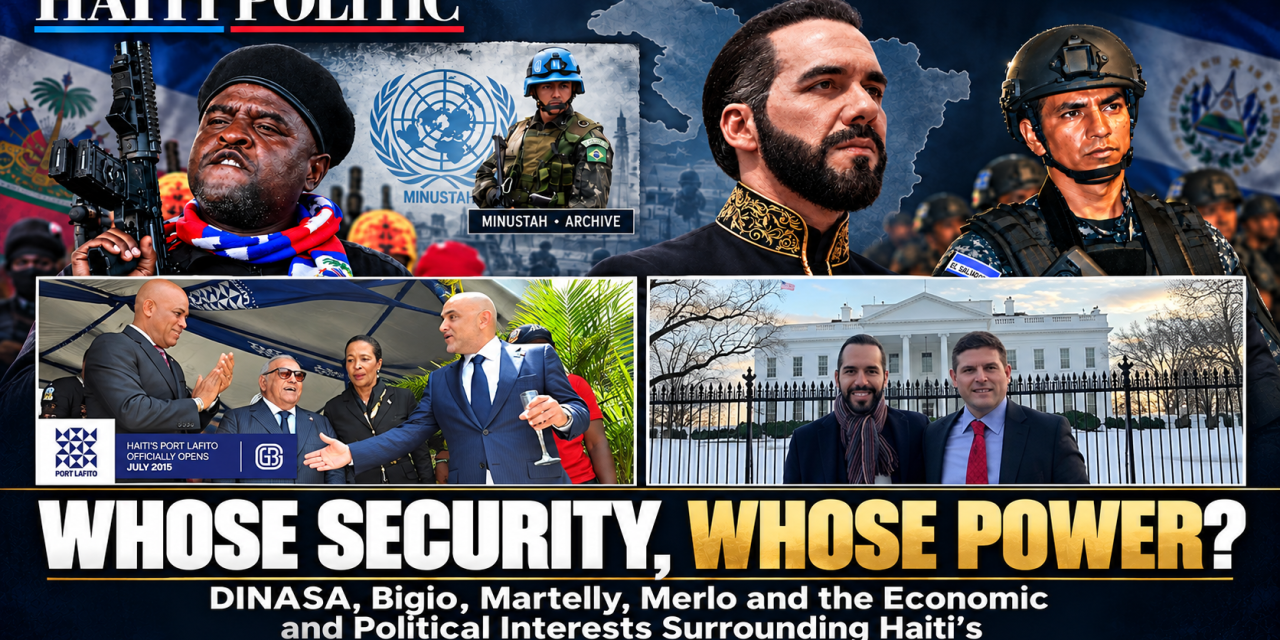
Haiti’s security debate cannot end with the number of foreign soldiers arriving at its airport. It must also ask who finances the operation, who influences its political objectives, who receives its contracts, and whose authority it strengthens. A deployment can confront armed groups while preserving an unequal political and economic order. Whether that is happening requires investigation of decisions and money.
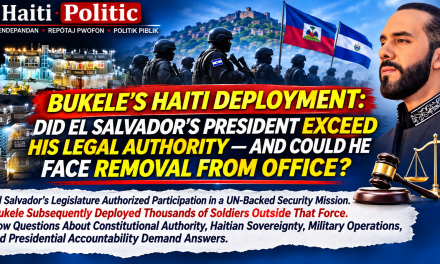
The narrative that Nayib Bukele has come to protect Haiti’s entrenched economic interests could weaken support for Salvadoran troops if it gains traction. But his Palestinian ancestry is not evidence of that purpose. Family origins establish neither commercial obligations nor political loyalties. The stronger case for scrutiny rests on documented relationships connecting Haitian business advocacy, former political leaders and Washington lobbyists.
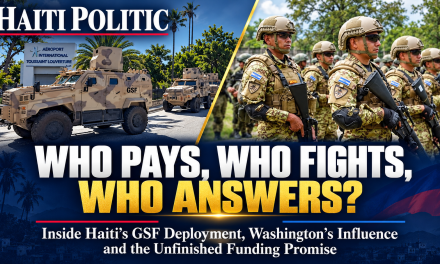
Reuters reported on October 27 that about 1,000 Salvadoran troops had arrived after four Salvadoran personnel went missing in an October 18 ambush. Its source was an unnamed Haitian security official. Command arrangements and the deployment’s duration remained unclear. Reuters also reported that the United States provided C-130 transport aircraft. Those facts establish an expanding operation and U.S. logistical assistance; they do not establish a secret bargain over Haiti’s future. [1]
The fuel records provide a concrete example of the commercial interests surrounding security assistance. According to federal contract data republished by GovTribe and G2X, the U.S. Embassy in Port-au-Prince awarded DINASA a $77,250 purchase order on October 23, 2026. Order 19HA7027P0134 is described as “PAP-INL-DIESEL FUEL FOR HNP SITES,” funded by the State Department’s Bureau of International Narcotics and Law Enforcement Affairs, or INL. Its listed performance end date is November 30, 2026. This establishes contracted business for DINASA through U.S.-funded security assistance; it does not establish the company’s profit or that payment has already been completed. [13–14]
The timing deserves examination. Jacqueline Charles’s reporting for the Miami Herald described the arrival of approximately 100 Salvadoran special forces personnel on October 22, followed by four flights carrying approximately 350 additional Salvadoran military personnel on October 23. One aircraft was a U.S. C-130 supplied by the Pentagon at the State Department’s request. DINASA’s diesel award therefore bears the same date as a substantial wave of Salvadoran reinforcements. That establishes a temporal overlap, not the operational destination of each fuel delivery. An award date is not automatically a delivery, consumption or payment date. [13–15]
The comparison with earlier purchases matters. On September 24, 2026, DINASA had already received another order for diesel for HNP sites, 19HA7026P1098, worth $68,520, with a listed completion date of October 11. This shows that such assistance preceded the October 18 ambush. Without gallon quantities, unit prices, delivery locations and comparable coverage periods, the difference between the two amounts does not establish that the Salvadoran deployment caused increased fuel consumption. [16]
The historical purpose of this assistance is documented. A June 2019 State Department Inspector General report explained that INL financed fuel for Haitian National Police generators and vehicles through the Embassy’s bulk fuel contract. Inspectors found inadequate supervision of deliveries and warned of increased risks of waste, fraud and mismanagement. That is a concrete reason to demand delivery records and oversight today; it is not evidence that the October 2026 order was diverted. [17]
The HNP and GSF can receive support from the same international partners and participate in coordinated operations. In that context, fuel purchased for police could support activities benefiting more than one force. That does not make all their budgets a single account or give every purchase the same destination. The necessary evidence would identify the sites and equipment receiving the fuel. The public order description identifies HNP sites, not Salvadoran aircraft or aircraft transporting Salvadoran troops.
DINASA itself confirms that it refuels aircraft at Port-au-Prince and Cap-Haïtien airports. This establishes its capacity to provide that service. Its airport operations and Embassy contracts together do not establish that the Embassy ordered it to refuel the Salvadoran flights. Establishing that connection requires an invoice or fueling ticket identifying the date, quantity, aircraft registration and account charged. [18]
DINASA’s historical connection to Bigio is also documented. GB Group held 50% of the company. UNIBANK financial statements and contemporary reporting establish that Groupe Financier National, a UNIBANK subsidiary, purchased GB Group’s entire stake in January 2016 and became DINASA’s sole owner. On May 2, 2017, Rubis announced that it had completed the acquisition of 100% of DINASA and Sodigaz at the end of April. DINASA’s documented commercial benefit today must therefore be distinguished from an unproven current benefit to Bigio. Establishing a continuing Bigio financial interest would require evidence of retained ownership, storage, transport, supply, financing or other agreements. [19–21]
The political question extends beyond ownership of a fuel company. If international assistance awards business to established suppliers while political decisions remain concentrated among networks with privileged access, security operations could reinforce the existing order even while confronting armed groups. DINASA’s contract demonstrates commercial activity generated by security assistance. Establishing that it increases the political power of the company or its former shareholders requires evidence connecting contracts, access to officials and public decisions.
Consider the other Bigio connections. In August 2025, CEPR researcher Jake Johnston reported that Reuven Bigio and other business figures participated in Haïti Chérie, an initiative that became a channel for political support to the PHTK, associated with Michel Martelly and Jovenel Moïse. Johnston also documented overlapping participants in Institut Macaya, a business-backed organization seeking influence over Haiti’s future. That reporting supports scrutiny of political continuity without proving that every participant shared every objective. [2]
Official disclosures establish that Macaya’s advocacy reached Washington. A 2025 filing by TSG Advocates DC reported $30,000 in lobbying income for work for Institut Macaya. That is the firm’s reported client income, not evidence that Reuven Bigio personally paid the amount. [3]
A separate August 2025 Foreign Agents Registration Act filing by consultant Andrew Craig Cheatham described preparation of a Haiti action plan covering security, governance, political transition, infrastructure and humanitarian assistance. Macaya intended to use it to seek support from U.S. officials and Congress. Its contemplated outreach included the State Department, Defense Department and Department of Homeland Security. This was organized advocacy concerning the framework for stabilization, not merely commercial promotion. [4]
The distinction matters. Business leaders have a legitimate interest in public safety, and lobbying is not automatically corruption. Nevertheless, when actors with substantial commercial interests help define security and political priorities, citizens should know what they propose, whom they meet and what financial interests they represent. Access to foreign policymakers should not substitute for consent from Haitians.
Damián Merlo provides another documented connection. O’Dwyer’s reported in December 2020 that he had served as special assistant to Martelly and former prime minister Laurent Lamothe. His Latin America Advisory Group received a Haitian government account covering congressional outreach, public relations and international media work. [5]
His firm also represented El Salvador. Its July 2023 FARA filing disclosed $325,000 received from the Salvadoran presidency during the reporting period ending June 30. The filing recorded no activity for Haiti during that period. These records establish Merlo’s work across the two countries’ political networks; they do not show that he acted for both governments simultaneously throughout those relationships or arranged the current deployment. [6]
The links therefore form an overlapping network of political support and paid advocacy. The reviewed evidence does not establish that Bigio employed Merlo, that Merlo represented Macaya, or that these actors directed the GSF. Alleged Bigio-family financing of Dominican political campaigns also requires campaign records or other corroboration before it can be presented as fact.
There are concrete reasons to investigate economic privilege. ICIJ reported that Haiti’s court of auditors criticized a $30 million dredging contract awarded to Bigio-family company Repsa despite a government decision limiting the amount to $15 million. Canada sanctioned Gilbert Bigio in 2022 over alleged support for armed gangs. His lawyer disputed that allegation. An audit criticism and a sanctions designation require careful attribution; neither should be rewritten as a criminal conviction. [7–8]
Haiti’s history also makes skepticism toward international assurances reasonable. During the disputed 2010–2011 election, OAS recommendations led Haiti’s electoral council to advance Martelly to the runoff in place of Jude Célestin. The Congressional Research Service documented pressure from the United States and other donors to accept those recommendations, including visa revocations and warnings concerning aid. MINUSTAH supported election security, but it is inaccurate to collapse the electoral council, OAS, Washington and MINUSTAH into a single actor. The documented lesson is that external intervention materially shaped the electoral path. [9]
MINUSTAH’s accountability failures deepen the concern. In 2016, the UN apologized for its role in Haiti’s cholera tragedy. In 2007, it announced disciplinary repatriation of 108 Sri Lankan peacekeepers amid sexual exploitation and abuse allegations. International authorization plainly did not guarantee protection from harm or adequate accountability. These precedents justify demanding enforceable safeguards; they do not, by themselves, prove that every subsequent mission has the same concealed purpose. [10–11]
The GSF’s founding authorization, Resolution 2793, established a multinational force with a UN support office. It is institutionally different from MINUSTAH. That difference cannot answer the political question: whether security operations will strengthen accountable Haitian institutions or shelter powerful actors from scrutiny. [12]
Preserving the status quo would not require a secret meeting at which everyone agreed to do so. It could emerge through routine choices: politically connected firms receiving contracts, temporary authorities gaining prolonged protection, corruption inquiries being deferred, or commercial sites receiving sustained security while nearby communities remain exposed. These are possible mechanisms to investigate, not findings established here.
The same distinction applies to military success. Salvadoran troops could win engagements against Viv Ansanm without producing lasting security. Civilians need safe movement, functioning courts, public services and protection from abuse by any armed actor. Neither Viv Ansanm’s internal cohesion nor divisions should be assumed without evidence. Predicting a decisive winner from troop numbers alone would confuse battlefield capacity with political legitimacy.
Bukele could gain international prestige and diplomatic influence from a successful operation. Those are plausible incentives, not established proof of personal enrichment or an agreement to protect Haitian business interests. Likewise, the stated rescue objective deserves independent verification, but uncertainty about missing personnel does not establish that their disappearance was fabricated.
Haitians should demand publication of deployment agreements, command arrangements, budgets, procurement awards and the beneficial owners of contracting companies. For DINASA’s orders, that means gallon quantities, unit prices, delivery addresses, receiving reports, invoices and payment dates. For the flights, it means aircraft fueling tickets and the identity of the organization paying. Independent investigators should be able to examine civilian harm and politically connected financial networks. Security priorities should be judged by protection delivered to communities, and political arrangements by whether Haitians can freely choose their leaders.
The central concern is serious: an intervention may reduce armed violence while leaving concentrated economic and political power intact. Fuel contracts show that security assistance has commercial beneficiaries; lobbying records show that actors with economic interests seek political influence. Those facts warrant investigation of whether the operation preserves the existing order, without presenting a current Bigio benefit or a direct GSF contract as established where the documents do not support that conclusion. Bukele’s ancestry adds no evidence to it. The decisive test is whether the operation changes who is accountable to the Haitian people—or merely makes the existing order more secure.
SOURCES
[1] Reuters, Sarah Morland, October 27, 2026.
https://www.investing.com/news/world-news/around-1000-soldiers-from-el-salvador-have-deployed-to-haiti-source-says-4976576
[2] Jake Johnston, CEPR, “Private Sector Assumes Control of Haitian State as DC Lobbying Picks up Pace,” August 18, 2025.
https://cepr.net/publications/private-sector-assumes-control-of-haitian-state/
[3] TSG Advocates DC, 2025 lobbying disclosure for Institut Macaya, signed July 14, 2025.
https://lda.gov/filings/public/filing/e324cb39-b726-45b2-ad5b-2898e52030aa/print/
[4] Andrew Craig Cheatham, FARA Exhibit A/B, August 3, 2025.
https://efile.fara.gov/docs/7628-Exhibit-AB-20250803-2.pdf
[5] Kevin McCauley, O’Dwyer’s, “Haiti Hires Latin America Advisory Group,” December 23, 2020.
https://www.odwyerpr.com/story/public/15397/2020-12-23/haiti-hires-latin-america-advisory-group.html
[6] Latin America Advisory Group, FARA supplemental statement filed July 30, 2023.
https://efile.fara.gov/docs/6898-Supplemental-Statement-20230730-5.pdf
[7] Will Fitzgibbon, ICIJ, February 7, 2023. Includes Bigio attorney’s denial.
https://www.icij.org/investigations/pandora-papers/how-us-lawyers-and-bankers-aided-powerful-haitian-tycoons-now-sanctioned-over-corruption-by-canada/
[8] Global Affairs Canada, sanctions announcement, December 5, 2022.
https://www.canada.ca/en/global-affairs/news/2022/12/canada-imposes-sanctions-against-haitian-economic-elites.html
[9] Congressional Research Service, “Haiti’s National Elections: Issues, Concerns, and Outcome,” July 18, 2011.
https://www.everycrsreport.com/reports/R41689.html
[10] UN Secretary-General, cholera remarks, December 1, 2016.
https://peacekeeping.un.org/en/node/131687
[11] UN Secretary-General spokesperson, briefing, November 2, 2007.
https://www.un.org/sg/en/content/highlight/2007-11-02.html
[12] UN Security Council Resolution 2793 (2025), founding GSF authorization.
https://mandates.un.org/mandate/S/RES/2793(2025)
[13] GovTribe, SAM.gov/FPDS award data for DINASA purchase order 19HA7027P0134, awarded October 23, 2026. The page includes an automated summary; this article relies on the award data fields.
https://govtribe.com/award/federal-contract-award/purchase-order-19ha7027p0134
[14] G2X, Department of State federal contract listings, entry 19HA7027P0134.
https://g2x.com/app/awards/contracts?awarding_agency=1900
[15] Jacqueline Charles, Miami Herald, republished by The Spokesman-Review, October 24, 2026; reporting on arrivals October 22–23.
https://www.spokesman.com/stories/2026/oct/24/salvadoran-troops-land-in-haiti-aboard-pentagon-pl/
[16] GovTribe, purchase order 19HA7026P1098, September 24, 2026; Federal Compass also confirms the award.
https://govtribe.com/award/federal-contract-award/purchase-order-19ha7026p1098
https://www.federalcompass.com/fed-contract-award/19HA7026P1098
[17] State Department Office of Inspector General, Inspection of Embassy Port-au-Prince, Haiti, ISP-I-19-18, June 2019, printed page 9.
https://www.stateoig.gov/uploads/report/report_pdf_file/isp-i-19-18_1.pdf
[18] DINASA, official aviation services page.
https://dinasa.ht/aviation
[19] UNIBANK, notes to 2015 consolidated financial statements, section 26(c), subsequent transaction.
https://www.unibankhaiti.com/wp-content/uploads/1628/70/sept2015a.pdf
[20] Patrick Saint-Pré, Le Nouvelliste, January 11, 2016; acquisition of GB Group’s stake effective January 6, 2016.
https://lenouvelliste.com/article/154224/groupe-financier-national-sa-filiale-de-la-unibank-sa-possede-totalement-la-dinasa
[21] Rubis, official announcement of completed acquisition of 100% of DINASA and Sodigaz, May 2, 2017.
https://www.rubis.fr/en/communique/rubis-completes-acquisition-of-the-leader-in-the-distribution-of-fuel-products-in-haiti/