
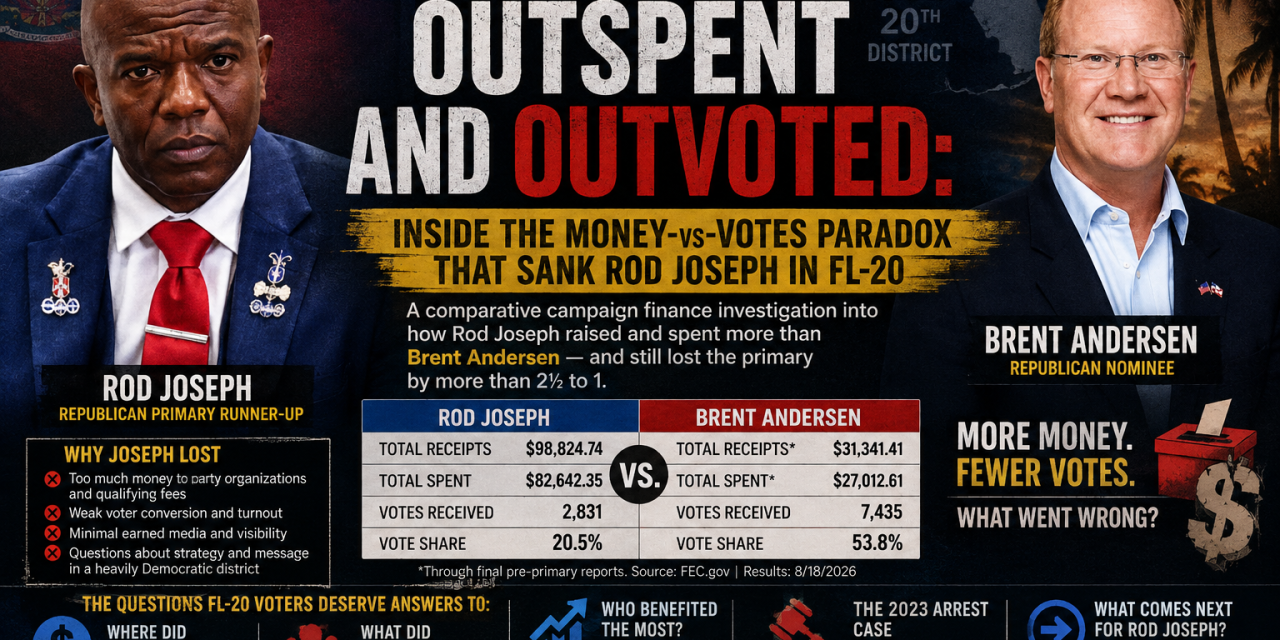
A comparative campaign finance investigation into how Rod Joseph raised and spent more than eventual Republican nominee Brent Andersen — and still lost the primary by more than 2½ to 1.
The Paradox
In politics, money is supposed to buy at least a fighting chance. So the outcome of Florida’s 20th Congressional District Republican primary on August 18, 2026 is worth sitting with: Rod Joseph, the Haitian-American Army veteran and Purple Heart recipient who built his campaign around grassroots Haitian diaspora networks and county-level GOP outreach, outraised and outspent the man who beat him. Brent Andersen won the nomination by more than two-and-a-half times Joseph’s vote total. This piece uses itemized FEC disbursement data from both campaign committees to explain why money and vote share diverged so sharply — and what it reveals about how this primary was actually won.
Two Committees, Two Very Different Spending Profiles
Federal Election Commission Schedule B filings show a stark contrast in how each campaign’s dollars were deployed.
Rod Joseph for Congress Committee (FEC ID C00892570) reported $98,824.74 in total individual contributions for the cycle and itemized disbursements across 98 separate transactions totaling $77,952.52 — a campaign that, on paper, looks like an active, multi-front grassroots operation: digital advertising, radio spots, canvassing payments to individual field workers, phone banking, campaign events, and office overhead.
Andersen for Congress (FEC ID C00950675), by comparison, shows only 16 itemized Schedule B transactions totaling just $15,573.40 in the disbursement data reviewed for this analysis. Critically, that spending is concentrated almost entirely in campaign infrastructure and compliance rather than voter contact: the $10,440 state ballot access fee, $2,906.50 paid to Red Curve Solutions for compliance consulting and data processing, and the remainder in WinRed and Anedot online-donation merchant processing fees. There is no itemized spending in this dataset on advertising, canvassing, radio, or direct voter outreach at all.
What This Actually Tells Us
On its face, this comparison could suggest Andersen ran a shoestring campaign. But the primary results say otherwise — he won by a decisive margin. A few explanations, not mutually exclusive, help square that circle:
1. Itemized Schedule B data only tells part of the story. The FEC requires itemization of disbursements and of contributions above certain thresholds, but a well-funded campaign can also spend heavily through channels — large lump-sum vendor contracts reported on other schedules, in-kind party support, independent expenditures made on a candidate’s behalf by outside groups rather than by the campaign itself — that would not appear in a single committee’s Schedule B export. Andersen’s thin itemized footprint may understate his campaign’s real reach if county party organizations, allied PACs, or the state party apparatus provided direct voter-contact support that never had to run through his own committee’s disbursement ledger.
2. Name recognition and institutional positioning can substitute for paid media. Andersen entered the race as, by most contemporaneous account, the best-positioned candidate in a four-way GOP field, facing Navy veteran Carla Spalding and Lateresa “LA” Jones alongside Joseph. In low-turnout primaries — which FL-20’s Republican primary almost certainly was, given the district’s heavily Democratic lean in general elections — a candidate with existing name recognition, local business or political ties, or party establishment support can win on turnout mechanics and endorsement signaling alone, without needing to outspend rivals on the persuasion and mobilization tactics smaller-profile candidates rely on.
3. Joseph’s spending pattern suggests a campaign working harder to buy what Andersen may have already had. Look again at where Joseph’s dollars went: nearly $14,200 combined flowed directly from his campaign to the Broward GOP, the Republican Party of Palm Beach, the Martin County Republican Party, and the Florida GOP — donations explicitly labeled “party building activities” and “campaign promotion” in the disclosure descriptions. That is a striking allocation for a challenger: rather than the party funding or amplifying Joseph, a meaningful share of Joseph’s itemized spending flowed the other direction, toward county party organizations, a pattern consistent with a relatively new arrival to the Republican Party (Joseph ran as a Democrat for the Florida House and U.S. Senate as recently as 2022–2024) trying to purchase access, credibility, and goodwill inside a party apparatus he hadn’t spent decades building relationships within. If Andersen already possessed that institutional trust without needing to buy it, it would help explain why Joseph’s higher spend didn’t convert into competitive vote share: he was paying an entry fee Andersen didn’t have to pay.
4. Raising money and converting it into votes are different skills. Joseph’s committee shows real, itemized voter-facing activity — door-knocking payments to Julnise Miguel and Karlos Blanc, phone bank and advertising spending with Djenane Gourgue, radio ads through Kerby Leveille and Guy Wewe Radio, and merchandise from Henan Enda New Material Co. in China. This is the machinery of a genuine grassroots campaign. But machinery alone doesn’t guarantee votes; a campaign can execute a full canvassing and advertising program and still lose decisively if the underlying message, candidate profile, or district dynamics don’t move persuadable primary voters. A 2½-to-1 margin despite comparatively heavier spending suggests Joseph’s outreach, however active, was not converting contacts into votes at anywhere near the rate Andersen’s presumably lighter, more targeted (or more institutionally backed) effort achieved.
The Broader Lesson
This race is a useful, concrete illustration of a pattern political scientists have long observed: campaign spending correlates with electoral success far more reliably for challengers introducing themselves to voters than it does in determining outcomes once other factors — incumbency-adjacent advantages, party infrastructure, name recognition, and candidate fit for the district — are already in play. Joseph did what conventional campaign wisdom recommends: he built a real field operation, bought real advertising, and invested in relationships with the county party structure. Andersen, at least based on what his own committee’s itemized disbursements show, did comparatively little of that — and won anyway. That gap is the story of this primary as much as any single policy dispute between the candidates.
What’s Next for Rod Joseph
As covered in earlier reporting on Joseph’s political career, his post-primary options fit a now well-established pattern: three campaigns for three different offices under two different party banners since 2022 (Florida House as a Democrat, U.S. Senate as a Democrat, and now U.S. House as a Republican) suggest a candidate unlikely to exit electoral politics after a single primary loss. His background — a political consulting firm, community organizing roots in Broward’s Haitian-American community, and a public speaking profile built around his military service — gives him multiple non-electoral avenues to remain publicly active while positioning for a future run, whether at the state legislative level, in local office, or in another federal cycle should district boundaries or political circumstances shift again. Whether his next campaign learns the lesson of this one — that buying institutional access without first securing it organically may not be a winning strategy — is likely to shape how competitive that next run actually is.