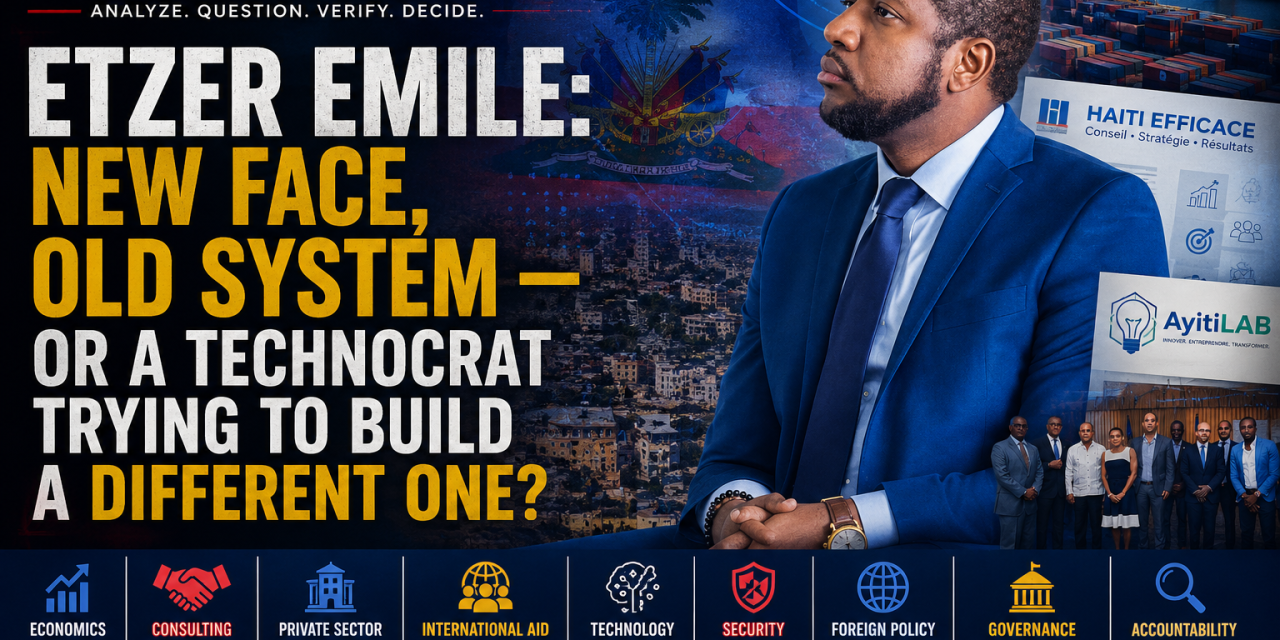
Economics. Consulting. Private sector. International aid. Technology. Security. Foreign policy. Governance. Accountability.
Haiti has produced economists, consultants, development specialists and reform plans for decades.
What it has struggled to produce is something more difficult:
a functioning state capable of turning expertise into results.
That is why Etzer Emile deserves examination beyond his popularity as an economist, author and television personality.
Emile’s professional biography is substantial. He is an economist, entrepreneur, educator, university professor and consultant. His public biography says he holds an MBA in finance and banking, studied in Haiti and Taiwan, participated in the U.S. State Department’s International Visitor Leadership Program, and has worked across entrepreneurship, economic research and institutional development.
But Haiti Politic’s central question remains:
Is Etzer Emile genuinely a new alternative to Haiti’s political-economic establishment—or a younger and more polished professional who has spent much of his career working inside the same corporate, governmental and international-development networks that reformers say must change?
The answer is more complicated than either label.
🔎 PART I — WHO IS ETZER EMILE?
Unlike many figures in Haitian national politics, Emile did not build his reputation through parliament, a ministry, an armed movement or a traditional political party.
He built it through economics.
His professional profile includes entrepreneurship education, consulting, research, financial literacy and public commentary. His website describes him as the founder of Haïti Efficace, president of Fondation Avenir and founder of the newer AyitiLAB initiative.
His best-known book, Haïti a choisi de devenir un pays pauvre: Les vingt raisons qui le prouvent, helped transform subjects normally confined to economists—productivity, public policy, institutions and development—into popular conversation.
His website currently reports more than 30,000 copies sold and more than 700,000 cumulative social-media followers. Those figures are self-reported, but they demonstrate the scale of the public platform he has built.
That makes Emile unusual.
He has political influence without having built that influence principally through elected office.
But influence is not governance.
And explaining why Haiti is poor is fundamentally different from possessing the political machinery required to make Haiti richer.
🏢 PART II — HAÏTI EFFICACE: FOLLOW THE CONSULTING NETWORK
This is where an investigation of Emile becomes particularly interesting.
Through Haïti Efficace, he has operated inside some of the most important corners of Haiti’s economy.
His biography says nearly 50 Haitian businesses and associations have received services from the firm.
Named organizations include:
BRANA
AIC
Comme Il Faut
ACME
Auto Plaza
J.B. Vital S.A.
Haïti Énergie Renouvelable
Les Céréales d’Haïti
Hôtel Mont-Joli
Haitian-Canadian Chamber of Commerce and Industry
Franco-Haitian Chamber of Commerce and Industry.
This establishes something important:
Etzer Emile isn’t an economist observing Haiti’s private sector from a classroom.
He has worked inside its professional ecosystem.
That could be an enormous advantage.
Or politically, it could become a vulnerability.
📊 PART III — WHAT DOES HAÏTI EFFICACE ACTUALLY DO?
The available source supports a broad portfolio of consulting services: coaching, recovery studies, market research, product launches, obtaining incentives, marketing strategy, training, market analysis and financing. Emile also says he has led household surveys and market studies involving remittances, energy and fuel consumption, alcohol, automobile purchases and Haiti’s flour market.
That means Haïti Efficace’s work goes considerably beyond motivational entrepreneurship seminars.
Its activities touch actual corporate decision-making.
📈 MARKET RESEARCH & MARKET PENETRATION
The firm’s portfolio includes market research and consumer studies designed to help businesses understand Haitian demand.
Companies identified among Haïti Efficace’s clients include J.B. Vital S.A. and Comme Il Faut.
An important distinction is necessary, however: the available biography establishes those companies as clients and separately identifies market research as a service. It does not, in the material reviewed, establish every specific client-to-service pairing suggested in the original description.
That distinction matters in investigative journalism.
📣 PRODUCT LAUNCHES & MARKETING
Product-launch planning and marketing strategy are explicitly among the firm’s listed consulting services, while BRANA is among its publicly identified clients.
Again, that demonstrates access to significant corporate institutions.
But it does not by itself prove precisely which BRANA product or campaign Haïti Efficace worked on.
💰 FINANCING & GOVERNMENT INCENTIVES
Haïti Efficace identifies both financing and assistance in obtaining incentives among its consulting activities.
Haïti Énergie Renouvelable (HER) appears among the firm’s clients.
For a potential political figure, this area deserves particular scrutiny.
Why?
Because someone who has professionally helped private enterprises navigate investment financing or state incentives could eventually find himself responsible for regulating those same systems.
That isn’t evidence of wrongdoing.
It is a potential conflict-of-interest question.
🏨 BUSINESS RECOVERY & CAPACITY BUILDING
Recovery studies, corporate coaching and training are also identified among Haïti Efficace’s services. Hôtel Mont-Joli appears on its client list.
The larger story is therefore clear:
Emile has practical exposure to companies trying to survive and grow inside Haiti’s dysfunctional business environment.
That could provide a future policymaker with valuable firsthand knowledge.
But it also means voters deserve transparency about the commercial relationships behind that knowledge.
⚠️ PART IV — THE QUESTION THAT FOLLOWS THE CLIENT LIST
There is nothing inherently improper about consulting for BRANA, AIC, Comme Il Faut, ACME, Auto Plaza or any other lawful Haitian enterprise.
In fact, a president who understands businesses could be preferable to politicians who understand only political patronage.
But Haiti’s economy has long faced accusations involving market concentration, preferential customs treatment, tax exemptions, politically connected import networks and weak competition.
So the relevant question isn’t:
“Did Etzer Emile work with wealthy companies?”
We know his firm has.
The serious question is:
Could President Etzer Emile regulate former clients without fear or favoritism?
Would his administration publish major tax exemptions?
Would customs privileges be disclosed?
Would competition investigations extend to companies whose executives he knows professionally?
Would former Haïti Efficace clients compete for public contracts under exactly the same rules as everyone else?
Would Emile disclose previous consulting income where necessary to establish that no conflicts exist?
That is how the public determines whether professional access represents expertise—or dependency.
🏛️ PART V — HAÏTI EFFICACE ALSO WORKED WITH GOVERNMENT
Emile’s professional biography says he worked as a consultant with:
Ministry of Commerce and Industry
Ministry of Tourism
Ministry of National Education and Vocational Training
Prime Minister’s Office.
That further complicates the “outsider” label.
Emile may be outside Haiti’s traditional electoral political class.
But he is certainly not unfamiliar with the Haitian state.
He has worked around ministries.
He has worked around corporations.
He has worked around international organizations.
He has worked around business chambers.
That makes “new face versus old system” too simplistic.
A better investigation asks:
What measurable institutional changes resulted from those engagements?
For each public consulting assignment, Haitians should be able to ask:
What problem was Haïti Efficace hired to solve?
How much was the contract worth?
Who authorized it?
What was delivered?
Was the recommendation implemented?
What measurable improvement occurred?
That is results-based accountability.
🌍 PART VI — THE INTERNATIONAL DEVELOPMENT APPARATUS
Emile’s career also reaches deeply into international development.
His biography says he coordinated programs financed by organizations including the IDB’s FOMIN and Clinton-Bush Haiti Fund and conducted cost-benefit research with Copenhagen Consensus.
It also lists work involving the World Bank, World Food Programme, HELVETAS, Desjardins International/PANSEH, SOS Children’s Villages, Embassy of Canada and UN Women.
This creates two dramatically different interpretations of the same résumé.
📈 INTERPRETATION #1 — INTERNATIONAL VALIDATION
Supporters can argue that this proves professional credibility.
International organizations generally require contracts, deliverables, reporting and financial controls.
Experience navigating those systems could help a future Haitian government negotiate:
development financing,
investment programs,
multilateral agreements,
technical assistance,
entrepreneurship financing,
and international economic partnerships.
And Emile isn’t merely discussing entrepreneurship theoretically.
🎓 PART VII — RéSACE: FROM BOARDROOMS TO ENTREPRENEURS
A particularly useful case is RéSACE — Réseau Solidaire d’Accompagnement à la Création d’Entreprises.
The AUF says the program was developed to bridge the gap between university training and Haiti’s labor market through incubation, mentoring and financing.
Its partners included the Swiss Embassy, BRH, Fondation Sogebank, FOKAL, CORPUHA and civil-society organizations.
Emile publicly reported that Haïti Efficace mobilized approximately ten consultants to train and support 169 businesses from different Haitian departments through RéSACE.
AUF’s own reporting provides broader program-level results: in 2022, 150 teams received 180 hours of training and 30 projects received $10,000 each; in 2023, 160 selected teams received intensive training and 30 beneficiaries were selected for $5,000 financing.
That strengthens Emile’s argument that his professional footprint extends beyond elite corporate clients.
He has also participated in systems intended to develop younger entrepreneurs.
📉 PART VIII — THE OTHER INTERPRETATION: THE “AID SUBCONTRACTOR” PROBLEM
There is nevertheless another Haitian political argument that cannot simply be dismissed.
For decades, Haiti has received enormous amounts of international assistance while state capacity has remained catastrophically weak.
So critics ask:
Does Haiti’s consultant-NGO-development ecosystem solve the state’s weakness—or make a career out of managing it?
That question applies well beyond Etzer Emile.
It applies to an entire Haitian professional class.
Consultants write reports.
NGOs execute projects.
Foreign donors establish priorities.
International institutions finance programs.
Local organizations implement them.
And the Haitian government sometimes remains institutionally weaker afterward.
So Emile should confront the contradiction directly:
If international development expertise works, why has decades of international development intervention failed to build a functional Haitian state?
And more personally:
Would an Emile administration continue Haiti’s donor-consultant model—or deliberately transfer technical capacity back into permanent Haitian institutions?
That would tell us whether his international experience represents a bridge out of dependency or professional expertise within dependency.
🗣️ HOW DOES EMILE ANSWER THE CRITIQUE?
The available evidence suggests an important theme in Emile’s approach:
production and domestic capacity.
His current public presentation emphasizes production, innovation and results rather than presenting foreign aid itself as the development model.
His work around entrepreneurship similarly emphasizes creating businesses and economic capabilities.
And his newest initiative provides perhaps the clearest test of that philosophy.
💻 PART IX — AYITILAB: CAN HAITI BUILD INSTEAD OF IMPORT?
In June 2026, Fondation Avenir, led by Emile, signed an agreement with Haiti’s Ministry of Commerce and Industry (MCI) and École Supérieure d’Infotronique d’Haïti (ESIH) around the launch of AyitiLAB.
The initiative is intended to help young Haitians transform technological ideas into sustainable companies.
Emile’s announcement describes an initial two-year program intended to accompany roughly 100 technology startups, including ventures in finance, education, commerce, health and agriculture.
The problem AyitiLAB identifies is important.
Haiti does not necessarily lack ideas.
Young entrepreneurs frequently lack:
business-model development, mentorship, financing, customers and market access.
The MCI publicly confirmed the partnership and described AyitiLAB as part of an effort to encourage innovation, entrepreneurship and job creation.
This is potentially one of the more important additions to Emile’s résumé because it moves his development philosophy toward an institutional experiment:
Can Haiti transform talented young people into companies rather than emigrants?
🧪 BUT AYITILAB MUST ALSO BE AUDITED
AyitiLAB is new.
Therefore, announcing a target of approximately 100 startups is not the same as successfully creating 100 sustainable companies.
Haiti Politic should return to the program and measure:
How many startups entered?
How many completed the program?
How many received financing?
How much private capital followed?
How many became revenue-generating companies?
How many jobs were created?
How many survived after one year?
How many founders were outside Port-au-Prince?
How many products were actually exported?
And how much public money, if any, supported those results?
If AyitiLAB succeeds, it strengthens Emile’s argument that his ideas can move from analysis to institution building.
If it produces conferences, photographs and certificates without durable enterprises, it becomes another development project in a country overflowing with them.
🚨 PART X — ECONOMICS STILL CANNOT NEGOTIATE WITH AN ASSAULT RIFLE
This remains perhaps the greatest weakness in evaluating an economist as a potential national leader.
Haiti’s crisis isn’t simply economic.
It is a crisis of state power.
Entrepreneurs cannot operate if highways are controlled by armed groups.
Banks cannot finance factories that cannot receive supplies.
Foreign investors won’t build plants if employees can be kidnapped.
Diaspora investors won’t return capital if property rights cannot be enforced.
Digital startups cannot replace police.
Therefore, an Emile national program eventually needs something substantially harder than entrepreneurship policy:
A SECURITY DOCTRINE.
How many police officers?
What intelligence architecture?
What customs enforcement?
What anti-arms-trafficking strategy?
What role for FAd’H?
What judicial reforms?
What prison system?
What international security assistance?
What budget?
What timetable?
And what happens when economically powerful interests resist reform?
Standard economic expertise is necessary for rebuilding Haiti.
It is nowhere near sufficient.
🌎 PART XI — WHAT WOULD AN “ETZER EMILE DOCTRINE” MEAN FOR FOREIGN POLICY?
This could potentially become one of his strongest areas.
Haiti’s diplomacy has too often revolved around:
international intervention,
migration crises,
foreign assistance,
political recognition,
security missions,
and emergency appeals.
An economist could attempt something different:
ECONOMIC DIPLOMACY.
Every Haitian embassy could become an investment and export office.
Ambassadors could receive measurable targets for:
diaspora investment,
foreign direct investment,
Haitian exports,
tourism,
university partnerships,
technology transfer,
and new markets for Haitian producers.
That would align naturally with Emile’s emphasis on production and entrepreneurship.
But foreign policy cannot be reduced to attracting investment.
He would still have to answer Haiti’s hardest geopolitical questions:
United States — partnership or dependency?
Dominican Republic — economic integration combined with what border doctrine?
CARICOM — symbolic membership or serious regional integration?
Taiwan and China — what serves Haiti’s strategic interests?
France — what should the post-colonial relationship become?
International financial institutions — financing under whose development priorities?
Diaspora — remittance source or genuine political-economic partner?
Foreign security forces — necessary bridge or perpetual substitute for Haitian sovereignty?
Until those positions become explicit, we can discuss Emile’s international experience.
We cannot yet speak confidently of an Emile foreign-policy doctrine.
💰 PART XII — THE CONFLICT-OF-INTEREST TEST
If Etzer Emile ever seeks high public office, one decision could immediately demonstrate whether his reform language is serious.
Publish.
Publish Haïti Efficace’s historical public-sector contracts.
Publish government payments where legally permissible.
Publish the deliverables.
Publish corporate interests requiring recusal.
Disclose ownership.
Create a blind trust or divest where appropriate.
Prohibit Haïti Efficace from receiving government contracts while he exercises public authority.
Establish procurement rules preventing former clients from receiving privileged treatment.
Then allow independent journalists and auditors to examine the record.
That would transform the debate from:
“Trust me, I’m different.”
into:
“Here is the evidence. Audit me.”
🎤 15 QUESTIONS ETZER EMILE SHOULD ANSWER
- Will you disclose every Haitian government contract received by Haïti Efficace/Emile & Co.?
- What measurable results did those government consulting contracts produce?
- Will you disclose former corporate clients if you seek high public office?
- Would you divest from Haïti Efficace or establish an independently controlled structure to eliminate conflicts?
- Would former clients such as BRANA, AIC, Comme Il Faut or Auto Plaza receive exactly the same regulatory treatment as competitors?
- Will you publish Haiti’s major tax and customs exemptions and their beneficiaries?
- Would you strengthen competition enforcement even if it affected companies within your former professional network?
- What lessons did you learn from working with international donors about why aid repeatedly fails to create Haitian institutional capacity?
- Would your government require international projects to transfer skills, data and operational capacity into Haitian institutions?
- What percentage of development spending should eventually move from NGOs toward accountable Haitian public institutions?
- What measurable outcomes will determine whether AyitiLAB succeeds?
- What is your operational plan—not economic diagnosis—for restoring territorial security?
- Would you accept another foreign security mission, and under what conditions and exit timetable?
- What would fundamentally change in Haiti’s relationships with Washington, Santo Domingo, CARICOM, Taiwan, France and international financial institutions?
- After years of advising companies and institutions, which organization can you identify and demonstrate: “I helped transform this institution, and here are the independently measurable results”?
That final question remains particularly important.
📊 HAITI POLITIC | EXPANDED ASSESSMENT
| Area | Evidence of Strength | Question Haiti Should Ask |
|---|---|---|
| Economics | MBA/finance background and extensive economic analysis | Can analysis survive political resistance? |
| Corporate Consulting | Work with dozens of businesses and associations | Can former clients be regulated impartially? |
| Market Research | Experience studying Haitian consumers and industries | Can research become national industrial policy? |
| Entrepreneurship | RéSACE involvement and business coaching | How many supported businesses survive and scale? |
| Technology | AyitiLAB startup accelerator initiative | Can it produce sustainable firms and jobs? |
| Government Exposure | Consulting experience with ministries and Primature | What measurable institutional improvements resulted? |
| International Networks | Donor-funded programs and international organizations | Reform the aid architecture—or remain inside it? |
| Public Education | Major platform explaining economic problems | Can communication become administration? |
| Security | Economics can finance institutional rebuilding | A complete operational security doctrine remains essential |
| Foreign Policy | Strong potential for economic diplomacy | Geopolitical positions need greater definition |
| Political Identity | Not principally produced by traditional elected-party machinery | Extensive establishment relationships complicate the outsider narrative |
| Accountability | Results-oriented professional branding | Will he submit his own consulting history to radical transparency? |
🧭 NEW FACE OR OLD SYSTEM?
The evidence doesn’t justify either simplistic conclusion.
Etzer Emile is clearly not a traditional Haitian politician in the conventional sense.
He did not become nationally prominent because he controlled a Senate bloc, commanded armed supporters, inherited a political machine or spent decades rotating through ministries.
But neither is he an outsider who has never touched Haiti’s establishment.
Quite the opposite.
His professional career intersects with:
major corporations, business chambers, government ministries, international donors, NGOs, universities and development institutions.
Perhaps that is exactly the experience Haiti needs.
Or perhaps Haiti has already seen too many sophisticated technocrats move comfortably through precisely those networks without fundamentally changing the state.
That is the investigation.
The central question isn’t whether Etzer Emile knows the system.
He clearly does.
THE QUESTION IS WHETHER HE WOULD BE WILLING — AND ABLE — TO CHANGE THE PARTS OF THAT SYSTEM THAT BENEFITED PEOPLE HE KNOWS.
Can the consultant regulate the client?
Can the economist command a security state?
Can the development professional challenge donor dependency?
Can the entrepreneurship advocate confront monopolies?
Can the internationally connected technocrat practice Haitian sovereignty?
Can the public educator transform knowledge into executive execution?
And can AyitiLAB become evidence that his development philosophy actually produces institutions, companies and jobs at scale?
Those questions cannot be answered by supporters or critics today.
They require records, disclosures, policies and measurable results.
New face?
Establishment technocrat?
Economic reformer?
Product of Haiti’s consultant-development ecosystem?
Or a bridge between the system Haiti has and the productive state Haiti desperately needs?
Let the Haitian people examine the evidence—and decide.
HAITI POLITIC 🇭🇹
Analyze. Question. Verify. Decide.