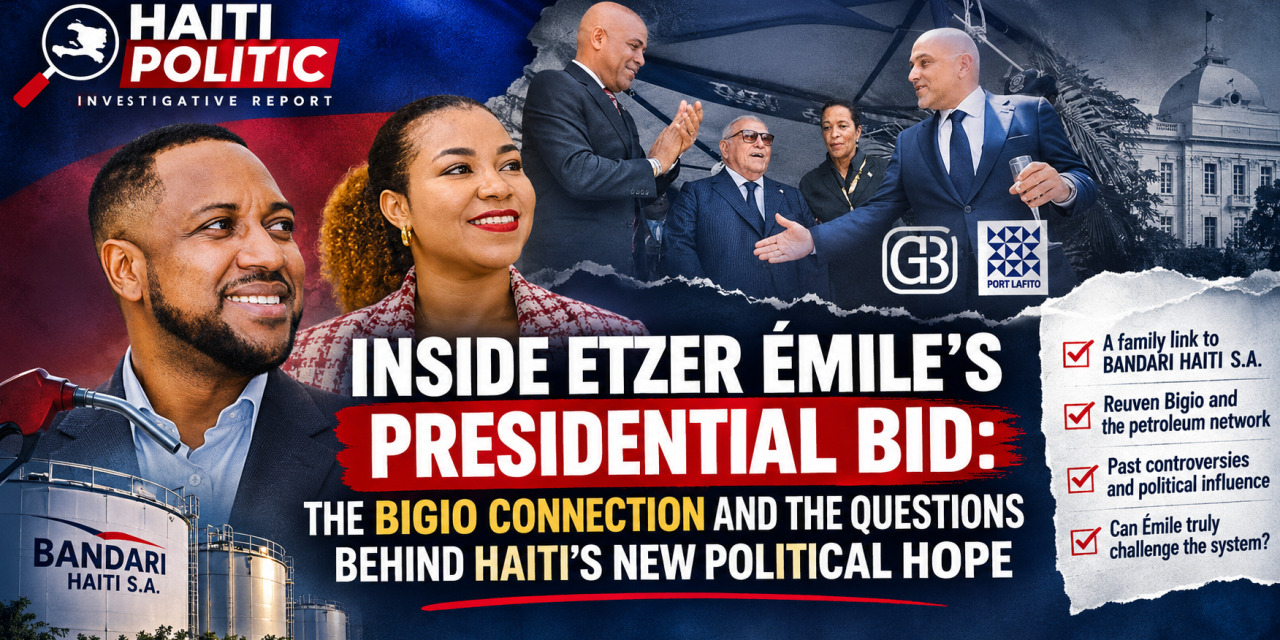
An investigation into the economist’s presidential ambitions, his consulting firm’s relationships with major Haitian businesses and foreign institutions, his wife’s employment at a Bigio-connected petroleum company, and the financial transparency questions surrounding his campaign.
HAITI POLITIC — SPECIAL INVESTIGATION
November 1, 2026
THE ECONOMIST WHO CRITICIZED HAITI’S SYSTEM NOW WANTS TO LEAD IT
On October 31, 2026, Haitian economist Etzer Émile officially announced his candidacy for president of Haiti under the banner of Gwoupman Solèy.
For years, Émile has presented himself as an economic analyst willing to challenge the failures of successive Haitian administrations.
He has criticized government mismanagement, excessive public spending, economic inequality, weak institutions, and the concentration of economic opportunities among established business interests.
His public reputation has been built largely on explaining why Haiti remains poor despite its economic potential.
Now, the economist wants to become the president responsible for addressing those problems.
But an examination of his professional background reveals a political question that deserves attention.
How independent can a presidential candidate be from Haiti’s established economic interests when his consulting firm publicly lists major corporations, petroleum businesses, government institutions, and foreign embassies among its clients?
A second question emerges from his immediate family.
Émile’s wife, Shelda Francillon, has publicly identified herself as an employee of BANDARI HAITI S.A., a petroleum company associated with the Bigio business network.
The available information does not establish improper conduct or undisclosed political financing.
It does, however, reveal relationships that deserve examination as Émile moves from economic commentary into presidential politics.
For Haiti Politic, the investigation begins with three interconnected subjects: business relationships, petroleum-sector interests, and political accountability.
1. WHO IS ETZER ÉMILE?
Etzer Émile is an economist, university professor, author, entrepreneur, and public commentator.
Originally from Cavaillon, in Haiti’s Southern Department, he studied economics at Université Quisqueya and sociology at the State University of Haiti.
He subsequently pursued graduate studies in Taiwan, earning an MBA in finance and banking from Tamkang University.
His professional background includes teaching, business consulting, financial education, and economic analysis.
He is widely associated with his book:
Haïti a choisi de devenir un pays pauvre: les 20 raisons qui le prouvent.
The publication examines structural obstacles to Haiti’s economic development.
Émile has also participated in professional development programs abroad, including executive education and international leadership initiatives.
His career has given him access to business leaders, government institutions, universities, international organizations, and diplomatic circles.
Those relationships are not inherently problematic.
However, when an economic consultant becomes a presidential candidate, his professional history becomes relevant to public discussions about potential conflicts of interest.
The question is not whether Émile has worked with powerful institutions. It is how he would manage those relationships while exercising presidential authority.
2. HAÏTI EFFICACE: THE CONSULTING FIRM BEHIND THE ECONOMIST
One of the most revealing sources in this investigation is Émile’s consulting firm, Haïti Efficace.
According to the company’s official website, Haïti Efficace operates under the registered business name EMILE & CO.
The firm states that it was established in Haiti in 2014, initially as an individual enterprise.
In 2017, it became a société en nom collectif (SNC), a form of business partnership recognized under Haitian commercial law.
This chronology is important.
It means the consulting business was operating before Jovenel Moïse became president in February 2017 and continued during the political and economic controversies of his administration.
The firm’s official website makes a significant disclosure:
Haïti Efficace states that it has provided consulting services to approximately 100 businesses, organizations, and public institutions.
Its client directory includes private companies, government ministries, financial institutions, international organizations, and foreign embassies.
The list provides an important picture of the professional environment in which Émile developed his economic expertise.
However, the website does not disclose the dates, financial values, or precise services associated with individual clients.
That missing information matters when examining whether particular assignments overlapped with public economic-policy controversies.
3. THE CLIENT LIST: PETROLEUM, BANKING, GOVERNMENT, AND DIPLOMATIC INSTITUTIONS
Haïti Efficace’s published client directory identifies organizations operating across several major sectors of Haiti’s economy.
Petroleum and energy
DINASA — Distributeurs Nationaux S.A.
DINASA operates in Haiti’s petroleum distribution industry.
Its inclusion is particularly relevant because Émile publicly discussed petroleum-sector policies during the Jovenel Moïse administration.
Haïti Énergie Renouvelable (HER)
The company also appears in the firm’s client directory.
Its inclusion reflects consulting activity involving the broader energy sector.
Financial institutions
The client list includes:
- Banque de l’Union Haïtienne (BUH)
- Banque de la République d’Haïti (BRH)
- Banque Nationale de Crédit (BNC)
- Banque Populaire Haïtienne (BPH)
- Alternative Insurance Company (AIC)
- ACME
These organizations operate in sectors affected by banking regulations, monetary policy, public finance, insurance oversight, and access to credit.
A consultant’s work with such institutions can provide valuable economic experience.
It can also create financial relationships that may warrant disclosure when that consultant seeks political office.
Major private companies
The website identifies several established Haitian businesses, including:
- BRANA
- Auto Plaza
- J.B. Vital S.A.
- Les Céréales d’Haïti
- Les Papiers d’Haïti
- RB Investment Établissements
The list demonstrates that Haïti Efficace has publicly represented itself as providing services to businesses across multiple sectors.
It does not establish that every listed organization remains an active client.
Haitian government institutions
The directory includes:
Ministry of Economy and Finance
Ministry of Commerce and Industry
Both ministries are central to Haiti’s economic policy.
The Ministry of Economy and Finance is involved in taxation, public expenditures, fiscal administration, and government financial management.
The Ministry of Commerce and Industry is involved in business regulation, commercial development, and economic policy.
Consulting work for these ministries is not evidence of political favoritism.
Nevertheless, the public has a legitimate interest in understanding whether a presidential candidate previously received government consulting contracts, what those contracts required, and how they were awarded.
4. THE FOREIGN EMBASSY CONNECTION
Perhaps one of the most politically interesting elements of Haïti Efficace’s client directory is the inclusion of foreign diplomatic institutions.
The firm’s website explicitly lists:
The United States Embassy in Haiti
The Canadian Embassy
The Swiss Embassy
It also lists international organizations, including ONU Femmes, the International Labour Organization, and UNCTAD.
These disclosures establish that Haïti Efficace publicly claims consulting relationships with diplomatic and international institutions.
They do not establish that those institutions endorse Émile’s presidential candidacy or influence his political decisions.
Nor does a consulting relationship establish the existence of a particular U.S. federal procurement contract.
Nevertheless, the information raises questions about the nature of the assignments.
What services did Haïti Efficace provide to the U.S. Embassy?
Were the assignments related to economic development, entrepreneurship, institutional training, or another subject?
Were the services performed directly for the embassy or through an implementing organization?
What were the dates and contract values?
Did any consulting assignments involve Haitian government institutions or economic-policy recommendations?
These questions are relevant because foreign embassies and international organizations have long participated in Haiti’s development and institutional-reform programs.
A presidential candidate who has provided consulting services to foreign institutions can reasonably be asked to explain the nature of those relationships and whether any financial obligations remain active.
Such disclosures would allow the public to evaluate the relationships without assuming improper foreign influence.
5. THE DINASA CONNECTION: A NEW DIMENSION TO THE PETROLEUM INVESTIGATION
The inclusion of DINASA in Haïti Efficace’s client directory deserves particular attention.
DINASA is an established participant in Haiti’s petroleum distribution industry.
That industry has been at the center of major economic and political controversies.
During Jovenel Moïse’s presidency, Haiti experienced fuel shortages, disputes over petroleum imports, government subsidy pressures, and accusations concerning the financial advantages enjoyed by certain operators.
In March 2019, the government liberalized petroleum imports after years of state involvement in procurement through the Bureau de Monétisation des Programmes d’Aide au Développement (BMPAD).
The policy generated questions about competition, government revenue, financing, and the role of private importers.
Émile was among the economists who publicly commented on the consequences of petroleum-sector policies.
Now, his firm’s client directory provides a concrete subject for further examination.
Did Haïti Efficace provide consulting services to DINASA during the same period that Émile publicly criticized the government’s petroleum policies?
The client directory alone cannot answer that question.
It contains no dates for the DINASA engagement.
It also does not establish that DINASA influenced Émile’s public statements.
But the chronology deserves verification.
Haiti Politic should request the relevant consulting dates, general scope of work, and any public disclosures concerning potential conflicts of interest.
6. THE BIGIO CONNECTION: SHELDA FRANCILLON AND BANDARI HAITI S.A.
A separate connection brings the investigation into Émile’s immediate family.
Shelda Francillon, Émile’s wife, has publicly identified herself on LinkedIn as an employee of BANDARI HAITI S.A.
The professional profile examined during this investigation lists the following employment history:
January–December 2020: Fuel Card Support, BANDARI HAITI S.A.
January 2021–Present: Business Consultant, BANDARI HAITI S.A.
These details come from screenshots of the profile and should be independently confirmed before publication.
Bandari operates within Haiti’s petroleum industry and is associated with the Bigio business network.
A previously identified 2023 Haitian corporate filing reportedly listed Reuven Bigio as president of Bandari Haiti S.A.’s board of directors.
The same filing reportedly identified former Haitian government officials Marie Carmelle Jean-Marie and Camille Leblanc as board members.
The original filing should be authenticated before its contents are presented as definitive evidence of the company’s current management.
Still, the information creates a relevant family-to-corporation connection.
The wife of a presidential candidate who has criticized Haiti’s economic establishment publicly identifies herself as working for a petroleum company connected to one of the country’s most prominent business families.
That fact does not establish political financing, influence over Émile, or wrongdoing by Francillon.
It does make financial transparency and conflict-of-interest safeguards relevant subjects for the campaign.
7. TWO PETROLEUM CONNECTIONS, TWO DIFFERENT RELATIONSHIPS
The investigation now identifies two separate professional relationships involving Haiti’s petroleum industry.
The first concerns Émile’s consulting firm.
HAÏTI EFFICACE / EMILE & CO. → DINASA
The second concerns his wife’s publicly reported employment.
SHELDA FRANCILLON → BANDARI HAITI S.A. → BIGIO-ASSOCIATED BUSINESS NETWORK
These relationships should not be conflated.
DINASA and Bandari are separate businesses.
The available records do not establish that they coordinated political activities or jointly supported Émile’s campaign.
Nor does the existence of these relationships establish that Émile received political financing from either company.
But the combination raises an important public-policy issue.
If Émile becomes president, his administration could make decisions affecting petroleum importation, fuel pricing, subsidies, taxation, and commercial regulation.
Those decisions could affect companies with which he or members of his household have had professional relationships.
The relevant question is how Émile would identify, disclose, and manage potential conflicts of interest.
That question can be answered through transparent records and specific institutional commitments.
8. BIGIO, BOULOS, VORBE: HAITI’S BUSINESS ESTABLISHMENT IS NOT ONE POLITICAL FACTION
Haiti’s major economic interests have not always supported the same political leaders.
The country’s business establishment has experienced rivalries involving petroleum, electricity generation, ports, manufacturing, banking, and government contracts.
During Jovenel Moïse’s presidency, disputes involving certain business figures became highly public.
Dimitri Vorbe’s SOGENER was involved in a major conflict with the Moïse administration over electricity-generation contracts.
Réginald Boulos emerged as a prominent critic of the president.
The Bigio family, meanwhile, maintained extensive commercial interests across multiple sectors.
These different experiences demonstrate why the expression Haiti’s oligarchy can obscure important distinctions.
The country’s major business families do not constitute a single corporation or political organization.
Their interests sometimes overlap and sometimes compete.
That reality is important when examining Émile’s political positioning.
His criticism of Jovenel Moïse does not, by itself, establish that he supported any particular business faction.
Similarly, his consulting firm’s relationship with DINASA and his wife’s employment at Bandari do not establish that he represents the political interests of those companies.
A credible investigation must identify specific transactions or communications before making claims about coordinated political activity.
9. THE BIGIO FAMILY’S POLITICAL HISTORY
The Bigio family’s influence extends across several generations of Haitian political history.
Gilbert Bigio established GB Group in 1972 during the Jean-Claude Duvalier period.
The group developed extensive interests in steel, petroleum, logistics, infrastructure, and distribution.
Its business operations continued through numerous changes in government.
The family’s history has also attracted international scrutiny.
Investigative reporting by the International Consortium of Investigative Journalists documented U.S. sanctions connected to support for Haiti’s 1991 military coup.
ICIJ also examined offshore financial structures and a controversial public contract involving a Bigio-associated company.
In December 2022, Canada sanctioned Gilbert Bigio over allegations concerning support for armed gangs.
His representatives disputed those allegations.
These historical controversies are relevant to understanding the political scrutiny surrounding the family’s economic influence.
They do not establish wrongdoing by every family member or company associated with the group.
Nor do they establish that Reuven Bigio finances Etzer Émile’s campaign.
The history provides context for investigating business influence. It is not a substitute for evidence of a present political-financing relationship.
10. WHAT HAPPENED TO THE PETROLEUM INVESTIGATION UNDER JOVENEL MOÏSE?
In 2020, the Moïse administration ordered an examination of petroleum-sector financial arrangements.
The investigation involved Haitian government oversight institutions, including the Inspection Générale des Finances, the Unité de Lutte Contre la Corruption, and the Unité Centrale de Renseignements Financiers.
Contemporary reporting described concerns about excessive financial benefits and government revenue losses associated with petroleum arrangements.
But the most important question remains unresolved in the materials reviewed for this article:
Which companies received which benefits, under what agreements, and with what legal consequences?
A complete investigation requires the original government reports, supporting calculations, contracts, and any subsequent enforcement decisions.
The available information does not establish that DINASA or Bandari was found criminally liable in connection with those allegations.
For Émile, however, the policy implications are significant.
Would his administration publish petroleum import contracts?
Would it disclose tax exemptions and pricing formulas?
Would it make the findings of government investigations accessible?
Would it support enforcement proceedings when evidence justifies them, regardless of the companies involved?
His answers would help clarify how he intends to address the relationship between private economic power and public regulation.
11. THE U.S. EMBASSY, FOREIGN ASSISTANCE, AND POLITICAL INDEPENDENCE
Haiti’s relationship with foreign governments has long influenced debates about sovereignty, economic development, and political legitimacy.
The United States, Canada, European governments, and international organizations have financed or supported numerous Haitian development and institutional programs.
Haïti Efficace’s client list shows that the firm publicly identifies several foreign diplomatic and international institutions among its clients.
That is a professional disclosure, not evidence of foreign political sponsorship.
Nevertheless, Émile’s candidacy creates an opportunity for greater transparency.
The public could reasonably ask whether his firm has received payments from foreign governments or international institutions, whether any engagements remain active, and how he would handle related conflicts of interest.
The same questions should apply to every candidate with comparable professional relationships.
A consulting assignment is not proof of political dependence. The relevant evidence would concern undisclosed financial obligations, campaign contributions, or documented attempts to influence public decisions.
No such evidence has been established here.
12. THE CAMPAIGN-FINANCING QUESTION: WHO IS PAYING FOR GWOUPMAN SOLÈY?
Émile’s presidential campaign presents itself as a movement supported by Haitians at home and abroad.
His official campaign website includes fundraising mechanisms and describes the candidacy as a people-centered political project.
But campaign messaging is not the same as independently verified financial disclosure.
The investigation has not identified a complete, authenticated list of the campaign’s major donors.
It has not established whether the campaign has received contributions from executives or owners of companies previously served by Haïti Efficace.
It has not established that Bandari, DINASA, GB Group, or Reuven Bigio finances the campaign.
These are unanswered questions—not established allegations.
For Haiti Politic, the appropriate next step is to seek donor disclosures, financial records, and explanations of the campaign’s fundraising controls.
The campaign should also clarify whether Émile continues to receive income from Haïti Efficace and whether the firm maintains active relationships with organizations affected by proposed economic policies.
13. WHAT ÉMILE’S CLIENT LIST REVEALS — AND WHAT IT DOES NOT
Haïti Efficace’s client directory changes the scope of this investigation.
It demonstrates that Émile’s professional activities have involved a broad range of organizations, including private corporations, financial institutions, Haitian government agencies, foreign embassies, and international organizations.
Those relationships may reflect ordinary consulting work, including economic research, business training, organizational development, or other professional services.
The website does not provide enough detail to determine the scope of each assignment.
It would therefore be inaccurate to conclude that every listed client paid Émile personally, maintained an ongoing financial relationship, or influenced his political opinions.
It would also be inaccurate to conclude that the presence of the U.S. Embassy on the client list establishes foreign government sponsorship of his candidacy.
The directory does, however, identify organizations from which relevant contract information could be requested.
That makes it a valuable source for further investigative reporting.
14. FIFTEEN QUESTIONS ETZER ÉMILE SHOULD ANSWER
Questions about petroleum interests
1. When did Haïti Efficace begin providing consulting services to DINASA, and when did those assignments end?
2. What was the general nature of the services provided to DINASA?
3. Did any DINASA consulting assignments overlap with your public criticism of petroleum policies under Jovenel Moïse?
4. Have you personally or through Haïti Efficace provided consulting services to BANDARI HAITI S.A., GB Group, or another Bigio-associated company?
5. What conflict-of-interest procedures would you establish for presidential decisions affecting petroleum companies with which you or your immediate family have professional relationships?
Questions about foreign institutions
6. What consulting services did Haïti Efficace provide to the U.S. Embassy in Haiti?
7. Were those assignments funded directly by the U.S. government, through implementing organizations, or through another arrangement?
8. What services did the firm provide to the Canadian and Swiss embassies?
9. Do any financial obligations or consulting agreements involving foreign governments or international organizations remain active?
Questions about Haitian government contracts
10. What consulting assignments did Haïti Efficace perform for the Ministry of Economy and Finance and the Ministry of Commerce and Industry?
11. Were those assignments awarded through competitive procurement, direct contracts, or another process?
12. Would you voluntarily disclose your firm’s government consulting contracts and relevant financial interests before assuming public office?
Questions about the presidential campaign
13. Will Gwoupman Solèy publish a detailed accounting of major campaign contributions and expenditures?
14. Have you or your campaign received financial support, services, loans, or other assistance from Reuven Bigio, GB Group, Bandari, DINASA, or executives associated with those businesses?
15. What enforceable commitments will you make to demonstrate that your administration would apply the same procurement, taxation, and regulatory standards to every major business group?
These questions should be submitted to the campaign for comment before publication.
15. THE QUESTION BEHIND THE CANDIDACY
Etzer Émile has spent years explaining why Haiti’s economy fails to generate sufficient opportunities for its population.
His consulting firm’s client list shows that his professional career has brought him into contact with some of the institutions operating at the center of that economy.
His wife’s publicly reported employment at Bandari adds a separate family relationship to a prominent petroleum business.
Those facts do not establish that Émile is controlled by Haiti’s economic elite.
They do, however, make the transparency of his professional and financial relationships an appropriate subject of public scrutiny.
His candidacy also raises a broader question about political reform.
Can a president strengthen competition, improve procurement, enforce regulations, and reduce the concentration of economic privilege while maintaining the confidence of businesses and institutions with which he previously worked?
The answer depends on policies, institutions, disclosures, and decisions—not simply on professional associations.
Émile now has an opportunity to explain how his economic principles would translate into presidential governance.
CONCLUSION: FROM ECONOMIC COMMENTATOR TO PRESIDENTIAL CANDIDATE
Etzer Émile’s presidential bid deserves examination beyond his speeches, academic credentials, and public reputation.
The newly reviewed Haïti Efficace client directory provides a more complete picture of his professional relationships.
It identifies DINASA, major banks, Haitian ministries, foreign embassies, and international organizations among the consulting firm’s clients.
Separately, his wife’s professional profile identifies employment at BANDARI HAITI S.A., a company associated with the Bigio business network.
These findings do not prove undisclosed campaign financing, improper influence, or political control.
But they establish specific relationships about which a presidential candidate can reasonably be asked to provide additional information.
Haiti’s voters deserve to know who finances presidential campaigns, which business relationships remain financially active, and what safeguards would prevent private interests from influencing public decisions.
Those standards should apply to Émile and to every other candidate seeking the presidency.
The next stage of the investigation is not to assume the answers.
It is to obtain the contracts, financial disclosures, donor records, and responses necessary to establish them.
For Haiti, the central question remains: Will the next president make the country’s economic institutions more transparent, competitive, and accountable—and what evidence can voters examine before entrusting that candidate with power?
HAITI POLITIC | INDEPENDENT INVESTIGATIVE JOURNALISM
Editor’s note: This investigation relies on publicly disclosed professional relationships, the candidate’s official campaign materials, previously identified corporate information, and employment details appearing in supplied LinkedIn screenshots. The client directory does not disclose contract amounts or dates. The reported 2023 Bandari board composition and Francillon’s current employment status require independent confirmation. No evidence reviewed establishes that Reuven Bigio, Bandari, or DINASA finances or controls Émile’s presidential campaign. The candidate and relevant organizations should be given an opportunity to respond before publication.
Sources and supporting documents
The updated article draws on the following sources:
- Haïti Efficace — Official Client Directory. Confirms the firm’s stated 2014 founding date, 2017 business restructuring, and published list of clients, including DINASA, foreign embassies, financial institutions, and government ministries.
- Etzer Émile — Official Campaign Press Page. Confirms the presidential candidacy announcement dated October 31, 2026.
- CNMP — Previously identified 2023 Bandari corporate document. The original PDF currently returns an error, so its reported board information remains subject to verification.
- Shelda Francillon — LinkedIn employment profile. Based on screenshots previously supplied for the investigation; the current employment relationship has not been independently confirmed.
- ICIJ — Investigation of Gilbert Bigio’s business and political history. Read the ICIJ investigation