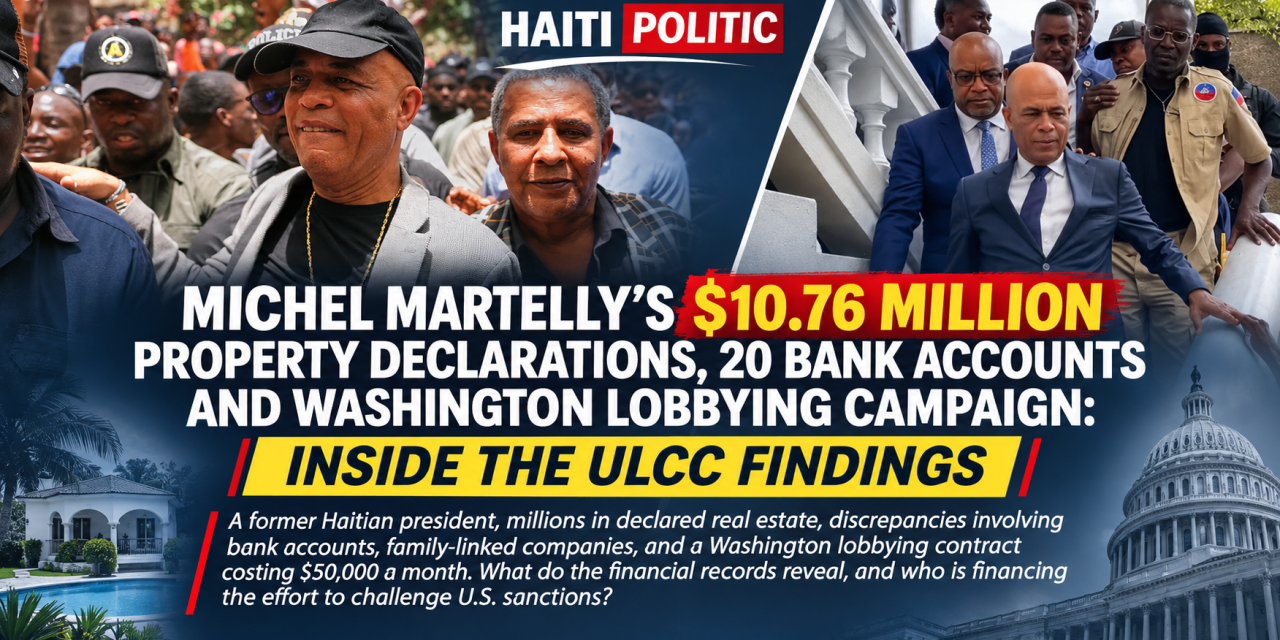
A former Haitian president, millions in declared real estate, discrepancies involving bank accounts, family-linked companies, and a Washington lobbying contract costing $50,000 a month. What do the financial records reveal, and who is financing the effort to challenge U.S. sanctions?
HAITI POLITIC | SPECIAL INVESTIGATION
November 11, 2026
INTRODUCTION — TWO COUNTRIES, TWO INVESTIGATIONS, ONE QUESTION OF ACCOUNTABILITY
Michel Joseph Martelly, Haiti’s president from May 2011 to February 2016, is once again at the center of questions involving wealth, political influence and international financial relationships.
In Haiti, the Unité de Lutte Contre la Corruption (ULCC) has examined discrepancies in Martelly’s declarations of assets.
In Washington, the former president has become the beneficiary of a lobbying arrangement involving an American government-relations firm and a Florida investigations company.
The lobbying registration, dated November 5, 2026, identifies Liberty Government Affairs, LLC, as the registrant and Michel Joseph Martelly, through Invisible Investigations, LLC, as the foreign principal.
The agreement introduces a new figure into the story: Edward L. Haynes, a South Florida security entrepreneur associated with Invisible Investigations.
The financial commitments are substantial.
The reported contract provides for a $125,000 initial deposit, $50,000 in monthly professional fees and additional reimbursable expenses.
At the same time, Haitian anti-corruption investigators have questioned the completeness and accuracy of Martelly’s declarations of property, bank accounts, income and business interests.
These are legally separate matters.
The ULCC’s findings do not establish that the Washington lobbying campaign was financed with illicit funds.
Nevertheless, the two developments raise a legitimate public-interest question:
Who ultimately finances Michel Martelly’s efforts to influence American sanctions policy, and how does that financing relate, if at all, to the financial interests identified by Haitian investigators?
PART I — THE ULCC INVESTIGATION
1. The September 2024 complaint
On September 2, 2024, the Haitian anti-corruption organization Ensemble Contre la Corruption (ECC) requested an investigation into the wealth accumulated by Michel Martelly and individuals associated with him.
The request concerned assets acquired in Haiti and abroad.
The ULCC subsequently examined financial declarations submitted by Martelly when he entered and left office.
The executive summary supplied to Haiti Politic identifies discrepancies involving real estate, banking relationships, income, commercial interests and financial transactions involving members of the Martelly family.
The investigators ultimately recommended criminal proceedings concerning allegedly false declarations of assets.
That recommendation is significant.
However, it is not a criminal conviction.
Martelly remains entitled to challenge the findings and present supporting evidence before the competent judicial authorities.
2. Six properties valued at approximately $10.76 million
One of the most striking findings concerns Martelly’s real estate declarations.
According to the ULCC executive summary, six properties appearing in his exit declaration carried combined estimated values of $10,760,000.
| Declared property | Estimated value |
|---|---|
| Apartment in Puits-Blain, Pétion-Ville | $1,500,000 |
| Residential property in Miami, Florida | $350,000 |
| Residential property in Péguy-Ville | $1,175,000 |
| Commercial property on Rue Moïse, Pétion-Ville | $1,600,000 |
| Second commercial property on Rue Moïse | $2,535,000 |
| Residential property in Bois-Neuf, Saint-Marc | $3,600,000 |
| TOTAL | $10,760,000 |
The figure represents estimated property values appearing in the declaration.
It does not represent an independently established net worth or a finding that the properties were acquired illegally.
Nevertheless, the investigators identified discrepancies requiring explanation.
Certain properties reportedly acquired before Martelly became president were absent from his initial declaration.
Another property appeared in the initial declaration but was missing from the later filing.
The commission reported that supporting documentation explaining these changes was incomplete or unavailable.
3. The Bois-Neuf property: From $180,000 to $3.6 million?
The Bois-Neuf property in Saint-Marc deserves particular attention.
According to the ULCC executive summary, the property was acquired during Martelly’s presidency for approximately $180,000.
Its estimated value in the later declaration was approximately $3.6 million.
That represents a twentyfold difference between the reported acquisition price and subsequent estimated valuation.
However, a change in declared value does not automatically establish wrongdoing.
The property’s physical characteristics, improvements, financing, ownership and valuation methodology must be examined.
The relevant questions are whether the acquisition was properly financed, whether the reported value was reasonable and whether the transaction was accurately disclosed.
PART II — THE BANK ACCOUNTS
4. Twenty accounts identified by investigators
The ULCC examined information from Haitian banking institutions, including Capital Bank, Banque Nationale de Crédit, Sogebank and Unibank.
According to the executive summary, investigators identified 20 bank accounts associated with Martelly, his wife and legally connected individuals or entities during the examination of his initial declaration.
Twelve accounts were reportedly absent from that declaration.
Some accounts were associated with Martelly’s electoral campaign and the Fondation Rose et Blanc.
This distinction is important.
An account associated with a political campaign, foundation or company is not automatically a personally owned account.
The ULCC’s concern was whether Martelly’s legally reportable financial interests were fully disclosed.
The commission also examined his exit declaration.
According to the summary, Martelly declared six bank accounts, while investigators identified 17 active accounts and three credit cards associated with the couple or entities they controlled directly or indirectly.
The 20 accounts identified during the initial review and the 17 accounts identified during the exit review should not be added together as though they were necessarily distinct.
The documents describe different stages of the investigation.
The principal finding is that investigators reported substantial discrepancies between the declarations and information obtained from financial institutions.
PART III — INCOME, FAMILY MEMBERS AND COMMERCIAL INTERESTS
5. Questions surrounding Martelly’s declared income
The ULCC identified differences between income figures appearing in Martelly’s declarations.
His initial declaration reportedly listed approximately $100,000 in annual artistic income.
Other sections contained different income calculations.
The commission questioned the absence of sufficient documentation reconciling those figures.
His exit declaration reportedly identified approximately $370,400 in artistic and speaking-related income.
Investigators also examined rental income and the supporting documentation for the properties generating that revenue.
The central issue is whether the income declarations were complete and supported by contracts, tax records and banking transactions.
6. Sophia Saint-Rémy Martelly
The investigation also examined financial information concerning Sophia Saint-Rémy Martelly.
The ULCC identified discrepancies between income figures appearing in different sections of the family’s declarations.
The report also referred to payments made through Haiti’s public treasury in connection with her reported advisory role during Martelly’s presidency.
Investigators questioned whether those payments were properly disclosed.
These findings require examination of the underlying employment records, payment authorizations and financial declarations.
They do not independently establish that the payments were unlawful.
7. M6 Consult and family-linked business interests
The ULCC report also discusses M6 Consult S.A.
According to the executive summary, Martelly’s exit declaration included 400 shares valued at approximately two million Haitian gourdes.
The report describes transactions involving members of the Martelly family.
Investigators considered those transactions relevant to questions of ownership and disclosure.
The issue is whether the declarations accurately represented the family’s financial interests.
A family business transaction is not inherently illegal.
The legal questions concern disclosure, documentation, beneficial ownership and compliance with applicable requirements.
PART IV — GLOBAL VOICE GROUP AND THE TELECOMMUNICATIONS QUESTION
8. The Martelly–Lamothe administration’s telecommunications revenue system
One of the companies mentioned in the ULCC materials is Global Voice Group S.A.
The company is relevant because of its historical involvement in telecommunications-related revenue arrangements in Haiti.
During the Martelly administration, Haiti implemented charges associated with international incoming telephone calls.
Former Prime Minister Laurent Lamothe was a prominent figure in the administration during the development and operation of telecommunications-related initiatives.
The financial structure of these arrangements deserves examination.
Important questions include:
What contractual authority allowed Global Voice Group to participate in the collection or monitoring of international-call charges?
What amounts were collected?
How much revenue reached the Haitian treasury?
What payments were made to private contractors?
What were the ownership interests of individuals associated with the administration?
And did any public official possess an interest requiring disclosure?
The ULCC’s mention of Global Voice Group is relevant to these questions.
However, it does not independently establish that Martelly personally received telecommunications surcharge revenue or that Lamothe unlawfully benefited from the arrangement.
Those conclusions require ownership documents, contracts and traceable financial transactions.
PART V — THE ULCC RECOMMENDS CRIMINAL PROCEEDINGS
9. Allegedly false declarations of assets
The ULCC executive summary recommends criminal proceedings concerning allegedly false declarations of assets.
The investigators cited Haiti’s February 12, 2008 asset-declaration law and applicable provisions of the Penal Code.
They identified omissions, contradictions and filing delays.
One particularly important issue concerns the timing of Martelly’s exit declaration.
Martelly left office in February 2016.
According to the ULCC, the declaration was filed on January 30, 2018.
Investigators considered that delay inconsistent with the applicable legal deadline.
The findings were sufficiently serious for the commission to recommend judicial action.
Nevertheless, the recommendation is not a determination of guilt.
10. The judicial proceedings
Court-related materials supplied to Haiti Politic show Martelly leaving Haiti’s Court of Appeal on July 20, 2026.
The materials also indicate that he appeared before the court on more than one occasion concerning the matter.
The precise number and procedural significance of those appearances require confirmation from official court records.
A hearing or court appearance does not establish that a defendant has been convicted.
The next important questions concern the status of the judicial proceedings and whether the ULCC’s findings have been independently tested before a court.
PART VI — THE WASHINGTON LOBBYING CAMPAIGN
11. Liberty Government Affairs and Brian Darling
On November 5, 2026, a FARA registration identified Liberty Government Affairs as representing interests associated with Michel Joseph Martelly through Invisible Investigations.
Liberty Government Affairs is a Washington-based public-affairs and lobbying firm headed by Brian Darling.
The firm’s official website describes Darling’s professional experience working with U.S. senators, conservative organizations and political advocacy campaigns.
His background includes work connected to Senator Rand Paul and the Heritage Foundation.
The firm advertises lobbying, public relations and outreach to conservative and libertarian political networks.
That background is relevant because the reported Martelly engagement concerns efforts to influence U.S. sanctions policy.
12. The reported financial agreement
The reported contract terms include:
| Provision | Amount |
|---|---|
| Initial deposit | $125,000 |
| Monthly professional fees | $50,000 |
| Reimbursable monthly expenses | Up to $5,000 |
| Previously reported payment | $75,000 |
The agreement was reportedly dated October 22, 2026.
The registration was filed November 5, 2026.
A payment of $75,000 was reportedly made by Invisible Investigations on September 10, 2026.
The payment date precedes the formal contract date.
That chronology requires examination of the original filing and any preliminary agreements.
It does not automatically establish an improper transaction.
At $50,000 per month, twelve months of professional fees would total $600,000, excluding additional contractual charges.
That is a hypothetical annualized amount, not a finding that a full year of fees has been paid.
13. What does the lobbying firm intend to accomplish?
The reported mandate concerns strategic advice, sanctions-policy monitoring and advocacy involving relevant American officials.
The Treasury and State Departments are central to the reported engagement.
The contract does not guarantee that Martelly’s sanctions will be removed.
Hiring a lobbying firm is not the same as obtaining a favorable government decision.
A sanctioned individual may seek reconsideration through available administrative and legal procedures, subject to applicable restrictions.
The public-interest issue is whether the advocacy activities and their financing are accurately disclosed.
PART VII — EDWARD HAYNES AND INVISIBLE INVESTIGATIONS
14. A Florida businessman enters the picture
The lobbying arrangement identifies Invisible Investigations, LLC, as the intermediary.
Edward L. Haynes is associated with the company.
Florida corporate records identify him in management of Invisible Investigations.
He is also associated with Haynes Security Services, Inc., a South Florida security company.
Haynes’s professional background includes military service, law enforcement and private security.
His business career predates the Martelly lobbying arrangement by many years.
The significance of his involvement lies in the contractual and financial questions it raises.
15. Who ultimately pays?
The fact that Invisible Investigations is identified as a contracting or paying intermediary does not establish the ultimate source of its funds.
Several possibilities exist, including company funds, outside financing or other contractual arrangements.
The available evidence does not establish which explanation applies.
The questions requiring answers include:
Who authorized the payments?
What is Invisible Investigations’ contractual relationship with Martelly?
Does the company expect reimbursement or another financial benefit?
Did another person or entity supply the funds?
Have all relevant payments been disclosed?
These are legitimate questions about financial transparency.
They are not proof that Haynes or his company engaged in wrongdoing.
PART VIII — THE BROADER POLITICAL QUESTION
16. U.S. sanctions and Haitian accountability
Martelly has faced U.S. sanctions over serious allegations involving drug trafficking and support for armed gangs.
Those sanctions are distinct from the ULCC investigation into asset declarations.
A U.S. sanctions designation is not equivalent to a Haitian criminal conviction.
Likewise, the ULCC’s recommendation for prosecution does not establish the truth of every allegation made against Martelly.
Nevertheless, both developments concern accountability for a former president.
The Washington lobbying arrangement raises another question:
Can the public identify the financial interests supporting efforts to change American policy toward a politically influential former Haitian official?
The answer depends on the transparency of the contractual and financial records.
CONCLUSION — $10.76 MILLION IN PROPERTY DECLARATIONS, 20 BANK ACCOUNTS AND AN UNFINISHED ACCOUNTING
The ULCC investigation identified significant discrepancies in Michel Martelly’s financial declarations.
The reported $10.76 million in estimated property values, the bank accounts identified by investigators, family-linked business interests and questions concerning declared income all warrant examination.
The Washington lobbying agreement adds another dimension.
A Florida investigations company associated with Edward Haynes is involved in an expensive advocacy effort benefiting the former president.
The available evidence does not establish that the lobbying payments originated from improperly acquired assets.
Nor does it establish criminal misconduct by the individuals and companies involved.
But it does justify continued investigation into the financial relationships surrounding the agreement.
For Haiti Politic, the question is not whether Michel Martelly has the right to challenge sanctions. He does.
The question is whether the financial declarations, business relationships and lobbying payments can withstand transparent, independent scrutiny.
Until those questions receive documented answers, the accounting remains unfinished.
HAITI POLITIC — SPECIAL INVESTIGATION
Editorial disclosure: This investigation relies on the ULCC executive summary supplied to Haiti Politic, publicly available FARA registration information, corporate records and official business materials. Allegations and investigative recommendations are distinguished from judicial findings.