
Haiti Politic | Public-record investigation and analysis | October 27, 2026
The route is visible: San Salvador to Port-au-Prince. The financial transaction behind it is harder to see.
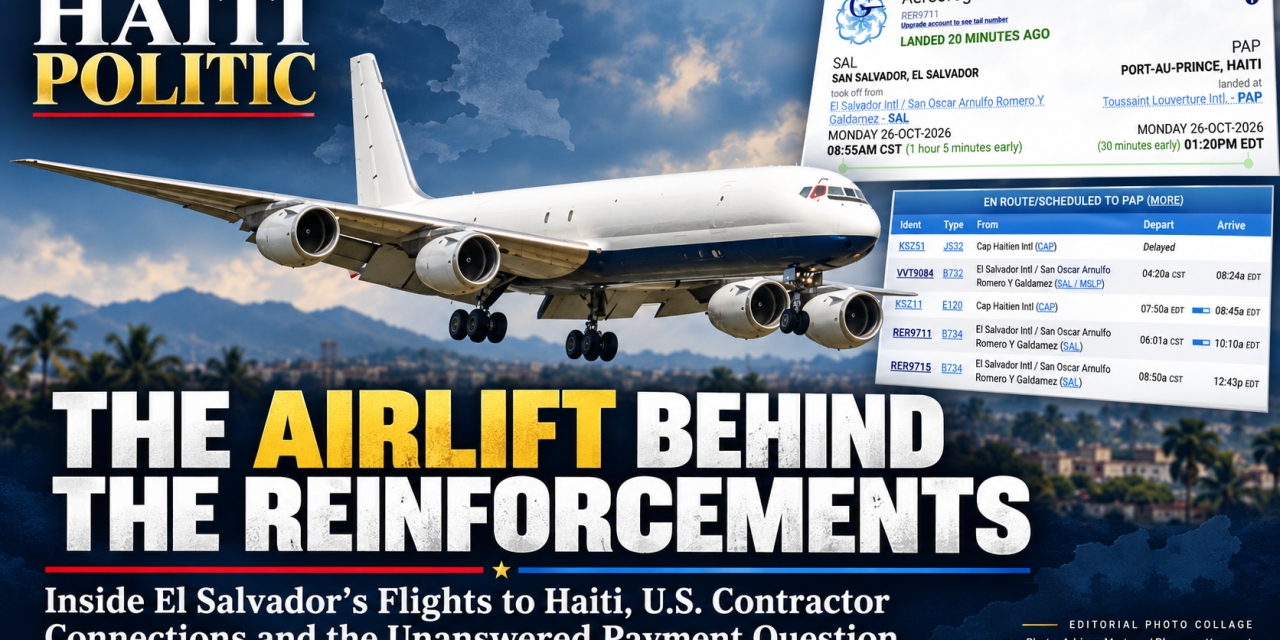
Flight-tracking screenshots supplied to Haiti Politic identify SkyBus flight HVY601 and Aeroregional flight RER9711 on that route during the latest Salvadoran reinforcement effort. Public reporting separately establishes that a U.S. military aircraft participated in transporting Salvadoran personnel to Haiti.
Together, those records reveal parts of a transportation operation. They do not yet reveal a complete purchasing chain.
Haiti Politic’s review found U.S. corporate, brokerage and training connections associated with the carriers, alongside historical Pentagon-funded commercial airlift contracts for Haiti. The strongest named connections include a charter broker advertising services to governments and prime contractors, and a Miami flight-training provider that also holds Defense contracts.
None of those connections, by itself, identifies the customer who bought HVY601 or RER9711’s recent Haiti services. That is the gap an accountable explanation of the deployment must close.
WHAT THE FLIGHT SCREENS ACTUALLY SHOW
One supplied screen labels SkyBus Air Cargo flight 601, callsign HVY601, as traveling from San Salvador to Port-au-Prince on Sunday, October 25. It displays an estimated arrival, rather than a completed landing record.
Another labels Aeroregional flight 9711, callsign RER9711, as having landed in Port-au-Prince on Monday, October 26, after departing San Salvador. A separate airport-arrivals screenshot lists RER9711 and RER9715 from San Salvador with the B734 aircraft-type code.
These distinctions matter. The screenshots are evidence of what a tracking service displayed; they are not independently authenticated manifests, invoices or official military movement records. Flight identifiers can recur on different dates and routes. A flight number does not identify a particular airframe, and the supplied screens conceal the tail numbers.
Nor should every movement be described as a cargo flight. SkyBus markets freight services, while Aeroregional operates passenger aircraft. The screenshots do not establish the passenger count, cargo contents or configuration used on each movement.
What they supply is a starting point for matching a date and route to an operator, an aircraft registration and, ultimately, a paying customer.
THE CONFIRMED U.S. ROLE—AND ITS LIMIT
Jacqueline Charles of the Miami Herald reported, in an account republished by Aviation Pros on October 26, that a U.S. military C-130 transporting Salvadoran personnel was provided by the Pentagon at the State Department’s request. The report attributed confirmation of a U.S. logistical flight’s arrival to Southern Command. It explicitly left uncertain whether Washington supplied three other charters discussed in the account. [1]
That establishes American participation in the reinforcement airlift. It does not identify the commercial purchaser behind the SkyBus and Aeroregional flights shown in the supplied screenshots.
A separate Charles report described continuing arrivals and reported that President Nayib Bukele was seeking additional forces and an arrangement allowing them to operate independently of the GSF. That remains attributed reporting about a proposed command arrangement, not a final structure established by documents reviewed here. [2]
The distinction between a multinational deployment and a national reinforcement or rescue operation has financial consequences. It determines which authority requested a service and which budget should ultimately bear its cost.
SKYBUS: A PERUVIAN OPERATOR WITH A DOCUMENTED U.S. PRESENCE
The FAA’s operator-designator directory identifies HVY as Sky Bus S.A.C., Peru, using the radio callsign LIFT PERU. It identifies RER separately as Servicio Aereo Regional Regair Cia. Ltda., Ecuador. These are foreign operating entities, not Salvadoran airlines simply because the flights depart El Salvador. [3]
SkyBus’s website lists a Lima main base and a U.S. office in Las Vegas. It advertises military charters, heavy cargo, dangerous goods and aircraft services for other airlines. Those statements describe the company’s marketed capabilities; they do not name a current U.S. government customer for the Haiti flights. [4]
There is also a U.S. company bearing the Skybus Jet Cargo name. A federal court judgment identifies Skybus Jet Cargo, Inc. as a Nevada corporation. Current FAA aircraft-owner records give that corporation a Las Vegas address. [5–6]
The operating company, an aircraft-owning corporation and a charter customer can be different legal entities. Their similar names do not justify treating their accounts, obligations or ownership as interchangeable. The full corporate relationship between the Nevada company and the Peruvian carrier requires additional documentation.
SkyBus’s Florida aviation footprint is nevertheless documented. Miami-Dade Aviation Department records list Skybus of Peru among foreign all-cargo carriers providing non-scheduled service at Miami International Airport as of September 30, 2023. The airport also reported SkyBus’s launch of weekly Peru cargo service in 2018. Airport operations establish a commercial presence, not Florida incorporation. [7–8]
THE ACA INTERNATIONAL CONNECTION
One U.S. business lead runs through ACA International LLC, an aircraft-charter broker.
Florida’s Third District Court of Appeal issued a decision in Skybus Jet Cargo, Inc. v. ACA International, LLC on July 12, 2023. The appeal, numbered 3D22-1603, arose from Miami-Dade case 2021-014017-CA-01. The appellate court dismissed it for lack of jurisdiction; it did not decide the merits of the underlying dispute. [9]
The court record establishes litigation involving the named companies. ACA’s own website supplies the industry context: it lists Boston and Miami locations, describes the company as a charter broker rather than an aircraft operator, and advertises experience serving governments, militaries, NGOs and prime contractors. [10]
That makes ACA a relevant name when examining the commercial networks around SkyBus. It does not make ACA the established broker for HVY601.
No reviewed charter agreement, purchase order or invoice connects ACA to the October 25 San Salvador–Port-au-Prince movement. The historical lawsuit cannot substitute for that missing transaction record.
The broader point is structural. The company whose name appears on a flight tracker may operate the aircraft while a broker handles the sale and another organization supplies the money. Identifying the carrier is only one step in identifying the payer.
AEROREGIONAL’S MIAMI TRAINING CONNECTIONS
For Aeroregional, the clearest documented Florida relationships involve training.
An Ecuadorian aviation-regulator technical report records Aeroregional’s request for inspection of the PAN AM training center in Miami, qualifications for external instructors and an evaluator, and pilot proficiency checks scheduled for April 14–19, 2025. [11]
Pan Am Flight Academy is also a U.S. federal contractor. USAspending identifies it as the recipient of Defense contract FA930225C0006. The public API record retrieved for this investigation lists a $10,000 award amount and the description “KCZRAP00-VC25B SIM TRAINING.” Other returned awards cover military aircrew training. [12]
The supported finding is specific: Aeroregional has a regulator-documented training connection to a Miami provider that also receives Pentagon contracts.
It is not evidence that Pan Am purchased, brokered or funded RER9711. Selling training to both an airline and a government does not place the training provider inside every commercial transaction involving either customer.
A second Ecuadorian regulator file identifies Paramount Aviation Services in Miami for Aeroregional cabin-crew instructor checks, external-instructor requalification and training-center verification scheduled for February 8–12, 2026. [13]
Paramount’s website identifies its Miami training campus and describes simulator services supporting commercial, business and military aviation. Again, this establishes a training connection, without establishing any role in arranging the Haiti flights. [14]
FLORIDA COMPANY NAMES ARE ANOTHER LEAD, NOT AN OWNERSHIP FINDING
Florida’s Sunbiz registry contains two similarly named companies: Aeroregional Group LLC, document L21000131773, filed in March 2021 and administratively dissolved in September 2022; and Aeroregional Skyair, LLC, document L26000057465, filed January 23, 2026 and listed as active when checked. Their listed locations are Miami and Tampa, respectively. [15–16]
The reviewed filings do not establish either as the Ecuadorian airline’s Florida subsidiary, charter agent or representative for RER9711. They therefore cannot support a claim that the operating airline is Florida-registered or that either LLC received deployment money.
Treating matching names as proven corporate links would turn an investigative lead into an unsupported conclusion.
THE PENTAGON’S EXISTING HAITI AIRLIFT CHANNEL
Separate from the SkyBus and Aeroregional leads, federal spending records establish a historical Pentagon-funded commercial airlift channel for Haiti.
Haiti Politic’s USAspending search covered prime-contract transactions dated October 1, 2023 through October 27, 2026, with Haiti as the place of performance and Defense as the funding agency. The following recipients appeared with Civil Reserve Air Fleet air-transportation records awarded through USTRANSCOM and funded by the Air Force: [17]
Reported prime recipient | Net obligations within the defined search
Patriot Team | $4,998,084.98
National Air Cargo Group, Inc. | $2,985,334.00
Atlas Air, Inc. | $395,000.00
Federal Express Corporation | $150,000.00
Western Global Airlines Inc. | $124,224.65
The combined amount is $8,652,643.63. These are recorded legal commitments, not a verified cash-payment total or the cost of the current Salvadoran deployment.
The ten retrieved National Air Cargo orders have start dates in August–November 2024; some list end dates through September 30, 2026. They establish a historical USTRANSCOM relationship serving Haiti. They do not establish a subcontract to SkyBus or Aeroregional for the new October flights.
Likewise, a large logistics contract does not establish that its recipient chartered these aircraft. The necessary link would be an order, subcontract, invoice or official confirmation tied to the relevant movement.
WHY AN EMPTY SEARCH DOES NOT SETTLE THE QUESTION
Recipient-name searches did not identify matching prime-contract recipients under Aeroregional, Regair or Servicio Aereo Regional. A search for Skybus returned awards under SKYBUS, LLC, but the reviewed evidence did not establish that recipient as the Peruvian airline. Those awards were excluded from any claim about its federal funding.
A broader search for Sky Bus also produced unrelated bus-company names and additional pages. It was not an exhaustive, airline-specific negative result.
The limits extend beyond spelling. An airline can be paid by a charter broker, a logistics company or a foreign government. Its name may not appear as the recipient of a U.S. prime award even if U.S. money eventually finances a service. A complete subcontract and broker-payment chain was not obtained here.
There is also a timing problem. USAspending’s official documentation describes a 90-day delay in publication of Defense procurement data. An October 27 search therefore cannot reliably exclude a newly awarded October Defense contract merely because it is not visible yet. [18]
This reporting delay helps explain why flight movements may be visible before related procurement records. It does not prove that a hidden U.S. contract exists for these flights.
USAID, THE UN FUND AND THE RISK OF COUNTING THE SAME SUPPORT TWICE
The reviewed records do not establish USAID as the purchaser of HVY601 or RER9711. Historical humanitarian aviation support should not be used as evidence that USAID paid for a current military charter.
Nor does American support automatically establish a contribution to the UN-administered GSF trust fund.
A U.S. agency can pay a contractor directly, provide a military aircraft or contribute money to a multilateral fund. Those are different financial routes. A direct flight may represent bilateral or in-kind support without being a cash deposit into the trust fund.
Resolution 2793 provides for voluntary support for GSF personnel costs, while UNSOH supplies a separate logistical and operational support structure financed through assessed UN contributions. Official Canadian briefing documents explain this distinction. A flight’s treatment within those arrangements requires its own financial documentation. [19–20]
Until the accounts are reconciled, adding a direct U.S. transportation expense to a bilateral-support total and again to a trust-fund total risks counting the same support twice.
WHO PAYS AND WHO COMMANDS
The payment question intersects with the command question without answering it.
Transport funding can enable a deployment. It does not, on its own, establish who issues operational orders, which mission a unit formally belongs to or which rules govern its activities.
If additional Salvadoran units are deployed under a distinct national arrangement, the public explanation should identify the Haitian authorization, coordination with the established mission and the budget responsible for their transport. If they are incorporated into the GSF, the explanation should identify that status and the applicable funding mechanism.
These are questions of public authority and accountability. They can be answered without releasing sensitive passenger identities or operational plans.
THE DOCUMENT THAT WOULD CHANGE THE STORY
A charter purchase order could connect the separate pieces already visible: the carrier on the tracker, the customer arranging transport, the organization supplying the money and the mission receiving the service.
For HVY601 on October 25 and RER9711 on October 26, the essential information is the aircraft registration, operating entity, charter customer, any broker or prime contractor, order number, agreed price, amount paid and reimbursement arrangement.
Until that link is documented, the public record supports a careful conclusion: American military resources participated in the reinforcement airlift; commercial airlines with documented U.S. business connections also appear on the San Salvador–Port-au-Prince route; and historical Pentagon-funded contracts demonstrate an existing Haiti airlift system.
What remains unestablished is who purchased these particular commercial movements.
Aircraft arrivals show that a deployment is moving. The contracts and payment records would show who is making it possible—and which authorities must answer for the expense.
METHOD AND LIMITATIONS
This article draws on user-supplied flight-tracking screenshots, public aviation and corporate records, court documents, company statements, federal spending data retrieved October 27, 2026 and attributed reporting. No Gazette Haiti material was used.
The screenshots were read as supplied and were not independently authenticated against a complete flight-history database. Their tail numbers are concealed. No complete manifests, charter agreements, broker invoices or internal government reimbursement records were obtained.
Company marketing statements establish what a company says it offers, not a verified government award. Court filings and decisions are used to identify named entities and litigation, not to imply misconduct or a Haiti contract. Training relationships are not treated as evidence of charter financing. Florida namesakes are not treated as airline affiliates.
USAspending obligations, award amounts and outlays are different measures. The airlift table uses transaction-based net obligations for the stated geography, funding agency and period. The Pan Am example is an award-level amount. Neither constitutes a flight-specific payment ledger. Funding routed through global awards, foreign procurement or undisclosed intermediaries may not appear in these searches.