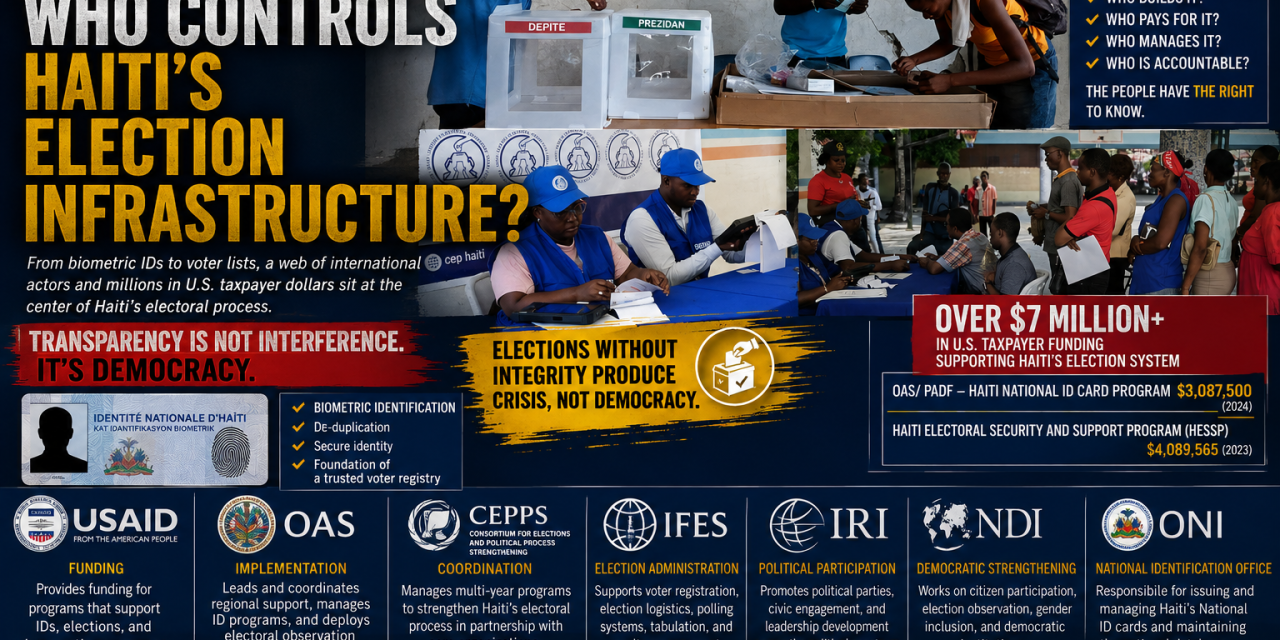
USAID. OAS. CEPPS. IFES. IRI. NDI. ONI. Millions of dollars. Biometric identification. Voter lists. Electoral security.
The central question is not whether Haiti needs international assistance.
The question is:
After two decades of international electoral assistance, does Haiti possess an electoral system that Haitians themselves can independently audit, trust and ultimately control?
That question deserves scrutiny—but it is important to distinguish documented foreign technical/financial assistance from an allegation of foreign interference or control. The available evidence establishes extensive international involvement in Haiti’s electoral infrastructure. It does not, by itself, establish that USAID, the OAS, CEPPS, IFES, IRI or NDI secretly control election outcomes.
This investigation therefore examines what these organizations actually do, where American taxpayer money went, what results have been reported, and what questions remain unanswered.
🇭🇹 PART I — HAITI’S ELECTIONS HAVE AN INTERNATIONAL ARCHITECTURE
Haiti’s electoral system is formally Haitian.
The Conseil Électoral Provisoire (CEP) administers elections. The Office National d’Identification (ONI) manages national identification. Haitian law determines eligibility and the electoral framework.
But significant parts of the infrastructure surrounding those institutions have received foreign financing, training, technology and technical assistance.
One major American program illustrates the structure particularly well.
According to USAID’s description of the Haiti Electoral Security and Support Program (HESSP), assistance is divided among three major organizations:
IFES works with electoral authorities on election administration, legal frameworks, voter outreach, results management and electoral security.
NDI works primarily with Haitian civil-society organizations on citizen participation, political and constitutional reform, and preparation of domestic election observers.
IRI works with civil-society organizations to expand citizen participation, particularly among historically marginalized groups.
USAID describes the objective as strengthening Haitian electoral institutions and improving credible elections—not replacing the CEP.
That distinction matters.
But so does the scale of foreign involvement.
💰 PART II — FOLLOW THE MONEY
The USAID project information supplied for this investigation shows two particularly important awards.
Haiti Electoral Security and Support Program — HESSP
Implementing partner: Consortium for Elections and Political Process Strengthening
Funding agency: USAID
Obligations shown: $4,089,565
Project end: May 14, 2028
OAS/PADF — Haiti National ID Card Program
Implementing partner: Organization of American States
Funding agency: USAID
Obligations shown: $3,087,500
FY: 2024
Project end shown: June 4, 2026
These figures should not automatically be interpreted as the total historical American expenditure on Haitian elections or identification. They represent the particular activities shown in the supplied records.
And the ID program extends far beyond the current USAID award.
The OAS says it has worked with Haiti’s identification system since 2005.
By 2012, OAS-supported efforts had helped ONI issue more than 5.05 million identification cards, trained more than 2,000 personnel, and supplied equipment and technology to 141 offices.
That means international participation in Haiti’s identification infrastructure isn’t new.
It has existed for roughly two decades.
🪪 PART III — THE OAS AND HAITI’S NATIONAL IDENTITY SYSTEM
The National Identification Card—Carte d’Identification Nationale (CIN)—is more than an ordinary government ID.
The OAS states that it is the only identification document allowing Haitian citizens to vote.
That makes ONI one of the most consequential institutions in Haitian democracy.
If the identification database is incomplete, outdated or geographically unequal, the electoral list inherits those problems.
If it works properly, however, biometric identification can become one of Haiti’s strongest defenses against duplicate identities and fraudulent registrations.
The OAS says its recent program has helped ONI deploy mobile registration units, train operators, acquire and distribute cards, install solar power in key offices and establish an OAS-ONI coordination mechanism.
And substantial measurable progress has occurred.
In January 2026, the OAS reported that since 2023:
1.07 million+ new citizens had been registered.
The ONI database contained more than 6.36 million people.
More than 1.22 million identification cards had been issued during the period.
Approximately 5.62 million Haitians held valid identity documents.
Those are substantial outputs.
But outputs are not the same thing as electoral integrity.
🚨 PART IV — THE QUESTION HAITI SHOULD ASK
Can citizens independently verify those numbers?
A credible electoral registry needs more than millions of records.
It needs an auditable chain connecting:
civil identity → biometric identity → residency → electoral district → polling station → electoral roll → ballot → published results.
That creates several questions that deserve answers before voting begins.
How many ONI records correspond to people who have died?
How quickly are deaths removed?
How are duplicate biometric records identified?
How many citizens possess valid records but have never received their physical CIN?
How many cards remain undelivered?
How many citizens have been displaced from the electoral district associated with their registration?
How are voters assigned to polling centers after displacement?
How frequently is the database deduplicated?
Who can audit the biometric system?
Are political parties allowed to inspect the provisional electoral roll?
Will an anonymized version of the register be available for independent statistical analysis?
And who certifies the final voter list?
These questions become even more important because of Haiti’s extraordinary displacement crisis.
🏚️ PART V — THE DISPLACEMENT PROBLEM
Gang violence has fundamentally altered Haiti’s population geography.
AP reported this month that approximately 1.5 million people have been displaced, many losing identification documents while fleeing.
That creates a problem biometric technology cannot solve by itself.
Imagine a voter registered in Carrefour who is now living in Cap-Haïtien.
The database may correctly establish who that person is.
But where should that person vote?
And for which legislative constituency?
Identification integrity and electoral-roll integrity are related—but they are not identical.
📊 PART VI — WHY HAITI’S CENSUS PROBLEM MATTERS
This is one of the most overlooked parts of the electoral debate.
A national census and a voter registry perform different functions.
A census asks:
Who lives where?
A voter registry asks:
Who is legally eligible to vote?
An identification database asks:
Who is this person?
All three datasets interact.
Reliable demographic information matters when determining constituency populations, polling-center locations, electoral logistics, representation and whether population movements have created severe disparities among districts.
Therefore, simply producing millions of biometric cards cannot answer every demographic question surrounding an election.
A biometric database can establish identity extremely well while still leaving policymakers with weak information about current population distribution.
That is especially significant after years of internal migration and mass displacement.
🇺🇸 PART VII — WHAT EXACTLY IS CEPPS?
The Consortium for Elections and Political Process Strengthening — CEPPS is the umbrella through which three prominent American democracy organizations cooperate:
IFES — International Foundation for Electoral Systems
IRI — International Republican Institute
NDI — National Democratic Institute
Their functions are not identical.
And describing all three simply as organizations that “run Haiti’s elections” would be inaccurate.
USAID’s own HESSP documentation provides a useful division of labor.
IFES — THE ELECTORAL TECHNICAL SIDE
IFES works most directly with electoral administration.
Its documented activities include support concerning:
legal frameworks,
voter outreach,
results management,
institutional training,
process improvement,
and electoral security.
That places IFES relatively close to the machinery of election administration.
🏛️ PART VIII — NDI: CIVIL SOCIETY AND OBSERVATION
NDI’s role is different.
USAID says NDI works with Haitian civic organizations to strengthen citizen engagement and democratic institutions.
The program includes preparation for a national network of citizen observers capable of monitoring elections when conditions permit them to occur.
That raises legitimate transparency questions.
Who selects participating civil-society organizations?
What qualification criteria are used?
Who trains observers?
What methodology determines whether an election is considered credible?
Are observation datasets made public?
Those questions do not prove manipulation.
They are normal accountability questions whenever organizations influence election observation.
🗳️ PART IX — IRI: POLITICAL PARTICIPATION
IRI’s HESSP role centers on political participation.
According to USAID, its work includes partnerships with Haitian civil-society organizations and outreach to women, youth, people with disabilities and other marginalized populations.
Again, the important investigative question isn’t simply:
“Is foreign assistance occurring?”
It obviously is.
The stronger question is:
What safeguards prevent democracy assistance from becoming political preference-setting?
That requires transparency regarding partner selection, grants, training programs, polling, political-party engagement and program evaluation.
🌎 PART X — WHAT DOES THE OAS ACTUALLY DO DURING ELECTIONS?
The OAS has historically operated through several distinct channels.
One is electoral observation.
Another is technical cooperation.
And in Haiti, another particularly significant function has been civil identification assistance.
The OAS says ONI has provided civil-registry information to Haiti’s Electoral Council for generating electoral lists since 2006.
Consequently, the institutional chain looks roughly like this:
HAITIAN CITIZEN
⬇
ONI / NATIONAL IDENTIFICATION
⬇
CIVIL-IDENTITY DATABASE
⬇
ELECTORAL LIST
⬇
CEP
⬇
POLLING CENTER
⬇
BALLOT
⬇
RESULTS
International organizations provide assistance around several parts of that chain.
But constitutional authority must remain with Haitian institutions.
⚠️ PART XI — “ASSISTANCE” VERSUS “INTERFERENCE”
This distinction is essential.
Evidence that USAID finances an electoral program is not evidence that Washington determines election winners.
Evidence that IFES advises an electoral authority is not evidence that IFES counts ballots secretly.
Evidence that NDI trains observers is not evidence that NDI chooses Haiti’s government.
Evidence that the OAS supports ONI is not evidence that the OAS owns Haiti’s voter database.
Those would require separate evidence.
However, extensive foreign involvement creates legitimate governance questions about dependency, transparency, accountability and sovereignty.
Haiti should therefore be able to answer:
Who owns the servers?
Who owns the software?
Who possesses administrator privileges?
Where are backups stored?
Which organizations have database access?
Who controls biometric matching?
Who writes the source code?
Who performs cybersecurity audits?
Who certifies database integrity?
What happens when international financing stops?
Those questions go directly to sovereignty.
🔥 PART XII — THE MOST IMPORTANT TEST MAY BE SECURITY, NOT TECHNOLOGY
A technically excellent registry cannot produce an inclusive election if citizens cannot safely reach polling stations.
Recent reporting illustrates the scale of the problem.
Voter registration began in Port-au-Prince on July 30, 2026, initially through ten centers in relatively safer neighborhoods. But armed groups control large portions of the metropolitan area and major transportation corridors.
That produces perhaps the most important equation of the entire election:
Valid ID + accurate registry + inaccessible polling station = disenfranchisement.
An election can therefore have sophisticated biometric technology and still face serious legitimacy problems if geography determines who can participate.
🇯🇵 PART XIII — ANOTHER $3 MILLION
On August 18, Japan and the OAS announced another $3 million initiative supporting identification ahead of the elections.
The program includes 350,000 blank ID cards, rural identification efforts and assistance addressing displacement-related documentation problems.
This is evidence that international partners continue investing in the identification system.
But it also produces a difficult policy question:
After twenty years of outside assistance, when does ONI become financially, technologically and operationally self-sufficient?
That may ultimately be more important than asking whether another donor project succeeds.
🧾 PART XIV — WHAT SHOULD BE PUBLISHED BEFORE ELECTION DAY?
A serious transparency package could allow Haitians themselves to evaluate the system.
Among the most useful disclosures would be:
1. Complete ONI registration statistics by department and commune.
2. Number of valid cards versus cards printed, delivered, undelivered, expired, replaced and revoked.
3. Number of duplicate biometric registrations detected and resolved.
4. Methodology for removing deceased citizens.
5. Procedures for displaced voters.
6. Final voter totals by polling center.
7. Cybersecurity and independent database-audit methodology.
8. USAID/OAS/CEPPS program expenditures and sub-awards.
9. Names and selection criteria for organizations receiving election-support grants.
10. Polling-station accessibility and security assessments.
11. Election-observation methodologies.
12. Publication of polling-station-level results in machine-readable form.
That would transform the debate from political accusation into measurable institutional accountability.
🧐 PART XV — QUESTIONS FOR USAID / CEPPS
American taxpayers also have legitimate questions.
How much money has the United States spent on Haiti’s electoral institutions since 2005?
How much went directly to Haitian institutions?
How much remained with American contractors and implementing partners?
How much paid salaries, consultants, security, vehicles, offices and administrative costs?
What measurable institutional capabilities remained after each project ended?
What performance indicators determine success?
And after twenty years of programs, why does Haiti still require major external assistance to organize an election?
Those questions can be asked without assuming misconduct.
🧐 QUESTIONS FOR THE OAS
The OAS should similarly be able to explain:
Who technically administers the biometric architecture?
Does OAS personnel have direct database access?
Where is biometric data stored?
Can Haitian auditors inspect the system independently?
What percentage of eligible adults remain unregistered?
How many CIN cards remain undelivered?
What protections exist against duplicate enrollment?
How are deaths reconciled?
How are displaced citizens handled?
And what is the OAS’s exit strategy for transferring complete technical capacity to ONI?
🧐 QUESTIONS FOR THE CEP
Ultimately, however, the election belongs to Haiti.
Therefore the most important questions belong to the Conseil Électoral Provisoire.
Can political parties audit the voter list?
When will the final list be published?
How will displaced voters participate?
How will inaccessible gang-controlled districts vote?
Who prints ballots?
How are ballots transported?
How are tally sheets transmitted?
Will polling-station results be published individually?
What audit trail exists between the paper ballot and national results?
Who investigates discrepancies?
And what happens if significant parts of the electorate cannot safely vote?
📅 ONE IMPORTANT UPDATE TO THE PROPOSED ELECTION TIMELINE
The timetable in the material supplied with this investigation should be treated carefully because Haiti’s electoral calendar has changed repeatedly.
Earlier OAS documentation listed August 30, 2026 as a tentative general-election date.
More recent reporting, however, says the first round is now scheduled for December 13, 2026. AP reports that continuing insecurity could still disrupt or delay that timetable.
That volatility itself demonstrates why election reporting should distinguish between a scheduled date and an election that is operationally ready to occur.
⚖️ THE HAITI POLITIC VERDICT: NO VERDICT YET
There is documented evidence of extensive international involvement in Haiti’s election ecosystem.
There is also documented evidence of tangible outputs.
Millions of Haitians are registered.
Millions possess identification documents.
ONI infrastructure has expanded.
Personnel have been trained.
Mobile registration units have been deployed.
USAID-funded programs are supporting electoral administration, civil society, observation and political participation.
But none of those accomplishments automatically proves that the coming election will be credible.
And foreign financing, by itself, does not prove electoral interference.
The decisive test is transparency.
Can Haitians inspect the registry?
Can independent auditors test the system?
Can candidates examine the electoral roll?
Can displaced citizens vote?
Can citizens safely reach polling stations?
Can every polling station’s result be independently reconciled with the national total?
And can Haiti eventually operate the entire system without permanent dependence on foreign governments and international organizations?
Those are questions that documents, audits and election-day evidence can answer.