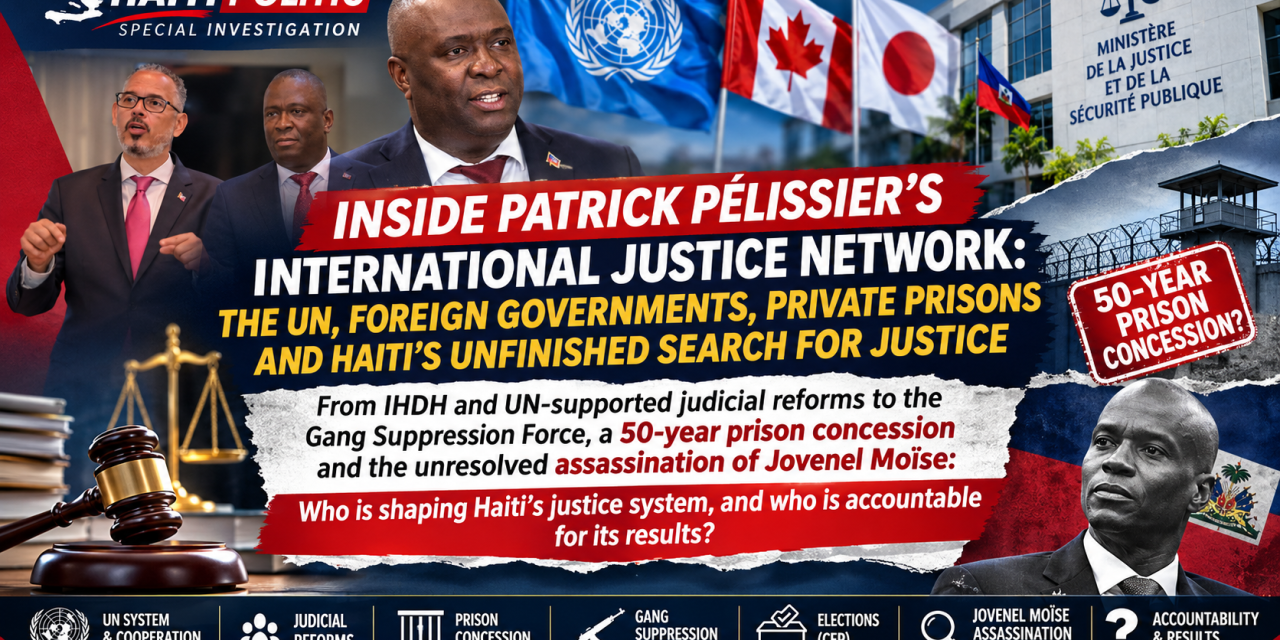
From IHDH and UN-supported judicial reforms to the Gang Suppression Force, a 50-year prison concession and the unresolved assassination of Jovenel Moïse: Who is shaping Haiti’s justice system, and who is accountable for its results?
HAITI POLITIC — SPECIAL INVESTIGATION
November 16, 2026
INTRODUCTION: A MINISTER AT THE CENTER OF HAITI’S INTERNATIONAL JUSTICE SYSTEM
Patrick Pélissier has emerged as an important figure in Haiti’s relationship with international institutions involved in security, justice, elections, human rights and prison administration.
Since becoming Minister of Justice and Public Security on November 17, 2024, Pélissier has participated in initiatives involving the United Nations system, UNICEF, international security partners, and the governments of Canada and Japan.
His ministry has also announced specialized judicial divisions, participated in electoral administration, and entered into a controversial long-term prison concession arrangement.
Yet fundamental questions remain unanswered.
Why has the Haitian investigation into President Jovenel Moïse’s assassination still not produced a completed criminal trial?
How many major gang-financing and corruption cases have resulted in convictions?
Why would Haiti consider guaranteeing payments for privately operated prisons even when cells remain empty?
And what influence do international institutions exercise over the priorities, financing and implementation of Haiti’s judicial reforms?
These questions require examining Pélissier’s professional history alongside the institutions and agreements that have defined his ministerial tenure.
The evidence establishes extensive institutional cooperation. It does not establish that Pélissier is a UN employee, a UN appointee, or an agent acting under UN direction.
That distinction is essential to understanding both the documented relationships and the unanswered questions.
I. BEFORE THE MINISTRY: PATRICK PÉLISSIER AND THE INSTITUT HAÏTIEN DES DROITS DE L’HOMME
Patrick Pélissier’s institutional history did not begin with his appointment as justice minister.
Before entering the government, he directed the Institut Haïtien des Droits de l’Homme (IHDH), an organization associated with human rights education, legal reform, and the strengthening of Haiti’s judicial institutions.
IHDH was reportedly established in 2014, during the presidency of Michel Martelly, and became publicly active in subsequent years.
Its activities included human rights education, professional training, legal research, and initiatives concerning the rule of law.
The organization also participated in activities involving international human rights institutions and development partners.
This background matters because it placed Pélissier within the professional community that works on many of the same issues addressed by the United Nations in Haiti.
The United Nations connection
The UN’s involvement in Haitian judicial reform predates Pélissier’s appointment.
Successive UN missions have worked with Haitian authorities on police reform, judicial administration, detention conditions, human rights monitoring, and institutional development.
Under its current mandate, the United Nations Integrated Office in Haiti (BINUH) provides advice and technical support concerning judicial reform, police accountability, elections, prison conditions, and human rights.
These areas closely overlap with the professional activities associated with IHDH and Pélissier’s subsequent ministerial responsibilities.
However, overlapping institutional objectives do not prove that the UN created IHDH, financed all its activities, or directed its leadership.
The relevant financial records, partnership agreements, and grant documentation would be necessary to establish the precise nature of those relationships.
His academic credentials
Pélissier is described as holding a doctorate in law from Université Toulouse 1 Capitole in France.
University records identify a 2018 doctoral thesis titled La garantie des droits fondamentaux en matière pénale en Haïti.
His academic work therefore concerned the protection of fundamental rights within Haiti’s criminal justice system.
This is directly relevant to his later responsibilities involving detention, judicial procedure, and human rights.
His reported earlier service as a juge de paix also deserves investigation.
Although biographical accounts describe him as a former justice of the peace, Haiti Politic has not established the dates of his judicial appointment or the government under which he served.
Those records could help reconstruct his professional relationships before 2014.
II. THE UNITED NATIONS SYSTEM: AN INTERNATIONAL FRAMEWORK FOR HAITI’S JUSTICE POLICY
The United Nations does not operate in Haiti through a single institution.
Its activities involve BINUH, UNICEF, UNDP, OHCHR and other agencies with different mandates.
BINUH’s responsibilities include supporting Haitian authorities in political dialogue, elections, police professionalism, judicial reform, detention management and human rights protection.
The UN Security Council’s 2026 mandate also provides for cooperation involving the Gang Suppression Force, detention reform and the protection of children affected by armed groups.
This creates an institutional environment in which Haiti’s Ministry of Justice regularly interacts with international organizations.
Where Pélissier fits
As minister, Pélissier heads a Haitian institution responsible for several areas that fall within the UN’s assistance mandate.
His ministry is therefore a natural counterpart for UN programs addressing:
-
Judicial reform and the rule of law.
-
Prolonged pretrial detention.
-
Police and judicial accountability.
-
Protection of children associated with armed groups.
-
Corruption and serious criminal investigations.
-
Prison administration and human rights.
This relationship is documented at the institutional level.
The question is how specific decisions are made.
Does the Haitian government establish priorities independently and request international assistance?
Do international donors influence which reforms receive funding?
Who drafts the agreements, establishes performance targets, and evaluates results?
These questions are particularly important when international assistance affects institutions responsible for arrests, detention, prosecutions and elections.
III. UNICEF, CHILDREN ASSOCIATED WITH GANGS AND THE GANG SUPPRESSION FORCE
An April 2026 UNICEF Haiti communication documented a meeting between UNICEF Representative Geeta Narayan and Minister Patrick Pélissier.
Their discussions addressed the PREJEUNES program, children associated with armed groups, and detention conditions at CERMICOL.
The meeting also addressed measures to protect children’s rights in anticipation of Gang Suppression Force operations.
This provides direct evidence of cooperation between Pélissier’s ministry and a UN agency.
It also raises questions about the treatment of minors encountered during security operations.
Children recruited or exploited by armed groups may require protection, rehabilitation and reintegration services, even when they are suspected of criminal conduct.
The Haitian government must also ensure that any detention complies with applicable law and children’s rights.
Questions requiring answers
What procedures determine whether a child encountered during a security operation is transferred to police custody or child protection services?
Which institutions supervise those transfers?
How many children have received legal assistance, rehabilitation or reintegration support?
What role does UNICEF play in monitoring detention conditions?
These questions concern the practical implementation of agreements rather than the mere existence of international cooperation.
IV. JULY 2026: PÉLISSIER AND THE GANG SUPPRESSION FORCE
A July 14, 2026, report supplied to Haiti Politic states that Pélissier signed a protocol with the Gang Suppression Force, identified in French as the Force de répression des gangs.
According to that report, the agreement was intended to regulate the transfer to Haitian authorities of individuals arrested and weapons seized during security operations.
The stated objectives included strengthening security and supporting the electoral process.
This arrangement is particularly consequential.
A foreign-supported security operation may arrest suspects or seize evidence, but Haiti’s judicial institutions must be capable of receiving detainees, preserving evidence, determining lawful detention, and conducting prosecutions.
Without functioning courts, successful security operations may fail to produce durable criminal accountability.
The legal questions
Who has authority to arrest suspects?
Which legal procedures govern their transfer?
Who maintains custody of seized weapons?
How are chains of evidence preserved?
What safeguards prevent arbitrary detention?
And what happens when Haitian courts lack the capacity to process the resulting cases?
The complete July 14 protocol is needed to determine its precise legal provisions.
Nevertheless, the reported agreement illustrates how closely Haiti’s justice ministry has become involved in international security operations.
V. CANADA AND JAPAN: FOREIGN GOVERNMENTS ENTER THE JUSTICE AND SECURITY FRAMEWORK
Pélissier’s international relationships extend beyond the United Nations.
Japan: Police capacity and elections
A communication provided to Haiti Politic describes a meeting between Pélissier and Japanese Ambassador Kazuhiko Nishiuchi.
The discussions reportedly concerned cooperation between Haiti and Japan, particularly strengthening the Haitian National Police.
Police training, equipment, and assistance against insecurity were identified as priorities.
Pélissier reportedly emphasized the government’s objectives of restoring security and organizing elections.
The communication does not identify a new financial commitment or signed agreement.
Canada: Judicial reform and detention
On October 26, 2026, Haiti’s Ministry of Justice announced a meeting between Pélissier and Canadian Ambassador Alexandre Côté.
The ministry stated that the meeting lasted nearly two hours.
Canada expressed interest in strengthening cooperation concerning the Haitian National Police, specialized judicial divisions, and prolonged pretrial detention.
The presence of the head of Canadian cooperation in Haiti is significant because the discussion involved areas where technical assistance and financing may be required.
However, the announcement did not identify specific funding amounts or establish that Canada had assumed responsibility for these initiatives.
An important distinction
Canada and Japan are sovereign governments, not components of the UN system.
Their bilateral cooperation should not automatically be described as UN-directed.
The broader pattern is one of multiple international actors working with the same Haitian ministry on overlapping security and justice priorities.
The relevant question is how these initiatives are coordinated, financed and evaluated.
VI. SPECIALIZED JUDICIAL DIVISIONS: REFORM ON PAPER OR JUSTICE IN PRACTICE?
On March 24, 2025, Haiti’s Ministry of Justice announced plans to establish two specialized judicial divisions under Pélissier’s leadership.
One would address mass crimes and sexual violence.
The other would address complex financial crimes, including corruption and embezzlement of public funds.
The initiative was presented as part of a broader effort to strengthen Haiti’s judicial system.
The UN subsequently reported that the divisions were established by decree in April 2025 and officially launched in May 2026.
According to BINUH’s report covering July through September 2026, 24 magistrates had been assigned, and 41 potentially eligible cases had been identified for examination.
These developments represent measurable institutional steps.
But institutional creation is not equivalent to successful prosecution.
The results question
How many major cases have reached trial?
How many have resulted in judgments?
How many involve alleged gang financiers, public corruption or organized criminal networks?
Are the divisions sufficiently independent to investigate politically connected suspects?
The November 2026 BINUH report specifically emphasized the need to make these judicial divisions fully operational and begin trials.
That assessment is important.
It indicates that the international institution supporting Haiti’s justice sector also recognizes the gap between establishing new structures and delivering judicial results.
VII. THE 50-YEAR PRISON CONCESSION: A FINANCIAL COMMITMENT WITH MAJOR CONSEQUENCES
Among the documents examined by Haiti Politic, one of the most consequential concerns a reported prison concession signed on December 15, 2025.
The excerpt identifies Patrick Pélissier and Finance Minister Alfred Fils Metellus as Haitian government signatories.
It also identifies Prime Minister Alix Didier Fils-Aimé as approving the arrangement.
The agreement reportedly involves Metric Facility S.A., in partnership with Metric Management Inc. and Transcaribbean Energy Partners & Consulting S.A.
Its stated purpose is the design, construction, operation and maintenance of three correctional facilities.
The proposed locations are Source Matelas, Morne Casse and Pasquette.
The financial provisions
The supplied excerpt identifies an estimated construction cost of $85,476,892.
The concession period is 50 years.
The document also describes a financing arrangement under which the concessionaire would provide or secure an initial portion of the project financing.
Two provisions deserve particular scrutiny.
First, the government reportedly commits to paying for minimum occupancy equivalent to 75% of each operational facility, even when those places are empty.
Second, the document describes a payment of $22 per detainee per day, subject to possible adjustment.
These provisions could create substantial long-term public obligations.
For illustration, if the facilities collectively held 3,000 prisoners and the $22 rate applied to a guaranteed 75% occupancy level, the resulting annual payment would be approximately $18.07 million.
Over 50 years, that would approach $903 million before inflation adjustments or additional charges.
This is a hypothetical calculation, not a verified estimate of the contract’s actual lifetime cost.
The complete contract is required to establish capacity, payment formulas, commencement dates, guarantees and termination conditions.
The central contradiction
Haiti’s government and international partners have repeatedly identified prolonged pretrial detention as a major problem.
The UN has also documented severe overcrowding and the detention of large numbers of people who have not been convicted.
At the same time, the prison concession excerpt appears to guarantee payments based on minimum prison occupancy.
A financial guarantee of this kind does not necessarily require authorities to keep prisons filled. But it can create budgetary obligations that remain in place even when detention populations decline.
That makes the relationship between prison financing and detention reform especially important.
A government committed to reducing unnecessary detention should explain how its prison contracts support that objective.
Who benefits financially?
The identities and beneficial ownership of the concessionaire and its corporate partners should be independently established.
The procurement process, financial guarantees, audit opinions, and approval requirements also warrant examination.
Haiti Politic has not established that Pélissier personally benefits from the agreement.
Nor has it established that the United Nations, Canada, Japan or another foreign partner financed or directed the concession.
The concern supported by the excerpt is the potential financial exposure of the Haitian state.
VIII. THE JOVENEL MOÏSE ASSASSINATION: THE MOST IMPORTANT TEST OF JUDICIAL ACCOUNTABILITY
On July 7, 2021, President Jovenel Moïse was assassinated at his residence.
More than five years later, the case remains a defining challenge for Haiti’s justice system.
Pélissier became minister in November 2024, more than three years after the assassination.
He therefore cannot automatically be held responsible for earlier investigative failures.
Nevertheless, the progress of the case during his tenure is a legitimate subject of public scrutiny.
The Haitian proceedings
In February 2024, investigating judge Walther Wesser Voltaire issued an order implicating numerous individuals in the assassination case.
Subsequent appellate proceedings required additional investigation.
According to BINUH’s November 2026 report, investigating judge Jean Denis Cyprien conducted further hearings in July and August 2026.
Those questioned included a former president, a former senator, a National Palace official and a journalist.
The UN reported that the supplementary investigation remained ongoing.
The American proceedings
The United States has pursued separate federal criminal proceedings involving the assassination conspiracy.
By September 30, 2026, according to BINUH, ten individuals had been found guilty in the American proceedings.
The UN also reported the September transfer of 18 suspects from Haiti to the United States, including 17 former Colombian military personnel and a former Haitian justice ministry official.
These developments highlight the contrast between substantial prosecutorial results in the United States and the unfinished Haitian proceedings.
The two jurisdictions have different laws, charges, resources and procedural requirements. Their results cannot be compared without acknowledging those differences.
Nevertheless, the contrast raises legitimate questions about Haiti’s judicial capacity.
What should Pélissier explain?
What resources has his ministry provided to the investigating magistrate?
What security arrangements protect judicial personnel and witnesses?
What cooperation exists between Haitian and American prosecutors?
What institutional obstacles continue to delay the Haitian proceedings?
And what steps are being taken to preserve evidence and ensure an independent trial?
A justice minister cannot dictate judicial findings.
But the public can reasonably demand an accounting of the administrative and institutional support provided to a case of such national importance.
IX. THE ELECTORAL CONNECTION: SECURITY, JUSTICE AND THE CEP
On June 5, 2026, the Haitian Prime Minister’s Office announced that Pélissier had installed Uder Antoine as director general of the Provisional Electoral Council.
The ceremony took place at the CEP’s headquarters in Pétion-Ville.
According to the communiqué, Pélissier described the appointment as an important step toward accelerating the electoral process.
He also emphasized the government’s priorities of security, elections and economic recovery.
The announcement followed the adoption of an electoral decree on June 2, 2026.
Why this matters
Haiti’s elections depend partly on security conditions, institutional credibility and the ability of citizens to participate without intimidation.
BINUH’s mandate includes supporting electoral preparations and coordinating international electoral assistance.
Pélissier’s participation in the CEP installation therefore occurred within a broader institutional environment involving both Haitian authorities and international electoral partners.
However, conducting an installation ceremony does not establish that Pélissier selected the director general or controlled the CEP.
The appointment process and legal authority should be examined separately.
The larger question concerns institutional independence.
How can Haiti ensure that electoral decisions remain under the authority of legally competent Haitian institutions while security assistance and technical support are provided by international partners?
X. HAITI’S SECURITY CRISIS: WHAT HAVE THE REFORMS ACHIEVED?
The seriousness of Haiti’s security situation makes accountability especially urgent.
BINUH reported that at least 1,167 people were killed and another 459 injured between July 1 and September 30, 2026.
The UN also documented kidnappings, sexual violence, attacks against civilians and continued recruitment of children by armed groups.
These figures demonstrate the scale of the crisis confronting Haiti’s institutions.
They do not, by themselves, establish that a particular minister caused the violence or that a specific reform failed.
But they provide essential context for evaluating government claims of progress.
A government may announce new judicial divisions, sign international cooperation agreements, expand police training and construct detention facilities.
The public still needs evidence of results.
Those results should include credible criminal investigations, lawful prosecutions, reduced arbitrary detention, improved prison conditions, protection of victims and measurable progress against impunity.
A necessary distinction
The Ministry of Justice is not solely responsible for every arrest, prosecution or conviction.
The Haitian National Police, prosecutors, investigating judges, courts and other institutions have distinct responsibilities.
Therefore, a fair assessment must examine the entire criminal justice system.
But the minister remains accountable for the policies, administrative decisions, agreements and institutional support falling within his legal authority.
XI. DOES PATRICK PÉLISSIER REPRESENT THE UNITED NATIONS SYSTEM IN HAITI?
This question lies at the center of the investigation.
The evidence supports three conclusions.
First: Pélissier has substantial institutional relationships with international actors.
His professional background in human rights advocacy and his ministerial activities place him in regular contact with institutions working on justice and security reform.
His ministry’s cooperation with UNICEF is documented.
His government’s justice initiatives also intersect with BINUH’s mandate.
Second: His ministry participates in a broader international framework for Haiti’s security and governance.
The United Nations, Canada, Japan and other international partners support activities involving the Haitian police, courts, detention system and electoral process.
Pélissier’s ministry is one of the Haitian institutions participating in that framework.
Third: Institutional cooperation is not proof of foreign control.
No evidence examined in this investigation establishes that Pélissier receives instructions from the United Nations, was appointed by the UN, or serves as its representative rather than as Haiti’s Minister of Justice.
His legal office is part of the Haitian government.
The United Nations’ formal position is that its assistance supports Haitian institutions and national ownership.
Whether individual programs consistently achieve that objective is a legitimate subject for investigation.
The more precise conclusion is that Pélissier is a central Haitian government counterpart within an internationally supported justice and security framework—not a proven representative of the United Nations.
XII. TEN QUESTIONS PATRICK PÉLISSIER SHOULD ANSWER
1. His professional history: Under which Haitian government did he serve as a juge de paix, and where are the official appointment records?
2. IHDH financing: Which international organizations financed IHDH programs during his leadership, and what amounts were received?
3. UN cooperation: What formal agreements exist between his ministry and BINUH, UNICEF, OHCHR or other UN entities?
4. International advisers: Do foreign advisers participate in drafting judicial reform decrees or designing specialized judicial divisions? If so, under what authority?
5. The Gang Suppression Force: What legal safeguards govern detainee transfers, evidence handling and judicial oversight under the reported July 2026 protocol?
6. The prison concession: Why did the government agree to a reported 50-year concession with minimum occupancy payments, and what is its projected lifetime cost?
7. Financial transparency: Who are the beneficial owners of the companies participating in the prison concession, and what procurement and audit procedures were followed?
8. Judicial results: How many major corruption, gang-financing and mass-crime cases have reached trial or resulted in convictions since November 2024?
9. Jovenel Moïse: What concrete administrative and institutional assistance has the ministry provided to the Haitian investigation into the president’s assassination?
10. National sovereignty: What mechanisms ensure that Haitian authorities retain decision-making responsibility over justice, detention and electoral policy when international assistance is involved?
These questions can be answered through public records, official agreements, audited financial statements and judicial statistics.
They do not require speculation about personal motives or undisclosed loyalties.
CONCLUSION: INTERNATIONAL COOPERATION CANNOT SUBSTITUTE FOR ACCOUNTABILITY
Patrick Pélissier’s tenure illustrates how deeply Haiti’s justice and security institutions interact with international organizations and foreign governments.
His ministry has participated in judicial reform initiatives, international security arrangements, child protection discussions, police cooperation, electoral administration and a controversial prison concession.
The United Nations remains an important participant in Haiti’s justice sector.
Canada and Japan have also expressed support for strengthening Haitian institutions.
But the existence of international partnerships does not resolve the underlying question of results.
Haiti still faces serious gang violence, prolonged pretrial detention, weak judicial capacity and unresolved criminal cases.
The assassination of President Jovenel Moïse remains a particularly important test.
The specialized judicial divisions provide another.
The proposed 50-year prison concession raises additional questions about public finance and long-term institutional priorities.
For Haiti Politic, the central issue is not whether Patrick Pélissier meets with UN officials or foreign ambassadors. The issue is whether the policies and agreements developed through these relationships strengthen independent Haitian institutions, protect citizens’ rights and produce verifiable justice.
International assistance should be transparent.
Government contracts should be subject to scrutiny.
Judicial institutions should remain independent.
And victims of violence should have access to credible investigations and fair trials.
Haiti does not need international cooperation to disappear from its justice system. It needs that cooperation to operate under clear legal authority, transparent financing, Haitian institutional responsibility and measurable public accountability.
The ultimate measure of Patrick Pélissier’s ministerial record will not be the number of diplomatic meetings he attended or agreements he signed.
It will be what those initiatives accomplished—and whether Haiti’s justice system became more capable of holding powerful offenders accountable.
HAITI POLITIC — SPECIAL INVESTIGATION
Justice, sovereignty, international cooperation and the public’s right to know.