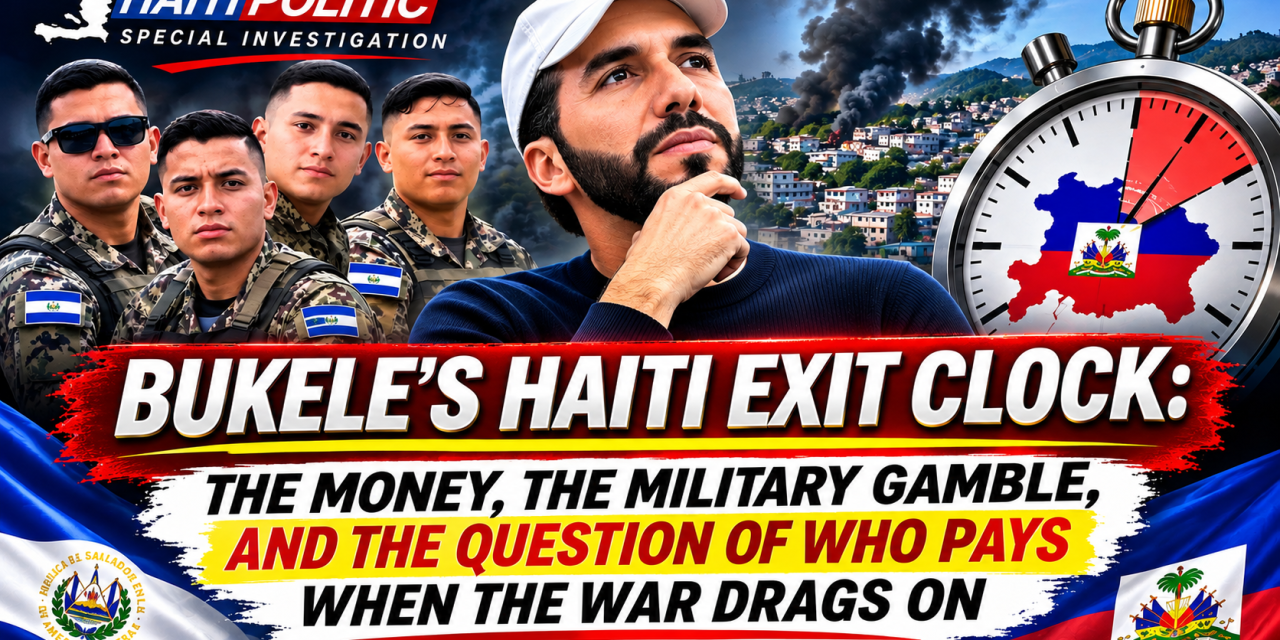
El Salvador’s financial limitations, dependence on international logistics, and the risks of a prolonged campaign against Haiti’s armed gangs raise a difficult question: Can Bukele sustain his military commitment if international support weakens?
HAITI POLITIC | SPECIAL INVESTIGATION & GEOPOLITICAL ANALYSIS
November 4, 2026
INTRODUCTION: THE CLOCK IS TICKING, BUT WHO IS PAYING?
President Nayib Bukele has built an international reputation around his government’s campaign against criminal gangs in El Salvador.
Now, with Salvadoran forces participating in security operations in Haiti, his administration faces a very different test.
Haiti is not El Salvador.
Its armed groups operate within a different political environment, across densely populated urban neighborhoods and strategically important transportation corridors. The country’s weakened institutions, illicit arms networks, and prolonged political instability complicate efforts to restore security.
For Bukele, the question is no longer simply whether Salvadoran forces can participate in operations against Haitian gangs.
The more consequential question is whether El Salvador can afford a prolonged military commitment if the operation becomes more expensive, more dangerous, and more politically controversial.
Bukele has reportedly claimed that El Salvador is financing as much as 90% of its current mission expenses.
That claim requires clarification.
Does the percentage include salaries, military equipment, fuel, transportation, ammunition, medical support, intelligence, maintenance, and logistical assistance?
Or does it refer only to a limited category of expenses paid directly by the Salvadoran government?
The distinction matters because Haiti’s international security architecture includes substantial logistical support from the United Nations.
A country may pay most of its directly recorded deployment expenses while still depending on international partners for essential operational support.
This is where the financial realities of Bukele’s Haiti commitment become particularly important.
1. THE REALITIES OF EL SALVADOR’S FINANCIAL AND MILITARY CAPACITY
A small economy confronting the possibility of an expensive foreign commitment
El Salvador is not a major military power with unlimited financial resources.
According to the International Monetary Fund’s April 2026 economic projections, El Salvador’s gross domestic product is approximately $39.8 billion, while general government gross debt is projected to reach approximately 85% of GDP in 2026.
The IMF’s October 1, 2026 review also describes an ongoing fiscal consolidation program intended to strengthen public finances and maintain economic stability.
These figures do not establish that El Salvador cannot afford its current deployment.
They do, however, illustrate the constraints under which the government operates.
A prolonged overseas military commitment competes with domestic priorities, including infrastructure, education, healthcare, policing, and debt servicing.
Military deployments also become more expensive as their duration increases.
Initial transportation and equipment costs are only the beginning.
Sustained operations can require repeated troop rotations, equipment replacement, medical evacuation, maintenance, ammunition replenishment, intelligence support, and additional personnel.
A short deployment can be financed as an exceptional expenditure. A prolonged campaign requires a dependable funding structure.
For El Salvador, the difference could become decisive.
Source: International Monetary Fund, April 2026 World Economic Outlook projections and October 1, 2026 review of El Salvador’s Extended Fund Facility.
2. LOGISTICAL DEPENDENCE ON MAJOR POWERS
Bukele’s soldiers may be Salvadoran, but the support system is international
The United Nations Security Council adopted Resolution 2793 on September 30, 2025, authorizing the transition of Haiti’s multinational security mission into the Gang Suppression Force, or GSF.
The resolution established a multinational security framework supported by international contributions.
It also created the United Nations Support Office in Haiti, known as UNSOH.
Under this arrangement, UNSOH provides essential logistical and operational support, including:
- Fuel, water, food, and accommodation.
- Ground transportation and aviation support.
- Medical services and evacuation capabilities.
- Communications and information technology.
- Infrastructure and operational facilities.
- Support for troop movements and rotations.
- Eligible equipment reimbursement under established arrangements.
The United Nations announced that UNSOH was fully operational as of April 1, 2026.
This is an important distinction.
The GSF is internationally authorized but is not commanded by the United Nations. Nor is Bukele the commander of the entire GSF.
Its operational command belongs to the mission’s designated command structure.
Participating countries retain responsibilities for their personnel, while international arrangements provide important support.
The precise extent to which Salvadoran forces benefit from these services depends on their deployment arrangements and eligibility.
Nevertheless, the broader financial reality is clear:
Haiti’s multinational security operation is not designed to function as a completely self-financed Salvadoran military campaign.
It is supported through a combination of national contributions, international logistical arrangements, and financial commitments from participating partners.
If that support changes, the operational and financial consequences could be significant.
Source: UN Security Council Resolution 2793 (2025); United Nations Support Office in Haiti, April 2026 operational announcement.
3. POLITICAL BACKING IS NOT THE SAME AS DIRECT FUNDING
Washington can support a mission without paying every bill
President Bukele’s relationship with the Trump administration has attracted considerable political attention.
However, diplomatic support, logistical assistance, equipment transfers, and direct financial contributions are different forms of international cooperation.
A foreign government may support a security operation politically without financing its entire cost.
Likewise, international logistical assistance may reduce the expenses borne directly by participating countries without appearing as a cash payment to their governments.
For this reason, public statements about who is paying for Haiti’s security operations must be examined carefully.
Consider four separate questions:
First: How much money does El Salvador directly appropriate for its personnel and operations in Haiti?
Second: What logistical services are provided through UNSOH or other international partners?
Third: Which governments finance the international support mechanisms?
Fourth: Are any Salvadoran expenses reimbursed through international arrangements?
Without detailed answers, claims that El Salvador is paying 90% of its expenses cannot establish that it is independently financing 90% of the total economic cost of its participation.
This distinction becomes increasingly important if international partners reconsider their financial commitments.
The September 29, 2026 Security Council decision extended the GSF mandate until March 31, 2027.
That extension provides a legal framework for continued operations.
But a renewed mandate does not automatically guarantee unlimited financing.
Source: UN Security Council Resolution 2829 (2026), extending the GSF mandate.
4. DOMESTIC BUDGETS VERSUS FOREIGN MILITARY OPERATIONS
What happens when an overseas mission competes with domestic spending?
Every government faces financial trade-offs.
El Salvador must finance its domestic security institutions, public services, infrastructure, and debt obligations while maintaining fiscal stability.
An overseas deployment adds another potential claim on public resources.
To understand the scale of that commitment, Salvadoran taxpayers and Haitian citizens need access to several basic figures.
How much has El Salvador spent on Haiti operations?
Which ministry pays those expenses?
How much is allocated to personnel, transportation, equipment, maintenance, and operational support?
Are the expenditures included in the country’s approved budget?
Has the government received reimbursements or material assistance from international partners?
And what additional appropriations would be required if the deployment continued for another six months, one year, or longer?
These questions are not evidence of financial mismanagement.
They are ordinary requirements of public accountability.
The financial sustainability of an overseas military commitment cannot be evaluated without knowing its actual cost.
The IMF’s assessment of El Salvador’s public finances makes this question especially relevant.
Although fiscal consolidation has progressed, public debt remains substantial.
A prolonged military operation would therefore need to be assessed alongside the government’s other financial obligations.
5. HAITI IS NOT EL SALVADOR: THE LIMITS OF EXPORTING A SECURITY MODEL
Different armed groups, different institutions, different operational challenges
Bukele’s domestic security strategy developed within El Salvador’s own territory, legal system, police institutions, prisons, and political structure.
Haiti presents a different operating environment.
Its armed groups have developed territorial influence, access to illicit weapons, and networks of economic activity that can include extortion, kidnapping, trafficking, and control over transportation routes.
Some groups have demonstrated the ability to disrupt roads, attack infrastructure, and challenge state authority.
But these organizations are not identical to one another, and their capabilities vary.
Describing all Haitian gangs as conventional military forces would oversimplify the threat.
Nevertheless, operations against heavily armed groups in densely populated areas create substantial tactical and humanitarian challenges.
Military vehicles and additional personnel may improve operational capacity, but they cannot independently restore functioning courts, reliable policing, public administration, or economic opportunity.
A sustainable security strategy must address more than the immediate presence of armed groups.
It must also confront the institutions and criminal networks that allow violence to continue.
Even successful military operations can produce only temporary gains if Haitian authorities cannot establish durable control and restore public services afterward.
That is why the GSF’s mandate includes cooperation with the Haitian National Police and Haitian armed forces, as well as efforts to strengthen their operational capacity.
The long-term measure of success should not be the number of military videos released.
It should be whether Haitian institutions become capable of maintaining security without indefinite foreign military assistance.
6. THE DANGER OF ESCALATION OF COMMITMENT
Could the desire to demonstrate success encourage a longer and more expensive deployment?
In political science and organizational decision-making, escalation of commitment describes a situation in which leaders continue investing resources in a project despite mounting costs because they have already invested heavily in it.
The concept does not prove that Bukele is experiencing this dynamic.
But it provides a useful framework for examining the political risks associated with his Haiti commitment.
Bukele’s international political image is closely associated with his administration’s campaign against gangs.
A visible security commitment in Haiti may reinforce that image if it produces demonstrable improvements.
Conversely, a prolonged operation without clear results could generate questions about costs, objectives, and strategy.
Three potential pressures deserve examination.
Political pressure
A government that publicly associates itself with a foreign security mission may face criticism if it withdraws before its stated objectives are achieved.
Financial pressure
Additional deployments, equipment, and operating expenses may increase the cost of maintaining the mission.
Reputational pressure
If officials repeatedly emphasize progress, they may face growing demands to demonstrate that progress through independently verifiable results.
None of these pressures establishes that Bukele intends to escalate the operation.
The danger is structural: when political credibility becomes tied to an overseas mission, governments may find it harder to adjust their strategy even when circumstances change.
The appropriate safeguard is a transparent assessment of costs, operational outcomes, and achievable objectives.
7. THREE SCENARIOS THAT COULD FORCE A CHANGE IN STRATEGY
Scenario One: International financing remains stable
Under this scenario, international partners continue supporting the GSF and UNSOH.
Salvadoran personnel remain part of a broader multinational operation.
El Salvador’s direct financial obligations remain more manageable because important logistical functions are supported internationally.
The central challenge would be demonstrating measurable security improvements and strengthening Haitian institutions.
Scenario Two: International support becomes more restrictive
Governments contributing to Haiti’s security arrangements could impose additional reporting requirements, revise financial commitments, or reconsider particular forms of assistance.
Such decisions would not necessarily end Salvadoran participation.
However, they could require changes in deployment size, equipment use, or operational priorities.
This is particularly relevant to U.S. congressional oversight.
Congress has authority over American appropriations and can investigate the use of U.S. assistance.
Any changes to American support would depend on the relevant laws, funding arrangements, and political decisions.
Scenario Three: Costs increase while operational progress remains limited
This is the scenario that would create the most difficult financial questions.
If operations require repeated deployments, equipment replacement, and extended logistical support without corresponding improvements in security, participating governments could face pressure to reconsider their commitments.
For El Salvador, the central question would become whether additional expenditures are justified by measurable results.
Possible responses could include reducing the Salvadoran contingent, transferring responsibilities to other partners, renegotiating support arrangements, or concentrating on narrower operational objectives.
An about-face would not necessarily mean abandoning Haiti. It could mean changing the scale, financing, or mission of Salvadoran participation.
There is no verified evidence establishing that Bukele has already decided to withdraw or that a withdrawal date has been set.
The scenarios illustrate potential choices, not confirmed government plans.
8. THE QUESTION OF A PROLONGED URBAN CONFLICT
What if the operation lasts much longer than originally anticipated?
A prolonged campaign against armed groups can generate substantial costs even when participating forces avoid major conventional battles.
Urban operations require intelligence gathering, protected transportation, communications, medical support, and coordination with local authorities.
They also create serious civilian-protection responsibilities.
Military operations may become more complicated when armed groups operate among civilian populations, use densely populated neighborhoods, or disrupt transportation routes.
These conditions increase the importance of reliable intelligence, disciplined command structures, and clear rules governing the use of force.
They also create the possibility that military gains will be difficult to sustain without effective Haitian policing and judicial institutions.
The international community has repeatedly confronted this problem in Haiti.
Removing armed actors from a neighborhood is not the same as restoring the authority of the state.
If a foreign force clears an area but Haitian institutions cannot maintain security, the operation may need to be repeated.
That creates a potentially expensive cycle.
For a country with limited fiscal flexibility, such a cycle could make prolonged participation difficult without dependable international support.
However, the actual sustainability of Salvadoran participation cannot be calculated without verified information about its troop strength, operating costs, reimbursement arrangements, and expected duration.
9. THE 90% QUESTION: WHAT EXACTLY IS EL SALVADOR PAYING?
Bukele’s reported assertion that El Salvador covers up to 90% of its mission expenses deserves a transparent accounting.
The figure should not be accepted or rejected without identifying what it measures.
For example, suppose a participating government pays $9 million in direct expenses while international partners provide $6 million worth of logistical services.
That government might accurately claim to finance 90% of a particular $10 million domestic expenditure category.
But it would not be accurate to conclude that it finances 90% of the combined economic cost of all services and resources used.
This is an illustrative example, not a statement of actual Salvadoran expenditures.
The same principle applies to Haiti’s security mission.
To evaluate Bukele’s claim, the public needs an itemized statement identifying:
- Direct Salvadoran government expenditures.
- Internationally supplied logistical services.
- Equipment and transportation contributions.
- Personnel reimbursements.
- Any bilateral financial assistance.
- The accounting period covered by the reported percentage.
Without that information, the 90% figure remains insufficient to establish financial independence.
The more important issue is not whether El Salvador pays a majority of one category of expenses.
It is whether the country could maintain the same operational capability if major international support mechanisms were reduced or withdrawn.
That question remains unanswered.
10. WHAT WOULD AN ABOUT-FACE LOOK LIKE?
A change in Bukele’s Haiti policy would not necessarily begin with a public announcement of defeat.
Governments can modify foreign military commitments in several ways.
They may reduce personnel while maintaining advisers.
They may transfer operational responsibilities to other contingents.
They may seek additional international financing.
They may redefine success around narrower security objectives.
Or they may establish a timetable for handing responsibilities to Haitian institutions.
Each option carries different political and financial implications.
A reduction in Salvadoran participation could reflect financial constraints, changing security conditions, strategic reassessment, or a planned transition.
It would not automatically establish that the mission had failed.
Likewise, maintaining the deployment would not by itself prove that the operation was succeeding.
The decisive issue is whether the costs, risks, and results remain consistent with the mission’s stated objectives.
That is the standard by which the Salvadoran government and its international partners should be evaluated.
11. TEN QUESTIONS BUKELE SHOULD ANSWER ABOUT HAITI
Haiti Politic believes the following questions are essential to understanding the sustainability and accountability of Salvadoran military participation.
1. What is the total amount El Salvador has spent on operations in Haiti?
Provide the expenditures by month, ministry, and category.
2. What exactly does the reported 90% financing figure include?
Does it include international logistical assistance and equipment support?
3. How many Salvadoran personnel are deployed, and under whose operational command?
Are all personnel operating within the GSF framework?
4. What is the expected duration of the Salvadoran deployment?
Is there an established timetable for reviewing or ending the commitment?
5. What additional funding would be necessary if the deployment continued through 2027?
Has the Salvadoran government prepared a multiyear cost estimate?
6. What support does El Salvador receive from the United States or other international partners?
Identify financial, logistical, equipment, and intelligence arrangements to the extent disclosure is consistent with operational security.
7. What happens if international partners reduce their contributions?
Can El Salvador maintain its current level of participation independently?
8. What measurable security improvements have Salvadoran forces helped achieve?
Provide independently verifiable indicators concerning territorial security, civilian protection, and the restoration of public services.
9. What safeguards protect Haitian civilians and ensure accountability?
Which institutions investigate alleged misconduct, and how are findings reported?
10. What is the long-term strategy for transferring security responsibilities to Haitian institutions?
How will Haiti avoid becoming permanently dependent on foreign forces?
These questions are not demands for the disclosure of sensitive tactical information.
They concern public spending, legal authority, institutional responsibility, and strategic objectives.
CONCLUSION: THE REAL COUNTDOWN IS FINANCIAL AND POLITICAL
President Nayib Bukele’s military involvement in Haiti is taking place within an internationally supported security framework.
That framework matters.
It provides legal authorization, logistical services, and opportunities for participating countries to share financial and operational responsibilities.
But it also means that the sustainability of Salvadoran participation cannot be assessed solely through statements about national determination or political leadership.
El Salvador’s economy is relatively small, its public debt remains substantial, and its government must balance domestic obligations against any additional costs associated with overseas military operations.
A prolonged deployment could become more difficult if expenses increase or international support changes.
At the same time, there is insufficient public evidence to establish that Bukele is preparing an imminent withdrawal or that El Salvador is already unable to finance its current commitment.
The relevant question is therefore not whether Bukele has secretly decided to retreat. It is what financial and operational conditions would cause his government to reconsider its role.
Haiti has experienced international security interventions before.
The central challenge has never been simply bringing foreign personnel into the country.
It has been creating security improvements that Haitian institutions can sustain.
That requires accountable policing, functioning courts, reliable public financing, and a legitimate national security strategy.
For Bukele, the test is whether Salvadoran participation can deliver meaningful results within a sustainable international framework.
For Haiti, the test is more fundamental.
Will foreign military assistance leave the Haitian state stronger and more capable of protecting its citizens, or will Haiti remain dependent on external forces whose commitments can change with budgets, elections, and diplomatic priorities?
That is the question Haiti Politic will continue examining.
The clock is ticking—not toward a confirmed Salvadoran withdrawal, but toward the moment when financial costs, operational results, and political commitments must be measured against one another.
SOURCES AND DOCUMENTARY REFERENCES
1. United Nations Security Council Resolution 2793 (2025).
September 30, 2025. Establishes the Gang Suppression Force framework, voluntary personnel financing, international coordination, and the United Nations Support Office in Haiti.
2. United Nations Support Office in Haiti.
April 20, 2026. Confirms that UNSOH became fully operational on April 1, 2026, and describes the logistical support available to the GSF.
3. United Nations Security Council Resolution 2829 (2026).
September 29, 2026. Extends the GSF mandate until March 31, 2027.
4. International Monetary Fund — World Economic Outlook, April 2026.
Provides economic projections for El Salvador, including GDP and public debt.
5. International Monetary Fund — Second and Third Reviews Under the Extended Fund Facility for El Salvador.
October 1, 2026. Examines fiscal consolidation, public debt, and economic conditions.
Editorial verification note: Bukele’s reported claim that El Salvador finances 90% of its Haiti mission expenses requires an attributable primary statement and supporting financial records. This article does not treat the figure as independently established. Similarly, the scenarios involving reduced international assistance or a Salvadoran change of strategy are analytical possibilities, not confirmed plans.
HAITI POLITIC — NEWS • ANALYSIS • PUBLIC ACCOUNTABILITY