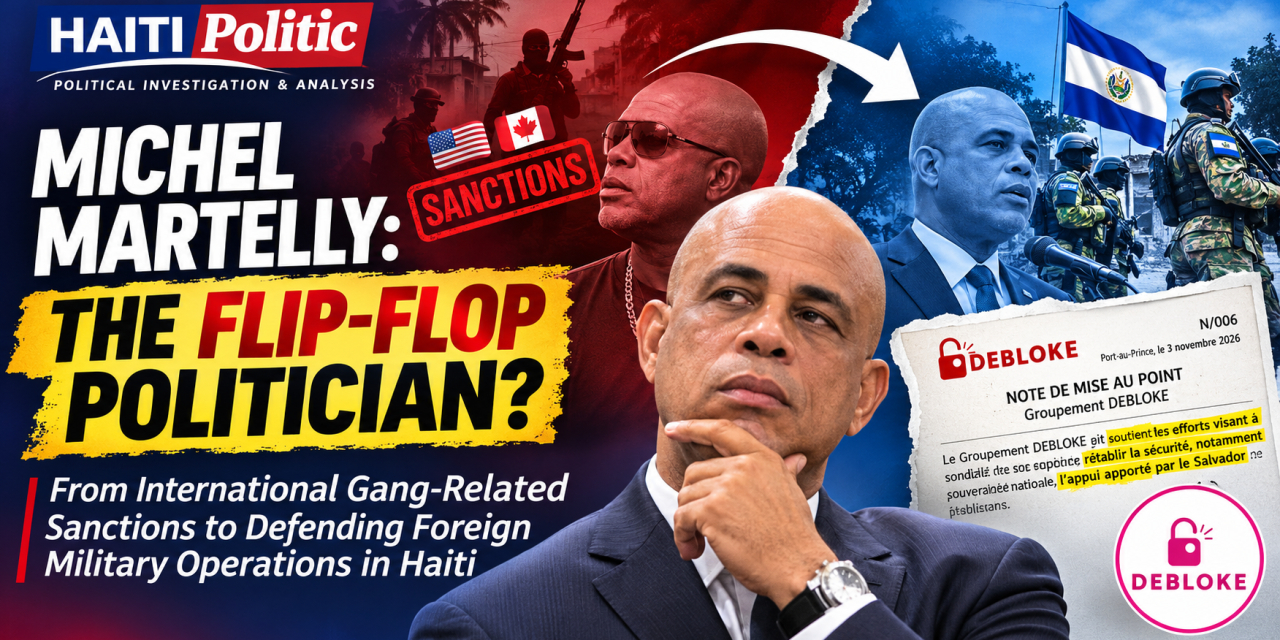
From International Gang-Related Sanctions to Defending Foreign Military Operations in Haiti
HAITI POLITIC | POLITICAL INVESTIGATION & ANALYSIS
DEBLOKE’s November 3, 2026, press release defends former President Michel Joseph Martelly against allegations that he attempted to obstruct Salvadoran military operations. But the statement raises a much larger question: Can a former president sanctioned by foreign governments over alleged connections to armed gangs credibly reinvent himself as the defender of Haiti’s security?
THE POLITICAL CONTRADICTION
Former Haitian President Michel Joseph Martelly is attempting a political comeback under the DEBLOKE banner.
His political organization now presents him as a candidate committed to restoring security, defending Haitian sovereignty, respecting human rights, and supporting international assistance against armed groups.
On November 3, 2026, DEBLOKE issued a formal statement rejecting allegations that Martelly had attempted to interfere with Salvadoran security operations in Haiti.
The statement was a direct response to accusations published by the Réseau Haïtien des Journalistes Anti-Corruption (RHAJAC) on November 2.
DEBLOKE denied that Martelly had requested or authorized any communication to the United Nations seeking the suspension of Salvadoran operations.
The organization also publicly supported security-restoration efforts, including assistance from El Salvador, subject to respect for Haitian sovereignty and civilian rights.
At first glance, this appears to be a straightforward political defense.
But when examined alongside Martelly’s political history and the international sanctions imposed against him, it reveals a far more complicated picture.
The central question is whether Martelly has genuinely changed his political approach—or whether his latest security message is a convenient position for a candidate seeking to return to power.
1. DEBLOKE’S NOVEMBER 3 STATEMENT: WHAT DOES IT ACTUALLY SAY?
The DEBLOKE press release, numbered N/006 and dated November 3, 2026, contains several important declarations.
First, the organization rejects RHAJAC’s allegation that Martelly sought to obstruct Salvadoran military operations against armed groups.
Second, it denies that Martelly instructed anyone to approach the United Nations through UNA-Haïti to obtain the suspension of those operations.
Third, DEBLOKE challenges RHAJAC to produce verifiable evidence supporting its allegations.
Fourth, the organization declares that Haiti must recover control of its territory and protect its population.
Finally, it expresses support for security-restoration efforts, including assistance from El Salvador, while emphasizing national sovereignty, applicable law, and civilian rights.
The statement was signed by three DEBLOKE representatives:
-
Joseph Junior Michel, responsible for political and electoral affairs.
-
Joseph Gérald Salomon, member.
-
Kesnerd Doblard, general coordinator.
These declarations establish DEBLOKE’s publicly stated position.
They do not independently establish whether the disputed communications occurred.
That distinction matters: a political denial is evidence of a party’s position, not conclusive proof that the underlying allegation is false.
Likewise, an accusation based on unnamed sources is not proof that the accused committed the alleged act.
Both sides must be subjected to the same evidentiary standards.
2. THE FIRST FLIP-FLOP QUESTION: FROM ALLEGED GANG SUPPORT TO ANTI-GANG POLITICS
The most serious contradiction surrounding Martelly’s political comeback does not originate with RHAJAC.
It originates with the official actions of the United States and Canada.
On August 20, 2024, the U.S. Department of the Treasury announced sanctions against Michel Joseph Martelly under Executive Order 14059, concerning the global illicit drug trade.
According to the Treasury Department, Martelly had abused his influence to facilitate drug trafficking, engaged in laundering illicit proceeds, worked with traffickers, and sponsored multiple Haiti-based gangs.
The U.S. State Department separately announced the designation and repeated allegations concerning drug trafficking and gang sponsorship.
Canada had previously sanctioned Martelly in November 2022.
These are documented government actions, not merely social media accusations.
However, sanctions are administrative measures and should not be confused with a criminal conviction. The allegations and government findings underlying them do not, by themselves, establish criminal guilt in a court of law.
Nevertheless, they create an unavoidable political accountability issue.
How does a former president accused by foreign governments of sponsoring gangs now ask Haitian voters to trust him as a champion of anti-gang security?
That is the first major contradiction.
DEBLOKE cannot reasonably expect the public to evaluate its candidate’s new security platform without considering this history.
If Martelly disputes the sanctions findings, voters deserve a detailed response supported by evidence.
A declaration that he supports Salvadoran operations does not resolve the underlying questions.
The accountability test
Martelly should publicly explain:
What is his response to the specific allegations that led to the U.S. and Canadian sanctions?
Has he formally challenged those sanctions?
What evidence can he provide to rebut the governments’ findings?
And what concrete safeguards would prevent political relationships with armed groups from influencing a future administration?
Until these questions are answered, his security message remains politically vulnerable.
3. THE SECOND FLIP-FLOP QUESTION: FOREIGN INTERVENTION OR HAITIAN SOVEREIGNTY?
DEBLOKE’s statement contains another tension.
The organization declares that Haiti must regain control of its territory while simultaneously supporting Salvadoran assistance against armed groups.
These positions are not necessarily contradictory.
A sovereign government can request international security assistance while maintaining national authority.
But that principle becomes meaningful only when the public understands the legal and operational arrangements.
Who commands the foreign personnel?
Who determines their operational objectives?
Who finances their deployment?
What authority do Haitian institutions retain?
And when will the mission end?
DEBLOKE’s press release does not answer these questions.
Instead, it combines two politically attractive messages: support for foreign security assistance and defense of Haitian sovereignty.
That combination may be legitimate policy, but without operational details it risks becoming a campaign slogan rather than a governing strategy.
Martelly should therefore explain what sovereignty means under his proposed security policy.
Would he support foreign forces operating independently of Haitian authorities?
Would he demand parliamentary oversight of international security agreements?
Would he require public disclosure of mission financing?
And what measurable conditions would trigger the withdrawal of foreign personnel?
A candidate cannot simply promise sovereignty and international military assistance without explaining how the two would coexist.
4. THE THIRD FLIP-FLOP QUESTION: THE POLITICIAN WHO ONCE GOVERNED HAITI NOW PROMISES TO UNBLOCK IT
Michel Martelly served as president of Haiti from 2011 to 2016.
That makes his political comeback fundamentally different from the candidacy of someone who has never held executive power.
He is not merely proposing a new vision.
He is asking voters to return a former president to office.
His campaign must therefore be evaluated against his previous administration’s record.
During Martelly’s presidency, Haiti continued to face major challenges involving institutional capacity, political instability, corruption allegations, public administration, and the development of national security institutions.
The Haitian National Police remained a central institution for public security, while the restoration of Haiti’s armed forces occurred later, under President Jovenel Moïse.
Martelly’s administration also operated during the period when MINUSTAH remained present in Haiti.
These circumstances raise legitimate questions about what he accomplished and what he would do differently.
If Martelly could not deliver the institutional transformation Haiti needed during his first presidency, what has changed in his political program, leadership team, and accountability mechanisms?
DEBLOKE’s name suggests removing obstacles.
But voters have a right to ask whether the same political leadership can credibly present itself as the solution to problems that persisted during its previous time in power.
That does not prove every current problem was caused by Martelly.
It does mean his record deserves more scrutiny than his campaign promises.
5. THE RHAJAC ALLEGATIONS: A SERIOUS CLAIM THAT STILL REQUIRES PROOF
On November 2, 2026, RHAJAC published allegations that Martelly had allegedly used associates and UNA-Haïti to seek international intervention against Salvadoran operations.
Its statement named Harvey Dupiton, Randolf St. Leger, and Jean Philippe Vixamar in connection with the alleged initiative.
RHAJAC referred to a purported October 28 communication concerning alleged Salvadoran military actions.
The organization also suggested that Martelly had a political interest in preserving the influence of armed groups.
These are serious accusations.
But their seriousness makes documentary verification more—not less—important.
The publicly available RHAJAC statement does not establish that Martelly personally ordered the alleged communication.
It does not, on its own, prove that the named individuals were acting under his instructions.
Nor does it prove that Martelly secretly sought to protect armed groups from Salvadoran operations.
DEBLOKE specifically disputes those claims.
Haiti Politic’s position should be clear: RHAJAC must produce the underlying correspondence and evidence of authorization before its allegations can be treated as established facts.
The public should be able to examine the communication’s authenticity, signatories, recipients, and any evidence linking it to Martelly.
At the same time, DEBLOKE should explain whether its candidate or representatives had any relevant contact with the individuals named in the accusation.
The burden of proving the alleged misconduct remains with those making the accusation.
6. THE FOURTH FLIP-FLOP QUESTION: SECURITY FOR HAITI OR SECURITY FOR THE CAMPAIGN?
The timing of DEBLOKE’s statement is politically significant.
Martelly’s return to electoral politics has placed him under renewed scrutiny.
Security is among Haiti’s most urgent national concerns.
A candidate who appears indifferent to the suffering caused by armed groups would face obvious political difficulties.
DEBLOKE’s public support for Salvadoran assistance therefore serves an important campaign function: it positions Martelly on the side of restoring order.
But a declaration of support is not the same as a credible security program.
A serious presidential candidate should explain how the state would regain and maintain control of neighborhoods after international operations.
Would the government expand the Haitian National Police?
How would it investigate financiers and political sponsors of armed groups?
What would happen to weapons recovered during operations?
How would courts prosecute kidnapping, murder, extortion, and trafficking cases?
What protections would be provided to civilians displaced by violence?
And how would the government prevent the reconstitution of armed groups after security forces withdraw?
Without answers, support for a foreign military operation risks becoming a political shortcut: praise the troops today, promise security tomorrow, and avoid explaining yesterday’s failures.
That is precisely the kind of political repositioning Haitian voters should examine critically.
7. THE FIFTH FLIP-FLOP QUESTION: ACCOUNTABILITY FOR OTHERS, BUT WHAT ABOUT MARTELLY?
DEBLOKE’s press release emphasizes freedom of expression, fact-checking, and the right to respond to accusations.
Those are legitimate democratic principles.
The organization is correct that serious allegations should be supported by verifiable evidence.
But the same principle must apply to its presidential candidate.
If Martelly demands evidence from RHAJAC, he should also provide a substantive public response to the findings announced by the U.S. Treasury and State Departments.
Those sanctions cannot simply be dismissed as an ordinary campaign rumor.
They are formal actions by foreign governments, accompanied by public explanations.
Martelly has the right to contest them.
Haitian voters have the right to examine them.
Accountability cannot be selective.
A politician cannot demand transparency when defending himself while avoiding detailed scrutiny of his own political record.
This is where the flip-flop argument becomes strongest.
The question is not whether Martelly has the right to change his political position.
He does.
The question is whether he has explained the change, acknowledged the controversies surrounding his record, and offered credible evidence that his approach to security would be different.
8. WHAT DOES DEBLOKE’S STATEMENT LEAVE UNANSWERED?
The November 3 press release is carefully structured.
It denies the alleged interference.
It challenges the credibility of RHAJAC’s evidence.
It endorses the restoration of security.
It supports Salvadoran assistance within legal limits.
And it condemns political intimidation.
But several important questions remain unanswered.
First: Does Michel Martelly personally endorse every element of DEBLOKE’s security statement?
Second: What is his detailed response to the U.S. Treasury’s allegations concerning gang sponsorship and drug trafficking?
Third: What specific security failures from his 2011–2016 presidency does he acknowledge?
Fourth: What new policies would distinguish a second Martelly presidency from his first?
Fifth: What safeguards would ensure that politicians, business interests, and state officials cannot finance or protect armed groups?
Sixth: Would Martelly support independent investigations into political and financial networks connected to Haiti’s armed gangs, even if those investigations involved former members of his administration?
Seventh: Does he support the GSF’s current command, financing, and accountability arrangements, or would he seek changes?
Eighth: Would he publicly disclose any communications between his representatives and organizations advocating changes to Salvadoran operations?
Ninth: What measurable security results would his government promise during its first 100 days?
Tenth: Why should Haitian voters believe that the political leadership associated with an earlier period of institutional weakness is now uniquely qualified to rebuild the state?
These questions go beyond the dispute between DEBLOKE and RHAJAC.
They concern the credibility of Martelly’s proposed return to power.
9. A POLITICAL REINVENTION OR A GENUINE CHANGE?
Political leaders can change their views.
They can acknowledge mistakes, adopt new policies, and offer voters a different approach.
Changing one’s position is not automatically evidence of dishonesty.
But political reinvention becomes questionable when a candidate presents a new message without explaining the contradictions between that message and the documented controversies of his past.
Martelly’s current political positioning creates exactly that challenge.
His party now publicly supports efforts to combat armed groups.
Yet the candidate remains subject to documented U.S. sanctions imposed following government findings concerning drug trafficking and gang sponsorship.
His party speaks about national sovereignty.
Yet it endorses foreign security assistance without explaining in detail how Haitian institutions would exercise control.
His campaign promises to help unblock Haiti.
Yet he previously served five years as president and must account for his administration’s record.
These contradictions do not prove that Martelly secretly opposes Salvadoran operations. They do provide substantial grounds to question whether his new political message represents a genuine transformation or an electoral rebranding.
That is the distinction between responsible political analysis and unsupported accusation.
10. THE REAL TEST: WHAT HAS MICHEL MARTELLY LEARNED?
The most important question for Martelly may be the simplest.
What has changed?
Has he changed his understanding of the relationship between political power and armed groups?
Has he changed his approach to government accountability?
Has he changed his views about the role of foreign military missions?
Has he changed his strategy for strengthening Haitian institutions?
And can he demonstrate those changes through specific commitments rather than political declarations?
DEBLOKE’s November 3 statement provides a defense against one allegation.
It does not provide a comprehensive explanation of Martelly’s political evolution.
That explanation remains necessary.
CONCLUSION: HAITI DOES NOT NEED ANOTHER POLITICAL MAKEOVER WITHOUT ACCOUNTABILITY
Michel Joseph Martelly has every right to respond to allegations against him and to seek political support, subject to Haiti’s electoral laws and applicable eligibility requirements.
But his candidacy deserves rigorous examination.
DEBLOKE’s defense of Salvadoran operations cannot erase the international sanctions record.
Its appeal to sovereignty cannot substitute for a detailed security strategy.
And its rejection of RHAJAC’s accusations cannot settle questions that still require documentary evidence.
The strongest case for calling Martelly a flip-flop politician is the contrast between his current anti-gang political message and the serious gang-related findings publicly announced by foreign governments—not an unproven allegation that he secretly tried to stop Salvadoran troops.
Haitian voters should demand more than a new slogan, a new political coalition, or a carefully written press release.
They should demand explanations, documents, measurable commitments, and accountability.
HAITI POLITIC’S FINAL QUESTION
MICHEL MARTELLY: ARE YOU RETURNING TO HAITI TO CHANGE THE POLITICAL SYSTEM—OR ARE YOU ASKING HAITI TO GIVE THE SAME POLITICAL SYSTEM ANOTHER CHANCE?
The answer must come from his record, his evidence, and his proposed policies—not merely his campaign’s promises.
Haiti Politic | Independent Political Analysis | November 5, 2026