
Former FBI informants, PHTK political divisions, competing presidential ambitions and federal courtroom testimony raise questions about the networks positioning themselves for power before Haiti’s president was assassinated.
HAITI POLITIC | SPECIAL INVESTIGATIVE REPORT
Updated: November 6, 2026 | Miami, Florida
INTRODUCTION: WHO WAS PLANNING TO REPLACE JOVENEL MOÏSE?
Five months before Haitian President Jovenel Moïse was assassinated on July 7, 2021, different political figures and intermediaries were discussing possibilities for replacing him.
One initiative involved Christian Emmanuel Sanon, a Haitian American pastor and businessman who believed he could become Haiti’s next president.
Another initiative, described in communications attributed to Helen Manich and discussed in reporting from Sanon’s federal trial, allegedly involved dissatisfied members of the Parti Haïtien Tèt Kale (PHTK).
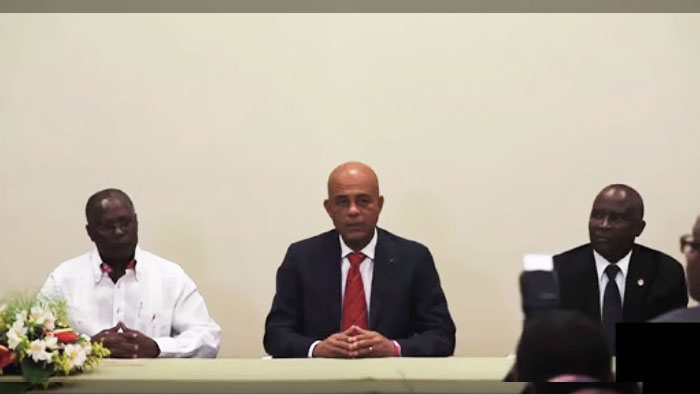
The second initiative reportedly included discussions about a possible political arrangement involving former President Michel Joseph Martelly, former Senate President Joseph Lambert and Emmanuel Ménard.
The communications raise questions about whether competing political networks were independently positioning themselves to replace Moïse during Haiti’s constitutional crisis.
They also raise a more consequential question.
Did any of those political initiatives intersect with the conspiracy that ultimately resulted in Moïse’s assassination?
The available evidence does not establish that Martelly, Lambert or Ménard knowingly participated in the assassination conspiracy.
Nor does the appearance of their names in reported communications establish that they approved a plan to remove Moïse through violence.
Nevertheless, the political relationships and communications examined during Sanon’s federal trial provide important leads.
They deserve scrutiny because they concern the period immediately preceding one of the most consequential crimes in Haiti’s modern history.
I. FEBRUARY 6, 2021: SANON’S PRESIDENTIAL AMBITIONS
According to an account of evidence presented during Sanon’s federal trial in Miami, Samir Handal reportedly sent Sanon a message on February 6, 2021, asking whether he had found the residence where he intended to live as president.
The message suggests that Sanon’s presidential ambitions were being discussed among his associates months before Moïse’s assassination.
However, the precise wording and context of the message have not been independently verified against the original digital exhibit or official court transcript.
The timing is significant.
On February 7, 2021, Haiti entered a major constitutional confrontation over the expiration of Moïse’s presidential mandate.
Opposition leaders argued that his term had ended.
Moïse maintained that his presidency would continue until February 7, 2022.
The disagreement intensified political tensions and generated competing proposals for a transition.
Sanon was apparently among those positioning themselves for a future government.
But political ambition alone does not establish criminal responsibility.
The important question is whether Sanon knowingly participated in the conspiracy to remove Moïse through kidnapping or assassination.
That question remained central to his federal trial.
II. HELEN MANICH: A FORMER FBI SOURCE AND POLITICAL INTERMEDIARY
Helen Manich emerged as an important figure during the October 2026 proceedings.
According to reporting by Miami Herald journalist Jacqueline Charles, FBI supervisor Nicholas Rahmer testified on October 9 that Manich had served as an FBI confidential human source between 2011 and 2016.
Rahmer also confirmed that Jean Robert “Bob” Balthazar had served as an FBI confidential source from 2011 to 2012.
Neither was an active FBI source during the 2021 events, according to the reported testimony.
This distinction matters.
A confidential human source is not necessarily an FBI employee or an individual authorized to represent the United States government.
An earlier relationship with the FBI does not establish that the agency directed or approved subsequent political activities.
Nevertheless, Manich’s communications are relevant because they provide insight into the political information circulating among Sanon’s associates.
Messages discussed during the proceedings reportedly showed Manich exchanging information about Haiti’s constitutional crisis, political parties and potential presidential successors.
In one exchange, she reported that Sanon had spoken with political party leaders who rejected the candidacy of a former Haitian Army general.
Sanon subsequently advanced his own candidacy.
The exchange suggests that Sanon was not the only person being considered for political leadership.
It also raises questions about the individuals encouraging or advising him.
Who introduced Sanon to political party leaders?
Who proposed the former general?
And who encouraged Sanon to believe he could become president?
The original communications may help clarify those questions.
III. THE ALLEGED SEPARATE PHTK MOVEMENT
One of the most significant investigative leads concerns a communication attributed to Helen Manich about a separate political movement.
According to an account of evidence presented during Sanon’s federal trial, Manich reportedly informed Sanon and Jean Robert Balthazar that another political initiative was developing among individuals associated with PHTK.
Those individuals were reportedly dissatisfied with President Moïse.
Manich allegedly distinguished the initiative from Sanon’s political efforts.
She reportedly suggested that Sanon’s group could observe how the other movement intended to assume control of the government.
The reported exchange raises the possibility that multiple political networks were considering Moïse’s removal during the same period.
But the distinction between what a message says and what it proves is essential.
The underlying message has not been independently authenticated for this article.
It remains unclear whether Manich personally witnessed the discussions, received information from a participant or repeated information circulating among political contacts.
Those possibilities carry different evidentiary weight.
The message may establish what Manich communicated to Sanon and Balthazar.
It does not necessarily establish that every event she described occurred.
Nevertheless, her reported distinction between Sanon’s initiative and another PHTK-associated movement warrants investigation.
IV. MICHEL MARTELLY AND THE REPORTED POLITICAL MEETING
The reported reference to former President Michel Martelly is politically significant.
Martelly served as Haiti’s president from 2011 to 2016.
Jovenel Moïse subsequently won the presidency as the PHTK-backed candidate.
By early 2021, Moïse faced opposition from several political sectors, including individuals who had previously supported his administration.
According to accounts of communications discussed during Sanon’s federal trial, a political meeting reportedly involved Martelly and other figures associated with discussions about replacing Moïse.
The reported communications also referenced Joseph Lambert and Emmanuel Ménard in connection with possible political arrangements.
The references raise several questions.
Did Martelly participate in a meeting concerning Moïse’s removal?
If so, when and where did it occur?
Who attended?
Was the discussion about a negotiated transition, constitutional succession, political pressure or an unconstitutional seizure of power?
Did participants communicate with Sanon or his associates?
And did anyone involved knowingly participate in the assassination conspiracy?
These questions require documentary evidence.
A political meeting about replacing a president does not establish participation in a murder conspiracy.
Likewise, a message mentioning Martelly does not independently prove that he attended a meeting or approved any particular proposal.
The original communications, accompanying testimony and corroborating records are necessary before reaching conclusions.
V. JEAN ROBERT “BOB” BALTHAZAR: THE POLITICAL INTERMEDIARY
Jean Robert “Bob” Balthazar is another important figure in the investigation.
According to FBI supervisor Nicholas Rahmer’s October 2026 testimony, Balthazar previously served as an FBI confidential human source from 2011 to 2012.
He was not an active FBI source during the events of 2021, according to the reported testimony.
Balthazar reportedly maintained relationships with Haitian political figures and individuals who believed he had access to American government institutions.
Former senator John Joël Joseph reportedly regarded Balthazar as an influential intermediary with connections to powerful American institutions.
However, those perceptions do not establish that Balthazar held an official position with the U.S. government.
Joseph Vincent, another individual implicated in the assassination conspiracy, reportedly told Haitian investigators that Balthazar encouraged him to travel to Haiti to assist Christian Emmanuel Sanon.
These accounts place Balthazar among the political intermediaries surrounding Sanon’s presidential ambitions.
The federal government’s August 20, 2026, exhibit list identifies forensic extraction records from Balthazar’s iPhone.
Similar records were identified for Helen Manich and Sanon.
These digital records could help reconstruct the chronology of communications among the three individuals and clarify what Balthazar knew about political discussions taking place before Moïse’s assassination.
Jean Robert Balthazar is not Liné Balthazar
An important distinction must be made between two individuals who share the same surname.
Jean Robert “Bob” Balthazar is the former FBI confidential source whose communications with Sanon and Manich were examined during the federal proceedings.
Liné Balthazar is a separate Haitian political figure who served as president of the Parti Haïtien Tèt Kale (PHTK).
Liné Balthazar has been associated with the political organization that supported Jovenel Moïse’s presidency and maintained close ties to the movement established under Michel Martelly.
His political activities should not be confused with those of Jean Robert Balthazar.
This distinction is particularly important when examining allegations involving PHTK, political succession discussions and individuals mentioned in the assassination investigation.
The available evidence does not establish that Jean Robert Balthazar knowingly participated in the assassination conspiracy.
His precise role remains an important subject for further investigation.
VI. WHAT DID THE FBI KNOW BEFORE JULY 7, 2021?
The disclosure that Manich and Balthazar previously served as FBI confidential sources raises questions about the timing of information received by American authorities.
But three separate issues must be distinguished.
First, whether either individual possessed information about political efforts to remove Moïse.
Second, whether either individual communicated that information to American authorities before the assassination.
Third, whether federal investigators understood that any political discussions were connected to an operational conspiracy.
The available evidence establishes the former confidential-source relationships.
It does not establish that Manich or Balthazar were reporting to the FBI in February 2021.
Nor does it establish that the FBI possessed the specific messages before July 7.
The fact that investigators subsequently recovered communications from electronic devices does not prove that those communications were available to investigators before the assassination.
Nevertheless, the question remains legitimate.
When did American authorities first learn about the individuals and organizations planning to remove Jovenel Moïse?
Answering it would require dated investigative records, communications or sworn testimony.
VII. THE SANON PLAN: FROM POLITICAL AMBITION TO A FEDERAL CONSPIRACY CASE
Federal prosecutors have alleged that Sanon sought to replace Moïse with assistance from individuals who organized an armed operation.
The conspiracy involved the recruitment of Colombian former soldiers and arrangements for equipment, transportation and financing.
According to the prosecution, the plan evolved over time.
Early discussions contemplated removing Moïse and installing Sanon as president.
Later, the conspirators shifted their preferred successor to former Supreme Court justice Windelle Coq Thélot.
Moïse was assassinated at his residence on July 7, 2021.
His wife, Martine Moïse, was wounded during the attack.
The federal investigation subsequently produced guilty pleas and convictions against multiple defendants.
On May 8, 2026, a federal jury convicted Arcangel Pretel Ortiz, Antonio Intriago, Walter Veintemilla and James Solages in connection with the conspiracy.
Those convictions establish criminal responsibility for the individuals convicted.
They do not establish that every politician or intermediary mentioned in communications surrounding the case participated in the crime.
Sanon’s individual responsibility remained the subject of his ongoing trial as of the November 6 reporting cutoff.
VIII. NOVEMBER 2026: FREDERICK BERGMANN’S TESTIMONY
One of the most important recent developments came during testimony from Frederick Bergmann, a longtime friend and financial supporter of Sanon.
According to reporting published November 5, Bergmann described conversations with Sanon before and after Moïse’s assassination.
Bergmann testified that Sanon had previously hoped to obtain a government position during Haiti’s 2011 political transition.
He said Sanon had expected a role in a possible Mirlande Manigat administration.
Bergmann also described Sanon’s disappointment after Martelly became president.
According to Bergmann, Sanon later believed he might become prime minister under a possible political arrangement involving Martelly’s PHTK and Manigat’s political movement.
However, Bergmann acknowledged that he had accepted several of Sanon’s representations without independently verifying them.
Consequently, his testimony establishes what he said Sanon believed or claimed.
It does not establish that Martelly actually offered Sanon a government position.
Sanon’s conversations after the assassination
Bergmann also testified about communications with Sanon following Moïse’s killing.
According to his account, Sanon expressed concern about possible imprisonment and complained about being excluded from the political outcome.
Bergmann described conversations involving James Solages and references to a clinic and a hospital.
He interpreted those references as the president’s residence and the presidential palace.
Under cross-examination, however, Bergmann acknowledged that Solages had not explicitly explained the operational plan to him.
This limitation matters.
Prosecutors may argue that the conversations demonstrate Sanon’s awareness of the conspiracy.
Defense attorneys may challenge whether the statements establish knowledge of the assassination plan rather than a separate effort to remove Moïse from office.
The jury must evaluate the credibility of the testimony and determine what the evidence proves.
IX. TWO POLITICAL INITIATIVES OR ONE INTERCONNECTED NETWORK?
The emerging evidence raises the possibility of two distinct political initiatives.
The first involved Christian Emmanuel Sanon
Sanon and his associates discussed a future government in which he would become president.
His ambitions eventually became entangled with individuals whom federal prosecutors accused of organizing the operation against Moïse.
The second allegedly involved dissatisfied PHTK-associated figures
According to the communication attributed to Manich, another political movement was considering Moïse’s removal.
The reported references to Martelly, Lambert and Ménard have raised questions about that initiative.
But the relationship between the two projects remains unresolved.
They may have operated independently.
They may have shared political contacts without coordinating their activities.
Or certain intermediaries may have communicated with participants in both initiatives.
Determining which explanation is supported requires documentary evidence.
The existence of a shared political objective is not enough.
Investigators would need to identify communications, financial transactions, meetings or other evidence establishing actual coordination.
X. FEDERAL TRIAL STATUS AS OF NOVEMBER 6, 2026
Case: United States v. Christian Emmanuel Sanon
Court: U.S. District Court, Southern District of Florida
Case No.: 22-CR-20104
Presiding Judge: Jacqueline Becerra
Sanon’s trial remained ongoing
Based on published courtroom reporting reviewed through November 6, Christian Emmanuel Sanon’s federal trial was continuing in Miami.
Sanon pleaded not guilty to the charges against him.
The prosecution presented evidence concerning his political ambitions, relationships with other defendants and alleged knowledge of the operation against Moïse.
The defense challenged the government’s interpretation of Sanon’s role.
Important developments
| Date | Development | Significance |
|---|---|---|
| May 8, 2026 | Four defendants convicted in an earlier federal trial | Established criminal responsibility for those defendants |
| August 20, 2026 | Government filed its proposed exhibit list | Identified digital records, financial evidence and other materials |
| September 2026 | Additional suspects transferred from Haiti to Miami | Expanded the federal prosecution |
| October 9, 2026 | FBI supervisor Nicholas Rahmer testified | Confirmed Manich and Balthazar’s former FBI-source relationships |
| October 2026 | Digital communications examined during proceedings | Raised questions about Sanon’s political contacts and potential successors |
| November 4–5, 2026 | Frederick Bergmann’s testimony reported | Addressed Sanon’s political ambitions and conversations surrounding the assassination |
| November 6, 2026 | Reporting cutoff | No Sanon verdict independently confirmed |
What remained unresolved
As of the November 6 cutoff, the available reporting did not establish that Sanon’s trial had concluded.
No verdict against Sanon had been independently confirmed.
His guilt or innocence therefore remained subject to the federal proceedings.
The broader investigation also continued, with additional defendants facing charges.
Trial status: Ongoing as of the reporting cutoff, with no independently verified verdict against Christian Emmanuel Sanon.
This status is based on published reporting rather than a certified November 6 court docket.
XI. TEN QUESTIONS THAT STILL DEMAND ANSWERS
1. Michel Martelly: Did you participate in any political meeting in early 2021 concerning the removal or replacement of Jovenel Moïse?
2. Michel Martelly: If such a meeting occurred, who attended, and what political arrangement was proposed?
3. Helen Manich: What was the source of your reported information about a separate movement involving dissatisfied PHTK figures?
4. Helen Manich: Did you personally witness any meeting involving Martelly, or were you repeating information received from another person?
5. Jean Robert Balthazar: What role did you play in introducing Sanon to Haitian political figures and individuals claiming connections to American institutions?
6. Samir Handal: What did you understand about Sanon’s presidential ambitions when you reportedly discussed his future presidential residence in February 2021?
7. Emmanuel Ménard: Were you aware of any proposal identifying you as a potential prime minister during the February 2021 political crisis?
8. Joseph Lambert: Did you participate in political discussions involving Martelly about replacing Moïse, and what was the purpose of those discussions?
9. Federal investigators: When were the February 2021 communications first recovered, and when were they analyzed?
10. Federal prosecutors: Does any admissible evidence establish that the alleged separate PHTK political initiative intersected with the operational conspiracy against Moïse?
These questions are intended to establish facts, not presume wrongdoing.
XII. CONCLUSION: HAITI DESERVES THE COMPLETE STORY
The federal trial of Christian Emmanuel Sanon is revealing more about the political environment surrounding Jovenel Moïse’s final months in office.
Sanon was pursuing presidential ambitions.
His associates were communicating with political intermediaries.
Former FBI confidential sources appeared in the network of individuals exchanging information about Haiti’s political crisis.
And communications attributed to Helen Manich have raised questions about a separate political initiative reportedly involving dissatisfied PHTK figures.
The reported reference to Michel Martelly deserves examination.
But it must not be transformed into an allegation of criminal responsibility without supporting evidence.
The same standard applies to Helen Manich, Jean Robert Balthazar, Emmanuel Ménard, Joseph Lambert and every other individual whose name appears in the proceedings.
Political ambition is not proof of assassination. Political association is not proof of conspiracy. And a person’s name appearing in a message is not proof that the person committed a crime.
Nevertheless, the possibility that competing political networks were simultaneously preparing for Moïse’s removal deserves serious investigation.
The original February 2021 communications could help establish who knew what, when they knew it and whether any coordination occurred.
The federal trial may answer some of those questions.
Others may remain unresolved.
For Haiti, the stakes extend beyond the fate of individual defendants.
The assassination of a sitting president represented a profound failure of national security, political institutions and constitutional governance.
Five years later, the Haitian public still deserves a complete accounting of the political, financial and operational networks involved.
The essential question is not simply who wanted Jovenel Moïse out of power. It is who knowingly helped turn political ambitions into a criminal operation—and what the evidence actually proves.
Until those connections are established, accountability must remain grounded in documents, corroborated testimony and the rule of law.
HAITI POLITIC | INDEPENDENT INVESTIGATIVE JOURNALISM
Editorial disclosure: This investigation distinguishes established convictions, reported testimony, documentary references and allegations requiring independent verification. The reported February 2021 message concerning a separate PHTK initiative has not been verified against an official transcript or the underlying digital exhibit. Individuals who have not been convicted are presumed innocent.
DOCUMENTARY SOURCES
Federal court records: United States v. Christian Emmanuel Sanon, Case No. 22-CR-20104, Government’s Exhibit List, filed August 20, 2026.
U.S. Department of Justice: May 8, 2026, announcement of four federal convictions connected to the assassination conspiracy.
Miami Herald — Jacqueline Charles, October 10, 2026: Investigation of Helen Manich, Jean Robert Balthazar and FBI supervisor Nicholas Rahmer’s testimony.
Miami Herald — Jacqueline Charles, November 5, 2026: Coverage of Frederick Bergmann’s testimony concerning Sanon’s political ambitions and conversations surrounding the assassination.
Associated Press, September 2026: Reporting on the expanded federal prosecution and additional suspects transferred from Haiti.
Federal digital evidence: Government-listed Cellebrite extraction reports concerning telephones associated with Sanon, Manich and Balthazar. The underlying extracted messages require separate verification.