An original Haiti Politic commentary on political legitimacy, foreign assistance and the obligation to hold every side accountable
Haiti Politic | Opinion | October 26, 2026
Any proposal to rescue Haiti should explain how it will protect people, strengthen public institutions and return political authority to citizens. A strategy that concentrates power needs particularly close examination: who gains that power, who supervises it and how can the public withdraw its consent?
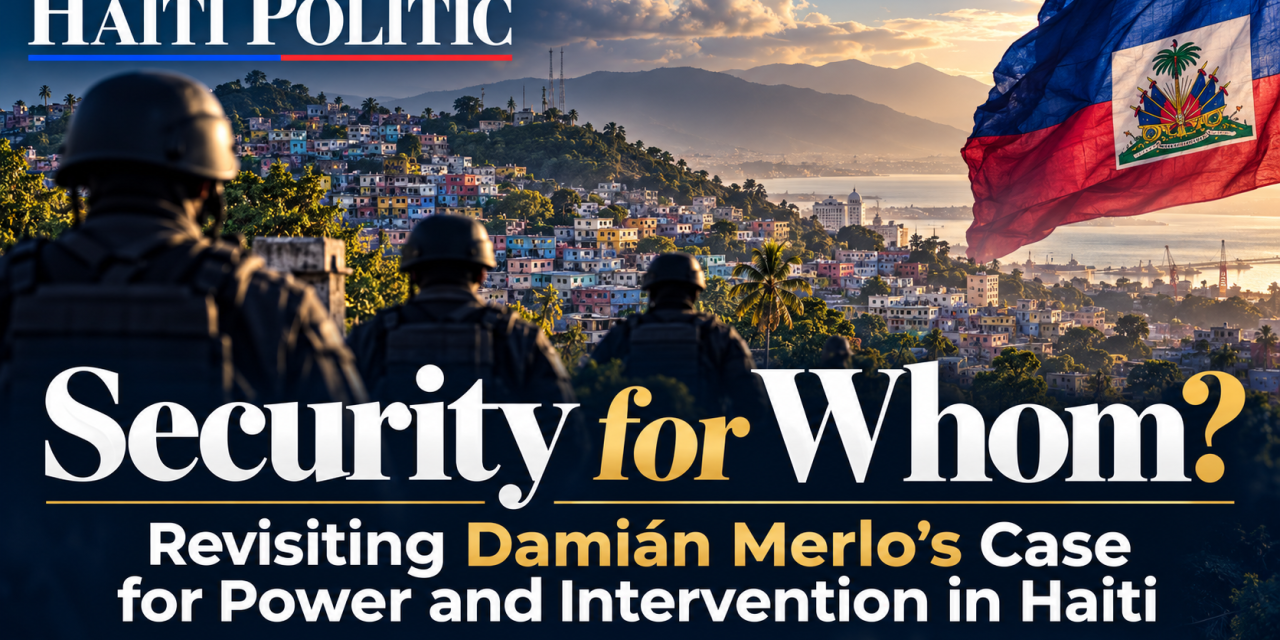
Those questions frame our reading of Damián Merlo’s opinion column, “La crisis en Haití, un análisis,” published by Diario Las Américas. A contemporaneous university bibliography dates the column to October 11, 2022. It should be read as an archival argument, rather than mistaken for current reporting because of the website’s changing date header.
Merlo’s argument is clear. He defends Ariel Henry, favors foreign military intervention, portrays political opponents as impediments to stability and presents Michel Martelly’s presidency favorably. He also suggests a connection between stalled negotiations involving the Montana group and the mobilization of gangs, while urging that obstructive elites be excluded from negotiations. He identifies Jovenel Moïse as “presidente y amigo mío”—president and my friend.
These are consequential political judgments. They deserve scrutiny on evidence and democratic principle, regardless of the author’s personal relationships.
Personal confidence cannot replace public accountability
Political advocacy often begins with an assurance that a particular leader means well. Citizens need something more durable.
A sound transitional arrangement should specify its legal basis, limits, spending controls, security responsibilities and route to replacement. The public should be able to assess progress without accepting an adviser’s confidence as proof.
Security can be a genuine prerequisite for elections. People cannot participate freely while threatened, displaced or unable to reach a polling station. But that practical difficulty does not settle who should govern during the delay or how long exceptional authority should last.
A defensible transition must pursue security and political accountability together. Otherwise, the conditions needed for elections can become an indefinitely postponed destination, while temporary rulers retain the advantages of office.
Later events make that distinction especially important. Henry’s resignation became public on April 25, 2024, when a transitional presidential council was installed. CARICOM welcomed the council while explicitly describing its installation as only one of several necessary steps toward constitutional government.
A change of officeholders is an event. A functioning democratic order requires institutions that can survive the next change.
Accusations require evidence, including against opponents
The column’s suggestion about Montana negotiations and gang mobilization is especially serious. The article does not present evidence establishing that causal connection.
Political disagreement, failed bargaining and criminal coordination are different propositions. To establish the third, investigators need identifiable actors, communications, financing, orders or other corroborated evidence.
A violent incident occurring after a political disagreement does not establish who arranged it. The same evidentiary standard should apply to government supporters, opposition leaders, business figures and foreign-connected actors.
That standard protects the public twice. It helps prevent innocent people from being accused by association, and it makes actual criminal networks harder to hide behind broad political labels.
An opposition group deserves scrutiny of its proposals, conduct and financing. A government deserves scrutiny of its decisions, spending and use of force. Neither should gain immunity because the other has faults.
Nor should disagreement with a favored security proposal automatically cost someone a place in political negotiations. Exclusion should follow defensible criteria—such as substantiated criminal involvement—not a sponsor’s preference for more agreeable participants.
The Martelly record cannot be exempt from the test
Merlo’s favorable account of the Martelly period requires reassessment alongside subsequent official findings.
On August 20, 2024, the U.S. Treasury announced sanctions against Michel Martelly, alleging involvement in drug trafficking, laundering illicit proceeds and sponsoring gangs. These were administrative sanctions and allegations, not a criminal conviction. They also came after the 2022 column; they should not be presented as information available to its readers at publication.
Their relevance today is nevertheless direct. An accountability argument cannot investigate elite influence selectively. The conduct of former presidents and their associates belongs within the same scrutiny applied to their opponents.
That does not justify treating every member of a party, family or professional network as culpable. It does require following evidence wherever it leads, including toward people previously presented as stabilizing forces.
A coherent anti-gang policy must confront the people who enable criminal power as well as those who exercise it on the street.
Sovereignty and effective assistance can coexist
Merlo dismisses sovereignty arguments used against intervention. Haiti Politic takes a different position: the design of foreign assistance should be open to democratic questioning.
Who authorizes an operation? Who commands it? Which rules govern force? Who investigates civilian harm? What happens when a participating officer commits an abuse? What capacity remains with Haitian institutions when the mission leaves?
Those questions make assistance more accountable and potentially more effective.
History supplies a concrete reason to insist on answers. In December 2016, UN Secretary-General Ban Ki-moon apologized for the United Nations’ role in Haiti’s cholera tragedy and acknowledged that the organization had not done enough.
That history does not establish that every future mission must fail. It establishes why public trust cannot be demanded in advance of safeguards.
Haitians should be able to support urgently needed protection while requiring transparent mandates, independent complaints mechanisms, remedies for harm and a credible transfer of capacity to Haitian institutions.
International responsibility also extends beyond deployments. At a 2023 Security Council meeting, UNODC’s executive director described illicit firearms and drug flows as drivers of Haiti’s violence. The assessment discussed trafficking by land, air and sea.
A serious partnership should therefore address weapons supply chains, financial networks, customs capacity, investigations and prosecutions alongside operational assistance.
A better standard for a security policy
Haiti Politic would judge a proposal by results citizens can independently assess: safer travel, accessible schools and hospitals, protection for displaced people, functioning courts, documented arrests that withstand judicial scrutiny and public accounting for security spending.
An electoral timetable should include published milestones and explanations when deadlines are missed. Operational secrecy may protect an imminent mission; it should not conceal a mission’s legal authority, overall budget or responsibility for misconduct.
The strongest case for assistance would explain how these protections work and how Haitians can challenge failures without being labeled enemies of stability.
Haiti deserves protection from armed groups and effective institutions through which citizens can hold power accountable. Every Haitian leader, foreign government, adviser and security partner should be measured against both obligations.
Editorial note: This is an original commentary responding to an archival opinion column. It is not a republication, translation or endorsement. The 2024 developments discussed above postdate the original argument.