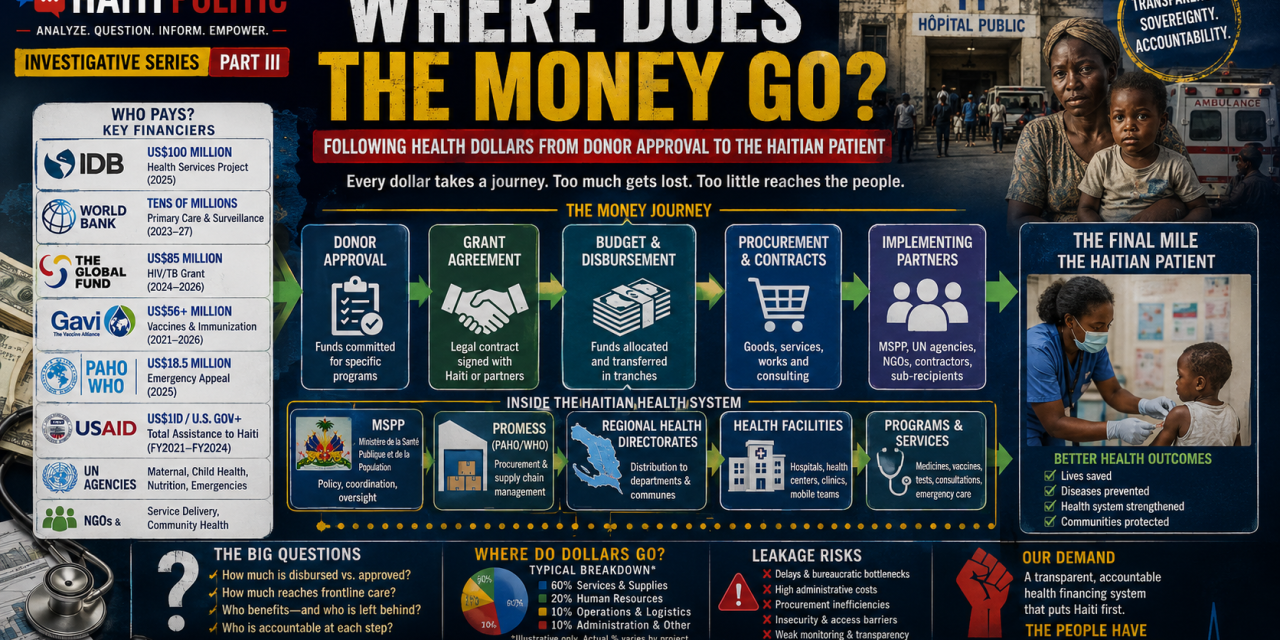
Following Health Dollars from Donor Approval to the Haitian Patient
Approved. Committed. Disbursed. Procured. Delivered. Treated.
Between those six words sits the real story of Haiti’s health financing system.
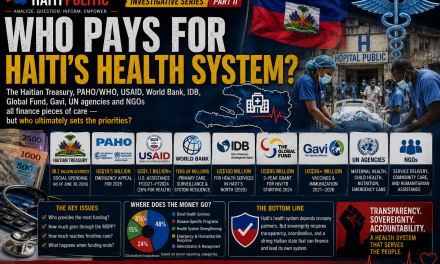
In Part II, Haiti Politic examined who pays for Haiti’s health system.
This third investigation asks a harder question:
Once a donor announces $20 million, $85 million, or $100 million for Haiti, how much of that money actually reaches a Haitian patient—and through which institutions does it pass before it gets there?
The answer is rarely simple.
A donor may approve $100 million. But that does not mean $100 million enters the MSPP bank account the next morning.
The money can move through:
multilateral institutions, project-management units, procurement systems, UN agencies, principal recipients, contractors, NGOs, warehouses, regional health directorates, public hospitals and community clinics.
By the time the patient sees a doctor, receives a vaccine, gets an HIV test, receives antibiotics or reaches an ambulance, the original financing has already passed through an extensive chain of administration.
That chain is not automatically evidence of waste.
Many layers exist because medicines must be purchased, hospitals constructed, grants audited, staff trained and fraud controlled.
But every additional layer raises legitimate questions about:
administrative cost, transparency, delays, procurement, local ownership and accountability.
💵 THE BASIC MONEY TRAIL
Health aid should never be evaluated only by the headline amount.
A more accurate chain is:
DONOR APPROVAL
⬇
LEGAL AGREEMENT / GRANT SIGNATURE
⬇
BUDGET ALLOCATION
⬇
DISBURSEMENT
⬇
PROCUREMENT OR SUB-GRANTS
⬇
IMPLEMENTING ORGANIZATION
⬇
HEALTH FACILITY / COMMUNITY PROGRAM
⬇
PATIENT
At each stage, the amount can mean something different.
Approved
The donor has authorized the project.
Committed
Money has been formally reserved or contracted.
Disbursed
Money has actually been transferred.
Expended
The implementing organization has spent it.
Delivered
Goods or services physically reached the health system.
Outcome
A patient actually benefited.
Those are not interchangeable measurements.
🏛️ TRACK 1 — HAITIAN TREASURY → MSPP → PUBLIC HEALTH SYSTEM
The most direct sovereign financing route begins with Haiti itself.
The revised 2025–2026 national budget allocates roughly 19.72 billion gourdes to the Ministry of Public Health and Population, including about 14.83 billion gourdes for operating expenditures and 4.89 billion gourdes for investment.
But even this apparently straightforward route has multiple stages:
DGI / Customs / Treasury revenue
⬇
Ministry of Economy and Finance
⬇
Budget authorization
⬇
MSPP
⬇
Central administration / departmental health directorates / programs
⬇
Public hospitals and clinics
⬇
Health workers, medicines, equipment and services
⬇
Patient
The advantage of Treasury financing is sovereignty.
The Haitian state decides how public money is appropriated.
The weakness is fiscal capacity.
The government’s entire revised 2025–26 budget contains about 290.2 billion gourdes in domestic resources and 70.1 billion gourdes in external resources.
So even Haiti’s national budget itself already contains an external-financing component.
That means the line between domestic government spending and foreign-supported spending is not always as simple as it appears.
🔎 FIRST ACCOUNTABILITY TEST: BUDGETED DOES NOT MEAN SPENT
A ministry can receive an appropriation on paper and still fail to spend the entire amount.
That can happen because of:
procurement delays;
security conditions;
cash-flow constraints;
bureaucratic authorization;
projects that never begin;
contracting disputes;
or administrative incapacity.
Fortunately, Haiti’s Directorate General of the Budget publishes execution reports, including expenditures funded by the Treasury.
The public should therefore evaluate MSPP using two numbers, not one:
How much was budgeted?
and
How much was actually executed?
Only after that should the public ask the third question:
What health outcomes were purchased with it?
🏦 TRACK 2 — IDB → HAITI → PROJECT UNIT → CONTRACTORS → FACILITIES → PATIENT
The Inter-American Development Bank’s US$100 million “Rebuilding Access to Essential Health Services” project provides a useful real-world example.
The grant was approved in October 2025 and is now listed as being in implementation. It is intended to strengthen essential health services in Haiti’s North, Northeast and Northwest departments.
Its pathway is broadly:
IDB
⬇
Sovereign grant agreement with Haiti
⬇
Haitian executing structures / project administration
⬇
Procurement plans
⬇
Construction companies / suppliers / consultants / equipment vendors
⬇
Health network and facilities
⬇
Doctors, nurses, medicines and equipment
⬇
750,000 targeted beneficiaries
The IDB says the grant will be disbursed over 84 months, not delivered as a single lump-sum payment.
That is crucial.
When the public hears:
“IDB gives Haiti $100 million for health”
the more accurate formulation is:
The IDB approved a $100 million multi-year grant whose funds will be disbursed during implementation subject to the project agreement, procurement, milestones and financial controls.
🧾 THE IDB PAPER TRAIL ALREADY EXISTS
The IDB project page currently publishes:
a procurement plan;
a general procurement notice;
a project monitoring report;
the grant contract;
and execution-related documentation.
This creates exactly the type of audit trail Haiti needs.
The next questions should be:
Which contracts have actually been awarded?
To whom?
For how much?
Which companies are Haitian?
Which are international?
How much has already been disbursed?
How much remains undisbursed?
Which facilities have physically received equipment?
Which facilities are now treating more patients?
Those questions turn a $100 million announcement into a real investigation.
🏥 WHERE THE IDB MONEY IS SUPPOSED TO END UP
The project is expected to strengthen services at approximately 40 priority locations and includes major rehabilitation of Hôpital Universitaire Justinien in Cap-Haïtien.
That means ultimate accountability should not end at an IDB spreadsheet.
A reporter should eventually be able to visit a facility and ask:
Was the rehabilitation completed?
Does the equipment work?
Is electricity reliable?
Are doctors present?
Are medicines stocked?
How many additional patients are being treated?
If the answers cannot be demonstrated locally, the project cannot be evaluated solely from the donor’s approval amount.
🌍 TRACK 3 — WORLD BANK → MSPP / PROJECT UNIT → HEALTH FACILITY
The World Bank follows another structured development-financing model.
Its primary-health and surveillance investments in Haiti have financed areas such as:
primary healthcare;
cholera response;
disease surveillance;
maternal and child health;
institutional strengthening;
and emergency preparedness.
A previous additional financing package provided US$20 million to strengthen primary healthcare and surveillance.
The pathway generally resembles:
World Bank financing
⬇
Grant agreement with Haitian government
⬇
MSPP / designated project implementation structure
⬇
Annual work plans and procurement
⬇
Service contracts / facility financing / supplies / training
⬇
Health institutions
⬇
Patient
This structure is important because the World Bank typically does not operate Haitian hospitals itself.
It finances an agreed program and supervises financial and implementation performance.
The Haitian side still has to execute it.
⚠️ PROJECT-MANAGEMENT UNITS: NECESSARY TOOL OR PARALLEL STATE?
One of the recurring questions in donor-financed government projects is the role of specialized project implementation units.
These units can be useful because they provide:
financial specialists;
procurement officers;
monitoring personnel;
auditors;
engineers;
and donor-compliance expertise.
But they create a policy problem if the project unit becomes far more capable than the permanent ministry surrounding it.
The project succeeds.
The grant ends.
The consultants leave.
And the ministry returns to its previous capacity.
That leads to a crucial test:
Does donor financing build the MSPP—or simply build a temporary project administration beside the MSPP?
🦠 TRACK 4 — GLOBAL FUND → PRINCIPAL RECIPIENT → SUB-RECIPIENT → PATIENT
The Global Fund offers perhaps the clearest example of a formal cascade system.
Its general grant model works this way:
Global Fund
⬇
Country Coordinating Mechanism
⬇
Principal Recipient
⬇
Sub-recipients
⬇
Clinics / laboratories / community organizations
⬇
HIV/TB services
⬇
Patient
The Global Fund explicitly states that its Principal Recipients may be ministries, NGOs, private institutions or other organizations. Principal Recipients can then transfer funds to sub-recipients that deliver services locally.
That is a deliberate structure.
It allows funding to reach populations that a central government may struggle to reach.
🇭🇹 HAITI HAS USED MSPP ITSELF AS A PRINCIPAL RECIPIENT
This point is particularly important.
Global Fund data show that for an earlier systemic health-strengthening grant, the Ministère de la Santé Publique et de la Population — through its Unité de Gestion des Projets — served as Principal Recipient.
That grant was signed for US$29.83 million, with about US$23.23 million reported disbursed before financial closure.
This demonstrates that foreign health financing does not always bypass the Haitian government.
Sometimes the MSPP itself is responsible for managing major international grants.
That creates both an opportunity and an accountability obligation.
If MSPP is the Principal Recipient, then Haitians should be able to ask:
Which sub-recipients received money?
How much?
What did they deliver?
What did MSPP spend directly?
What remained unspent?
What performance targets were met?
💉 WHERE THE CURRENT GLOBAL FUND MONEY GOES
The present Global Fund program includes a US$85 million three-year grant beginning in January 2024, plus more than US$1.8 million in emergency financing.
The emergency money was designated for activities including:
post-exposure prophylaxis for survivors of sexual violence;
HIV testing;
TB screening;
mobile clinics;
services in shelters and displacement settings;
prevention of mother-to-child HIV transmission;
and blood-safety supplies.
In this case, the true final “product” is not a building.
It may be:
one HIV test;
one dose of preventive medication;
one TB diagnosis;
one safe blood transfusion;
or
one displaced patient reached by a mobile clinic.
That is why health-financing accountability must connect dollars to services.
📊 THE GLOBAL FUND HAS ONE TRANSPARENCY ADVANTAGE
Its Data Explorer now publishes increasingly granular financial information, including:
budgets;
disbursements;
expenditures;
and intervention-level financial data.
Haiti should demand comparable transparency across every major health donor.
Imagine one public portal where citizens could compare:
Global Fund → $X disbursed
IDB → $X disbursed
World Bank → $X disbursed
Gavi → $X disbursed
Treasury → X gourdes executed
PAHO → $X received / spent
UNICEF → $X implemented
That would dramatically change public accountability.
💉 TRACK 5 — GAVI → VACCINES → UNICEF/PAHO/MSPP LOGISTICS → CHILD
Gavi financing illustrates another kind of pathway.
The financing may not simply appear as money that a local clinic can spend.
Much of it supports:
vaccine procurement;
cold-chain equipment;
technical assistance;
campaign implementation;
health-system strengthening;
and immunization programs.
The pathway can therefore resemble:
Gavi
⬇
Approved vaccine / program financing
⬇
International procurement and implementing partners
⬇
MSPP national immunization system
⬇
Cold chain
⬇
Departmental vaccine distribution
⬇
Health center / mobile vaccination team
⬇
Child receives vaccine
This means the Haitian patient may receive the benefit in kind, not as visible cash transferred to MSPP.
That is another reason simple financial accounting can be misleading.
🚚 THE LAST MILE MAY MATTER MORE THAN THE DONOR
A vaccine can be fully financed.
Purchased correctly.
Delivered to Haiti.
Stored in Port-au-Prince.
And still fail to reach a child.
Why?
Because the last mile can fail.
Fuel shortages.
Gang-controlled roads.
Broken refrigerators.
Electricity failure.
Staff absenteeism.
Insecurity.
Population displacement.
Cold-chain interruption.
Missing syringes.
No community outreach.
Therefore:
Procurement success is not patient success.
The true endpoint is not:
“vaccine arrived in Haiti.”
It is:
“eligible Haitian received vaccine safely and on time.”
📦 TRACK 6 — PAHO/WHO → PROMESS → HEALTH FACILITIES
PAHO/WHO occupies a particularly important logistical position through PROMESS, Haiti’s essential medicines and supplies system.
PROMESS was created in 1992 and has functioned under PAHO/WHO technical and managerial leadership while coordinating with MSPP. It serves as a major national warehouse and supply mechanism for essential medicines and medical supplies.
The pathway can look like:
Donor / UN agency
⬇
PAHO/WHO / PROMESS
⬇
Central warehouse
⬇
MSPP / health programs / humanitarian partners
⬇
Hospitals and clinics
⬇
Medicine administered to patient
This is not simply “aid money.”
It is a supply-chain architecture.
⚠️ THE PROMESS PARADOX
PROMESS demonstrates both the value and weakness of Haiti’s international health architecture.
PAHO documentation has historically described PROMESS as indispensable for supplying medicines.
But it has also acknowledged that reliance on external financing and agreements prevented it from evolving fully into the comprehensive national pharmaceutical supply system originally envisioned.
That is the larger Haiti dilemma in miniature:
An international partnership becomes essential precisely because the national institution remains weak—and because it remains essential, the transition to complete national ownership becomes harder.
🇺🇸 TRACK 7 — U.S. FUNDING → CONTRACTORS/NGOS → SERVICE DELIVERY
U.S. health assistance has historically followed several routes.
Not all USAID money goes directly to the Haitian Treasury.
A simplified pathway can be:
U.S. Congress / U.S. government
⬇
USAID / other U.S. health agencies
⬇
Cooperative agreement / contract / grant
⬇
U.S. contractor / international NGO / Haitian NGO
⬇
Program staff / supplies / clinics / community programs
⬇
Patient
USAID OIG reported that the U.S. government committed more than US$1.1 billion in total Haiti assistance from FY2021 through FY2024, with health representing about 26% of program funding by area in its breakdown.
But that figure does not mean 26% was deposited into MSPP accounts.
This distinction is critical.
💼 THE CONTRACTOR QUESTION
International assistance may finance:
salaries;
vehicles;
security;
offices;
IT systems;
international specialists;
monitoring personnel;
audit costs;
procurement teams;
travel;
local partners;
and actual medical services.
Many of these costs are legitimate components of delivering a program.
But the public should still ask:
What percentage of every donor dollar reaches actual frontline service delivery?
Without that breakdown, “US$50 million for health” tells only half the story.
🏥 THE PATIENT DOESN’T CARE WHO FUNDED THE BANDAGE
From the patient’s perspective, the system looks much simpler.
A pregnant woman wants a safe delivery.
A child needs a vaccine.
A tuberculosis patient needs treatment.
A trauma victim needs blood.
A diabetic needs insulin.
A displaced family needs a clinic.
The patient does not care whether the service was financed by:
the Haitian Treasury, IDB, World Bank, Global Fund, Gavi, PAHO, USAID, UNICEF or an NGO.
But taxpayers and citizens should care deeply about the financing architecture.
Because someone must remain responsible when the service disappears.
🧮 THE MOST IMPORTANT FORMULA
For every project Haiti Politic should ask:
APPROVED AMOUNT
minus
UNDISBURSED FUNDS
minus
ADMINISTRATION
minus
CONSULTING / MANAGEMENT
minus
PROCUREMENT COST
minus
LOGISTICS
minus
UNUSED / RETURNED FUNDS
=
ACTUAL VALUE DELIVERED TO THE HEALTH SYSTEM
And then one final question:
What measurable improvement did the patient receive?
That is the figure that ultimately matters.
🔎 WHAT CAN DISAPPEAR WITHOUT BEING “STOLEN”?
This is an important distinction.
Money does not have to be embezzled for a project to produce poor value.
Aid can lose impact through:
slow implementation;
duplicated studies;
repeated workshops;
unused equipment;
construction delays;
high logistical costs;
international salaries;
security costs;
poor planning;
currency losses;
stock expiration;
inaccessible facilities;
or programs that collapse after donor funding ends.
Those are efficiency problems, not necessarily corruption.
A serious investigation must distinguish the two.
🚨 AND THEN THERE IS CORRUPTION RISK
Healthcare procurement is inherently vulnerable.
Medicines.
Fuel.
Construction.
Vehicles.
Laboratory supplies.
Equipment.
Consulting contracts.
Warehousing.
Distribution.
Every category can be manipulated through:
inflated prices;
phantom deliveries;
conflicts of interest;
noncompetitive contracting;
substandard products;
kickbacks;
ghost employees;
or diverted medicines.
Therefore the health-financing question cannot stop at:
“How much did the donor give?”
It must include:
“Who got the contract?”
📋 THE PUBLIC CONTRACT DATABASE HAITI NEEDS
Every major donor-funded health project should disclose, where legally possible:
| Field | What the public should see |
|---|---|
| Donor | Name |
| Project | Program name |
| Approved amount | Original authorization |
| Signed amount | Contract/grant total |
| Disbursed | Actual transfers |
| Expended | Actual spending |
| Implementer | Ministry, UN agency, NGO or contractor |
| Sub-recipient | Recipient organizations |
| Procurement | Vendor and contract |
| Location | Department/commune |
| Output | Facility, medicine, vaccine, training, service |
| Beneficiaries | Number reached |
| Outcome | Health result |
| Audit | Findings |
| Remaining balance | Unspent funds |
That single table would answer many of the questions Haitians currently struggle to resolve.
📍 FOLLOW THE MONEY GEOGRAPHICALLY
Another missing element is geographic transparency.
A donor can claim:
“500,000 people benefited.”
But where?
Port-au-Prince?
Cap-Haïtien?
Artibonite?
Nippes?
Grand’Anse?
Nord-Est?
A national financing dashboard should map every substantial health investment by:
department → commune → facility → program.
That would immediately show whether certain regions are repeatedly favored while others remain underserved.
🏚️ WHAT ABOUT GANG-CONTROLLED AREAS?
This is now one of the largest distortions in health financing.
The Global Fund explicitly says insecurity has disrupted implementation through:
limited access to gang-controlled areas;
transport difficulties;
staff shortages;
and higher operating costs.
PAHO’s 2025 emergency appeal says 4.2 million people needed health assistance and sought US$18.5 million to target about 1.8 million people.
This raises a painful equity question:
Do health dollars increasingly flow toward the populations easiest to reach rather than the populations in greatest need?
If so, security becomes a health-financing problem.
A donor cannot finance access to a clinic that no doctor can safely enter.
⚖️ WHO IS ACCOUNTABLE WHEN FIVE ORGANIZATIONS TOUCH THE SAME DOLLAR?
Consider a hypothetical chain:
Donor
→ UN agency
→ international NGO
→ local NGO
→ clinic
→ patient
If the patient receives nothing, who is responsible?
The donor?
The UN agency?
The NGO?
MSPP?
The clinic?
That fragmented accountability is one of the greatest weaknesses of heavily donor-financed systems.
Everyone has responsibility.
And sometimes that means no single institution owns the failure.
🇭🇹 THE MSPP SHOULD BECOME THE NATIONAL FINANCING CONTROL TOWER
The solution is not necessarily to demand that every international dollar pass through a single Haitian bank account.
That may not always be efficient or appropriate.
But MSPP should at minimum possess a complete real-time picture of:
who is financing what;
where;
for how long;
through which implementer;
with what results;
and
what happens when the financing ends.
Without that information, national health planning becomes impossible.
🧠 HAITI ALREADY RECOGNIZES THE FINANCING PROBLEM
The MSPP’s new 2026–2030 strategic plan covering reproductive, maternal, newborn, child, adolescent and older-person health explicitly says required resources remain subject to resource mobilization.
It identifies cooperation with partners including PAHO/WHO, USAID, UNICEF, UNFPA and other financing partners, and points to Haiti’s participation in the World Bank-linked Global Financing Facility as part of the investment-planning architecture.
That is a revealing admission.
Haiti can develop a national plan.
But implementation still depends substantially on assembling financing from multiple partners.
🔥 THE “DONOR PROJECT ENDS” TEST
Every foreign-funded project should have to answer this question before it begins:
WHO PAYS IN YEAR 6?
If an IDB grant finances 50 new nurses, who pays them after the grant?
If Gavi purchases equipment, who maintains it?
If USAID finances a clinic, who keeps the clinic open?
If PAHO establishes surveillance software, who pays the server costs?
If the Global Fund supports laboratory technicians, who absorbs those salaries later?
Sustainability cannot be an afterthought.
It should be part of the original financing agreement.
📊 HAITI POLITIC — MONEY-TO-PATIENT SCORECARD
| Financing stream | Money path | Final patient benefit | Main accountability risk |
|---|---|---|---|
| Haitian Treasury | MEF → MSPP → public system | General public care | Low execution / limited fiscal resources |
| IDB | IDB → Haiti/project structures → procurement → facilities | Expanded essential services | Slow procurement / sustainability |
| World Bank | Bank → government project unit → services | Primary care/surveillance | Parallel project capacity |
| Global Fund | Fund → Principal Recipient → sub-recipients | HIV/TB prevention and treatment | Fragmented implementation |
| Gavi | Gavi → procurement/partners → EPI system | Vaccination | Last-mile cold chain/access |
| PAHO/WHO | Donors → PAHO/PROMESS → health system | Medicines/emergency services | Long-term external dependency |
| USAID/U.S. | U.S. → contractor/NGO → program | Multiple health services | Administrative layers / continuity |
| UN agencies | Donors → agency → implementers | Maternal/child/nutrition/emergency care | Fragmentation |
| NGOs | Donor/subgrant → NGO → clinic/community | Direct service | Oversight and integration |
🎤 20 QUESTIONS FOR THE NEXT HEALTH-DOLLAR AUDIT
- How much health financing was approved for Haiti in 2026?
- How much was actually disbursed?
- How much was actually spent?
- How much flowed directly through MSPP?
- How much flowed through international institutions?
- How much flowed through NGOs?
- How much was spent outside Haiti on international administration?
- What are the ten largest health contracts currently operating in Haiti?
- Who owns the companies holding those contracts?
- How much money went to Haitian businesses?
- How much went to foreign contractors?
- What percentage purchased medicines and medical supplies?
- What percentage funded salaries?
- What percentage funded consultants and administration?
- How many facilities actually benefited?
- How many patients actually benefited?
- Which departments received the most financing per capita?
- Which projects are currently behind schedule?
- Which programs would collapse if donor financing ended this year?
- Will MSPP publish a national donor-to-patient financial dashboard?
🧭 THE INVESTIGATIVE CONCLUSION
Haiti’s health-financing story does not end when the donor board approves a grant.
That is where it begins.
A US$100 million IDB grant does not treat a patient until the procurement is completed, the facility is repaired, the staff are present and the service is actually delivered.
An US$85 million Global Fund grant has no human value until HIV medication, TB testing, laboratory capacity and community services reach people who need them.
A vaccine financing commitment means little if the vial never survives the cold chain.
A Treasury appropriation means little if the funds are never executed.
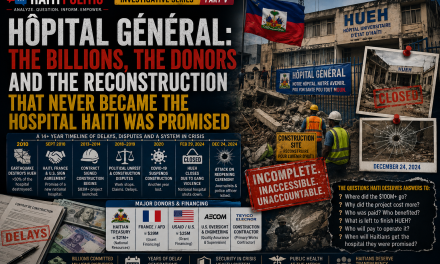
A hospital construction contract means little if the building cannot operate after the donor leaves.
And a donor report claiming thousands of beneficiaries means little unless Haiti itself can independently verify those results.
THE REAL UNIT OF ACCOUNTABILITY IS NOT THE DOLLAR ANNOUNCED.
IT IS THE HEALTH SERVICE ACTUALLY DELIVERED.
Haiti should therefore move toward a radically transparent system capable of connecting:
donor → dollar → contract → supplier → facility → service → patient → outcome.
Until that chain is visible, Haitian citizens will continue hearing enormous funding announcements while struggling to answer a very basic question: