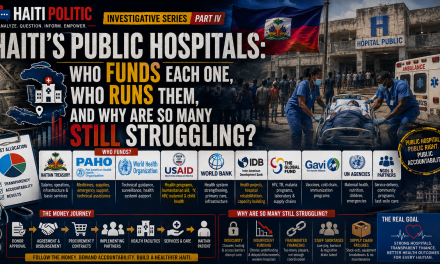

From the 2010 earthquake to French, U.S. and Haitian financing, construction disputes, years of delay, the 2024 closure and an armed attack on its attempted reopening — how Haiti’s most important public hospital became a case study in reconstruction without completion.
HUEH. USAID. France/AFD. Haitian Treasury. Construction contracts. Delays. Security. Public health. Procurement. Accountability.
There may be no single institution that better represents Haiti’s post-earthquake reconstruction problem than the Hôpital de l’Université d’État d’Haïti (HUEH) — the national teaching hospital known simply to generations of Haitians as Hôpital Général.
It was supposed to become one of the flagship achievements of the post-2010 reconstruction.
France committed money.
The United States committed money.
The Haitian government committed money.
A multinational construction arrangement was assembled.
Engineers were hired.
Designs were approved.
Contracts were signed.
Construction began.
And yet, more than sixteen years after the earthquake, Haitians still do not have the fully functioning national referral hospital that the project was meant to deliver.
That does not mean that nothing was built. Significant construction occurred.
It does mean the public is entitled to ask a much harder question:
HOW DOES A HOSPITAL PROJECT BACKED BY THREE GOVERNMENTS, INTERNATIONAL ENGINEERS AND ROUGHLY US$100 MILLION STILL FAIL TO BECOME THE FULLY OPERATIONAL NATIONAL HOSPITAL HAITI WAS PROMISED?
The answer is not one scandal.
It is a timeline of planning delays, evolving budgets, construction disputes, civil unrest, COVID-19 disruption, weak institutional continuity and finally a security collapse so severe that armed groups were able to shut the country’s principal public hospital altogether.
🕰️ 2010 — THE EARTHQUAKE DESTROYS THE HEART OF HAITI’S PUBLIC HEALTH SYSTEM
On January 12, 2010, the earthquake devastated Port-au-Prince.
The HUEH campus was already suffering from severe maintenance problems before the disaster. According to the AFD, more than half of the hospital was destroyed or rendered unusable by the earthquake. More than 50 hospitals and health centers nationwide also collapsed or became unusable.
The stakes were enormous.
HUEH was not just another hospital.
It was Haiti’s:
principal national referral institution;
largest public teaching hospital;
major training site for physicians and specialists;
and a crucial provider of care for patients unable to afford private medicine.**
Rebuilding it therefore became a priority of the post-earthquake reconstruction.
🇭🇹🇺🇸🇫🇷 SEPTEMBER 2010 — THREE GOVERNMENTS MAKE A DEAL
The United States, France and Haiti agreed to reconstruct the hospital jointly.
The U.S. Government Accountability Office says the three governments signed a memorandum of understanding in September 2010 for the rehabilitation, reconstruction and modernization of HUEH.
The arrangement appeared to represent exactly the kind of international cooperation Haiti needed after the earthquake:
Haiti owned the hospital.
France supplied major financing and technical support.
The United States supplied financing and engineering oversight.
The problem was that signing an agreement and producing a functioning hospital would prove to be very different things.
⏳ 2011 — THE FIRST DELAYS ARRIVE BEFORE CONSTRUCTION EVEN STARTS
A 2011 GAO investigation is particularly revealing because it documents the problems while they were happening—not years afterward.
At the time, USAID expected construction to be awarded in late 2011 and completed by June 30, 2013.
Instead, the project was already approximately five months behind schedule because, among other things, a USAID-funded environmental assessment was taking longer than planned.
This is the first important lesson in the HUEH story:
The project was delayed before the main reconstruction contract had even begun.
GAO found broader problems across U.S. reconstruction infrastructure in Haiti, including planning and staffing constraints. As of September 2011, USAID and the State Department had allocated nearly $412 million for infrastructure projects across several sectors but had expended only about $3.1 million.
HUEH was part of that larger reconstruction environment.
💵 WHAT WAS THE ORIGINAL HUEH BUDGET?
This is where the financial history becomes particularly important.
In 2013, officials described the reconstruction program as totaling approximately:
US$83.2 million
with:
USAID — US$25 million
France/AFD — US$25 million
Haitian government — US$33.2 million.
A construction contract valued at approximately US$41.48 million was announced in August 2013.
The work was expected to last 34 months.
If that schedule had held, the reconstructed hospital would essentially have been delivered around 2016.
It wasn’t.
💰 THE FINANCING NUMBERS LATER CHANGED
This is one of the areas journalists should explain carefully.
The project’s financing did not remain frozen at the original 2013 figures.
AFD’s current project description lists:
France/AFD — US$39 million
United States — US$25 million
Haiti — US$21 million
and says the overall project has evolved toward approximately US$100 million, with part of the total still needing to be completed.
This differs from the earlier structure of $25M + $25M + $33.2M.
That does not automatically imply that money disappeared.
Large infrastructure projects can undergo revised financing structures, reallocations and supplementary costs.
But it creates a legitimate accountability question:
WHY DID THE FINANCING MODEL CHANGE, AND CAN THE PUBLIC SEE A COMPLETE RECONCILIATION OF EVERY CONTRIBUTION, contract amendment and expenditure?
The original project was roughly $83 million.
The more recent AFD description places it near $100 million.
That is a difference of roughly $17 million in overall project scale.
The public deserves a clear explanation of why.
🏗️ 2013–2014 — THE CONSTRUCTION CONTRACT
The government announced the reconstruction contract in August 2013.
The Spanish firm Teyico Elecnor was identified as the company responsible for executing the works, while Haiti’s Unité Technique d’Exécution (UTE) within the Ministry of Economy and Finance was responsible for project conduct in collaboration with the Ministry of Health.
The project was unusually difficult from the beginning.
Haiti wanted HUEH to remain on its existing downtown site.
And the hospital was supposed to continue treating patients while reconstruction occurred around it.
USAID’s infrastructure-program documentation says the Haitian government specifically requested that HUEH remain at the same location in order to preserve downtown access and continuity of care.
The UTE issued the formal Notice to Proceed on April 29, 2014.
So despite the 2013 contract announcement, the main construction clock effectively began in 2014.
Already, the original timeline had slipped.
🏥 WHAT WAS HAITI SUPPOSED TO GET?
This was not supposed to be a cosmetic rehabilitation.
The project envisioned a modern referral and university hospital designed to:
reorganize hospital services;
rebuild and upgrade infrastructure;
equip medical departments;
strengthen clinical personnel;
improve administrative and financial management;
and restore HUEH as Haiti’s national reference hospital.
AFD also financed administrative-management reform and professional training through cooperation with French hospitals.
In other words:
THE PROJECT WAS SUPPOSED TO REBUILD BOTH THE BUILDING AND THE INSTITUTION.
That is a much more ambitious task.
🔍 THE UNITED STATES WAS NOT THE MAIN BUILDER — IT WAS ALSO AN OVERSIGHT ACTOR
USAID contracted AECOM to provide quality-assurance reviews and construction oversight.
AECOM’s final Haiti Infrastructure Program report says its personnel repeatedly inspected the site, reviewed architectural, structural, electrical, plumbing and mechanical work, and documented deficiencies for USAID, AFD, UTE and the construction-management team.
During one reporting period alone, AECOM documented:
148 architectural inspections
and
164 mechanical/electrical/plumbing inspections.
This becomes important because one cannot explain HUEH’s history simply by saying:
“Nobody was watching the project.”
International technical oversight was extensive.
The more difficult question is:
Why did extensive oversight still fail to produce timely completion?
🚧 2018–2019 — POLITICAL UNREST HITS THE WORKSITE
Haiti’s political instability increasingly disrupted construction.
AECOM’s report says civil unrest affected site productivity in November 2018 and February 2019.
Across its Haiti infrastructure portfolio, AECOM also described evacuation orders, travel restrictions and severe instability affecting project operations.
This matters because infrastructure projects have a hidden cost that becomes enormous in unstable environments:
security.
Engineers cannot inspect sites they cannot safely reach.
Materials cannot move through blocked roads.
Foreign specialists may evacuate.
Construction crews may stop working.
Schedules stretch.
Costs increase.
HUEH became trapped inside the political crisis that was unfolding outside its walls.
⚠️ JULY 2019 — THE CONTRACT DISPUTE THAT STOPPED THE WORK
Then came one of the most important moments in the entire reconstruction.
USAID’s infrastructure-program report says that in July 2019, a dispute between the construction contractor and the Government of Haiti resulted in stalled negotiations and work stopped.
The public should pay particular attention to this event.
This was no longer merely an earthquake recovery delay.
It was a contractual breakdown.
AECOM says it brought in a multilingual specialist experienced in FIDIC construction-contract claims to analyze the parties’ responsibilities and help negotiations proceed.
That means the dispute had become serious enough to require specialized international contract expertise.
Yet one critical question remains difficult for an ordinary Haitian citizen to answer from the public record:
WHAT EXACTLY WAS THE DISPUTE ABOUT, HOW MUCH MONEY WAS CLAIMED, WHO WAS DETERMINED TO BE RESPONSIBLE, AND WHAT FINANCIAL SETTLEMENT WAS REACHED?
Those records should be public.
🦠 2020 — COVID-19 BRINGS ANOTHER INTERRUPTION
Just as the project was navigating contractual and political problems, COVID-19 arrived.
AECOM reports that USAID halted construction on many Haiti projects from March through September 2020 because of the pandemic.
Again, HUEH became the victim of a larger external shock.
But by this point, the hospital reconstruction had already been underway for roughly six years after the 2014 Notice to Proceed.
The original 34-month schedule was long gone.
📉 2021 — A DECADE AFTER THE EARTHQUAKE, THE PROJECT STILL WASN’T FINISHED
By 2021, the extraordinary duration of the project had attracted renewed U.S. government scrutiny.
The Government Accountability Office later used HUEH as one of its examples of post-earthquake infrastructure construction that had experienced significant delays.
Its 2023 review concluded that most major USAID infrastructure activities it examined experienced delays, budget increases or reductions in scope, partly because initial plans had been unrealistic.
GAO specifically illustrated the slow progress of the HUEH construction between June 2014 and May 2021.
This is significant because the criticism did not come from Haitian opposition parties or social-media commentators.
It came from the United States Government Accountability Office, Congress’s independent auditing arm.
🇺🇸 THE BROADER U.S. RECONSTRUCTION RECORD MATTERS
By 2020, USAID had allocated nearly US$2.3 billion for reconstruction and development activities in Haiti since the earthquake.
GAO found that U.S.-based organizations carried out more than half of USAID-funded reconstruction and development activities during that period.
That doesn’t mean $2.3 billion went to HUEH—it emphatically did not.
But it puts the hospital inside a much larger debate:
How much post-earthquake assistance actually built permanent Haitian institutional capacity?
The same GAO investigation found that local Haitian entities secured only a limited share of USAID funding, partly because of capacity constraints.
That raises a structural question that goes beyond HUEH:
CAN FOREIGN ASSISTANCE BUILD HAITIAN INSTITUTIONS IF SO MUCH OF THE IMPLEMENTATION CAPACITY REMAINS OUTSIDE HAITIAN INSTITUTIONS?
🔨 DID NOTHING GET BUILT? THAT WOULD BE FALSE.
It is important to avoid turning a complicated reconstruction story into a simplistic claim that all the money vanished.
Substantial work was completed.
USAID’s infrastructure report documents continued construction, hundreds of technical inspections and major physical progress. By late 2019, AECOM reported that the project had advanced sufficiently that the contractor no longer required its continuous oversight.
AFD continues to classify the reconstruction as an active project and describes the broader goal as restoring the hospital’s reference functions.
The correct criticism therefore isn’t:
“Nothing was done.”
The stronger criticism is:
After more than a decade, substantial international financing and extensive construction, the project still failed to deliver a fully operational national hospital before Haiti’s security crisis overtook it.
That distinction matters.
🔫 FEBRUARY 29, 2024 — THE RECONSTRUCTION STORY BECOMES A SECURITY STORY
By 2024, HUEH’s biggest problem was no longer construction.
It was territorial control.
PAHO reports that the hospital closed on February 29, 2024, after attacks associated with the expanding gang crisis.
The United Nations later described HUEH as remaining non-operational because of gang violence.
This represents perhaps the most devastating lesson of all.
France could contribute tens of millions.
The United States could contribute tens of millions.
The Haitian government could contribute tens of millions.
International engineers could oversee construction.
But none of that could substitute for the most basic function of a state:
CONTROL THE TERRITORY WHERE THE HOSPITAL IS LOCATED.
🏚️ WHAT HAPPENS TO A NATIONAL HOSPITAL WHEN IT CLOSES?
The closure did not simply inconvenience patients.
HUEH’s disappearance shifted enormous pressure onto the remaining health system.
Patients requiring emergency, surgical, specialty and teaching-hospital services had to seek care elsewhere.
Health workers were displaced.
Medical training was disrupted.
Other hospitals had to absorb patients.
And some poor Haitians lost access to the country’s principal public referral facility.
The reconstruction project’s failure to reach full operational maturity before the security collapse therefore had a compounding effect:
Haiti entered its worst modern security crisis without its national flagship hospital fully available.
🎄 DECEMBER 24, 2024 — THE ATTEMPTED REOPENING ENDS IN BLOODSHED
The government planned a partial reopening of HUEH for Christmas Eve 2024.
Journalists gathered at the hospital.
Gunmen opened fire.
AP reported that two journalists and a police officer were killed, with others wounded.
PAHO’s initial situation report described multiple deaths and injuries and noted that HUEH had been closed since February.
The UN later documented the attack as part of a broader pattern of gang violence against healthcare and humanitarian access.
The symbolism could hardly have been more brutal.
A hospital that international partners spent years trying to rebuild could not safely hold a reopening ceremony.
🧮 SO HOW MUCH DID HUEH ACTUALLY COST?
This is precisely where Haiti needs a forensic public audit.
The available records show several different reference points:
| Stage | Reported amount |
|---|---|
| 2013 overall program | ~US$83.2 million |
| USAID contribution | US$25 million |
| Initial AFD contribution | US$25 million |
| Initial Haitian contribution | US$33.2 million |
| 2013 reconstruction contract | ~US$41.48 million |
| Later AFD commitment | US$39 million |
| Later stated Haitian contribution | US$21 million |
| Current AFD description of overall project | ~US$100 million |
Sources: 2013 reconstruction reporting and AFD project documentation.
These figures cannot simply be added together because some represent revised versions of the same financing architecture.
That is precisely the point.
THE PUBLIC NEEDS ONE RECONCILED LEDGER.
Not scattered numbers published across different years.
📑 THE FORENSIC AUDIT HAITI SHOULD DEMAND
A serious HUEH audit should publish:
Original project budget
Every subsequent budget revision
Every donor commitment
Every donor disbursement
Every Haitian Treasury contribution
Construction contract and amendments
Change orders
Claims submitted by the contractor
Amounts approved or rejected
Payments actually made
Construction-management fees
Engineering and quality-assurance costs
Equipment purchases
Storage costs
Security expenditures
Training expenditures
Administrative-reform expenditures
Remaining unpaid obligations
Value of unfinished works
Current replacement cost
Only then can anyone credibly answer:
Did HUEH become more expensive because of legitimate delays and changed conditions—or because the project was poorly managed?
⚖️ THE ACCOUNTABILITY MAP
The HUEH project had many actors.
That makes accountability difficult.
Haitian State / Treasury
Owner and national financing partner.
MSPP
Health-policy authority and ultimate institutional beneficiary.
UTE
Key Haitian entity responsible for managing the construction process.
France / AFD
Major financing and institutional-support partner.
USAID
Major financing partner.
AECOM
Engineering and construction-quality oversight for USAID.
Teyico Elecnor
Construction contractor identified in the reconstruction agreement.
Construction management and other technical actors
Responsible for various supervision and implementation functions.
When a project has this many institutions involved, failure can become distributed.
Everyone can say:
“Our part was completed.”
But the hospital can still remain unfinished.
That is why the ultimate accountability measure cannot be whether each contractor delivered its individual scope.
It must be:
DID HAITI RECEIVE THE FUNCTIONING HOSPITAL THE PROJECT WAS DESIGNED TO PRODUCE?
🧠 FIVE REASONS THE HUEH PROJECT FAILED TO MATCH ITS PROMISE
1. Unrealistic timelines
USAID initially anticipated completion by 2013.
The primary construction Notice to Proceed did not occur until 2014.
That alone demonstrates how detached the early schedule was from reality.
2. Complex construction on an operating hospital campus
Haiti wanted the hospital to remain on its existing downtown site while medical services continued during construction.
That made an already difficult reconstruction considerably more complicated.
3. Contractual conflict
The 2019 contractor-government dispute stopped work and required outside claims expertise.
Construction disputes cost both time and money.
4. Political instability and COVID
Civil unrest repeatedly interrupted construction.
Then the pandemic brought another major stoppage.
5. State security collapse
Ultimately, the most destructive problem was beyond ordinary project management.
Armed groups rendered the hospital inaccessible and later attacked its reopening.
A construction project cannot overcome the disappearance of territorial security.
🚨 BUT SECURITY CANNOT EXPLAIN THE ENTIRE 14-YEAR RECORD
This point is critical.
It would be misleading to blame everything on today’s gangs.
HUEH had already suffered years of delays before the security environment reached its current catastrophic level.
GAO documented planning problems as early as 2011.
Construction did not formally begin until 2014.
Political instability disrupted work years later.
A contract dispute stopped construction in 2019.
COVID added another delay in 2020.
Gang control then became the dominant problem in 2024.
The security crisis was the final devastating layer.
It was not the first.
🔎 20 QUESTIONS FOR A HUEH PUBLIC HEARING
- What is the complete amount spent on HUEH reconstruction since 2010?
- How much has France actually disbursed?
- How much has the United States actually disbursed?
- How much has Haiti actually paid?
- Why did the original Haitian financing figure change from $33.2 million to the later $21 million figure cited by AFD?
- Why did the project’s overall estimated cost rise from approximately $83 million toward $100 million?
- What was the final value of the Teyico Elecnor contract after amendments?
- How many change orders were issued?
- What caused the July 2019 dispute?
- How much did the contractor claim from the Haitian government?
- Was a settlement reached?
- How much did international construction supervision and consulting cost?
- What percentage of the physical project is actually complete today?
- Which buildings are structurally ready for use?
- What medical equipment has already been purchased?
- Where is that equipment now?
- How much additional money is required to finish and open the hospital?
- What security perimeter would be necessary to operate it safely?
- Who would pay its annual recurrent operating cost after reopening?
- Will the Haitian government, France and the United States jointly publish a complete final reconstruction ledger?
📊 HAITI POLITIC — HUEH TIMELINE
| Year | What happened |
|---|---|
| 2010 | Earthquake severely damages HUEH |
| Sept. 2010 | Haiti, U.S. and France sign reconstruction MOU |
| 2011 | USAID planning already delayed; environmental assessment takes longer than expected |
| 2013 | ~$83.2M financing package publicly described; ~$41.48M construction contract announced |
| Apr. 2014 | Formal Notice to Proceed issued |
| 2014–2018 | Construction and international quality oversight continue |
| 2018–2019 | Political unrest repeatedly affects construction |
| July 2019 | Contractor-government dispute stops work |
| 2019–2020 | Specialist brought in to help resolve contractual claims |
| 2020 | COVID-19 suspends construction activity |
| 2021 | Project remains unfinished more than a decade after earthquake |
| 2023 | GAO cites delays, budget pressures and unrealistic planning across U.S. reconstruction projects including HUEH |
| Feb. 29, 2024 | HUEH closes amid gang violence |
| Dec. 24, 2024 | Attempted reopening attacked; journalists and police officer killed |
| 2025–2026 | Haiti still lacks full use of its national flagship public hospital |
🏛️ THE BIGGER FAILURE IS NOT JUST A BUILDING
There is a temptation to see HUEH as a failed construction project.
That would miss the larger point.
HUEH demonstrates what happens when:
foreign aid;
public procurement;
institutional weakness;
political instability;
contract management;
health-system financing;
and
national security
all intersect.
A hospital can have donors and still fail.
It can have construction contracts and still fail.
It can have engineers and still fail.
It can have completed buildings and still fail.
Because a hospital is not only concrete.
A national hospital requires:
doctors;
nurses;
management;
security;
medicine;
electricity;
water;
oxygen;
laboratories;
maintenance;
transport;
public financing;
and functioning government.
🇭🇹 THE HAITI POLITIC CONCLUSION
HUEH was supposed to symbolize Haiti rebuilding after January 12, 2010.
Instead, its history has come to symbolize something more uncomfortable:
Haiti became extraordinarily good at assembling reconstruction projects without becoming equally good at guaranteeing the institutions those projects were supposed to create.
France contributed.
The United States contributed.
Haiti contributed.
International firms supervised construction.
Contractors built.
Experts trained personnel.
Reports were written.
Years passed.
And before Haiti could fully benefit from the reconstructed national hospital, the country’s institutional and security crisis became so severe that armed groups could shut it down.
This is why the HUEH investigation cannot end with:
“Where did the money go?”
The deeper question is:
WHAT DID THE MONEY LEAVE BEHIND?
If approximately $100 million in international and Haitian commitments cannot reliably produce one secure, functioning national teaching hospital after more than a decade, Haiti has a problem larger than donor financing.
It has a problem of state capacity.
And until that changes, rebuilding buildings will never be enough.