A contract-by-contract audit of Teyico–Elecnor, UTE, AECOM, AFD, USAID, contract amendments, disbursements—and what it may now cost to finish Hôpital Général
HUEH. Contracts. Avenants. Claims. USAID. AFD. UTE. AECOM. Teyico–Elecnor. Public money. Procurement. Security. Accountability.
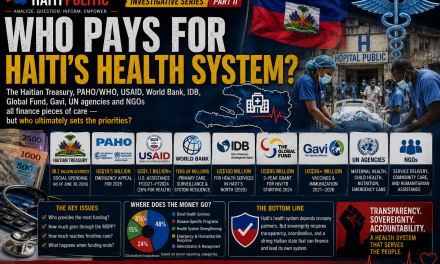
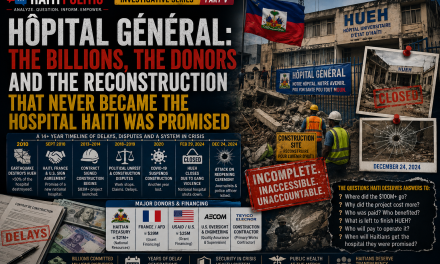
The reconstruction of Haiti’s Hôpital de l’Université d’État d’Haïti (HUEH) began as an approximately US$83.2 million international reconstruction program. By 2022, the officially stated cost had risen to just over US$100 million. By mid-2026, France said it had suspended further financing after the hospital site was overrun by armed groups.
The important question is therefore no longer simply:
“Why is Hôpital Général unfinished?”
It is:
“What did each contract cost, what changed, who authorized the changes, how much was actually spent, what remained unfinished, and how much new money would now be required to rescue the project?”
The public record answers part of that question.
It does not yet answer all of it.
And that missing ledger is itself one of the central findings of this investigation.
1. THE ORIGINAL DEAL: US$83.2 MILLION
In August 2013, Haiti signed the principal reconstruction contract with the Groupement International Santé pour Haïti (GISH/GISIH), associated with the Spanish firms Teyco/Teyico and Elecnor.
The construction contract itself was worth approximately:
US$41.48 million
The overall reconstruction program was then described as:
- USAID: US$25 million
- AFD/France: US$25 million
- Haitian government: US$33.2 million
- Total: US$83.2 million
The UTE—the Unité Technique d’Exécution of Haiti’s Ministry of Economy and Finance—was designated to manage the project in cooperation with the MSPP. The construction schedule was supposed to last 34 months.
That was the baseline.
Everything that followed should be measured against it.
2. WHO WAS TEYICO–ELECNOR?
The public record often refers loosely to “Teyico Elecnor” as though it were a single company.
The contracting entity was Groupement International Santé pour Haïti, or GISH/GISIH, a joint arrangement involving Spanish construction firms associated with Teyco/Teyico and Elecnor. Later reporting described Elecnor as the lead participant in the joint venture. Elecnor’s own financial statements continued listing Groupement International Santé pour Haiti among its temporary business associations.
That distinction matters because the legal counterparty in Haiti’s public-procurement records is generally GISH, not simply “Elecnor.”
3. UTE: THE HAITIAN INSTITUTION THAT HELD THE PROJECT TOGETHER
The UTE was not the hospital operator.
It was the project-management and delegated contracting authority responsible for implementing the reconstruction on behalf of Haiti’s Ministry of Economy and Finance.
UTE’s own project page now lists:
Total project budget: US$102,497,793.86
It describes the financing sources as the Haitian Treasury, USAID and AFD, and identifies UTE as the executing agency.
An earlier UTE operational manual from 2017 had still listed:
- Total financing: US$83.2 million
- Amount managed by UTE: US$77,063,882
and the original project closing date as March 22, 2016.
That comparison alone shows how dramatically the project evolved.
4. THE CONTRACT LEDGER WE CAN DOCUMENT
Here is the most important reconstruction table.
| Contract / amendment | Date | Contractor | Publicly documented amount | What it did |
|---|---|---|---|---|
| Initial reconstruction contract | Aug. 2013 | GISH / Teyico–Elecnor | US$41.48M | Main reconstruction works |
| Avenant #1 | Not located in the sources reviewed | GISH | Not yet verified | Public record incomplete in sources found |
| Avenant #2 | Aug. 2017 | GISH | US$1,271,107.13 | Amendment to reconstruction/equipment contract |
| Avenant #3 | Dec. 2020 | GISH/GISIH | US$2,026,307.39 | Additional modification; 32-month execution period listed |
| Avenant #4 | Feb./Mar. 2021 | GISH | US$603,153.78 | Modified/additional/reduced works and settlement of contract dispute/claims |
| USAID additional financing delegated to AFD | Dec. 2022 | AFD as delegated financier | US$10M | Completion financing, construction works |
| AFD additional grant | Dec. 2019 | AFD | €6M | Cost overruns, equipment, completion/opening support |
Sources: CNMP, AFD, 2013 contract reporting.
The obvious missing item is Avenant #1.
I could not verify its amount from the authoritative sources retrieved for this review.
That means any article claiming to provide the “complete” amendment total today would be overstating what the accessible record actually proves.
5. AVENANT #2: +US$1.27 MILLION
Haiti’s Commission Nationale des Marchés Publics (CNMP) records Avenant #2 as validated August 25, 2017.
Amount:
US$1,271,107.13
Contract holder:
Groupement International Santé pour Haïti
Financing:
AFD / USAID / Haitian Treasury
The amendment listed a 36-month execution period.
This is already revealing.
A hospital contract originally expected to take 34 months now had an amendment referring to another 36-month execution horizon.
The schedule was no longer remotely close to the original promise.
6. THE 2019 BREAKDOWN: A US$16 MILLION CLAIM
By July 2019, the contractor and Haitian government had reached a major impasse.
Reporting at the time said the GISH joint venture shut down the construction site and cited approximately:
US$16 MILLION IN CLAIMS
The claims reportedly involved:
change orders;
inflation;
costs from political unrest;
and repeated work stoppages.
UTE officials disputed the full amount, saying not all claims were justified.
This is crucial.
A claim is not the same thing as an amount legally owed.
The existence of a US$16 million contractor demand does not mean Haiti ultimately paid US$16 million.
What happened next is much more interesting.
7. AECOM WAS BROUGHT INTO THE CLAIM DISPUTE
USAID’s engineering contractor AECOM had been conducting quality-assurance inspections on HUEH.
When the 2019 dispute froze construction, AECOM says it mobilized a multilingual specialist in FIDIC construction claims to analyze the contractual positions of GISH and the Haitian government.
According to AECOM’s final Haiti Infrastructure Program report, the specialist helped quantify the responsibilities of each party, allowing negotiations to move forward.
AECOM does not say that it paid the contractor or acted as the contracting authority.
Its role was technical and advisory on behalf of USAID.
That distinction matters.
8. WHAT EXACTLY WAS AECOM PAID?
This is one of the points where public discussion often becomes imprecise.
AECOM’s report identifies its overall USAID Haiti Infrastructure Program contract as:
Contract AID-OAA-I-15-000045 / Order 72052118F00004
and explains that AECOM provided program management, engineering, architectural, technical-support and quality-management services across multiple infrastructure sectors, not only HUEH.
Therefore, the entire AECOM contract value cannot responsibly be attributed to HUEH without a task-level financial breakdown.
For HUEH specifically, the public record reviewed establishes that AECOM performed:
quality assurance;
site inspections;
architectural and structural review;
MEP review;
claim-analysis assistance;
and coordination with USAID, UTE and construction-management actors.
But I have not found an authoritative source in this review that isolates the exact AECOM dollar amount billed specifically to HUEH.
That figure should be requested.
9. AVENANT #3: +US$2.026 MILLION
CNMP records show that Avenant #3 was validated in December 2020 for:
US$2,026,307.39
The source of financing is listed as the Haitian Treasury.
The contractor remained GISH/GISIH.
That is significant because it demonstrates that Haiti itself was absorbing additional construction costs beyond the headline contributions from foreign donors.
10. AVENANT #4: THE CONTRACT SETTLEMENT AMENDMENT
Then comes perhaps the most legally important amendment.
CNMP describes Avenant #4, validated in March 2021, as addressing:
modified works;
additional works;
reductions;
and, critically,
settlement of the dispute arising from the termination decision and the contractor’s earlier and later financial claims.
The recorded amendment amount was:
US$603,153.78
The amendment also modified the cost and duration of the original contract.
This is a major clue.
The contractor had reportedly asserted roughly US$16 million in claims in 2019.
Yet the publicly recorded Avenant #4 itself is only about US$603,000.
That does not necessarily mean all claims were settled for $603,000—the amendment could embody offsets, reductions, other payment arrangements or prior modifications.
But it strongly reinforces why the actual negotiated settlement documents should be public.
11. SUPERVISION CHANGED TOO
By 2021–22, CNMP documentation identified:
GISH as the execution contractor;
WSP under a term contract for supervision;
and later the Techniplan / CECOM consortium as the new supervision firm.
This tells us that the reconstruction did not have one continuous supervisory architecture over its entire life.
The public audit therefore needs to include not merely the construction contract but also:
every supervision contract;
every consulting contract;
every engineering contract;
and every transition between supervision firms.
12. AFD: FROM US$25 MILLION TO ABOUT US$39 MILLION
France’s original commitment was around US$25 million.
AFD later added financing.
In December 2019, AFD approved another:
€6 million
specifically to help cover cost overruns required to finish construction and acquire equipment, along with support for opening the hospital.
AFD’s current project page lists French financing at approximately:
US$39 million
and describes the overall project as roughly US$100 million.
This is why the original US$83.2 million number is no longer sufficient for understanding HUEH.
13. USAID: US$25 MILLION BECAME US$35 MILLION
USAID’s original contribution was:
US$25 million
Then, on December 7, 2022, USAID committed an additional:
US$10 million
delegated to AFD.
AFD said the new money was intended exclusively for construction completion.
At that point, AFD described the project’s financing roughly as:
- France: €39.4 million
- USAID: US$35 million
- Haiti: US$27.2 million
- Overall: slightly more than US$100 million
and said construction was approximately:
90% complete
with handover then expected in 2023.
That projected handover never became reality.
14. WHY DID HAITI’S CONTRIBUTION APPEAR TO CHANGE?
This is one of the most confusing points in the paper trail.
The early financing package said Haiti would contribute:
US$33.2 million
Later AFD documentation cited:
US$27.2 million
and another current AFD page describes Haiti’s contribution as roughly:
US$21 million
while UTE’s own project page lists an overall budget exceeding US$102 million.
These numbers may represent:
different accounting dates;
different eligible cost categories;
actual versus planned contributions;
currency effects;
or revised financing structures.
But without a consolidated reconciliation schedule, outsiders cannot determine the explanation confidently.
That reconciliation should be published.
15. HOW MUCH HAS ACTUALLY BEEN SPENT?
Here is where the investigation reaches its biggest limitation.
In July 2026, reporting on the French suspension said:
more than US$80 million had been spent on the works
with approximately half attributed to France.
That is the clearest current public figure I found.
But it is not the same thing as a fully audited disbursement schedule showing:
every transfer;
every contractor payment;
every consultant payment;
every equipment invoice;
and every undisbursed balance.
So the safest conclusion is:
At least US$80 million-plus is reported as having been spent, while the approved/structured financing has exceeded US$100 million.
The exact complete expenditure-to-date figure still needs a reconciled public ledger.
16. THE “90% COMPLETE” PROBLEM
In December 2022, AFD said physical completion was about:
90%
and the supplemental US$10 million from USAID was designed to close the financing gap for the works.
If all conditions had remained normal, one might have loosely inferred that the remaining construction requirement was around the final 10%.
But that would be unsafe today.
Why?
Because the site was subsequently:
occupied;
closed;
exposed to armed violence;
and left inaccessible after 2024.
By July 2026, France said it had been forced to suspend the project because of the security situation.
So the remaining cost is no longer merely:
“finish the last 10%.”
It may now include:
damage assessment;
replacement of stolen or damaged equipment;
site rehabilitation;
security infrastructure;
remobilization of contractors;
inflation;
new procurement;
engineering recertification;
and potentially redesign or remediation.
17. HOW MUCH WOULD IT COST TO FINISH HUEH TODAY?
The responsible answer is: no reliable current figure is publicly established.
UTE currently lists the project budget as:
US$102,497,793.86
AFD describes the overall project as approximately:
US$100 million, with a portion still needing completion.
But those figures reflect the planned reconstruction architecture—not necessarily the post-occupation cost of recovering and completing the hospital in 2026.
The government’s 2025–26 budget contains broader allocations for hospital construction and rehabilitation, including HUEH among multiple facilities, but it does not provide a clean, HUEH-only “completion cost” figure in the cited budget extract.
Therefore:
Any precise claim today that “HUEH needs another $10 million” or “$20 million” to finish would be speculation unless backed by a new engineering and security assessment.
That assessment should be the first step before any new donor conference.
18. THE MOST IMPORTANT NEW DEVELOPMENT: FRANCE SUSPENDED FINANCING
This substantially changes the story.
On July 30, 2026, French Ambassador Antoine Michon said France had suspended its financing of the HUEH reconstruction because the site had become inaccessible after armed groups took control of the area in 2024. He indicated that French support could potentially return if Haitian authorities requested it under viable conditions.
This means the HUEH financing structure that existed in 2022 cannot simply be assumed to remain active in August 2026.
That should be explicitly reflected in any current article about the project.
19. THE AUDIT MAP: WHO DID WHAT?
GISH / Teyico–Elecnor
Main construction contractor.
UTE / MEF
Haitian delegated project-management authority; contracting and implementation oversight.
MSPP
Ultimate beneficiary and future hospital operator.
AFD
French financing partner; also supported hospital governance, management, training and completion financing.
USAID
U.S. financing partner; originally US$25M, later additional US$10M delegated to AFD.
AECOM
USAID technical/engineering quality-assurance adviser; not the main construction contractor.
WSP / Techniplan–CECOM
Supervision roles documented later in the project.
CNMP / CSCCA
Haitian procurement and public-finance oversight institutions relevant to contract validation and accountability.
20. THE CLEANEST CURRENT MONEY MAP
21. WHAT WE STILL DO NOT KNOW
A real forensic audit should not pretend the paper trail is complete.
These gaps remain:
1. The verified amount and purpose of Avenant #1.
2. The complete value of every contract amendment and change order.
3. The final settlement calculations arising from the US$16 million GISH claim.
4. Exact cumulative payments to GISH.
5. Exact cumulative payments to project supervisors.
6. HUEH-specific AECOM expenditures, rather than the value of AECOM’s broader Haiti infrastructure program.
7. Exact expenditure against France’s additional €6 million.
8. Exact drawdown/disbursement of USAID’s supplemental US$10 million.
9. Inventory of medical equipment procured before the security collapse.
10. What equipment remains intact today.
11. Value of damage, theft or deterioration after 2024.
12. Post-security remobilization cost.
13. Current cost to finish construction.
14. Cost to secure the campus.
15. Annual operating budget once HUEH opens.
Until those numbers exist in one place, Haiti does not have a complete publicly accessible money trail.
22. THE CONTRACT QUESTION IS BIGGER THAN CORRUPTION
Nothing in these records by itself proves that the project’s missing years or rising cost resulted from theft.
The documented causes include:
planning delays;
scope modifications;
political unrest;
inflation;
contract disputes;
COVID-19;
technical changes;
and eventually armed territorial collapse.
Those are real cost drivers.
But transparency matters precisely because a project can be delayed and become expensive without criminal corruption.
The public needs to distinguish:
legitimate cost escalation
from
poor project management
from
contractual failure
from
waste
from
actual misuse of public funds.
Only the underlying invoices, contract files and payment schedules can make that distinction.
23. THE 25 DOCUMENTS HAITI POLITIC WOULD REQUEST
A full HUEH audit should obtain:
- Original 2013 GISH construction contract.
- Bill of quantities.
- Original technical specifications.
- Avenant #1.
- Avenant #2.
- Avenant #3.
- Avenant #4.
- Every change order.
- Every extension-of-time decision.
- Every GISH claim.
- FIDIC claim-evaluator report.
- Settlement agreement from the 2019 dispute.
- All payment certificates.
- All Treasury payment records.
- AFD disbursement schedules.
- USAID disbursement schedules.
- USAID–AFD delegation agreement for the extra US$10M.
- AECOM HUEH-specific task orders and invoices.
- WSP supervision agreement.
- Techniplan/CECOM supervision agreement.
- Medical-equipment procurement contracts.
- Imaging-equipment contract.
- 2022–24 completion reports.
- Post-2024 damage and inventory assessment.
- New completion-cost estimate.
That is what a true “follow the money” investigation would require.
24. THE CENTRAL FINDING
The original HUEH reconstruction was not simply a US$41.48 million construction contract.
It became a layered, multinational financing structure exceeding US$100 million, involving:
foreign grants;
Haitian Treasury money;
construction amendments;
contract claims;
engineering oversight;
supervision changes;
equipment procurement;
hospital-transition costs;
and opening-support programs.
Yet the hospital never reached the stable operational handover Haitians were promised.
That makes one question unavoidable:
DID HAITI RECEIVE US$100 MILLION WORTH OF PERMANENT PUBLIC-HOSPITAL CAPACITY?
That is not answered simply by determining whether every dollar was legally spent.
It requires evaluating what the spending produced.
25. HAITI POLITIC VERDICT
The HUEH paper trail reveals something more complex than the popular narrative that “$83 million disappeared.”
The record supports a different story:
A US$41.48 million construction contract expanded through amendments and claims.
The original US$83.2 million financing package increased beyond US$100 million.
France increased its support.
USAID increased its support.
Haiti paid additional costs.
AECOM documented extensive technical oversight.
The contractor made a major US$16 million claim during the 2019 dispute.
CNMP later recorded multiple amendments, including one explicitly resolving elements of that dispute.
By late 2022, AFD said the project was approximately 90% complete.
And then:
the state lost physical control of the hospital environment.
Today, the project faces a fundamentally different problem.
It no longer needs only construction completion.
It needs:
territorial security;
damage assessment;
asset inventory;
new cost estimates;
new financing;
contract remobilization;
and ultimately a credible operating plan.
France’s July 2026 suspension makes that urgency even clearer.
So the final question is not merely:
Where did the HUEH money go?
It is:
WHAT REMAINS OF THE US$100+ MILLION INVESTMENT—AND HOW MUCH MORE WILL HAITI HAVE TO PAY TO FINALLY TURN THAT INVESTMENT INTO A WORKING HOSPITAL?
The public record does not yet provide a defensible number.
Before Haiti accepts another dollar, euro or gourde for HUEH, there should be a joint independent physical-and-financial audit establishing:
what was paid;
what was built;
what survived;
what was lost;
what remains contractually owed;
and exactly what it will now cost to finish.
That is the ledger Haitians have been waiting more than a decade to see.