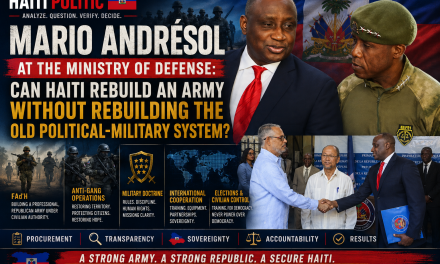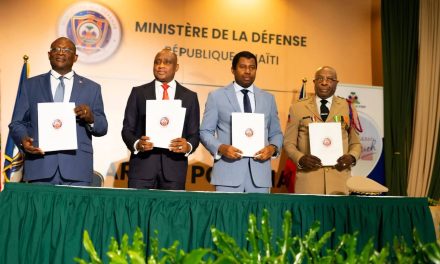
The following is an illustrative political response — written as a critical commentary exercise, not attributed to any specific named individual — reacting to the Ministry of Defense’s August 21, 2026 tweet following the “Quelle armée pour Haïti?” forum at the Karibe Hotel.
Minister,
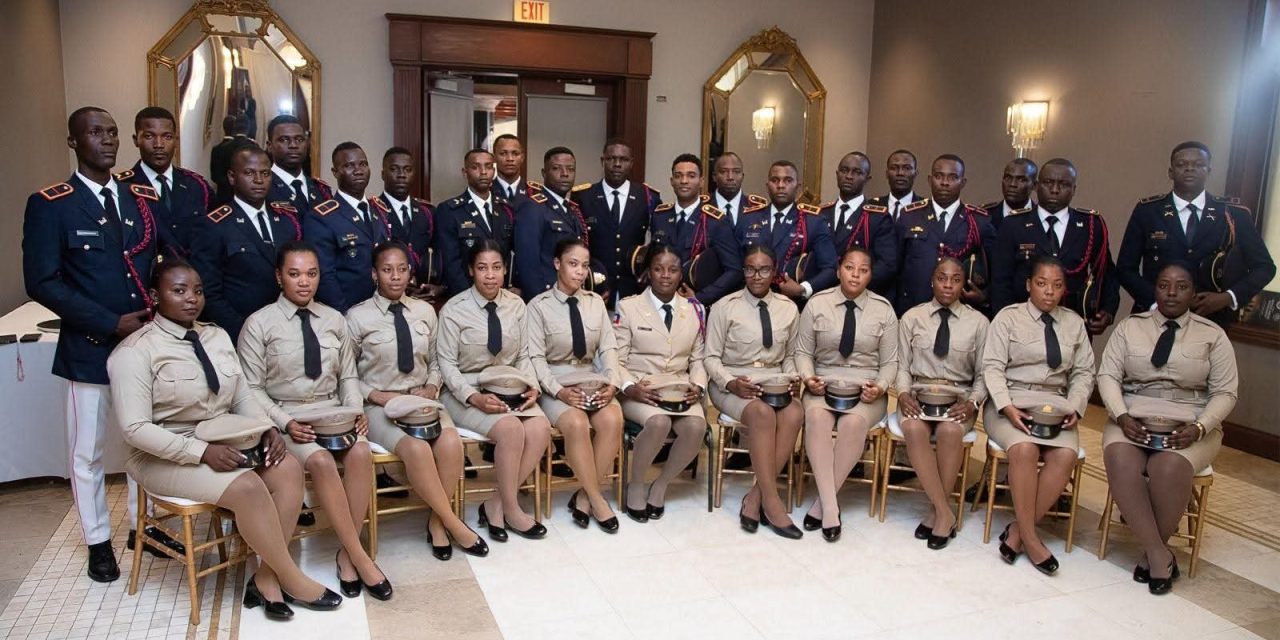
Congratulations on the photograph. The dress blues are sharp, the gold braid catches the light well, and the young men in that lobby at the Karibe Hotel look, by any visual standard, like soldiers of a serious nation. But a uniform is a piece of cloth. It is not a perimeter. It does not hold a checkpoint, does not clear a road, and does not answer when a family in Mamon-Pòl or Morne à Bateau calls for help at three in the morning. Before this photograph is allowed to stand as an answer to the question your own forum posed — “What kind of army for Haiti?” — it deserves to be measured against the country those soldiers are actually being asked to defend.
Start with the arithmetic. The Armed Forces of Haiti you are rebuilding number roughly 1,471 active personnel, on a budget in the range of $60 million a year — about two-tenths of one percent of GDP. The armed coalitions your soldiers are meant to help contain, by contrast, now hold most of Port-au-Prince and reach well beyond it: by the United Nations’ own count, more than 2,300 people were killed and nearly 1.5 million Haitians displaced from their homes in roughly the first half of this year alone. A well-tailored jacket does not close that gap. Neither does a group photo in a hotel lobby in Pétion-Ville, however photogenic the setting.
Consider, too, what “new” is actually supposed to mean here. This is not the first time Haiti has been told its army is being modernized, professionalized, doctrine-driven, ethically grounded. The FAd’H was disbanded once already, in 1995, precisely because a well-dressed, well-armed institution had repeatedly proven more dangerous to Haitian democracy than to Haiti’s enemies. Rebuilding trust in this institution requires more than new insignia and a partnership agreement with a university. It requires those cadets, once they leave that lobby, to be visibly present where Haitians are actually afraid — in Gressier, in Saint-Michel de l’Attalaye, on the roads gangs currently tax like sovereign toll-collectors — and to stay there.
A forum is not a deployment. Three days of panels at a hotel that markets itself to tourists for its pool and its airport shuttle is a legitimate way to gather expert input; it is not, on its own, a security plan. The Haitian public does not need another communiqué explaining that ethics and doctrine matter. It needs to know, in plain terms: how many additional territories will the FAd’H help secure in the next twelve months? Alongside which police units, and under what chain of command? With what equipment, purchased with what budget, delivered on what timeline? None of that was in the tweet. All of it is more urgent than the photograph.
And the timing deserves to be named honestly. This image was published in a country heading toward general elections later this year, elections that depend — as your own ministry has said elsewhere — on citizens being able to “vote freely and in complete security.” A polished parade photo, released at a moment when the government badly needs the public to feel that security is returning, risks looking less like an army’s face and more like a campaign’s. Haitians have been offered images of reform before. What they have too rarely been offered is a schedule, a budget line, and a body count of territory actually reclaimed.
None of this is to dismiss the value of professionalizing officer training, or of building an institution around law and ethics rather than the coup-and-loyalty logic that discredited the old FAd’H. That work matters, and it is not quick. But it is precisely because that work is slow and unglamorous that a fast, glamorous photograph should not be allowed to stand in for it. The homeland does not need a new army with better tailoring. It needs one that can hold ground — and until it can, the most honest caption for that photo is not “the faces of the new army.” It is “the faces of the army we are still waiting to see tested.”
This response is offered as political commentary and analysis, not as an official statement from any government, party, or named individual.