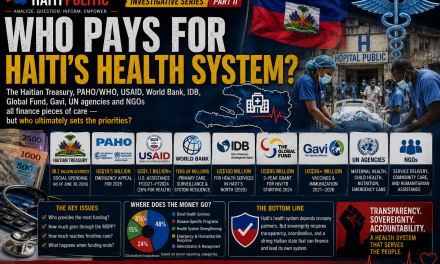

The Haitian state owns the core public network. Foreign governments, development banks, PAHO/WHO, NGOs and charities finance equipment, construction and programs. But when a hospital closes, runs out of supplies or cannot pay staff, who is actually accountable?
Public hospitals. MSPP. Treasury. IDB. PAHO/WHO. USAID. AFD. NGOs. Security. Procurement. Staffing. Accountability.
Haiti does not have a single hospital-financing model.
It has several systems operating at the same time.
Some hospitals are unmistakably state institutions, managed under the Ministry of Public Health and Population, or MSPP, with salaries and operating expenses coming primarily from Haiti’s national budget.
Others are publicly oriented institutions built or operated through unusual partnerships with NGOs.
Still others depend on international donors for reconstruction, equipment, medicines, fuel, training, laboratory support or specialty programs.
The result is a system in which ownership, financing and actual operating capacity are often three very different things.
That creates the central question of this investigation:
WHEN WE CALL A HOSPITAL “PUBLIC,” HOW MUCH OF ITS ABILITY TO TREAT PATIENTS IS ACTUALLY BEING FINANCED BY THE HAITIAN STATE?
And the second question may be even more important:
IF FOREIGN MONEY BUILDS THE HOSPITAL, WHO PAYS TO KEEP IT RUNNING?
🏥 FIRST: WHAT DOES HAITI OFFICIALLY CONSIDER A PUBLIC UNIVERSITY HOSPITAL?
The MSPP currently identifies seven principal hospital-university establishments within its network:
Hôpital de l’Université d’État d’Haïti — HUEH
Hôpital Psychiatrique Mars & Kline
Maternité Isaïe Jeanty & Léon Audain
Sanatorium de Port-au-Prince
Hôpital Universitaire La Paix
Hôpital Universitaire Justinien
and
Hôpital Saint-Michel de Jacmel.
According to the ministry, these institutions are intended not simply to treat patients but also to provide tertiary referral services, train health professionals and conduct medical research.
That means when one major university hospital stops functioning, Haiti loses more than hospital beds.
It loses:
specialty care;
residency training;
clinical education;
referral capacity;
and part of the pipeline producing the country’s future doctors and nurses.**
💰 THE BIG PICTURE: HAITI DOES PAY FOR HOSPITALS
It would be inaccurate to claim that foreign organizations finance Haiti’s entire public hospital system.
The Haitian government’s 2025–2026 budget classifies approximately 4.96 billion gourdes under general hospital services and another 651.7 million gourdes under specialized hospital services.
The Public Investment Program also contains state-financed hospital projects.
For example, it allocates 100 million gourdes from the Haitian Treasury for a second phase of rehabilitation at Hôpital Universitaire Justinien. It also lists national resources for other hospital, ambulance, blood-transfusion and healthcare-infrastructure projects.
That is important.
Haiti is not simply standing outside its own system while donors pay every bill.
But Treasury financing frequently coexists with substantial external financing.
And that is where the architecture becomes complicated.
🗺️ HAITI POLITIC — MAJOR HOSPITAL FUNDING MAP
| Hospital | Who formally runs it? | Major documented financing/support | Current structural issue |
|---|---|---|---|
| HUEH / Hôpital Général | MSPP / Haitian public system | Haitian state + France/AFD + U.S. cooperation for reconstruction | Reconstruction delays, insecurity, closure/displacement |
| Hôpital Universitaire La Paix | MSPP public hospital | Haitian Treasury + PAHO/WHO + Spain/AECID + IDB-linked projects | Massive overflow from closed hospitals |
| Hôpital Universitaire Justinien | MSPP public hospital | Haitian Treasury + major IDB rehabilitation program | Aging infrastructure, modernization needs |
| Hôpital Saint-Michel de Jacmel | MSPP public university hospital | Haitian state; historic external infrastructure/program support | Regional resource and staffing constraints |
| Maternité Isaïe Jeanty | MSPP | Haitian state + maternal-health partners/programs | Security, maternal-care capacity, supplies |
| Sanatorium de Port-au-Prince | MSPP | Haitian public system + TB/infectious-disease partners | Looting/security damage and continuity challenges |
| Mars & Kline | MSPP | Haitian public system + mental-health partnerships | Severe national underinvestment in mental health |
| Hôpital Universitaire de Mirebalais | Zanmi Lasante/Partners In Health partnership model | PIH/Zanmi Lasante + international philanthropy + public-sector collaboration | Forced closure after gang expansion |
| Regional public hospitals | MSPP / departmental structures | Treasury + different donors/projects | Unequal equipment, staffing and geographic resources |
The table deliberately does not assign a single annual operating dollar amount to most individual hospitals because the available public sources do not provide a reliable, current facility-by-facility consolidated budget.
That missing information is itself a transparency issue.
PART I — HUEH: HAITI’S MOST IMPORTANT PUBLIC HOSPITAL AND ONE OF ITS LONGEST-RUNNING RECONSTRUCTION STORIES
The Hôpital de l’Université d’État d’Haïti, commonly called Hôpital Général, is Haiti’s principal national teaching and referral hospital.
It should be the centerpiece of the public system.
Instead, HUEH has become a case study in the collision between:
foreign reconstruction financing, Haitian institutional weakness, security collapse and delayed implementation.
💵 WHO FINANCED THE RECONSTRUCTION?
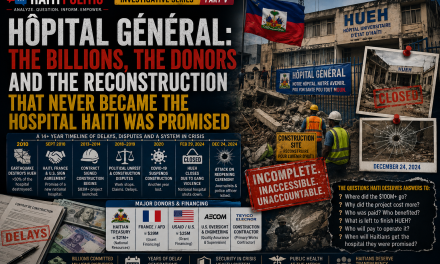
After the 2010 earthquake destroyed more than half of HUEH, France and the United States joined Haiti in financing reconstruction.
France’s development agency, Agence Française de Développement (AFD), lists US$39 million in grant financing for the reconstruction project and identifies the Haitian state and USAID as partners.
This was supposed to help restore Haiti’s national reference hospital.
But the project stretched over years.
That illustrates one of the fundamental weaknesses in Haiti’s hospital model:
Money for rebuilding does not automatically create the administrative, security and operational conditions required to finish and operate the hospital.
🔥 THEN SECURITY OVERWHELMED THE RECONSTRUCTION PROBLEM
HUEH closed in February 2024 amid the escalation of violence.
An MSPP situation report stated that the hospital had been closed since February 29, 2024, and that attempts to resume services were blocked by the deteriorating security situation.
PAHO likewise reported that HUEH remained closed while Hôpital Universitaire La Paix absorbed additional demand.
Then came another extraordinary episode.
On December 24, 2024, a planned reopening event at HUEH was attacked. A police officer and two journalists were killed.
By May 2025, Haitian authorities were discussing temporarily shifting basic HUEH services to Canapé-Vert because the original site remained inaccessible.
Think about the financing lesson.
France can finance construction.
The United States can participate.
Haiti can budget for the hospital.
Doctors can be trained.
Equipment can be purchased.
But:
IF THE STATE CANNOT SECURE THE HOSPITAL, ALL OF THOSE INVESTMENTS CAN BECOME STRANDED ASSETS.
PART II — HÔPITAL UNIVERSITAIRE LA PAIX: THE HOSPITAL CARRYING THE CAPITAL
While HUEH collapsed operationally, Hôpital Universitaire La Paix — HUP became one of the most important surviving public hospitals in metropolitan Port-au-Prince.
PAHO calls it the only public hospital in the metropolitan area capable of handling mass-casualty influxes under the current conditions.
Its importance has increased dramatically because other facilities have closed or become inaccessible.
WHO RUNS LA PAIX?
It is an MSPP public university hospital.
That means the Haitian state remains responsible for:
management;
staffing;
public-sector governance;
and core hospital operations.
But its ability to remain functional has also depended heavily on external support.
WHO ELSE IS PAYING?
In 2024, PAHO reported supporting La Paix with:
medicines;
medical supplies;
fuel;
and
other logistical assistance to keep the hospital operating.
In 2025, PAHO reported that it provided more than 30 metric tons of medical supplies to La Paix, helping the hospital deliver more than 25,000 emergency consultations.
Then in April 2026, PAHO/WHO—using financial support from Spain’s AECID—provided additional essential medical equipment.
And in July 2026, the Haitian government’s FAES and MSPP began constructing a new blood-transfusion station at La Paix under an IDB-financed program, with PAHO providing technical assistance.
So one hospital can simultaneously involve:
MSPP
Haitian Treasury
IDB
PAHO/WHO
Spanish cooperation
FAES
THAT IS THE FINANCING MOSAIC IN ONE BUILDING
And it raises a crucial question:
If PAHO stops supplying fuel and medical inputs, can MSPP independently maintain the same level of emergency capacity?
That is a sustainability question—not an accusation.
PART III — HÔPITAL UNIVERSITAIRE JUSTINIEN: CAN US$100 MILLION TRANSFORM THE NORTH?
Hôpital Universitaire Justinien in Cap-Haïtien is the principal hospital and teaching institution in northern Haiti.
Unlike HUEH, its problem today is less about complete physical inaccessibility and more about whether large-scale modernization can create a functioning regional medical hub.
HAITI IS PUTTING MONEY INTO JUSTINIEN
The government’s 2025–2026 Public Investment Program allocates:
100 million gourdes from national resources
for rehabilitation of:
pediatrics;
operating rooms;
surgery;
and
internal medicine.
That is direct Haitian financing.
But it is small relative to the international financing now being contemplated around the institution.
ENTER THE IDB
In 2025, the Haitian government announced that an IDB health investment centered partly on Justinien had been recalibrated to approximately US$100 million, based on priorities and available financing.
The IDB separately described plans including rehabilitation of Justinien’s emergency and surgical services.
This is exactly the model discussed in Part III of this series:
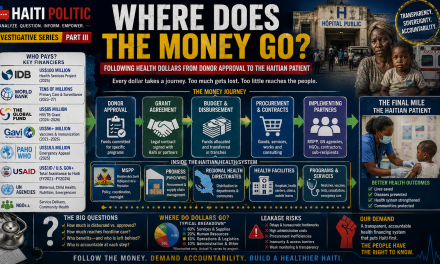
Donor approval
→ project agreement
→ procurement
→ construction
→ equipment
→ hospital
→ patient
But the real test begins after construction.
THE JUSTINIEN QUESTION
If US$100 million helps modernize the regional system:
Who will pay nurses after the project closes?
Who maintains new imaging equipment?
Who purchases reagents?
Who pays for generators?
Who maintains surgical equipment?
Who replaces equipment after ten years?
Who guarantees uninterrupted oxygen?
Who pays the utility bill?
The hospital’s long-term success depends on converting capital investment into recurring Haitian operating capacity.
PART IV — HÔPITAL SAINT-MICHEL DE JACMEL: A REGIONAL PUBLIC HOSPITAL THAT SHOWS WHY DECENTRALIZATION MATTERS
The MSPP classifies Hôpital Saint-Michel de Jacmel as one of Haiti’s hospital-university institutions and the major public referral facility in the Southeast.
Its importance illustrates a broader issue:
Haiti cannot build an effective public hospital system by concentrating advanced care in Port-au-Prince.
Every regional hospital that lacks:
specialists;
blood;
oxygen;
laboratories;
ambulances;
surgical capacity;
or intensive-care resources
forces patients toward other departments.
That adds travel costs, delays care and puts greater pressure on tertiary centers.
The sources reviewed for this investigation do not provide a current consolidated donor-by-donor annual operating budget for Saint-Michel.
That should be stated clearly rather than filled with assumptions.
But the central accountability question remains:
Can MSPP publish exactly how much it costs to operate Saint-Michel each year, what share comes from Treasury resources, and which partners finance specific services?
The same question should be asked of every departmental hospital.
PART V — MATERNITÉ ISAÏE JEANTY: MATERNAL CARE CANNOT DEPEND ON EMERGENCY FINANCING
The Maternité Isaïe Jeanty & Léon Audain is Haiti’s major public maternal and neonatal teaching facility.
MSPP identifies its responsibilities as including:
prenatal care;
delivery;
obstetric surgery;
postnatal care;
and professional training.
A maternal hospital depends on more than doctors.
It needs:
blood;
operating rooms;
anesthesia;
oxygen;
neonatal equipment;
antibiotics;
24-hour electricity;
emergency transport;
and trained nurses and midwives.
When even one of those elements fails, maternal mortality risk increases.
The critical financing question therefore is not simply:
How much money does maternal health receive?
It is:
Is there a guaranteed recurrent financing mechanism keeping the maternity functioning every day of the year?
Maternal care cannot be treated like a temporary humanitarian project.
PART VI — SANATORIUM DE PORT-AU-PRINCE: WHAT HAPPENS WHEN A SPECIALIZED PUBLIC HOSPITAL IS LOOTED?
Haiti’s public Sanatorium is designed primarily for pulmonary and infectious diseases, particularly tuberculosis.
But during the 2024 security collapse, the MSPP reported that the facility had been completely looted on March 16, 2024, while more than 100 TB patients were associated with the institution.
This is not merely a hospital-security problem.
It is a national infectious-disease problem.
Patients with interrupted TB treatment may:
become sicker;
remain infectious;
develop drug resistance;
or disappear from care entirely.
A specialized public hospital therefore represents a form of national security infrastructure.
PART VII — MARS & KLINE: HAITI’S MENTAL HEALTH BLIND SPOT
MSPP identifies Mars & Kline as Haiti’s principal public psychiatric institution.
Yet mental health has historically received a fraction of the institutional attention dedicated to:
HIV;
TB;
vaccination;
maternal health;
and communicable diseases.
This creates a larger donor-priority question.
International health financing frequently concentrates on measurable disease programs.
Mental-health care is harder to package into short funding cycles.
But Haiti now has:
mass displacement;
children exposed to gang violence;
sexual-violence survivors;
families experiencing kidnapping and murder;
health workers experiencing trauma;
and entire communities living under chronic fear.
The public-health need is enormous.
So where is the financing?
A future MSPP hospital-finance dashboard should identify how much national and international money is allocated specifically to psychiatric services.
PART VIII — HÔPITAL UNIVERSITAIRE DE MIREBALAIS: THE MOST IMPORTANT HYBRID MODEL
Mirebalais deserves separate treatment because its governance structure is different.
The Hôpital Universitaire de Mirebalais (HUM) was developed through Zanmi Lasante / Partners In Health, with broad international philanthropic and institutional support.
PIH describes it as a roughly 300-bed teaching hospital serving a broad national referral population and previously providing hundreds of outpatient visits per day.
Its donor roster historically included foundations, corporations, U.S. health institutions and other philanthropies.
It became one of the most successful examples of NGO-state health cooperation in Haiti.
Then security demonstrated the vulnerability of even a high-performing hospital.
MARCH 31, 2025 CHANGED THE EQUATION
Armed groups attacked Mirebalais.
Partners In Health began evacuating patients and staff on April 2 and suspended services because of the danger.
UNICEF later reported that the hospital had been attacked and remained inaccessible, while more than 50,000 people had been displaced from the area.
WHO subsequently described the hospital as shut because of the violence.
This case proves something important.
Mirebalais had:
strong infrastructure;
international financing;
highly trained personnel;
renewable-energy capacity;
specialty care;
and a major NGO behind it.
Yet it still could not withstand the collapse of territorial security.
THE BEST-FUNDED HOSPITAL CANNOT FUNCTION IF THE STATE LOSES CONTROL OF THE ROAD LEADING TO ITS DOOR.
PART IX — WHY ARE SO MANY HOSPITALS STILL STRUGGLING?
The easy answer is:
not enough money.
The real answer is more complicated.
1. SECURITY IS DESTROYING HEALTH INVESTMENT
PAHO reported that in 2025 nearly 65% of hospitals in the capital were closed or only partly functioning.
Money cannot fully compensate for:
gang occupation;
roadblocks;
kidnapping risk;
looting;
attacks;
staff displacement;
and destroyed supply routes.
Haiti’s hospital crisis has therefore become inseparable from national security.
2. CAPITAL MONEY IS EASIER TO FIND THAN OPERATING MONEY
Foreign donors often prefer financing:
buildings;
equipment;
project-based programs;
and measurable interventions.
But hospitals live on recurrent expenditure:
payroll.
fuel.
oxygen.
medicines.
laboratory reagents.
food.
electricity.
maintenance.
cleaning.
ambulances.
Those bills return every month.
A new hospital without recurrent financing can become an expensive shell.
3. DONOR FINANCING IS FRAGMENTED
A hospital may have:
one donor financing maternity;
another financing HIV;
another financing TB;
another donating equipment;
another rebuilding surgery;
and Treasury money paying salaries.
Each program may be individually successful.
But nobody may be financing the hospital as one integrated institution.
4. HEALTH WORKERS ARE LEAVING
Hospitals require skilled people, not simply infrastructure.
Haiti’s continuing emigration of:
physicians;
nurses;
anesthetists;
laboratory professionals;
engineers;
and administrators
means newly financed facilities can still struggle to staff departments.
Training a specialist takes years.
Losing one can happen in weeks.
5. PROCUREMENT AND SUPPLY CHAINS REMAIN FRAGILE
A CT scanner is useless without maintenance.
A laboratory cannot function without reagents.
An operating room cannot function without sterile supplies.
A dialysis machine cannot function without consumables.
A blood bank cannot function without refrigeration and testing.
This is why hospital financing must be examined as lifecycle financing, not simply purchase financing.
6. THE PATIENT OFTEN STILL PAYS
Public does not necessarily mean free.
When hospitals lack medicines or supplies, families may have to purchase them privately.
That produces a hidden financing mechanism:
THE PATIENT’S POCKET.
If the state pays the doctor but the patient has to buy:
gloves;
syringes;
medicine;
laboratory testing;
oxygen;
or surgical supplies,
then the hospital is partly being financed at the bedside by the family.
That burden deserves its own audit.
PART X — THE PUBLIC HOSPITAL ACCOUNTABILITY PROBLEM
A Haitian citizen should be able to open one government website and answer:
What is HUEH’s annual budget?
What is La Paix’s annual budget?
What is Justinien’s annual budget?
How much Treasury money did each actually receive?
How much did each spend?
What did PAHO provide?
What did IDB finance?
What did USAID finance?
What did AFD finance?
How much was donated in kind?
How many employees does each have?
How many beds are operational?
How many patients are treated?
How many surgeries are performed?
What drugs are out of stock?
That integrated public database does not emerge from the sources reviewed.
And without it, hospital accountability is unnecessarily difficult.
📊 THE DASHBOARD HAITI SHOULD PUBLISH
For every public hospital:
| Indicator | Public disclosure needed |
|---|---|
| Hospital name | ✓ |
| Managing authority | ✓ |
| Director | ✓ |
| Authorized beds | ✓ |
| Operational beds | ✓ |
| Treasury budget | ✓ |
| Treasury execution | ✓ |
| External donor financing | ✓ |
| In-kind donations | ✓ |
| Salaried staff | ✓ |
| Vacancies | ✓ |
| Emergency visits | ✓ |
| Admissions | ✓ |
| Surgeries | ✓ |
| Maternal deliveries | ✓ |
| Drug stock-outs | ✓ |
| Equipment downtime | ✓ |
| Electricity uptime | ✓ |
| Audit findings | ✓ |
| Security closure days | ✓ |
Then Haitians could compare hospitals using evidence rather than rumor.
🔥 20 QUESTIONS FOR MSPP AND HOSPITAL DIRECTORS
- What is the complete 2026 operating budget of each major public hospital?
- How much comes from the Haitian Treasury?
- How much comes from donors?
- How much comes from patient fees?
- What percentage of each budget is salaries?
- What percentage goes to medicines?
- How many hospital beds physically exist?
- How many are actually usable today?
- How many medical positions are vacant?
- How many doctors and nurses left during the past three years?
- Which hospitals have reliable oxygen production?
- Which hospitals have 24-hour electricity?
- Which hospitals have blood available around the clock?
- Which donated machines are currently out of service?
- How much does MSPP spend annually maintaining donor-financed equipment?
- Which hospitals depend on PAHO/WHO for emergency supplies?
- Which hospitals would have to reduce services if donor support stopped tomorrow?
- How much money has actually been disbursed for Justinien’s modernization?
- What is the current plan and financing requirement for restoring HUEH and Mirebalais?
- Will MSPP publish audited facility-by-facility financial statements every year?
🧭 THE INVESTIGATIVE CONCLUSION
Haiti’s public hospital crisis cannot be explained with one sentence.
It is not simply:
“The government doesn’t spend enough.”
It is not simply:
“Foreign donors failed Haiti.”
And it is not simply:
“Gangs destroyed the health system.”
All three forces matter, along with others.
Haiti has public hospitals receiving Treasury money.
Some also receive millions of dollars in foreign reconstruction financing.
PAHO supplies medicines, equipment, fuel and technical assistance.
Development banks finance infrastructure.
Foreign governments finance reconstruction.
NGOs operate or support major hospitals.
Patients themselves absorb costs when supplies disappear.
And then insecurity can destroy years of investment within days.
The resulting system is financially fragmented and institutionally vulnerable.
The central challenge is therefore not merely attracting more money.
It is building a system in which the Haitian state can answer:
Who owns the hospital?
Who runs it?
Who pays for it?
Who maintains it?
Who audits it?
Who secures it?
And who is responsible when it stops functioning?
Because a hospital is not truly sustainable simply because someone financed its construction.
It is sustainable when Haiti can staff it, supply it, maintain it, secure it and keep its doors open every day.