
GISH/Teyico–Elecnor, AECOM, WSP, Techniplan/CECOM and the companies that designed, supervised, inspected and tried to rescue Haiti’s unfinished national hospital
Contracts. Consultants. Construction. Supervision. Claims. Engineering. Procurement. USAID. AFD. UTE. Accountability.
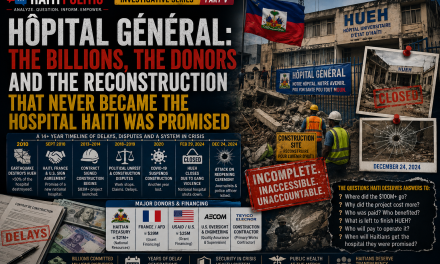
The reconstruction of Haiti’s Hôpital de l’Université d’État d’Haïti (HUEH) is usually described as a three-government project: Haiti, France and the United States.
Financially, that is true.
Operationally, however, the money moved through a much larger network of private contractors, engineering firms, supervision consultants and government project-management structures.
That distinction matters because the question “Who financed Hôpital Général?” is not the same as:
“Who actually got paid to build, supervise, inspect and manage the project?”
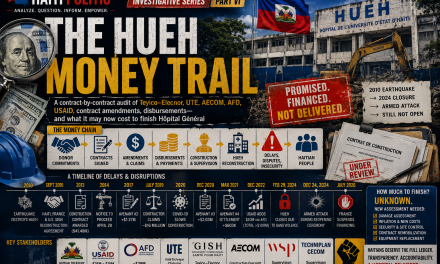
The public record reviewed for this investigation identifies several major players:
GISH / Teyico–Elecnor — construction;
WSP/GENIVAR — early project/construction-management and supervision role;
AECOM — USAID-funded quality assurance and technical oversight;
Techniplan International Consulting / CECOM Consultants — later completion supervision and technical assistance;
UTE — Haiti’s delegated project-management authority;
plus additional bidders, engineering specialists and consultants appearing in the procurement trail.
The records also reveal something equally important:
Not every contract value is publicly identifiable from the readily accessible record.
Some amounts are explicit.
Others are embedded in larger contracts covering multiple projects.
And at least one major supervision arrangement—WSP—appears in Haitian procurement records without a clearly isolated HUEH contract value in the sources reviewed.
That is where this investigation begins.
1. THE MAIN BUILDER: GISH / TEYICO–ELECNOR
The principal reconstruction contract was signed in August 2013 between the Haitian government and the Groupement International Santé pour Haïti, generally abbreviated GISH/GISIH.
Contemporary reporting described the executing company as Teyico Elecnor and put the contract at:
US$41.48 MILLION
The broader reconstruction package was then valued at US$83.2 million.
Elecnor’s own 2013 annual report provides a useful corporate clarification.
It says a consortium led by Elecnor won the international tender for design and reconstruction of HUEH. Elecnor described the hospital project as worth more than US$41 million and as its first project in Haiti.
So the relationship can be understood as:
Haitian government / UTE
→ contracts with GISH
→ consortium associated with Teyico/Teyco + Elecnor
→ Elecnor publicly describes itself as leading the consortium.
That is more precise than simply calling Elecnor “the contractor.”
2. WHAT WAS GISH SUPPOSED TO DELIVER?
The reconstruction was not a simple building renovation.
UTE describes the project as a modern third-level referral hospital with 534 beds and places, new technical, hospitalization and logistics buildings, parking, biomedical-waste treatment, wastewater infrastructure and hospital equipment.
The initial US$41.48 million works contract therefore sat inside a larger program that also included:
temporary works;
equipment;
supervision;
technical studies;
hospital-management reform;
and professional training.
That distinction matters when following the money.
The US$41.48 million construction award was not the entire HUEH budget.
3. THE GISH CONTRACT DID NOT STAY AT US$41.48 MILLION
Public CNMP records show subsequent amendments.
The clearly documented amendments identified so far include:
| Contract item | Public amount |
|---|---|
| Original GISH construction contract | US$41.48M |
| Avenant #2 | US$1,271,107.13 |
| Avenant #3 | US$2,026,307.39 |
| Avenant #4 | US$603,153.78 |
| Avenant #1 | Amount not verified in sources reviewed |
CNMP says Avenant #2 concerned the original reconstruction/equipment contract and was validated in August 2017.
Avenant #3, financed by Haiti’s Treasury, added US$2.026 million in December 2020.
Avenant #4 added US$603,153.78 and is especially revealing: CNMP says it incorporated modified, additional or reduced works and addressed the dispute arising from a termination decision and the contractor’s financial claims.
So the contract history was not simply:
US$41.48 million awarded → hospital constructed.
It became a moving contractual relationship with amendments, additional works, claims, delay and dispute resolution.
4. THE CONTRACTOR’S CLAIM: WHY “PAID” AND “CLAIMED” MUST NOT BE CONFUSED
During the 2019 breakdown in negotiations, the contractor reportedly asserted roughly US$16 million in claims.
That figure should not be described as money paid.
A contractor claim can include disputed amounts for:
additional works;
price escalation;
work stoppages;
schedule extensions;
political unrest;
or other contractual damages.
Haitian authorities disputed portions of those claims, and the disagreement helped stop construction.
USAID’s later AECOM report confirms that a dispute between the contractor and the Haitian government stalled negotiations and caused work to stop in mid-2019.
The eventual Avenant #4 explicitly mentions settling the dispute and financial claims, but the public amendment entry alone does not provide a full reconciliation of that US$16 million demand.
That settlement file remains one of the most important missing documents.
5. AECOM: THE AMERICAN QUALITY-ASSURANCE LAYER
AECOM is sometimes described as though it were another HUEH construction contractor.
It was not.
AECOM worked for USAID, providing construction-quality assurance, engineering review and technical oversight.
Its final Haiti Infrastructure Program report says AECOM:
conducted frequent site walkthroughs;
documented architectural and structural deficiencies;
reviewed mechanical, electrical and plumbing systems;
monitored the construction contractor and construction-management firm;
and later brought in a multilingual FIDIC claims specialist during the GISH-government dispute.
In other words, AECOM’s role was closer to:
“Verify whether the work USAID was helping finance met technical requirements.”
It was not the company pouring the concrete under the principal reconstruction award.
6. HOW MUCH WAS AECOM PAID?
Here the distinction between program-level and HUEH-specific spending becomes essential.
USAID records identify the AECOM Haiti Infrastructure Program under:
Contract AID-OAA-I-15-000045
Task Order 72052118F00004
with an overall task-order ceiling/value of approximately:
US$22,822,798
The April 2020 report said about US$3.944 million had been obligated at that point.
But this was not a US$22.8 million HUEH contract.
AECOM’s Haiti Infrastructure Program covered multiple sectors and projects, including health clinics, WASH, agriculture, roads and other infrastructure. Its final report identifies HUEH as one health-sector task among several.
Therefore:
We cannot responsibly say AECOM received US$22.8 million for HUEH.
The exact HUEH-specific amount would require task-level labor, travel, subcontract and invoice records.
That amount is not isolated in the public material reviewed here.
7. WHO DID AECOM BRING INTO THE CLAIM DISPUTE?
AECOM says that when the 2019 contractor dispute froze progress, it mobilized a specialist fluent in French, Spanish and English with expertise in FIDIC construction-contract claims.
The specialist analyzed the contractual positions and helped quantify responsibilities between the parties.
That raises another financial question:
Was that specialist compensated inside AECOM’s existing USAID task order or under a separate modification?
The available report establishes the work but does not isolate that individual consultant’s compensation.
A forensic cost audit should.
8. WSP / GENIVAR: THE EARLY SUPERVISION AND PROJECT-MANAGEMENT LAYER
WSP appears much earlier in the HUEH reconstruction history.
An MSPP publication from 2012 identifies architect Renaud Poirier, then described as vice-president of the project-management council of GENIVAR-WSP, explaining the hospital’s three-phase reconstruction plan and expected schedule.
Later USAID documentation identifies the abbreviation:
WSP = William Sale Partnership Global, Inc.
And the CNMP’s 2021–22 review describes the HUEH procurement structure this way:
GISH — execution
WSP — term contract / supervision
Techniplan/CECOM — new supervision firm.
This confirms that WSP had an identifiable supervision role before Techniplan/CECOM took over later completion supervision.
9. HOW MUCH WAS WSP PAID?
This is one of the unresolved items.
The CNMP documentation reviewed identifies WSP’s supervision role but does not show an isolated contract amount in the extracted entry.
Likewise, the sources retrieved in this investigation did not provide a reliable HUEH-only total showing:
original WSP contract;
extensions;
amendments;
payments;
or final amount.
Therefore the proper entry in a contractor ledger is:
WSP — supervision / construction management: contract value not yet verified from the public sources reviewed.
Anything more precise would be speculation.
10. WHY DID SUPERVISION CHANGE?
By 2021, UTE launched a new international procurement process for:
“Supervision des travaux d’achèvement et assistance technique”
—supervision of completion works and technical assistance.
Eight firms or groups expressed interest.
A shortlist was formed and four proposals were ultimately received.
The bids included:
Techniplan / CECOM
GINGER/CREDES-GITEC-IGIP
Conseil Santé/SOFRECO/C.E.S.
and
WE Working for Environment.
That process eventually produced a new supervision contractor.
11. TECHNIPLAN / CECOM: THE CONTRACT VALUE IS PUBLIC
Unlike WSP, the later completion-supervision contract has an unusually clear public award record.
The selected consultant was:
Groupement Techniplan International Consulting / CECOM Consultants S.A.
The final awarded contract was:
US$1,324,743
with:
15 months of execution
plus
12 months of warranty/guarantee period.
The procurement was handled by UTE/MEF with AFD financing and an international selection process.
12. AN INTERESTING DETAIL: THE WINNING FINANCIAL PROPOSAL CHANGED DURING NEGOTIATIONS
Techniplan/CECOM’s submitted financial proposal was listed at:
US$1,151,950.23
After negotiations regarding taxes and other matters, the final contract award became:
US$1,324,743
The technical score was 95.32, placing the consortium first.
That does not itself suggest anything improper.
Negotiated consultancy contracts can change due to tax treatment, scope clarification or contract conditions.
But it is exactly the kind of movement a transparent procurement file should explain.
13. WHO ARE TECHNIPLAN AND CECOM?
The procurement notice identifies the consultant as Techniplan International Consulting / CECOM Consultants S.A., with the selected consortium associated with Italy and a Rome address.
The key point for HUEH is not merely corporate nationality.
It is the role:
They were hired to supervise the completion of the reconstruction and provide technical assistance.
This was not the original construction contract.
It was a later professional-services contract intended to help bring an already delayed hospital across the finish line.
That distinction matters when assigning responsibility.
14. THE COMPETING CONSULTANTS ARE PART OF THE PROCUREMENT STORY TOO
For transparency, the firms that competed but did not win should also be recorded.
The 2021 selection process included interest from or shortlisting of:
Hydroplan Ingenieur-Gesellschaft mbH
BETA Ingénieurs Conseils
WE Working for Environment
Egis Bâtiments International / AP-HP International
GENINOV / GBM
Conseil Santé / SOFRECO / C.E.S.
CREDES / GITEC / IGIP
IMCW Europe
and the eventual winner Techniplan / CECOM.
Their inclusion does not mean they were paid.
It shows the competitive field from which the later supervision contract was selected.
15. THE SECOND-PLACE BID WAS MORE EXPENSIVE
The procurement record reports:
Techniplan/CECOM: US$1,151,950.23 proposal, technical score 95.32.
GINGER/CREDES-GITEC-IGIP: US$1,778,826 proposal, technical score 84.37.
The Techniplan consortium therefore ranked higher technically and submitted the lower listed proposal before negotiated tax adjustments.
That is exactly the kind of procurement comparison that allows the public to assess whether competition occurred.
16. UTE: PAID CONTRACTOR OR GOVERNMENT EXECUTION UNIT?
UTE belongs in the contractor map—but not in the same category as GISH or AECOM.
UTE is the Unité Technique d’Exécution within Haiti’s Ministry of Economy and Finance.
It serves as the Maître d’ouvrage délégué, or delegated project owner/implementing authority, for HUEH.
UTE:
administered procurement;
issued the Notice to Proceed;
managed relations with contractors;
handled consultant selections;
and represented the state’s project-management interests.
Its current website gives the total HUEH budget as:
US$102,497,793.86
UTE should therefore be audited for administrative and project-management expenditure.
But describing it simply as a “company paid to build the hospital” would be inaccurate.
17. AFD: FINANCIER, NOT CONSTRUCTION COMPANY
France’s Agence Française de Développement is another actor sometimes mixed into the contractor conversation.
AFD did not serve as the HUEH building contractor.
It was a:
financier;
project partner;
and supporter of institutional reform, management and professional training.
AFD currently lists approximately:
US$39 million
in French financing for HUEH.
France originally committed US$25 million, and financing later increased as costs rose. AFD also became the delegated channel for an additional US$10 million from USAID in 2022.
Money passing through AFD therefore should not automatically be treated as “money paid to AFD as fees.”
Much of it was project financing administered under agreements.
18. USAID: FINANCIER AND PURCHASER OF TECHNICAL OVERSIGHT
USAID also occupied two different positions.
First, it was a donor.
The original U.S. financing contribution was US$25 million, later supplemented by another US$10 million delegated through AFD.
Second, USAID directly purchased technical services such as the AECOM Haiti Infrastructure Program.
That means American money flowed through at least two different channels:
USAID → HUEH reconstruction financing
and
USAID → U.S. technical/engineering contractor → oversight services.
A complete U.S. money trail therefore needs to account for both.
19. THE MOST USEFUL CURRENT CONTRACTOR MAP
| Actor | Role | Publicly identifiable HUEH amount |
|---|---|---|
| GISH / Teyico–Elecnor | Main reconstruction contractor | US$41.48M initial contract |
| GISH Avenant #2 | Contract amendment | US$1.271M |
| GISH Avenant #3 | Contract amendment | US$2.026M |
| GISH Avenant #4 | Modifications/dispute settlement | US$603K |
| GISH Avenant #1 | Amendment | Not yet verified |
| AECOM | USAID QA/engineering/claims support | HUEH-specific amount not isolated |
| AECOM Haiti Infrastructure Program | Multi-project USAID technical program | US$22.823M overall task-order value—not HUEH-only |
| WSP/GENIVAR | Early project management/supervision | Amount not verified |
| Techniplan/CECOM | Completion supervision + technical assistance | US$1.324743M |
| UTE | Haitian delegated executing/project-management authority | Government unit; administrative cost requires separate audit |
| AFD | Financier/project partner | ~US$39M project financing, not contractor compensation |
| USAID | Financier | US$35M cumulative financing cited by 2022, plus separately funded technical contracts |
The GISH amendment amounts come from CNMP records; the Techniplan/CECOM award comes from the AFD procurement notice; AECOM’s overall program ceiling comes from USAID reporting.
20. DO NOT ADD THESE NUMBERS TOGETHER CARELESSLY
This is one of the biggest pitfalls in investigating HUEH.
You cannot simply calculate:
US$41.48M GISH
- US$22.82M AECOM
- US$39M AFD
- US$35M USAID
- US$1.32M Techniplan
and declare:
“That is how much HUEH cost.”
That would be wrong.
Why?
Because:
the AFD and USAID figures represent financing sources;
the GISH figure is a construction contract funded from the project financing;
the AECOM US$22.8 million figure covers multiple Haitian infrastructure projects;
and Techniplan is a specific supervision contract inside the wider reconstruction architecture.
The same dollar can therefore appear at different points in the financing chain.
FINANCING ≠ CONTRACT VALUE ≠ PAYMENT ≠ EXPENDITURE.
Those categories must be separated.
21. THE CORPORATE RELATIONSHIP MAP
The reconstruction ecosystem can be visualized like this:
This is a simplified institutional map, but it makes the key distinction clear:
one group built;
others supervised;
others financed;
UTE managed on behalf of the state.
22. WHO SHOULD BE HELD RESPONSIBLE FOR WHAT?
A fair investigation should assign responsibility by contractual role.
GISH / Teyico–Elecnor
Questions about:
construction progress;
work quality;
claims;
delays attributable to contractor performance;
change orders;
and contractual delivery.
WSP
Questions about:
early construction management;
supervision;
certification;
schedule tracking;
and reporting.
AECOM
Questions about:
quality-assurance findings;
technical deficiencies identified;
whether findings were corrected;
claims-analysis support;
and what USAID was told.
Techniplan/CECOM
Questions about:
completion supervision;
remaining works;
technical-assistance deliverables;
and progress before the security collapse.
UTE
Questions about:
procurement;
contract administration;
payments;
amendments;
claims;
performance enforcement;
and overall project control.
AFD and USAID
Questions about:
disbursement;
donor supervision;
additional financing decisions;
and whether warning signs triggered sufficient corrective action.
23. THE CONTRACTORS ARE NOT RESPONSIBLE FOR EVERYTHING
HUEH’s delay history also includes:
civil unrest;
COVID-19;
insecurity;
gang territorial expansion;
political discontinuity;
inflation;
and the challenge of reconstructing an operating hospital in downtown Port-au-Prince.
AECOM documents political unrest and the 2019 dispute as real impediments to work.
The February 2024 closure created an entirely different level of risk.
Therefore a serious audit should not assume:
“Long delay = contractor corruption.”
Delay attribution must be established contractually.
24. BUT PUBLIC MONEY REQUIRES PUBLIC DOCUMENTS
The fact that the explanation may be legitimate does not reduce the transparency obligation.
For each paid contractor or consultant, the public should be able to see:
original contract;
scope of work;
final negotiated price;
amendments;
payment certificates;
amount actually paid;
performance reports;
extensions;
claims;
settlement;
and
final deliverables.
That is ordinary infrastructure accountability.
25. THE TEN DOCUMENTS THAT WOULD ANSWER “WHO WAS PAID?”
The next records that matter most are:
- GISH master payment ledger showing every certified payment.
- Avenant #1 and its amount.
- 2019 GISH US$16M claims package.
- Final negotiated claim-settlement schedule.
- WSP original HUEH contract and all amendments.
- WSP final payment statement.
- AECOM HUEH-specific work-authorization and expenditure ledger.
- Techniplan/CECOM invoices and payment certificates against US$1.324743M.
- All HUEH equipment procurement contracts.
- UTE administrative expenditure ledger attributable specifically to HUEH.
Until those records are assembled, “Who was paid?” can only be answered partially.
26. WHAT THE CURRENT RECORD DOES ESTABLISH
It establishes that the project was not managed by one mysterious foreign company.
It was a multi-layered public-infrastructure program involving:
a Spanish-led construction consortium;
a Canadian/global engineering-management lineage through WSP/GENIVAR;
a major U.S. engineering contractor through AECOM;
an Italian/Haitian-linked consultancy consortium through Techniplan/CECOM;
French development financing;
U.S. development financing;
and Haiti’s UTE as delegated project authority.
That complexity is precisely why accountability is difficult.
Everyone had a piece.
No single actor had the entire project.
27. THE HARDER QUESTION: HOW MUCH DID CONSULTING COST?
Infrastructure investigations often focus almost exclusively on the construction contract.
But professional services matter too.
A US$100+ million hospital can accumulate substantial costs for:
architects;
engineers;
construction managers;
quality-assurance specialists;
procurement experts;
claims specialists;
hospital-management consultants;
training advisers;
and supervision firms.
Those expenses can be legitimate and necessary.
But they should be visible.
At present, we can definitively identify the US$1.324743 million Techniplan/CECOM contract and the broader US$22.823 million AECOM multi-project task-order ceiling, but not a complete HUEH-only total for all consulting and supervision.
That total should be calculated.
28. THE MOST IMPORTANT DISTINCTION OF PART VII
The HUEH investigation has now reached a point where four numbers must no longer be mixed together:
Amount financed
Money governments committed to the overall project.
Contract value
Maximum or agreed compensation under a contract.
Amount paid
Cash actually transferred after invoices/certification.
Value delivered
Work or services actually received.
Those numbers can differ enormously.
The next phase of accountability needs all four for every contractor.
29. HAITI POLITIC CONTRACTOR SCORECARD
| Entity | Role clearly documented? | Contract amount transparent? | Payments transparent? | Final deliverables transparent? |
|---|---|---|---|---|
| GISH/Teyico–Elecnor | Yes | Partially | Incomplete publicly | Incomplete |
| WSP/GENIVAR | Yes | Not yet established here | No consolidated public figure found | Partial |
| AECOM | Yes | Overall USAID task order known; HUEH share unclear | HUEH-specific amount unclear | Technical reports available |
| Techniplan/CECOM | Yes | Yes — US$1.324743M | Full payment ledger not reviewed | Contract scope public |
| UTE | Yes | Government administration, not conventional contractor | HUEH admin expenditure needs reconciliation | Project information public, ledger incomplete |
That is a much more defensible picture than declaring that every dollar is either “accounted for” or “missing.”
30. THE INVESTIGATIVE CONCLUSION
The HUEH reconstruction was not merely a story about France, the United States and Haiti putting money into a common pot.
It created an international contracting ecosystem.
GISH/Teyico–Elecnor received the principal construction award.
WSP/GENIVAR appears in the early construction-management and supervision chain.
AECOM received USAID money to perform engineering, quality-assurance and specialized contract support across a broader Haiti infrastructure portfolio that included HUEH.
Techniplan/CECOM later won a US$1.324743 million contract to supervise completion works and provide technical assistance.
UTE remained the Haitian authority managing the project on behalf of the state.
And behind them sat the financiers:
the Haitian Treasury, AFD and USAID.
The available records show real contracts, real supervision, real engineering work and real construction.
They also show real amendments, real disputes and real delays.
What they do not yet provide the Haitian public is one simple document answering:
WHO RECEIVED EVERY DOLLAR?
That ledger should contain:
company;
contract number;
original contract amount;
amendments;
approved invoices;
actual payments;
retentions;
claims;
settlements;
deliverables;
and
final status.
Until that exists, Haiti can identify many of the people and companies around the Hôpital Général reconstruction—but still cannot easily reconcile the complete contractor-and-consultant bill.
And after more than US$100 million in overall financing, that is no longer a minor paperwork issue.
IT IS A PUBLIC ACCOUNTABILITY ISSUE.
The hospital is still unfinished.
The public deserves not only to know who financed it.
Haitians deserve to know: