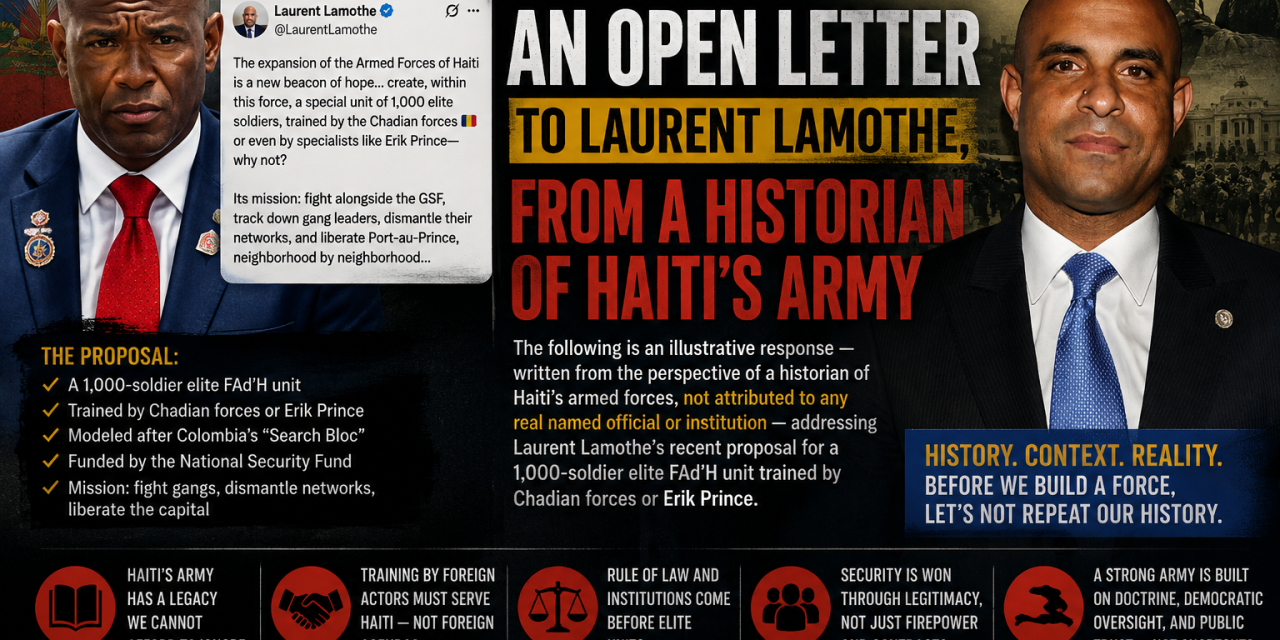
The following is an illustrative response — written from the perspective of a historian of Haiti’s armed forces, not attributed to any real named official or institution — addressing Laurent Lamothe’s recent proposal for a 1,000-soldier elite FAd’H unit trained by Chadian forces or Erik Prince.
Mr. Lamothe,
Your proposal reads with real urgency, and the urgency itself is not the problem. Haitians are dying in numbers that should shame every government that has touched this crisis, yours included. But history is not kind to proposals like this one, and since you invoke history yourself — Pablo Escobar, the Search Bloc, “beacons of hope” — it deserves to be answered with history, not slogans.
Start with the unit you’re describing. A 1,000-strong elite force, foreign-trained, funded outside normal budgetary transparency, operating with a mandate to “liberate” territory neighborhood by neighborhood — this is not a new idea in Haiti. It is, structurally, the oldest idea in Haiti. The Garde d’Haïti that the U.S. Marines built during the 1915–1934 occupation was also meant to be a modern, elite, foreign-trained force capable of doing what existing institutions could not. Within a generation, that same force had become the machinery of dictatorship. The FAd’H that followed it went on to overthrow elected governments more often than it defended the nation from external threat, culminating in the 1991 coup against Haiti’s first freely elected president. Haiti disbanded its army entirely in 1995 for exactly this reason: a well-armed, well-trained institution answerable to no durable civilian check had proven, again and again, more dangerous to Haitian democracy than to Haiti’s actual enemies. An elite unit — better equipped, better trained, and more autonomous than the rest of the reconstituted FAd’H — is precisely the shape that risk has historically taken. You are not proposing something untested. You are proposing something Haiti has tested to destruction, twice.
Then there is the question of who trains it. Chadian forces have real, hard-won counter-insurgency experience in the Sahel — that is a fair point in the proposal’s favor. But naming Erik Prince in the same breath undercuts it. Prince built Blackwater, a private military contractor whose personnel were convicted for the 2007 Nisour Square massacre of Iraqi civilians, and who has spent the years since pitching mercenary security arrangements to fragile and post-conflict states — including, notably, Haiti itself in earlier proposals under previous governments that went nowhere for good reason. A force trained and potentially advised by a private military contractor with that record is not a technical detail to wave away with “why not?” It is a governance and accountability question at the center of whether this unit answers to the Haitian state or to whoever is paying its foreign trainers.
The Search Bloc comparison deserves more scrutiny than a tweet allows. Colombia’s Search Bloc did track down and kill Pablo Escobar — but it did so in close, documented coordination with the U.S. DEA and CIA, and its campaign ran parallel to Los Pepes, a vigilante death squad that carried out extrajudicial killings against Escobar’s associates and family, with credible evidence that some Search Bloc members fed it intelligence. Colombia spent decades afterward reckoning with the human rights costs of that campaign. If that is the model, Haitians deserve to know now — not after the fact — whether “liberate Port-au-Prince, neighborhood by neighborhood” means judicial process and territorial control, or whether it means importing Colombia’s extrajudicial shortcuts along with its results.
We have also already run something close to this experiment, and watched it fail. Between 2004 and 2017, the United Nations Stabilization Mission in Haiti (MINUSTAH) deployed thousands of foreign troops and police — at its peak, a force many times the size of the 1,000-soldier unit you’re proposing — with a mandate that explicitly included dismantling armed gangs. MINUSTAH’s most cited “success” was Cité Soleil in 2006–2007: Brazilian-led forces ran sustained military-style operations against gang strongholds, complete with armored vehicles and door-to-door raids, and for a period gang activity in that neighborhood did fall. It looked, at the time, like proof that a sufficiently equipped, foreign-trained force could do what Haitian institutions alone could not. But MINUSTAH stayed in Haiti for thirteen years, at a cost of billions of dollars, and left in 2017 with gangs not eliminated but simply waiting — the same networks that had been pushed underground in Cité Soleil resurfaced, regrouped, and by the 2020s had grown into something far larger and better armed than anything MINUSTAH ever faced. On top of that, the mission left two lasting wounds of its own: a cholera epidemic traced to Nepalese peacekeepers that killed an estimated 10,000 Haitians, and a well-documented pattern of sexual abuse and exploitation by peacekeepers against Haitian civilians, including children — for which the UN itself formally apologized years later. If a thirteen-year, multinational, heavily resourced foreign deployment with a much larger footprint than your proposed unit could not produce a durable defeat of Haiti’s gangs, and left its own scandals behind in the process, the burden of proof sits with anyone proposing a smaller foreign-trained force to explain what would be different this time — not just in firepower, but in accountability, exit strategy, and what happens to the gang networks that survive contact and simply go quiet until the cameras leave.
And then there is the funding mechanism. You propose the National Security Fund. Haitians have heard this before. PetroCaribe funds were also meant to build infrastructure and strengthen the state; instead they became the largest corruption scandal in modern Haitian history, the same scandal whose unresolved anger fueled the “peyi lòk” protests that helped destabilize the very government you led. Before any fund finances a 1,000-soldier armed unit with an operational mandate to use lethal force, Haitians are owed independent oversight mechanisms specified in advance — not promised after the money has already moved.
One more thing, said plainly because you said things plainly about others. You have spent much of the past year publicly, angrily denying Canada’s 2022 sanctions designation accusing you of enabling gang activity during your own time in office. Whatever the truth of that dispute, it means you are, right now, uniquely positioned to be asked: what oversight would you propose for a new armed force that you, of all people, would not also want applied retroactively to the era you governed in? That is not an attack. It is the same standard of accountability your own proposal claims to want for the future.
None of this means Haiti should do nothing. The FAd’H’s current force — roughly 1,471 personnel against gang coalitions that, by UN counts, killed over 2,300 people and displaced nearly 1.5 million in the first half of this year alone — is plainly inadequate to the scale of the crisis, and a serious, well-resourced expansion is a legitimate conversation. But “invest massively” and “we have nothing to lose” are exactly the words Haiti has heard before every previous militarized shortcut that ended in a coup, a massacre, or a stolen fund. The lesson of two centuries of Haitian military history is not that force is never the answer. It is that force without durable civilian oversight, transparent funding, and accountable command has never once, in this country’s history, stayed the servant of the state that created it.
Haiti does not need another beacon that turns into a warning. It needs an army — however large, however trained — that a future government won’t have to disband all over again.
This response is offered as historical and political commentary, not as a statement from any government, party, or named individual.