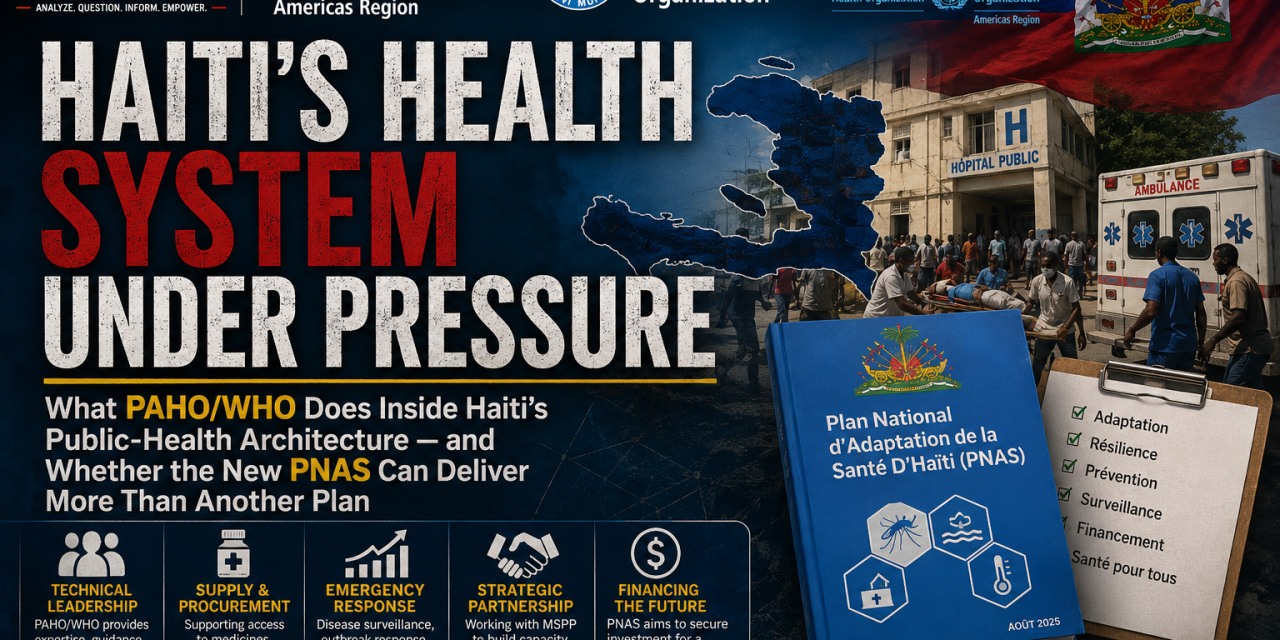
What PAHO/WHO Does Inside Haiti’s Public-Health Architecture — and Whether the New PNAS Can Deliver More Than Another Plan
By Haiti Politic | Health Policy & Public Administration Analysis
Haiti’s health crisis did not begin with the current wave of armed violence, and it cannot be explained simply by a shortage of hospitals or doctors. For decades, the country has struggled with a deeper structural problem: the Haitian state has never developed a sufficiently financed, geographically accessible and institutionally strong national health system capable of guaranteeing basic care to the population.
The consequences are visible everywhere—from overcrowded public hospitals and shortages of medicines to weak emergency transportation, dependence on international donors, unequal rural access, health-worker migration and repeated disruptions caused by political instability, earthquakes, hurricanes, epidemics and, increasingly, armed groups.
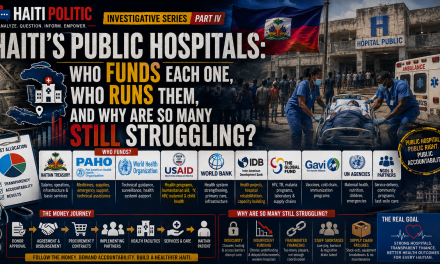
Against this background, the Ministère de la Santé Publique et de la Population (MSPP) works alongside an unusually large network of international organizations. Among the most influential is the Organisation panaméricaine de la Santé (OPS/PAHO), which also serves as the Regional Office for the Americas of the Organisation mondiale de la Santé (OMS/WHO).
That relationship raises an important policy question:
Where does Haitian public-health leadership end and international technical assistance begin?
And a newer question has emerged with Haiti’s Plan National d’Adaptation de la Santé (PNAS) 2025–2029:
Can Haiti actually finance and implement this ambitious climate-health strategy—or will PNAS join a long history of technically sophisticated national plans whose implementation has been constrained by weak institutions, insecurity and dependence on external financing?
I. First, understand the institutions: OPS and OMS are not two unrelated organizations
There is often confusion in Haiti when people hear OPS/OMS.
The World Health Organization (WHO/OMS) is the United Nations specialized agency responsible for international public health.
The Pan American Health Organization (PAHO/OPS) is the specialized international health agency for the Americas and simultaneously functions as WHO’s Regional Office for the Americas.
Consequently, when documents in Haiti refer to OPS/OMS, they are generally describing an integrated PAHO-WHO relationship rather than two independent international agencies separately running Haitian health policy.
But there is an equally important distinction:
OPS/OMS is not Haiti’s Ministry of Health.
Under Haiti’s governmental structure, the MSPP remains legally responsible for formulating and implementing national public-health policy. Its official mission includes protecting the population’s health, regulating health activities, developing nationwide health coverage and coordinating external partners.
That distinction matters.
PAHO/WHO can provide:
technical expertise, epidemiological support, international standards, training, procurement systems, emergency assistance, surveillance assistance, policy advice and resource mobilization.
But ultimately, Haiti’s health system is supposed to be governed by Haiti.
II. What exactly does PAHO/WHO do in Haiti?
PAHO/WHO’s footprint inside Haiti’s health sector is extensive.
Its work with MSPP includes strengthening primary healthcare, training health personnel, supporting disease surveillance, helping improve health-information systems, expanding access to medicines and technologies, emergency preparedness and assisting Haiti’s movement toward universal health coverage.
One particularly important—and often overlooked—function is medical supply and procurement.
PAHO supports Haiti through PROMESS and the PAHO Strategic Fund, mechanisms used for planning, purchasing and managing medicines and medical supplies.
During humanitarian emergencies, the organization’s role becomes even larger.
For 2026, PAHO says its Haiti response is concentrating on restoring essential health services, strengthening disease surveillance and epidemic response, assisting displaced populations, maintaining supply chains and supporting health facilities operating under extremely difficult security conditions.
That makes PAHO/WHO simultaneously:
a technical adviser, emergency-response partner, health-system development partner, procurement facilitator, surveillance partner and international resource-mobilization actor.
And that produces both advantages and risks.
III. The fundamental problem: Haiti’s health system depends heavily on actors the MSPP does not fully control
This is where the historical analysis becomes important.
Haiti’s own Plan Directeur Santé 2021–2031 acknowledged serious structural weaknesses in health financing.
Among the problems identified were fragmented financing, insufficient mechanisms for pooling resources, limited progress toward financial protection for patients, weak national financing strategy and substantial influence by technical and financial partners.
The plan explicitly recognized that donors make a decisive contribution to health expenditures and therefore possess considerable influence over resource allocation and the health-policy agenda.
That is an extraordinary admission.
It means Haiti faces what could be called a health sovereignty paradox:
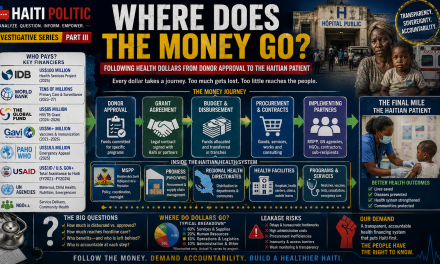
The MSPP is responsible for the national health system, but significant financial and technical resources required to operate that system originate outside the MSPP.
This does not mean international organizations are secretly controlling the ministry.
There is no evidence supporting such a claim.
The problem is structural.
If an institution lacks sufficient domestic financing, infrastructure, personnel and logistical capacity, the organizations possessing those resources inevitably acquire substantial practical influence over what can actually be implemented.
IV. Enter PNAS: what is Haiti’s Plan National d’Adaptation de la Santé?
The Plan National d’Adaptation de la Santé d’Haïti (PNAS) is fundamentally a climate-change and health strategy.
It should not be confused with a general plan to rebuild the entire Haitian healthcare system.
Haiti officially presented the plan in September 2025 following work involving the MSPP, the Ministère de l’Environnement (MDE) and technical support from PAHO/WHO. The finalized plan covers 2025–2029.
The MSPP subsequently published the PNAS through its official publications system in February 2026.
PNAS is Haiti’s health-sector response to a much bigger question:
What happens to an already fragile healthcare system when climate change makes existing health problems worse?
Consider Haiti’s vulnerabilities.
Hurricanes.
Flooding.
Extreme heat.
Drought.
Contaminated water.
Damage to hospitals.
Disrupted roads.
Food insecurity.
Population displacement.
Mosquito-borne diseases.
Waterborne disease.
Interrupted pharmaceutical supply chains.
And health facilities that themselves may lack reliable electricity, clean water, sanitation or disaster-resistant infrastructure.
Climate change acts as a threat multiplier across all of them.
V. PNAS is connected to a much larger Haitian climate strategy
PNAS did not appear in isolation.
Haiti already adopted a broader Plan National d’Adaptation 2022–2030, developed around national climate resilience.
That national adaptation strategy identifies four particularly important sectors:
agriculture, water, health and infrastructure.
The broader plan contains approximately 340 adaptation actions, including 21 identified as highly prioritized.
PNAS essentially takes the health component of climate adaptation and develops it into a more specialized health-sector framework.
This is consistent with WHO’s international model for Health National Adaptation Plans.
WHO encourages ministries of health to create dedicated health adaptation plans while integrating those plans into the country’s broader National Adaptation Plan.
So conceptually:
National Adaptation Plan → national climate resilience
while
PNAS → health-system climate resilience.
VI. What is PNAS actually trying to accomplish?
According to PAHO/WHO’s description of Haiti’s plan, PNAS has three fundamental ambitions:
reduce climate-related health vulnerabilities, establish effective governance, and mobilize resources necessary for implementation.
It also establishes monitoring and evaluation mechanisms.
But translated from development-policy language into practical healthcare, the ambition is much larger.
PNAS is essentially attempting to move Haiti from:
reacting to climate-related health emergencies
to
anticipating and preparing for them.
That distinction is enormous.
Instead of waiting until flooding produces a disease outbreak, health authorities should be capable of identifying vulnerable communities beforehand.
Instead of rebuilding the same damaged facility repeatedly, hospitals and clinics should increasingly become climate-resilient.
Instead of discovering an outbreak after hospitals begin filling with patients, epidemiological and climate information should contribute to early-warning systems.
Instead of treating climate, environment and health as separate government portfolios, MSPP, Environment and other ministries should coordinate.
VII. The PNAS implementation test
The strategy can therefore be understood through several practical tests.
| PNAS objective | What success would look like |
|---|---|
| Climate-health surveillance | MSPP identifies emerging climate-related disease risks earlier |
| Resilient facilities | Hospitals continue operating during disasters |
| Emergency preparedness | Medicines, oxygen, blood and personnel are available when disasters occur |
| Disease prevention | Better anticipation of vector- and water-borne outbreaks |
| Governance | MSPP, Environment and other agencies coordinate instead of operating separately |
| Health information | Climate information becomes integrated into public-health decision-making |
| Workforce | Health professionals understand climate-related health threats |
| Financing | Haiti obtains dedicated domestic and international climate-health financing |
| Monitoring | Government publicly measures whether PNAS targets are actually achieved |
That last point may ultimately determine whether PNAS becomes transformational.
A plan without measurable implementation is simply a document.
VIII. What has PNAS failed to accomplish?
This question requires an important correction.
It is too early to responsibly declare PNAS itself a failure.
The plan covers 2025–2029 and was officially launched only in September 2025.
At launch, Haiti approved a first-year work plan and established a coordination mechanism. PAHO specifically described the next phase as operationalizing that mechanism, conducting regular assessments and developing climate-health projects.
Therefore, in August 2026, PNAS is not a completed program whose final performance can be evaluated.
Claims that it has already “failed” should be treated cautiously unless individual targets and implementation data can be documented.
What can be examined instead is something more important:
PNAS has not yet solved the structural weaknesses that could prevent it from succeeding.
And those weaknesses are substantial.
IX. Failure risk #1: a climate-resilient health plan inside a health system struggling to function normally
There is an uncomfortable contradiction at the center of PNAS.
Haiti wants to make healthcare infrastructure resilient against future climate shocks while parts of the existing system are struggling with today’s security emergency.
PAHO describes Haiti’s current situation as a Grade 3 humanitarian emergency.
Its 2026 priorities include maintaining essential services, supplying medicines and oxygen, assisting displaced populations, providing fuel and logistical support to facilities and helping the national ambulance system continue functioning.
Think about what that means.
PNAS asks:
How do we make a hospital climate resilient in 2030?
The current humanitarian crisis asks:
Can the hospital remain open next week?
Both questions matter.
But the second can overwhelm the first.
X. Failure risk #2: financing
This may be PNAS’s greatest vulnerability.
A sophisticated adaptation plan can identify hundreds of interventions.
But:
Who pays?
Historically, Haiti has struggled to establish sustainable domestic health financing.
The MSPP’s earlier health strategy acknowledged fragmented funding arrangements and major dependence on technical and financial partners.
PNAS therefore enters an environment where Haiti must compete for:
international climate finance,
humanitarian funding,
development assistance,
multilateral financing,
bilateral assistance,
and limited domestic public resources.
That is not the same as possessing a guaranteed PNAS budget.
XI. So where exactly is PNAS funding coming from?
This is perhaps the most important question in the entire investigation.
The public documents reviewed do not support describing PNAS 2025–2029 as a fully financed program with one dedicated donor paying its entire implementation cost.
Instead, its financing model appears to depend on resource mobilization from multiple sources.
PAHO’s official account says explicitly that the next phase includes developing climate-and-health projects, including proposals for submission to the:
Green Climate Fund — Fonds vert pour le climat
That wording is critical.
It means:
a potential funding source is not necessarily secured funding.
A proposal to the Green Climate Fund does not mean the Green Climate Fund has already financed the entire PNAS.
Those distinctions must remain clear in public reporting.
XII. There are potentially several financing layers
PNAS implementation can theoretically draw upon several categories of resources:
1. Haitian public financing
The Haitian government remains responsible for financing its health institutions and incorporating priorities into national budgeting.
2. International development partners
Bilateral and multilateral donors have historically financed substantial portions of Haiti’s health programs.
3. PAHO/WHO technical and project support
PAHO/WHO provides technical assistance and can help Haiti develop fundable programs, strengthen institutional capacity and mobilize international resources.
4. International climate-finance mechanisms
This is potentially transformative.
The Green Climate Fund is explicitly mentioned in the PNAS implementation pathway.
WHO has also become an accredited implementing entity of the Adaptation Fund, meaning WHO can receive resources from that international climate mechanism for eligible adaptation programs consistent with national priorities. That does not establish that Haiti’s PNAS has received such financing; it demonstrates another possible international financing pathway.
5. Humanitarian financing
Emergency resources may indirectly strengthen components relevant to resilience—surveillance, logistics, emergency services, medical supplies and facility continuity—but humanitarian emergency financing should not automatically be counted as PNAS financing.
For example, PAHO has sought $19.17 million for its 2026 Haiti health emergency response. That money is intended for emergency health interventions, not automatically the PNAS budget.
This distinction is extremely important for financial accountability.
XIII. PAHO/WHO’s role deserves both recognition and scrutiny
PAHO/WHO’s involvement has clear advantages.
Haiti gains access to international epidemiological expertise, procurement mechanisms, global health standards, emergency coordination, climate-health expertise and institutional support that would be extremely difficult for MSPP to reproduce immediately on its own.
But a mature public-health debate should ask another question:
Has international assistance strengthened Haitian institutions—or unintentionally helped create permanent dependency?
Those are not the same thing.
If PAHO/WHO trains Haitian epidemiologists who eventually operate an MSPP-controlled surveillance system, that builds national capacity.
If international partners indefinitely operate functions the Haitian government cannot finance or manage itself, dependency persists.
The ultimate measurement of successful technical cooperation should therefore not simply be:
How much did international organizations do?
It should also be:
How much more can the Haitian state now do independently because of that assistance?
XIV. A new PAHO-Haiti relationship is now being formalized
Another major development occurred shortly after PNAS was launched.
In October 2025, Haiti and PAHO/WHO signed their first Country Cooperation Strategy for 2026–2028.
It establishes three major priorities:
strengthening the health system and universal access;
improving prevention and management of major health problems;
and strengthening emergency preparedness and response through a humanitarian-development-peace NEXUS approach.
This means the PNAS should not be evaluated in isolation.
It sits within a much larger attempt to rebuild the relationship between:
MSPP → PAHO/WHO → donors → humanitarian organizations → healthcare institutions → communities.
XV. Haiti’s bigger problem: plans have historically exceeded implementation capacity
This is where history should make policymakers cautious.
Haiti does not suffer from a complete absence of health plans.
There have been:
national health policies,
health-sector development plans,
strategic disease plans,
maternal and child-health strategies,
emergency plans,
financing strategies,
universal-health objectives,
and now climate-health adaptation plans.
The recurrent weakness has often been implementation capacity, financing, institutional continuity and accountability.
Haiti’s Plan Directeur Santé itself documented limited progress in health-financing reform and acknowledged that donor allocation decisions exert substantial influence over the sector.
PNAS therefore needs to break a historical cycle:
Plan → workshop → validation → donor conference → partial financing → political crisis → interrupted implementation → new plan.
If PNAS follows that trajectory, the technical quality of the document will ultimately matter very little.
XVI. The questions Haiti Politic believes MSPP and PAHO/WHO should answer publicly
Rather than asking whether PNAS “sounds good,” journalists, parliamentarians when constitutional legislative government returns, civil society and the Haitian medical community should demand measurable answers.
- What is the total estimated cost of implementing PNAS 2025–2029?
- How much has actually been financed as of 2026?
- How much is financed directly by Haiti’s Treasury?
- How much comes from PAHO/WHO?
- Which bilateral donors are financing PNAS activities?
- Which multilateral institutions are financing implementation?
- Which Green Climate Fund proposals have actually been submitted?
- Which have been approved?
- How much money has actually been disbursed—not pledged?
- Which Haitian institutions receive and administer those funds?
- Are funds flowing through MSPP, Environment, UN agencies, NGOs or contractors?
- What percentage reaches departmental and community health systems?
- Which hospitals will receive climate-resilience investments?
- What measurable indicators will determine success by December 2029?
- Will MSPP publish annual PNAS expenditure and performance reports?
Those answers would allow the Haitian public to distinguish a funded national program from an aspirational policy framework.
XVII. A PNAS Accountability Scorecard should be public
Haiti could go further.
Every year MSPP could publish something like this:
| Indicator | 2025 baseline | 2026 | 2027 | 2028 | 2029 target |
|---|---|---|---|---|---|
| Climate-resilient health facilities | — | — | — | — | Target |
| Facilities with reliable water | — | — | — | — | Target |
| Facilities with emergency electricity | — | — | — | — | Target |
| Climate-health early-warning systems | — | — | — | — | Target |
| Personnel trained | — | — | — | — | Target |
| Departments covered | — | — | — | — | Target |
| PNAS budget required | — | — | — | — | — |
| Funding committed | — | — | — | — | — |
| Funding actually disbursed | — | — | — | — | — |
| Haitian Treasury contribution | — | — | — | — | — |
The blanks are intentional.
They should not be filled with estimates masquerading as verified facts. MSPP should publish the numbers.
XVIII. The central question is bigger than PNAS
PNAS is potentially one of the more important health-planning developments Haiti has undertaken because climate change will increasingly affect disease patterns, food security, water availability, migration, disasters and healthcare infrastructure.
But Haiti’s greatest health challenge remains institutional.
A climate-resilient hospital cannot function without nurses.
A surveillance platform cannot protect communities without reliable data.
An emergency plan cannot transport patients without ambulances and fuel.
A national strategy cannot be implemented without financing.
And an internationally financed health system cannot become truly sustainable unless Haiti progressively develops the fiscal and institutional capacity to finance more of its own healthcare.
That brings us back to PAHO/WHO.
The organization remains one of Haiti’s most important health partners and is playing a significant technical role in PNAS. But the long-term objective should not be a Haitian health system permanently dependent upon PAHO, WHO, NGOs and foreign donors.
The objective should be something much more difficult:
a Haitian state capable of governing, financing, regulating and operating a functioning national health system—with international organizations supporting that system rather than substituting for its weaknesses.
PNAS will therefore be judged not by the number of workshops held, plans published or international commitments announced.
It should be judged by outcomes:
Are hospitals more resilient?
Are outbreaks detected earlier?
Are vulnerable communities better protected?
Can facilities survive hurricanes and floods?
Is financing reaching frontline healthcare?
Can MSPP demonstrate where every dollar went?
And ultimately:
Is Haiti becoming more capable of protecting the health of its population without depending indefinitely on outsiders to keep the system functioning?
That is the real test of the Plan National d’Adaptation de la Santé 2025–2029.
And it is also the larger test confronting the Ministère de la Santé Publique et de la Population, PAHO/WHO and every international partner working inside Haiti’s health system.
Editor’s note: Because PNAS is still in its 2025–2029 implementation period, it would be inaccurate at this stage to label the program itself a success or failure. The stronger investigative approach is to track its financing, disbursements, projects and measurable results annually against its published objectives.