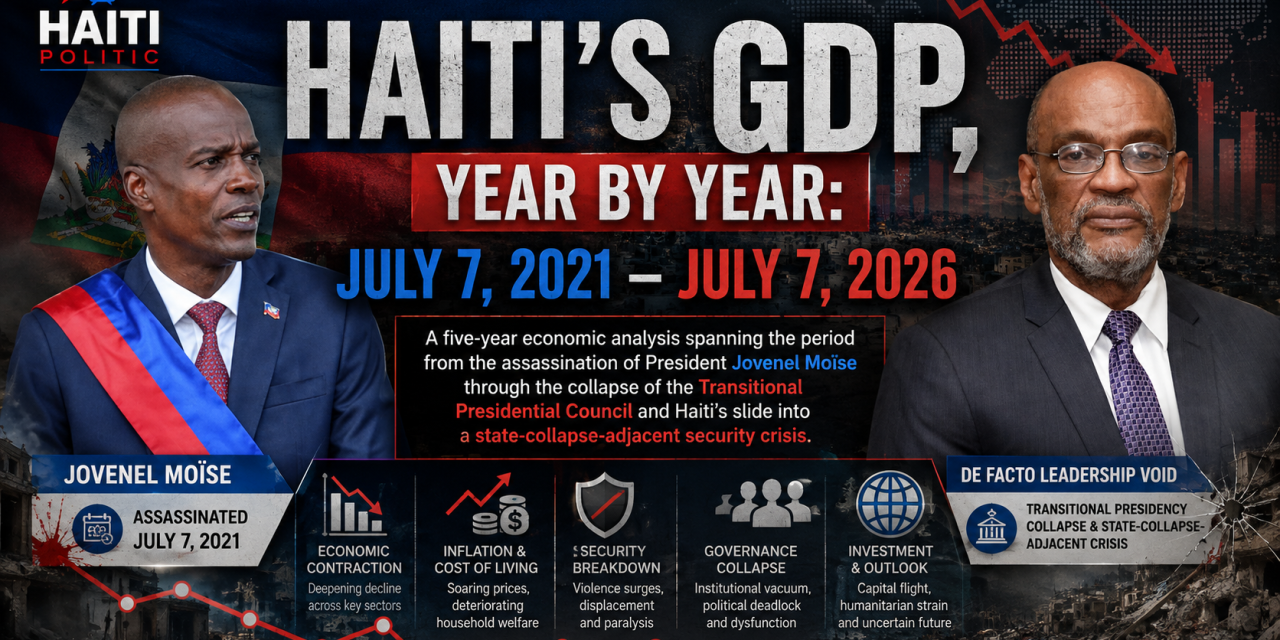
A five-year economic analysis spanning the period from the assassination of President Jovenel Moïse through the collapse of the Transitional Presidential Council and Haiti’s slide into a state-collapse-adjacent security crisis.
Overview and Data Notes
This has been, by a wide margin, the most volatile five-year stretch in Haiti’s modern economic history — not primarily because of natural disaster or global shocks, but because of a near-total collapse of state authority in and around the capital. Two data complications are worth flagging up front. First, Haiti’s own national accounts (compiled by the Institut Haïtien de Statistique et d’Informatique, IHSI) run on an October–September fiscal year, while most international sources (World Bank, IMF) report calendar-year equivalents; the two don’t line up exactly, so growth-rate figures below are presented by fiscal year where that is the authoritative source (World Bank Macro Poverty Outlook), and by calendar year for nominal dollar GDP. Second, nominal (current US$) GDP figures for 2024–2026 vary unusually widely across data providers — some sources show 2024 nominal GDP around $22 billion, others above $25 billion — a divergence driven by extreme gourde exchange-rate swings and differing conversion methodologies rather than disagreement about underlying real output. Where that uncertainty exists, it’s noted explicitly rather than papered over with false precision.
| Period | Nominal GDP (current US$, billion) | Real GDP Growth | Governing Authority |
|---|---|---|---|
| 2021 | ~20.9 | ~−1.8% | Moïse (to July 7) → Ariel Henry (interim PM) |
| 2022 | ~20.1–20.3 | ~−1.7% | Ariel Henry (interim PM, no elected government) |
| 2023 | ~19.6–19.9 | ~−1.9% (FY2022/23) | Ariel Henry (interim PM) |
| 2024 | ~22–26 (source-dependent) | ~−4.2% (FY2023/24) | Henry ousted (March) → Transitional Presidential Council → PM Garry Conille → PM Alix Didier Fils-Aimé |
| 2025 | 32.1 (World Bank) | ~−2.7% (FY2024/25) | Transitional Presidential Council / PM Fils-Aimé |
| 2026 (through July) | ~33–39 (forecast, source-dependent) | ~+0.6% projected (FY2025/26) | TPC dissolved Feb. 2026; Prime Minister exercising executive functions; elections planned for August–December 2026 |
Sources: World Bank Macro Poverty Outlook for Haiti (April 2026 edition, fiscal-year real GDP growth and 2025 nominal GDP); World Bank/IMF current-US$ series and Macrotrends, StatisticsTimes, and Trading Economics for nominal GDP ranges; IHSI for underlying national accounts.
Year-by-Year Analysis
2021 — Assassination, Earthquake, and Institutional Collapse
President Jovenel Moïse was assassinated at his private residence on July 7, 2021, plunging Haiti into a constitutional crisis with competing claimants to power before Ariel Henry consolidated control as interim prime minister with international backing, governing without a sitting president, functioning parliament, or elected mandate. Weeks later, on August 14, 2021, a 7.2-magnitude earthquake struck Haiti’s southern peninsula, killing over 2,200 people and causing extensive damage in a region still recovering from Hurricane Matthew five years earlier. Despite these shocks, real GDP contracted only modestly for the year (roughly −1.8%), continuing rather than sharply deepening the recession that had begun in 2019; nominal GDP actually rose on paper to around $20.9 billion, an increase driven substantially by currency-conversion effects rather than genuine economic expansion.
2022 — Fuel Blockades and the Rise of Gang Federations
2022 was defined by the consolidation of armed gang power as a force capable of paralyzing the national economy. In September 2022, the G9 gang federation, led by former police officer Jimmy “Barbecue” Chérizier, blockaded the Varreux fuel terminal near Port-au-Prince for nearly two months, cutting off the country’s main fuel supply, shutting down hospitals, schools, and gas stations nationwide, and triggering a cholera resurgence as water-treatment and sanitation systems lost power. Real GDP contracted again, by roughly 1.7–1.9%, while nominal GDP slipped to around $20.1–20.3 billion. Henry’s government, still unelected and increasingly reliant on international support, formally requested foreign armed intervention in October 2022 — a request that would take nearly two years to produce any deployment.
2023 — Deepening Insecurity, International Response Takes Shape
Gang violence intensified further through 2023, with kidnapping, extortion, and territorial control expanding well beyond Port-au-Prince’s traditionally gang-affected neighborhoods. In October 2023, the UN Security Council authorized a Kenya-led Multinational Security Support (MSS) mission to help Haiti’s National Police confront the gangs, though actual deployment was repeatedly delayed by funding, legal, and logistical obstacles. Economically, real GDP contracted by an estimated 1.9% for fiscal year 2022/23, with nominal GDP falling further to roughly $19.6–19.9 billion — the lowest nominal figure of the entire five-year period. Persistent insecurity, capital flight, and a near-total halt in new private investment characterized the year.
2024 — State Collapse in the Capital and the Steepest Contraction
2024 saw Haiti’s crisis reach its most acute point of the period. In late February and early March, coordinated gang assaults — under the newly formed “Viv Ansanm” (“Living Together”) coalition uniting previously rival gang federations — stormed police stations, opened fire on the main international airport (forcing its closure for months), and attacked prisons, freeing thousands of inmates. Prime Minister Ariel Henry, out of the country at the time, was effectively barred from returning and resigned under pressure in April 2024. A Transitional Presidential Council (TPC) was installed to govern in his place, appointing Garry Conille as prime minister in June 2024, who was himself replaced by Alix Didier Fils-Aimé by November 2024 amid continued council infighting. Against this backdrop, real GDP contracted sharply — an estimated 4.2% for fiscal year 2023/24, the steepest single-year decline of the entire period and one of the worst in the Western Hemisphere for the year — as industry (particularly apparel manufacturing, hit by both insecurity and lapses in U.S. trade preferences) and exports collapsed (exports of goods and services fell an estimated 31% for the fiscal year) and gross fixed capital investment cratered by nearly 37%. One rare bright spot: Haiti reached a resolution of its long-standing PetroCaribe oil-financing debt obligations with Venezuela in early 2024, easing a portion of the country’s external interest burden going forward. Nominal dollar GDP figures for 2024 vary substantially by source (from roughly $22 billion to over $25 billion), reflecting significant exchange-rate volatility during the year.
2025 — Displacement Doubles, Hurricane Melissa, and a Fragile Fiscal Stabilization
Real GDP contracted for a seventh consecutive year in fiscal year 2024/25, by an estimated 2.7%, as gang control expanded further and forced displacement doubled nationally — from roughly 700,000 people in September 2024 to 1.4 million a year later. In late October 2025, Hurricane Melissa struck Haiti’s southern departments, compounding food insecurity by damaging crops in a region where roughly a quarter of jobs are tied to agriculture, on top of an estimated 270,000 Haitians forcibly returned during the year, predominantly from the Dominican Republic. More than half the population faced Crisis, Emergency, or Catastrophic levels of food insecurity by year’s end. Yet amid the human catastrophe, several fiscal indicators stabilized or even improved on paper: interest expenditure fell sharply following the PetroCaribe resolution with Venezuela, the government recorded a small fiscal surplus for the fiscal year, and the gourde appreciated slightly, aided by remittances equivalent to roughly 16% of GDP. Nominal GDP for 2025 is put by the World Bank at $32.1 billion — a large jump from 2024 figures across most sources, though this reflects currency and price-level effects at least as much as real output growth, since real GDP was still contracting over the same period. In a significant policy development, the UN Security Council authorized a much larger, 5,500-member Gang Suppression Force (GSF) to succeed the underpowered Kenya-led mission, though its full operationalization remained gradual through year-end. The U.S. also retroactively extended Haiti’s preferential apparel trade access through the end of 2026 after it had briefly lapsed.
2026 (through July 7) — Political Reset Amid Continued Fragility
The Transitional Presidential Council was dissolved as scheduled in February 2026, having failed to organize elections during its mandate; the sitting prime minister has since assumed executive functions, a move contested by some departing council members, adding a fresh layer of political uncertainty even as the country nominally moves toward its next milestone. General elections are planned for August and December 2026, contingent on security conditions and financing — the first electoral process attempted since Moïse’s assassination nearly five years earlier. Economically, the World Bank’s April 2026 outlook projects the recession is bottoming out: real GDP growth for fiscal year 2025/26 is forecast at a modest positive 0.6%, the first projected expansion of the entire five-year window, attributed to gradual security gains expected from the expanded Gang Suppression Force. Inflation, while still severe, is projected to ease somewhat, from 28.3% in FY2024/25 to roughly 22.0% in FY2025/26, anchored in part by an IMF Staff-Monitored Program. As of the first quarter of calendar 2026, economic activity was reported to be shrinking at its softest pace in nearly three years, with agricultural and industrial output declining more slowly and services output beginning to grow again — tentative signs, though far from confirmation, that the worst of the contraction may be behind the country.
Synthesizing the Five Years
Unlike the 2011–2021 decade, which was shaped by natural disasters, electoral crises, and corruption scandals layered on top of a fundamentally aid-dependent economy, the 2021–2026 period has been dominated by a single overriding force: the collapse of state security authority, particularly in and around Port-au-Prince, and the corresponding rise of organized gang federations as de facto governing powers over large parts of the capital and its economic infrastructure (ports, the airport, fuel terminals, and major roads).
Three phases emerge:
- 2021–2023, Sustained but Moderate Contraction (real GDP growth averaging roughly −1.8% per year): The post-assassination interim government under Ariel Henry presided over persistent decline, punctuated by episodic shocks (the August 2021 earthquake, the 2022 fuel blockade) but without the kind of acute institutional collapse that would follow in 2024.
- 2024, Acute Crisis (real GDP contracting roughly 4.2%): The coordinated Viv Ansanm gang offensive, the fall of the Henry government, and the establishment of the Transitional Presidential Council marked the sharpest single-year deterioration, as the closure of the main airport and the near-total disruption of exports and investment pushed the contraction to its worst point of the decade.
- 2025–2026, Fragile Stabilization (real GDP growth moving from roughly −2.7% to a forecast +0.6%): Even as the human toll continued to deepen — mass displacement, worsening food insecurity, and a damaging hurricane — several macroeconomic indicators (inflation, the fiscal balance, the exchange rate) began stabilizing, and international backing for a larger, better-resourced Gang Suppression Force created the first tentative basis for a positive growth forecast since before the pandemic.
Taken as a whole, Haiti’s economy shrank in real terms every single fiscal year from 2019 through 2025 — seven consecutive years of contraction, the longest sustained decline in the country’s modern statistical record — before the World Bank’s April 2026 projections point to the first (still fragile) return to growth. Nominal dollar GDP figures across the period are difficult to compare cleanly given exchange-rate volatility, but the underlying real economy by 2025 was smaller, by most measures, than it had been a decade earlier — a reflection not of any single shock, but of the cumulative and compounding effect of assassination, earthquake, gang warfare, mass displacement, and institutional breakdown occurring almost without pause across five consecutive years.
Data sources: World Bank Macro Poverty Outlook for Haiti (April 2026); World Bank World Development Indicators; International Monetary Fund; Institut Haïtien de Statistique et d’Informatique (IHSI); Trading Economics, Macrotrends, and StatisticsTimes for supplementary nominal GDP figures; contemporaneous reporting on the 2021 assassination and earthquake, the 2022 Varreux blockade, the 2023 UN Security Council MSS authorization, the 2024 Viv Ansanm offensive and Transitional Presidential Council formation, and the 2025–2026 Gang Suppression Force authorization. This analysis is for informational purposes; consult primary World Bank/IMF/IHSI datasets for citation-grade figures, particularly given the wide variance in nominal GDP conversions during this period.