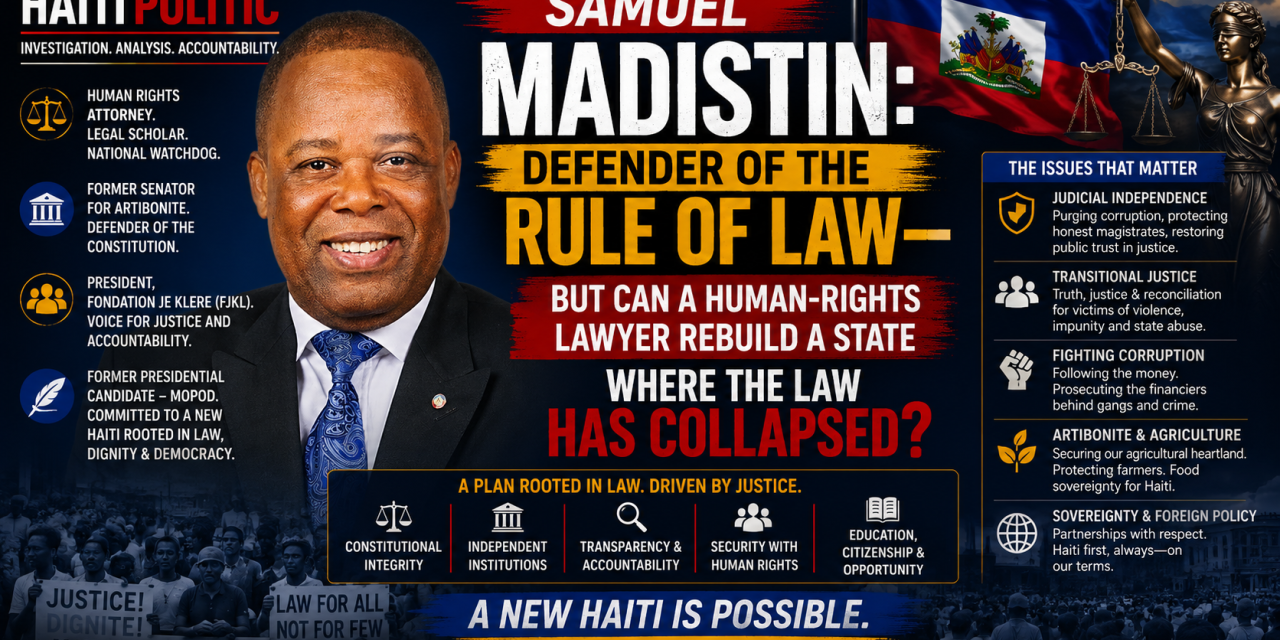
Lawyer. Former Senator. Human-rights advocate. Former presidential aspirant. President of Fondasyon Je Klere.
Samuel Madistin presents an unusual profile in Haitian public life. His strongest political asset is not a business empire, celebrity persona, armed movement or massive electoral machine.
It is the law.
For years, Madistin has operated where Haitian politics, policing, constitutional disputes and human-rights accountability collide. Today he serves as president of the board of Fondasyon Je Klere (FJKL), which describes its mission as helping transform Haiti’s failed state into a modern democratic state governed by human rights and good-governance principles.
But Haiti Politic must ask a harder question:
Can someone who has spent years investigating and criticizing the system actually take control of that system and make it work?
🔎 WHO IS SAMUEL MADISTIN?
Madistin is a lawyer and former Senator representing the Artibonite Department in the 1990s. He later sought the presidential nomination of the Mouvement Patriotique Populaire Dessalinien (MOPOD) in 2015, competing against former first lady Mirlande Manigat for the party’s nomination.
His more enduring contemporary role, however, has been in human-rights advocacy.
FJKL was officially launched in April 2018. Its stated agenda encompasses human rights, responsible citizenship, government reform, decentralization, good governance and the fight against corruption and impunity. Madistin is currently identified by the organization as President of its Board.
That record gives him something many Haitian politicians struggle to establish:
a documented institutional focus on accountability.
But watchdog credibility must itself withstand scrutiny. FJKL has also faced public criticism from Haiti Liberté, which published a series challenging the organization’s credibility and aspects of the backgrounds and positions of its leadership. Those critiques should be part of any serious examination rather than ignored.
That leads directly to the first test.
⚖️ 1. THE LAWYER WHO WANTS ACCOUNTABILITY
Haiti doesn’t simply have a crime problem.
It has an impunity problem.
A gang member pulling a trigger represents only one level of a criminal ecosystem.
Behind violent organizations can sit weapons suppliers, money launderers, corrupt officials, compromised police personnel, political patrons and businessmen who profit from disorder.
Madistin’s human-rights work has repeatedly put him inside debates about precisely these relationships.
In 2021, for example, FJKL publicly challenged the appointment of Frantz Elbé as head of the Haitian National Police, raising allegations concerning his past record and relationships with armed groups.
🎤 QUESTION #1 — WHO GOES TO JAIL?
Mr. Madistin, if evidence demonstrates that a wealthy businessman, former minister, senator or senior police commander financed a gang:
Would your government arrest them?
Would their assets be frozen?
Would beneficial ownership records be opened?
Would UCREF financial-intelligence investigations automatically trigger judicial review?
Would ULCC investigations become publicly trackable?
And most importantly:
Would you permit prosecutors to investigate members of your own administration?
Because anti-corruption means very little until it reaches one’s political allies.
🧑🏾⚖️ 2. CAN HAITI CLEAN UP ITS COURTS WITHOUT DESTROYING JUDICIAL INDEPENDENCE?
This presents Madistin with a constitutional paradox.
Haiti desperately needs cleaner courts.
But a president ordering a “purge” of judges could itself become an assault on judicial independence.
So the challenge isn’t merely removing corrupt magistrates.
It is creating an independent legal mechanism capable of doing so without presidential interference.
🎤 QUESTION #2 — WHAT EXACTLY IS YOUR JUDICIAL REFORM?
Would Madistin support:
➡️ Mandatory asset declarations for judges and prosecutors?
➡️ Financial background investigations?
➡️ Stronger CSPJ vetting?
➡️ Digitized case assignment to reduce judicial manipulation?
➡️ Publicly searchable court calendars?
➡️ Specialized anti-corruption courts?
➡️ Protected salaries and security for judges?
➡️ Witness-protection legislation?
➡️ Independent disciplinary tribunals?
The key distinction matters.
A strong president controlling judges isn’t judicial reform.
Strong institutions capable of investigating everyone—including the president—would be.
🚨 3. GANGS: HUMAN RIGHTS VS. THE DEMAND FOR FORCE
This could become Madistin’s greatest political challenge.
Haitians living under kidnapping, extortion, rape, displacement and territorial gang control may have little patience for abstract legal arguments.
They want security.
Immediately.
But a government cannot restore the rule of law by abandoning the rule of law.
FJKL’s work has also scrutinized dysfunction within the PNH. In 2020, it called for an independent commission to investigate discrimination, injustice and corruption within the police while simultaneously emphasizing discipline and respect for institutional hierarchy.
🎤 QUESTION #3 — HOW DO YOU DEFEAT GANGS LEGALLY?
Would President Madistin authorize specialized anti-gang units?
What rules of engagement would govern them?
Would officers wear body cameras?
Who investigates civilian deaths?
Would Haiti establish specialized organized-crime prosecutors?
Would captured gang leaders receive ordinary criminal trials or special tribunals?
And what happens when gang-controlled neighborhoods contain thousands of innocent civilians?
How does Haiti become more aggressive against organized crime without turning security forces into another source of abuse?
Madistin should be required to answer that operationally—not philosophically.
💰 4. FOLLOW THE MONEY
Haiti has spent years discussing gang leaders.
Perhaps it should spend more time discussing gang balance sheets.
Weapons cost money.
Ammunition costs money.
Vehicles cost money.
Political protection has economic value.
Kidnapping proceeds have to move somewhere.
Money laundering requires financial channels.
A serious Madistin security doctrine should therefore answer a critical question:
🎤 QUESTION #4 — CAN HAITI DESTROY GANGS THROUGH FINANCIAL WARFARE?
Would his administration create a permanent joint task force linking:
PNH + UCREF + ULCC + Customs + DGI + prosecutors + banking regulators?
Would suspicious transactions associated with sanctioned or indicted individuals trigger rapid asset restraints subject to judicial review?
Would customs databases be integrated with financial-intelligence systems?
Would shell-company ownership become transparent?
Would political campaign accounts be audited?
And would Haiti request evidence-sharing agreements with the United States, Canada, Dominican Republic, CARICOM states and European financial authorities?
This is where Madistin’s legal background could become a significant asset.
The challenge would be turning legal theory into enforcement.
🏛️ 5. THE CONSTITUTION QUESTION
Madistin has publicly taken strong constitutional positions.
In 2020, he argued that President Jovenel Moïse’s proposed constitutional referendum conflicted with Article 284-3 and with the constitutionally prescribed amendment process through Parliament.
That history makes his position particularly important now.
Haiti’s 1987 constitutional framework was designed partly to prevent another concentration of authoritarian presidential power.
But critics argue that Haiti’s semi-presidential architecture also contributes to chronic conflict among the presidency, prime minister and Parliament.
🎤 QUESTION #5 — REFORM THE CONSTITUTION OR ENFORCE IT?
Does Samuel Madistin believe Haiti’s constitutional system is fundamentally defective?
If yes:
Which articles should change?
The Prime Minister’s role?
Presidential powers?
Parliamentary oversight?
Election calendars?
Local government authority?
Dual nationality?
Diaspora political participation?
The amendment process?
Or does he believe Haiti’s fundamental problem isn’t the Constitution at all—but generations of leaders refusing to obey it?
That distinction deserves a direct answer.
🌾 6. THE ARTIBONITE TEST
Madistin once represented Artibonite.
Today, the department illustrates how security failure becomes economic collapse.
Farmers cannot prosper if roads are unsafe.
Agricultural credit cannot work when borrowers can be extorted.
Irrigation investments accomplish little if armed organizations dominate territory.
And Haiti cannot seriously discuss food sovereignty while agricultural regions remain insecure.
🎤 QUESTION #6 — HOW WOULD YOU RECLAIM HAITI’S AGRICULTURAL HEARTLAND?
Would a Madistin administration establish protected agricultural corridors?
Permanent PNH installations?
Rural intelligence networks?
Anti-extortion units?
Agricultural courts for land disputes?
State-backed farm credit?
Crop insurance?
Irrigation rehabilitation?
Government purchasing guarantees?
Because restoring Artibonite cannot simply mean sending police.
Security must produce economic activity afterward.
🕊️ 7. DOES HAITI NEED A TRUTH AND JUSTICE COMMISSION?
Haiti has accumulated decades of unresolved political violence.
Assassinations.
Massacres.
Kidnappings.
Forced displacement.
Police abuses.
Political persecution.
Gang atrocities.
And repeatedly, governments change while victims wait.
🎤 QUESTION #7 — JUSTICE, RECONCILIATION OR BOTH?
Would President Madistin establish a Truth, Justice and Reconciliation Commission?
Would perpetrators receive reduced sentences for testimony?
Would gang financiers qualify?
Would political officials qualify?
Would victims receive reparations?
Would amnesty ever be permissible for serious human-rights violations?
Could such a commission actually uncover the political-financial architecture behind Haiti’s violence—or would it become another institution producing reports nobody implements?
A human-rights candidate should provide unusually precise answers here.
🌎 8. FOREIGN POLICY: SOVEREIGNTY WITHOUT ISOLATION
Madistin’s profile suggests a foreign policy potentially centered more heavily on law, sovereignty and institutional accountability than on personality-driven diplomacy.
But Haiti’s foreign-policy dilemma is brutal.
The country needs international cooperation.
It also needs independence from externally engineered political arrangements that lack domestic legitimacy.
Those goals aren’t automatically compatible.
🎤 QUESTION #8 — WHAT DOES SOVEREIGN FOREIGN POLICY ACTUALLY MEAN?
Would Madistin support an international security mission?
Under whose command?
Would foreign personnel accused of abuses face Haitian jurisdiction?
Would Haiti negotiate formal human-rights compliance agreements?
What measurable benchmarks would trigger foreign-force withdrawal?
Would international assistance flow through Haitian institutions or parallel NGO structures?
And would Haiti be willing to reject foreign assistance when conditions contradict domestic priorities?
Sovereignty is easy to proclaim.
Financing it is harder.
👮 AN IMPORTANT EPISODE IN MADISTIN’S OWN RECORD
Human-rights advocacy in Haiti has carried real risks.
In February 2020, Madistin’s law office was vandalized, vehicles were burned and human-rights organizations demanded an investigation. Front Line Defenders reported that Madistin believed the attack was connected to his position supporting police unionization.
That episode demonstrates something important about his public career:
He has not merely discussed institutional conflict from a television studio.
He has operated inside it.
But personal courage and presidential competence are different things.
And voters should evaluate them separately.
🔍 FJKL MUST ALSO FACE SCRUTINY
Investigative journalism should not simply repeat a candidate’s preferred biography.
FJKL describes itself as an independent civic watchdog devoted to human rights, good governance, decentralization and combating corruption and impunity.
But critics have publicly challenged the organization’s credibility and political history. Haiti Liberté, for example, published an extended critique in 2023 alleging problems with FJKL and tracing controversies involving people associated with Haiti’s human-rights sector.
Those allegations do not by themselves establish wrongdoing by Madistin.
But they create legitimate questions.
🎤 QUESTION #9 — WHO WATCHES THE WATCHDOG?
Would FJKL publish its complete funding sources?
Audited financial statements?
Donor restrictions?
Conflict-of-interest rules?
Methodologies behind major investigations?
Corrections when reports contain errors?
And if Madistin returns to electoral politics, how would FJKL maintain institutional independence from him?
A politician whose reputation rests on transparency should welcome transparency applied to himself.
📊 HAITI POLITIC ASSESSMENT
| AREA | POTENTIAL STRENGTH | QUESTION TO CHALLENGE |
|---|---|---|
| ⚖️ Rule of Law | Decades in law and rights advocacy | Can legal principles survive Haiti’s violent political reality? |
| 🏛️ Institutional Knowledge | Former Senator with constitutional experience | Can he build a governing parliamentary coalition? |
| 🔍 Accountability | FJKL watchdog leadership | Will the same scrutiny reach allies and donors? |
| 👮 Security | Long record scrutinizing PNH governance | What is his actual operational anti-gang strategy? |
| 💰 Financial Crime | Legal framework potentially suited to anti-corruption enforcement | Can UCREF, ULCC and prosecutors be made genuinely independent? |
| 🌾 Artibonite | Historical political connection to the department | What is the measurable agricultural-security plan? |
| 📜 Constitution | Strong defense of constitutional procedure | What exactly would he amend, if anything? |
| 🌎 Foreign Policy | Potential rule-of-law/sovereignty orientation | How would Haiti preserve cooperation without dependency? |
| 🗳️ Electoral Politics | Previous Senate and presidential-level political experience | Can a rights advocate build a nationwide electoral machine? |
🧭 THE CENTRAL QUESTION
Samuel Madistin presents Haitian voters with a fascinating political proposition:
What if Haiti’s next transformation began not with another strongman—but with stronger law?
There is obvious appeal to that argument.
Haiti has repeatedly searched for powerful presidents.
Perhaps the country needs powerful institutions instead.
But there is also a danger.
A government can produce impeccable legal documents while criminals control roads outside the courthouse.
A constitution cannot patrol a neighborhood.
A human-rights report cannot reopen a port.
A court judgment means little if the state cannot enforce it.
The real test for Samuel Madistin is therefore not whether he understands the law.
His career strongly establishes that law and institutional accountability are central to his public identity.
The question is:
CAN HE GIVE THE LAW POWER?
🇭🇹 HAITI POLITIC — LET THE PEOPLE DECIDE
SAMUEL MADISTIN:
⚖️ DEFENDER OF JUSTICE?
🔍 ANTI-CORRUPTION WATCHDOG?
🏛️ INSTITUTIONAL REFORMER?
👮 RULE-OF-LAW PRESIDENT?
🌎 SOVEREIGNTY ADVOCATE?
OR ANOTHER RESPECTED HAITIAN INTELLECTUAL WHO MAY DISCOVER THAT DIAGNOSING A FAILED STATE IS MUCH EASIER THAN GOVERNING ONE?
Haiti does not need another personality cult.
It needs candidates willing to answer difficult questions with budgets, laws, deadlines and measurable results.
👇 LET THE PEOPLE DECIDE.
#HaitiPolitic #SamuelMadistin #Haiti #Ayiti #HaitiPolitics #Justice #HumanRights #RuleOfLaw #FJKL #Artibonite #AntiCorruption #HaitiElections #ForeignPolicy #LetThePeopleDecide