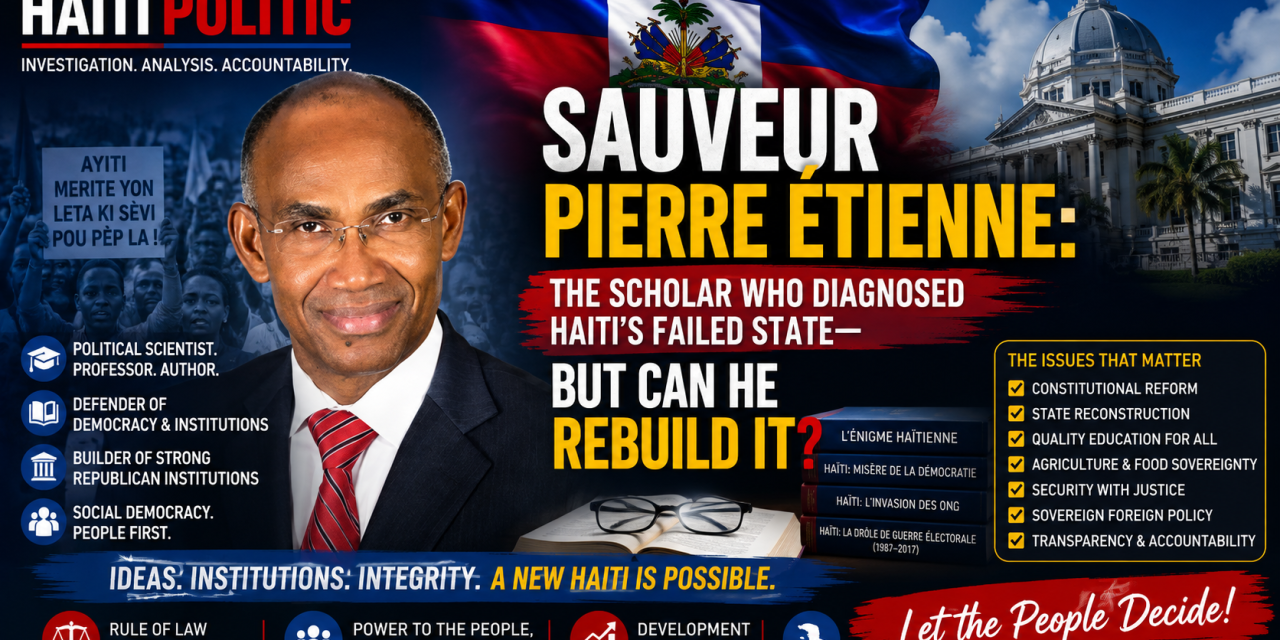
Political scientist. Professor. Author. OPL leader. Former presidential candidate.
For decades, Dr. Sauveur Pierre Étienne has studied a question that continues to haunt Haiti:
Why has the Haitian state repeatedly failed to transform elections, international assistance and political change into functioning institutions?
Unlike candidates whose reputations were built primarily in business, parliament, municipal government or mass protest, Étienne built much of his public identity around political science, institutional analysis, teaching and organized party politics.
That distinction matters.
But Haiti’s crisis raises a harder question:
Understanding why the state failed is one thing. Can a political scientist actually govern it differently?
That is the question Haiti Politic puts before the public.
🔎 FIRST, A FACT CHECK
Some biographical details circulating about Étienne need correction.
Étienne is indeed a Haitian political scientist, professor, author and longtime figure in the Organisation du Peuple en Lutte (OPL). But available biographical sources identify his doctorate in political science as coming from the Université de Montréal, not Mexico’s UNAM. He also pursued postdoctoral research at EHESS-CNRS in France and has taught and conducted research at the State University of Haiti.
His intellectual résumé is substantial. His published works include Haïti: l’invasion des ONG, Haïti: misère de la démocratie, and his major 2007 study, L’énigme haïtienne: Échec de l’État moderne en Haïti. In 2024, he and sociologist Laënnec Hurbon published Haïti: la drôle de guerre électorale (1987–2017).
That scholarship gives Étienne an unusual credential in Haitian politics:
He has spent years studying the system he once sought to lead.
🧠 WHO IS SAUVEUR PIERRE ÉTIENNE?
Étienne’s political history reaches well beyond university classrooms.
Available biographical accounts describe political activism beginning during the Duvalier era. He later became associated with the Lavalas political movement before joining the political current that became the Organisation du Peuple en Lutte following its rupture with Jean-Bertrand Aristide and the emergence of Fanmi Lavalas.
OPL has described itself as a center-left, democratic, popular and decentralized organization, and sources document its historical connection with the Socialist International.
Étienne eventually became OPL’s general coordinator and its presidential candidate.
That means he cannot be evaluated merely as an outside academic criticizing politicians.
He became a politician himself.
And that distinction creates the central accountability test of his career.
If Étienne understands Haiti’s institutional weaknesses so deeply, what did his political movement actually succeed in changing?
📚 THE BOOK THAT DEFINES HIS POLITICAL QUESTION
Perhaps the best place to understand Étienne’s worldview is L’énigme haïtienne.
Published by the Presses de l’Université de Montréal, the book examines Haiti’s repeated inability to construct a durable modern state. Its analysis addresses political instability, economic stagnation, dictatorship, dysfunctional elites, state-society relations and transnational power relationships.
His earlier Haïti: misère de la démocratie examined the difficult democratic transition after Duvalier, including the 1991–94 coup period and the inability of political actors to fully institutionalize the democratic order envisioned by the 1987 Constitution.
These were not abstract questions.
They anticipated much of today’s debate.
Haiti still confronts weak institutions, contested sovereignty, dependence on international intervention, fragile political parties, armed violence and repeated breakdowns in constitutional government.
So Étienne’s diagnosis deserves attention.
But voters are entitled to ask:
Where is the prescription?
⚖️ INVESTIGATION 1 | CAN THE SCHOLAR REENGINEER THE STATE?
Étienne’s strongest political asset may also be his greatest vulnerability.
He knows institutional theory.
But Haiti does not suffer from a shortage of constitutional language, development reports or political diagnoses.
It suffers from an enormous implementation deficit.
Police need salaries and equipment.
Courts need functioning judges.
Customs must collect revenue.
Municipalities need resources.
Schools need teachers.
Ports must operate.
Public officials must be audited.
Government contracts must be enforceable.
And elected governments must survive political opposition without collapsing.
So Haiti Politic would ask Étienne:
❓ THE STATE-BUILDING TEST
Dr. Étienne, after decades explaining Haiti’s institutional failure, name the first five state institutions you would restructure during your first two years in office.
And for each:
What law changes? What budget changes? Who loses power? Who gains accountability?
Without those answers, institutionalism remains a philosophy rather than a governing program.
📜 INVESTIGATION 2 | DOES HAITI NEED A NEW CONSTITUTION?
The 1987 Constitution was designed partly as protection against another authoritarian presidency.
But Haiti’s experience has exposed recurring conflict among the presidency, prime minister, parliament and electoral institutions.
Étienne’s scholarship makes him especially qualified to confront this debate.
The question should therefore be precise:
❓ REFORM OR ENFORCEMENT?
Is Haiti’s constitutional crisis caused primarily by defects in the Constitution—or by political actors refusing to obey it?
If the document itself is structurally defective:
Which articles would Étienne change?
Would he strengthen presidential authority?
Redefine the prime minister’s role?
Change the electoral calendar?
Reform Parliament?
Strengthen municipalities?
Create permanent rather than provisional electoral institutions?
Or would concentrating additional authority in the presidency simply reconstruct the authoritarian state the 1987 system was designed to prevent?
Haiti deserves specifics—not another constitutional slogan.
🌹 INVESTIGATION 3 | THE OPL QUESTION
Étienne’s candidacy cannot be separated from OPL’s history.
The organization emerged from one of the defining fractures of Haiti’s post-Duvalier democratic left. Government research documents Étienne among OPL’s founding political figures, while historical accounts place him earlier within the Lavalas political organization before the subsequent rupture.
That history matters because fragmentation remains one of Haiti’s political diseases.
Parties split.
Coalitions collapse.
Presidential alliances become opposition movements.
Opposition movements enter governments.
And ideological movements frequently revolve around personalities.
❓ THE LEFT-WING RECONCILIATION TEST
What responsibility does OPL accept for the fragmentation of Haiti’s democratic left?
And today:
Could Étienne construct a governing coalition with Lavalas, social democrats, peasant organizations, youth movements and moderate private-sector actors without sacrificing OPL’s institutional principles?
Because winning an election is only the beginning.
A Haitian president who cannot construct a parliamentary and social coalition may simply become the next occupant of an ungovernable presidency.
💰 INVESTIGATION 4 | SOCIAL DEMOCRACY NEEDS A PRICE TAG
Calling for education, agricultural investment and stronger public institutions is easy.
Financing them is considerably harder.
Haiti has a narrow fiscal base and enormous competing demands.
Security.
Infrastructure.
Education.
Agriculture.
Healthcare.
Justice.
Energy.
Municipal government.
So Haiti Politic would ask:
❓ WHERE DOES THE MONEY COME FROM?
If an Étienne government promises expanded public education:
How much would it cost?
Would he increase customs collection?
Raise taxes?
Eliminate exemptions?
Tax large fortunes or property?
Reduce ministries?
Cut subsidies?
Borrow internationally?
Issue diaspora bonds?
Reallocate security expenditures?
And if politically connected economic interests resist stronger taxation:
Would an OPL government actually confront them?
Social democracy without fiscal arithmetic is campaign rhetoric.
🌾 INVESTIGATION 5 | CAN OPL MAKE AGRICULTURE COMPETITIVE?
Protecting Haitian farmers is politically attractive.
But immediately restricting imported food could increase prices for millions of consumers before domestic production is capable of replacing imports.
That creates a serious policy dilemma.
❓ AGRICULTURE WITHOUT HUNGER
Would Étienne favor tariffs on imported rice, poultry and other products?
If yes:
How would his government prevent food inflation while domestic agriculture scales up?
A credible program would need to address irrigation, agricultural credit, seeds, fertilizer, land titles, storage, transportation, farm-to-market roads and agricultural insurance—not tariffs alone.
The central measurement should be simple:
Can Haitian farmers produce more food competitively while Haitian families still afford to eat?
🚨 INVESTIGATION 6 | THE SECURITY REALITY
This may be where academic institutionalism encounters its hardest test.
Haiti’s security problem cannot be solved through constitutional scholarship alone.
Armed organizations control territory, transportation routes and economic corridors. Weapons trafficking crosses international borders. Police capacity remains constrained.
Étienne has spent years examining institutional weakness.
A presidential campaign would therefore need an operational security doctrine.
❓ FIRST 100 DAYS
How many additional police officers?
How much additional police funding?
What intelligence structure?
What border strategy?
What weapons-trafficking strategy?
What prison reforms?
What judicial protections?
What anti-corruption mechanisms inside the PNH?
What happens to gang members who surrender?
And what happens to political or business figures proven to finance them?
The critical question is not whether Étienne understands the problem.
Can he command the institutions responsible for solving it?
🌎 INVESTIGATION 7 | FOREIGN POLICY: ENDING DEPENDENCE WITHOUT CREATING ISOLATION
This is where Étienne’s scholarship becomes particularly relevant.
His work has examined not merely domestic actors but the role of transnational power relationships in Haiti’s political development.
Haiti’s modern history has repeatedly involved international actors attempting to stabilize institutions that Haitian governments themselves have struggled to sustain.
That creates a vicious cycle:
State weakness → foreign intervention → sovereignty backlash → incomplete institution-building → renewed crisis → another foreign intervention.
Breaking that cycle should be a centerpiece of any Étienne foreign-policy doctrine.
❓ WHAT DOES SOVEREIGNTY ACTUALLY MEAN?
Would an Étienne government tell Washington, Ottawa, Paris, CARICOM and the United Nations:
Haiti welcomes partnership—but Haitian institutions determine Haitian priorities?
If so, how would that principle work when foreign governments provide money, security assistance and humanitarian support?
Would Haiti diversify relations toward Latin America, Africa and other emerging partners?
What role would the diaspora play?
And most importantly:
How does Haiti reduce foreign political leverage without losing the investment, trade, security cooperation and financing necessary for reconstruction?
Sovereignty without capacity risks becoming isolation.
International partnership without Haitian control risks becoming dependency.
A serious foreign policy must navigate between them.
🎓 INVESTIGATION 8 | THE PROFESSOR’S PROBLEM
Étienne’s intellectual credentials distinguish him.
They don’t automatically elect him.
His challenge is translating ideas about institutionalization, state formation, constitutionalism and democratic consolidation into something immediately meaningful to someone asking:
Can I safely send my child to school tomorrow?
Will electricity work?
Can I find a job?
Can I drive between cities without being kidnapped?
Can a farmer sell crops profitably?
Will a judge decide my case without a bribe?
That is the academic-to-street test.
A successful Étienne campaign would have to transform political science into tangible promises—and those promises into measurable government performance.
📊 HAITI POLITIC ASSESSMENT
| AREA | POTENTIAL STRENGTH | QUESTION VOTERS SHOULD ASK |
|---|---|---|
| State Building | Decades studying Haitian institutional failure | Can theory become administrative execution? |
| Academic Credentials | Political scientist, professor and published author | Does scholarship translate into crisis leadership? |
| Party Experience | Long history inside OPL | Can OPL expand beyond its traditional political constituency? |
| Democratic Institutions | Strong institutional and rule-of-law orientation | What concrete reforms would actually prevent another constitutional collapse? |
| Economic Policy | Social-democratic orientation | Where is the detailed fiscal and investment model? |
| Foreign Policy | Deep understanding of international influence on Haiti | Can Haiti gain autonomy without diplomatic or economic isolation? |
| Security | Institutional approach rather than strongman politics | Can that approach defeat heavily armed criminal networks quickly enough? |
| Political Appeal | Serious policy profile | Can intellectual politics mobilize a frustrated mass electorate? |
⚠️ WHAT SHOULD NOT BE ASSUMED
An investigative profile should distinguish documented facts from campaign claims.
For example, Étienne’s record clearly supports describing him as an academic, political scientist, author and OPL political figure. His major writings genuinely examine Haiti’s democratic and institutional failures.
But claims about what an Étienne presidency would specifically do today—on tariffs, gangs, constitutional reform, foreign security missions, education spending or geopolitical alliances—should not be presented as established positions unless he or OPL has formally adopted them.
Those are questions Haiti Politic should put directly to him.
That distinction is important.
Investigation means testing politicians—not writing their platforms for them.
🗳️ THE CENTRAL QUESTION
Sauveur Pierre Étienne has spent a substantial part of his intellectual career explaining why Haiti failed to construct a durable modern democratic state.
That gives him something many political candidates do not possess:
a developed diagnosis of the disease.
But Haiti has heard diagnoses before.
The country now needs execution.
Can a professor become an effective commander of a state under extraordinary pressure?
Can institutionalism compete against populism?
Can OPL overcome the divisions of Haiti’s democratic left?
Can social democracy be financed?
Can sovereignty coexist with international cooperation?
Can constitutional government survive armed political competition?
And can someone who has spent years studying Haiti’s institutional failure finally demonstrate how to reverse it?
🇭🇹 SAUVEUR PIERRE ÉTIENNE:
ARCHITECT OF A MODERN DEMOCRATIC STATE—OR ANOTHER INTELLECTUAL WHO UNDERSTANDS HAITI’S CRISIS BETTER THAN HE CAN GOVERN IT?
Haiti Politic does not make the choice.
Let the record speak. Let the candidate answer. Let the Haitian people decide.
#HaitiPolitic #SauveurPierreEtienne #OPL #HaitiElections #HaitiPolitics #HaitiForeignPolicy #HaitiSecurity #HaitiDemocracy #Haiti2026 #LetThePeopleDecide