No scandal. No long resume either. Here’s everything actually on the record — and why that itself is the story.
📌 THE HEADLINE
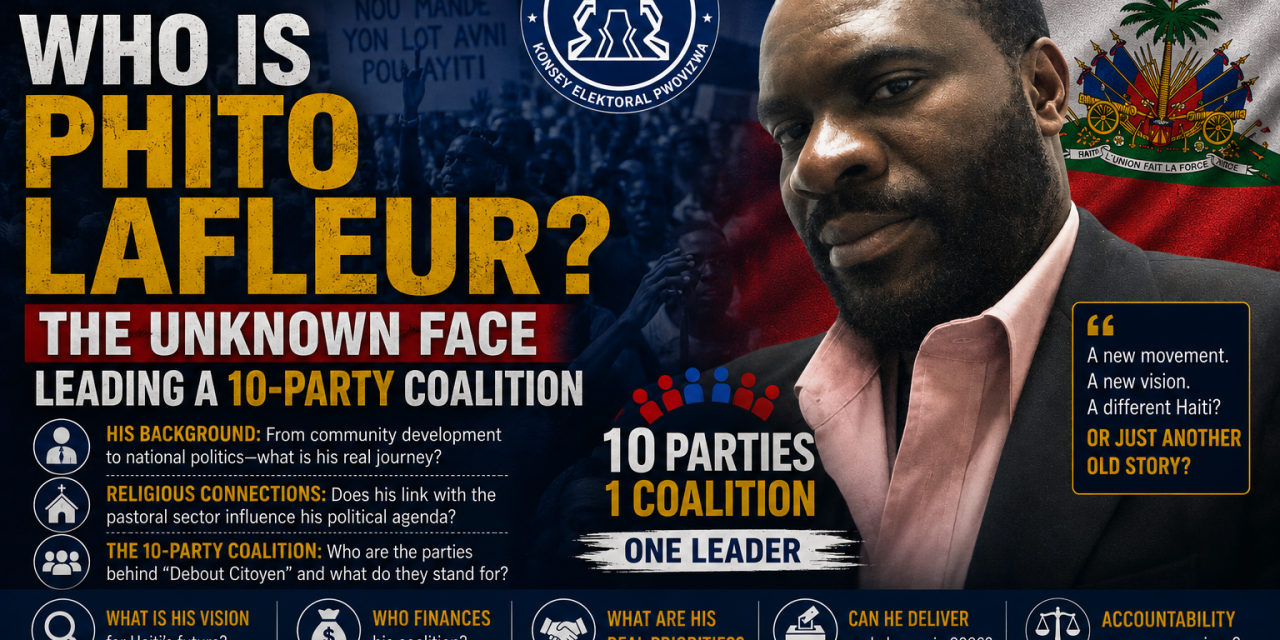
Haiti’s electoral council just approved 15 political coalitions for the 2026 elections, covering 208 parties. One of them — Debout Citoyen pour la Transformation d’Haïti — is led by Phito Lafleur, a name with almost no public footprint compared to the political veterans running other coalitions.
We looked into his actual background. Here’s what’s there — and what isn’t.
🔍 THE FACTS
On August 8, 2026, the CEP confirmed Debout Citoyen pour la Transformation d’Haïti as one of 15 approved groupements, uniting 10 political parties under Lafleur’s leadership heading into the vote.
What’s documented about him:
- Previously identified in Haitian press as president of a political party called “Solisyon” (“Solution”)
- In 2024, publicly called for national reconciliation in Haiti
- Now the officially registered representative of a new 10-party electoral coalition
That’s it. That’s the full public record we could verify. No history of ministerial posts, no Senate seat, no documented tenure inside Haiti’s major state institutions — and, just as notably, no corruption cases, no scandals, no detentions tied to his name either.
🧾 THE HONEST TAKE ON A THIN RECORD
A short public record cuts two ways, and we’re not going to pretend otherwise:
On one hand — accomplishments are hard to point to. Leading a small party and calling for reconciliation is a start, not a body of work. Voters weighing him against candidates with years of documented governance experience are working with less information here, plain and simple.
On the other hand — that thinness also means he’s untangled from the corruption investigations, the institutional collapses, and the scandals that have defined Haiti’s political class over the past decade. No paper trail of failure is not the same as a record of success, but it’s also not nothing.
🏛️ THE SYSTEM HE’S STEPPING INTO
Haiti hasn’t had a functioning elected Parliament since January 2023. Governance has fallen to a Transitional Presidential Council operating largely by decree, amid ongoing public criticism over accountability and results. It’s that vacuum — and that record of institutional failure — that 208 parties across 15 coalitions are now maneuvering to fill in 2026.
Coalition-building itself is one thing Lafleur has already had to do: holding 10 separate parties together under one banner requires negotiation and trust-building, even before a single vote is cast. Whether that skill translates into governing is a separate, open question.
🤔 SO — BLANK SLATE OR EMPTY RESUME?
The skeptical take:
Nobody should get credit just for staying out of trouble. Haiti needs leaders with a demonstrated ability to actually run something — and right now, there’s little evidence Lafleur has done that at scale.
The hopeful take:
Untested doesn’t mean unqualified. Every political veteran running in 2026 with a longer resume also carries the weight of Haiti’s failures. A newer face with a clean record, even a thin one, is at least a chance to try something outside that cycle.
Both are fair reads of the same limited facts. Neither is proof of anything yet.
🗳️ THE BOTTOM LINE
Phito Lafleur enters Haiti’s 2026 elections with a coalition of 10 parties behind him and very little public track record ahead of him. That makes him harder to judge than most — not because the record is bad, but because there’s so little of it to judge.
Whether that’s a reason for hope or hesitation isn’t something this article can settle. It’s up to Haitian voters, and to how Lafleur performs from here, to answer.