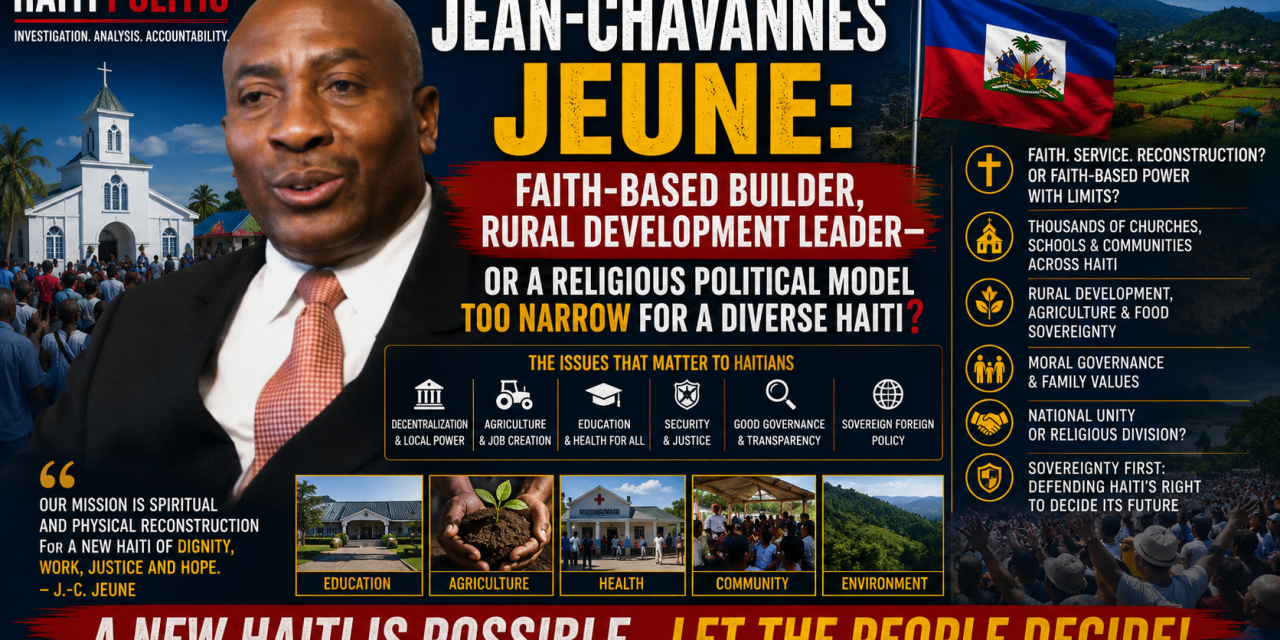
Pastor. Educator. Development administrator. Christian political leader. Presidential candidate.
Jean-Chavannes Jeune offers Haiti a political résumé unlike that of most traditional candidates. His career has been rooted less in ministries, Parliament, or Port-au-Prince political circles than in Haiti’s Protestant institutions, education, community development, and Christian politics.
But HaitiPolitic’s central question is not whether Jeune has built an impressive religious and civic network.
It is whether that experience can be transformed into effective democratic government for an entire country.
And there is an equally important foreign-policy question:
Can a leader whose political identity is deeply rooted in evangelical Christianity defend Haitian sovereignty while representing Catholics, Protestants, Vodou practitioners, nonbelievers, business interests, farmers, the diaspora—and citizens who want religion kept outside government?
Let the people decide.
🔎 WHO IS JEAN-CHAVANNES JEUNE?
Available biographical accounts describe Jeune as a pastor, evangelist, organizer, administrator and development practitioner from southern Haiti. A 2010 candidate biography listed training in theology, development and communications, development administration, and civil engineering, as well as teaching roles at the Institut Biblique Lumière and Université Lumière. Because that biography was candidate-supplied, those credentials should be understood in that context rather than treated as an independent audit of his record.
His political vehicle, the Union Nationale Chrétienne pour la Reconstruction d’Haïti (UNCRH), was officially recognized in 2005, according to Haiti-Référence. Independent country-information material from Canada’s Immigration and Refugee Board also identifies Jeune as the UNCRH’s leader.
His most significant demonstrated electoral performance came in 2006. Officially compiled election data show Jeune receiving 108,283 votes, or 5.59%, placing behind René Préval, Leslie Manigat and Charles-Henri Baker.
That result matters.
Jeune was not simply a pastor expressing political opinions. He demonstrated an ability to convert a religious and organizational network into a measurable national constituency.
Moreover, country-information reporting indicates that UNCRH emerged from the 2006 cycle with representation in both chambers of Parliament—evidence that the movement possessed organizational reach beyond one presidential personality.
🏛️ THE CENTRAL QUESTION
Can someone who helped build institutions outside the Haitian state successfully rebuild institutions inside the Haitian state?
Churches, universities, charities and community organizations operate very differently from a national government.
A president cannot choose his constituency.
The Haitian state must serve everyone.
That includes people who reject the president’s religion, ideology and moral philosophy.
So Jeune’s experience creates both his strongest argument for leadership and perhaps his greatest unanswered question.
1️⃣ FAITH, POWER & THE SECULAR REPUBLIC
Jeune’s Christian identity isn’t incidental to his political career—it is central to it.
His earlier political material explicitly promoted moral values, family, justice, individual liberty, political tolerance, productive-sector development, technology and knowledge as components of national reconstruction.
That creates a legitimate political philosophy.
But governing Haiti raises a harder constitutional challenge:
Where does religious conviction end and state authority begin?
Questions HaitiPolitic would put directly to Jean-Chavannes Jeune:
🔴 How would your government guarantee equal treatment for Protestants, Catholics, Vodou practitioners and Haitians with no religious affiliation?
🔴 Would religious organizations receiving government contracts face exactly the same financial audits and procurement requirements as secular organizations?
🔴 Would your administration ever condition education, healthcare or social assistance on religious participation?
🔴 Which elements of your Christian moral philosophy should become legislation—and which should remain matters of personal conscience?
A president may personally be deeply religious.
A republic, however, belongs equally to citizens who do not share the president’s faith.
2️⃣ FROM CHURCH ADMINISTRATION TO GOVERNING HAITI
Jeune’s supporters can make a serious argument:
Haiti needs builders, not another generation of professional political negotiators.
His documented biography emphasizes decades of organization, administration, education and development work. His political pitch has historically emphasized competence, public service, productive investment and restoration of state authority.
But running nongovernmental institutions is not the same thing as governing Haiti.
A Haitian president confronts:
Customs corruption. Tax evasion. Gang-controlled territory. Politicized procurement. Weak courts. Smuggling. Public payroll fraud. Electricity losses. Institutional patronage. International pressure.
Good intentions cannot solve those problems.
Systems might.
So show Haiti the system.
🔴 What would Jeune do during his first 100 days?
🔴 Which ministries would be audited first?
🔴 Would government procurement contracts and beneficial owners be published online?
🔴 Would customs collections become digitally traceable?
🔴 How would he prevent his own political supporters and religious allies from receiving preferential government contracts?
That last question is particularly important.
Anti-corruption credibility isn’t demonstrated by refusing to enrich your enemies. It is demonstrated by refusing to enrich your friends.
3️⃣ 🌾 THE RURAL QUESTION: CAN DEVELOPMENT MOVE BEYOND PORT-AU-PRINCE?
This may be where Jeune deserves especially serious examination.
Haiti has spent generations operating a political and economic system disproportionately centered on Port-au-Prince.
A candidate whose experience comes substantially from southern Haiti could offer a different development perspective.
Instead of asking simply:
“How do we rebuild Port-au-Prince?”
Haiti should perhaps ask:
“Why must virtually everything important pass through Port-au-Prince in the first place?”
A credible Jeune program should therefore explain:
🔴 How much national revenue should remain in communes?
🔴 Should regional governments control larger infrastructure budgets?
🔴 How would Haiti finance irrigation, agricultural roads and storage facilities?
🔴 How would farmers obtain affordable credit?
🔴 Which imported agricultural products, if any, should face protective tariffs?
🔴 How would Haiti create regional economic centers around Les Cayes, Cap-Haïtien, Jacmel, Hinche and Gonaïves?
This is where Jeune could potentially distinguish himself from candidates offering another capital-centered presidency.
4️⃣ 🌎 FOREIGN POLICY: FAITH NETWORKS OR HAITIAN SOVEREIGNTY?
This is one of the most important questions surrounding a Jeune presidency.
Religious institutions can create powerful international networks.
Those relationships potentially provide Haiti access to universities, hospitals, charities, donors, investors and diaspora communities.
But relationships are not a foreign policy.
Haiti needs interests, priorities and negotiating leverage.
A Jeune administration would need to answer:
🔴 What should Haiti demand from the United States and Canada?
🔴 What should its long-term relationship with the Dominican Republic look like?
🔴 Should Haiti deepen cooperation with CARICOM?
🔴 How should Haiti approach China and Taiwan?
🔴 What relationship should Haiti maintain with France, the European Union, Latin America and Africa?
🔴 Would foreign churches and missionary organizations be required to disclose financing and expenditures in Haiti?
🔴 Should international NGOs continue implementing development programs parallel to Haitian ministries?
The objective should not simply be finding more foreign aid.
It should be converting international relationships into Haitian productive capacity.
5️⃣ ⚠️ THE MISSIONARY-DEPENDENCY PARADOX
This deserves particular scrutiny.
Religious organizations have often provided schools, clinics and humanitarian services where the Haitian state failed.
That is valuable.
But there is a paradox.
Every institution successfully replacing the state can unintentionally make it easier for the state to remain weak.
If foreign-funded organizations educate children, operate clinics, distribute food and respond to disasters indefinitely, political leaders face less pressure to build permanent public institutions.
So HaitiPolitic would ask Jeune:
Would you be willing to reform the very NGO/missionary development structure from which Haiti’s religious sector has historically benefited?
Would his government require:
• transparent NGO financial reporting;
• Haitian government coordination;
• measurable transfer of expertise to Haitian institutions;
• increased employment of Haitian professionals;
• and eventual transition of essential services toward sustainable Haitian control?
That would be a meaningful test of sovereignty.
6️⃣ 🚨 SECURITY: MORAL AUTHORITY DOESN’T DISARM GANGS
Jeune’s politics emphasizes reconciliation and moral reconstruction.
Those concepts matter.
But Haiti’s security emergency presents a brutally practical problem.
Armed organizations do not surrender because government becomes morally persuasive.
A presidential candidate must explain:
Who secures the territory?
With what money?
Under whose command?
According to what law?
Jeune should therefore answer:
🔴 How large should the Haitian National Police become?
🔴 Should Haiti rebuild a substantially stronger military capability?
🔴 Where will the weapons, intelligence systems, vehicles and training come from?
🔴 What role—if any—should foreign security forces have?
🔴 How will the government distinguish gang members from civilians living under gang control?
🔴 What happens after territory is recovered?
Because clearing territory without restoring courts, schools, policing, electricity, municipal government and employment simply creates a vacuum for armed organizations to return.
7️⃣ 💰 FOLLOW THE MONEY
Every candidate should face this investigation.
Including religious candidates.
HaitiPolitic would ask Jeune to voluntarily disclose:
Campaign donors. Major organizational donors. Foreign financial relationships. Business interests. Assets. Political-party financing. Organizations seeking government contracts.
And one additional question:
Would you support real-time public disclosure of every significant donation to your presidential campaign?
If the answer is yes, publish it before asking voters for power.
Transparency should begin during the campaign—not after inauguration.
8️⃣ 🗳️ HIS ELECTORAL RECORD DESERVES CONTEXT
One factual point in the proposed profile needs correction.
Jeune did not place fourth in 2006 according to the published election totals. He finished fifth, receiving 108,283 votes (5.59%), behind René Préval, Leslie Manigat, Charles-Henri Baker and the aggregated ordering reflected in official result presentations. The numerical result itself is consistently reported by IFES and Georgetown’s Political Database of the Americas.
That 5.59% nevertheless represented a substantial constituency in an election with many presidential candidates.
The larger question is:
Can that constituency expand?
A church network can mobilize believers.
A presidential coalition must mobilize a nation.
Jeune would need farmers, entrepreneurs, workers, young people, professionals, diaspora voters and citizens who may disagree fundamentally with his theology.
That is the difference between having a base and building a majority.
📊 HAITI POLITIC ASSESSMENT
| AREA | POTENTIAL STRENGTH | QUESTION THAT REMAINS |
|---|---|---|
| Institution Building | Long organizational and development background | Can nongovernmental management translate to state administration? |
| Political Organization | Demonstrated electoral constituency and established Christian political movement | Can it grow beyond a faith-centered base? |
| Rural Development | Potentially valuable perspective outside Port-au-Prince politics | Can local development models operate nationally? |
| Integrity Narrative | Less identified with several dominant governing machines of recent decades | Will he submit his own networks to radical financial transparency? |
| Foreign Policy | Potential access to substantial international religious networks | Would those networks strengthen Haitian sovereignty or deepen external dependency? |
| Security | Moral authority and reconciliation message | Haiti’s armed crisis requires a concrete operational strategy |
| National Unity | Strong community-organizing potential | Can a Christian political movement fully represent Haiti’s pluralistic society? |
🔥 THE HAITIPOLITIC VERDICT: NO VERDICT.
Jean-Chavannes Jeune deserves neither automatic praise because he is a pastor nor automatic suspicion because religion informs his politics.
The relevant test is performance.
He has demonstrated that a Christian political organization can win meaningful votes and legislative representation.
But Haiti’s next political era demands something much larger.
It requires territorial security.
Functional courts.
Domestic production.
Professional public administration.
Transparent taxation.
Decentralization.
Credible elections.
And a foreign policy in which Haiti negotiates rather than merely receives.
So the question Haitians should ask isn’t:
“Is Jean-Chavannes Jeune a good pastor?”
It is:
🇭🇹 CAN JEAN-CHAVANNES JEUNE TURN MORAL LEADERSHIP AND COMMUNITY ORGANIZATION INTO A SECULAR, ACCOUNTABLE AND FUNCTIONING HAITIAN STATE?
And perhaps the harder question:
CAN HE GOVERN JUST AS FAIRLY FOR HAITIANS WHO DO NOT BELIEVE WHAT HE BELIEVES?
That answer belongs to Jean-Chavannes Jeune.
The judgment belongs to the Haitian people.
HAITI POLITIC — Investigation. Analysis. Accountability.
#HaitiPolitic #JeanChavannesJeune #Haiti #HaitiPolitics #UNCRH #HaitiElections #ForeignPolicy #HaitiSecurity #HaitiDevelopment #Governance #Accountability #Democracy