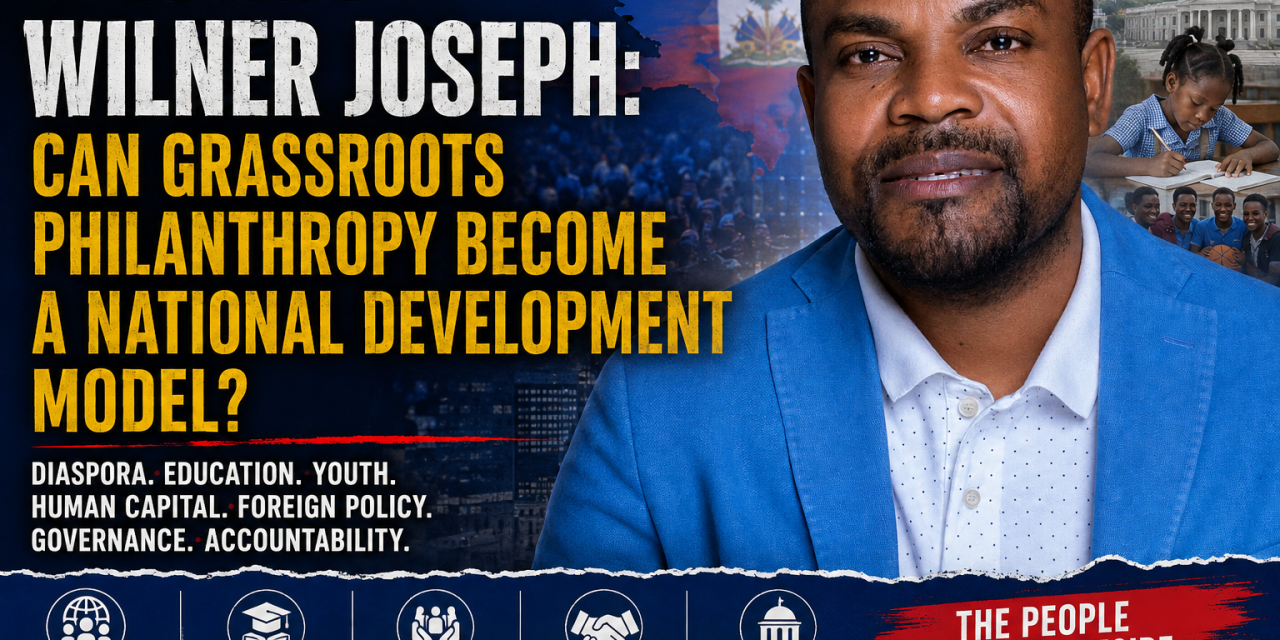
Diaspora. Education. Youth. Human capital. Foreign policy. Governance. Accountability.
For decades, Haiti has received billions through remittances, international assistance, NGOs, humanitarian programs and government initiatives. Yet the fundamental question remains painfully familiar:
Why has so much money circulating around Haiti produced so little durable institutional capacity?
Wilner Joseph offers an interesting case study because his public profile sits at the intersection of two worlds Haiti has repeatedly struggled to connect: diaspora civic power and Haitian state power.
Publicly available records describe a Wilner Joseph in Stamford, Connecticut as a community advocate and director of Young Athletes 4 Change, using sports and mentoring as tools for youth development and violence prevention. The City of Stamford publicly identified him in that capacity during its 2021 National Gun Violence Awareness activities.
But there is an important complication that any serious investigative profile must acknowledge.
There are multiple Haitian public figures named Wilner Joseph, and the available online record does not establish that every political, philanthropic and governmental reference circulating under that name belongs to the same individual. Haitian reporting, for example, separately identifies a Wilner Joseph as a former secretary of state and political actor, while another public profile concerns the Connecticut-based community advocate.
So instead of manufacturing a political résumé, we ask a more useful question:
If Wilner Joseph wants his model of community activism and human-capital investment to influence Haiti nationally, what has he actually demonstrated—and what would he still have to prove?
🔎 PART I — WHAT CAN BE DOCUMENTED?
One of Joseph’s clearest publicly documented areas of activity is youth development.
The City of Stamford identified him as a youth mentor and director of Young Athletes 4 Change, an organization engaging children and young adults through basketball and extracurricular activities. Joseph connected that work explicitly to preventing gun violence by creating safe programs capable of keeping young people productively engaged.
His professional profile similarly describes community advocacy, leadership development, coaching and change-management interests and references Young Athletes 4 Change activities.
This is significant for Haiti.
Gang recruitment cannot be understood exclusively as a policing problem. It is also connected to unemployment, educational exclusion, community disintegration and the absence of credible alternatives for young people.
Joseph’s philosophy therefore starts at the opposite end of the security chain:
Invest in young people before armed organizations recruit them.
That’s compelling.
But it isn’t yet a national policy.
Running youth programs and running a Ministry of Education, national vocational system or multibillion-gourde social-development budget require completely different institutional capabilities.
That is the first test Joseph would face.
🧠 PART II — HUMAN CAPITAL VS. EMERGENCY CHARITY
Haiti doesn’t simply need more charitable distributions.
It needs human capital.
That means turning children into educated adults, students into professionals, apprentices into skilled workers and entrepreneurs into employers.
Joseph’s community-oriented philosophy potentially offers something valuable here because it emphasizes relationships rather than simply distributing resources.
The progression would ideally become:
Mentorship → Education → Skills → Employment → Entrepreneurship → Community reinvestment.
But Haiti has seen hundreds of admirable charitable initiatives disappear when founders retire, donors leave or financing dries up.
So the investigative question isn’t whether philanthropy is good.
Obviously it can be.
The question is:
Can Wilner Joseph convert philanthropy into institutions that survive Wilner Joseph?
That is the standard against which any national leadership argument should be judged.
💰 PART III — THE BIG COMPARISON: WILNER JOSEPH VS. THE FNE MODEL
This is where the debate becomes especially interesting.
Haiti already possesses an ambitious mechanism designed to turn external Haitian economic activity into domestic human-capital investment:
The Fonds National de l’Éducation — FNE.
The FNE represents essentially the state-financing version of diaspora mobilization.
Historically, Haiti imposed special charges associated with international telecommunications and money transfers to generate education financing.
A CSCCA public-finance report says that during fiscal year 2020–21 the FNE was financed through US$0.05 charges associated with international calls and US$1.50 levies on international currency transfers. The report says the FNE had approximately 3.26 billion gourdes available during that fiscal year, including collections and the prior balance.
World Bank documentation also describes the $1.50 international-transfer fee and $0.05 international-call charge as mechanisms introduced to increase domestic financing for education.
The concept is powerful:
Millions of small diaspora-linked transactions → national education capital.
But that model raises a major democratic issue.
People are compelled to contribute.
Therefore they deserve exceptional transparency about what happens to the money.
⚖️ TWO VERY DIFFERENT MODELS FOR MOBILIZING THE DIASPORA
| Joseph-style civic philanthropy | FNE state-financing model | |
|---|---|---|
| Funding | Voluntary | Mandatory/public levy |
| Relationship | Donor → project/community | Contributor → state |
| Scale | Usually localized | Potentially nationwide |
| Flexibility | High | Bureaucratically constrained |
| Accountability | Donors/boards/community | Government/auditors/public |
| Sustainability | Depends on fundraising | Recurring revenue stream |
| Political risk | Founder dependence | Patronage/state capture |
| Major advantage | Trust and speed | National scale |
| Major weakness | Fragmentation | Public distrust |
Neither model alone solves Haiti’s problem.
The opportunity is to combine them.
🇭🇹 DIASPORA MOBILIZATION STRATEGY BRIEF
THE JOSEPH–FNE HYBRID QUESTION
Imagine that Haiti stopped treating the diaspora merely as a remittance machine.
Instead, it treated Haitians abroad as development shareholders.
The state could maintain sovereign education financing while adopting the transparency and community participation expected from reputable philanthropy.
A credible architecture could have five components:
1. Diaspora Education Dashboard. Every gourde or dollar generated through diaspora-linked education charges should be publicly traceable by department, commune, school, contractor, project status and completion date.
2. Matching Development Fund. Rather than simply collecting money, Haiti could match qualified diaspora investments. A diaspora association raising $100,000 for a vocational center could receive transparent state co-financing after meeting procurement and auditing requirements.
3. Departmental Human-Capital Funds. Diaspora communities could voluntarily designate contributions toward education, healthcare, vocational training or entrepreneurship projects in specific departments while national taxation continues funding universal obligations.
4. Independent Auditing. CSCCA oversight should coexist with publicly accessible procurement data and independent financial reviews.
5. Results, not ceremonies. Every project should publish measurable outcomes: students enrolled, graduation rates, vocational certifications, employment placements, businesses created and cost per beneficiary.
That would transform diaspora engagement from:
SEND MONEY HOME
into:
BUILD CAPACITY AT HOME.
🌎 PART IV — COULD THIS BECOME FOREIGN POLICY?
This is potentially Joseph’s most interesting contribution to Haiti’s political conversation.
Haitian foreign policy has traditionally been dominated by governments talking to other governments:
Washington.
Ottawa.
Paris.
CARICOM.
The Dominican Republic.
The United Nations.
International financial institutions.
But Haiti possesses another diplomatic network that governments have repeatedly failed to organize strategically:
The Haitian diaspora itself.
A modern Haitian foreign policy could treat Haitian doctors, engineers, professors, entrepreneurs, investors and elected officials abroad as a decentralized national influence network.
Instead of asking:
“What will Washington do for Haiti?”
the question becomes:
“What political, intellectual and economic influence can Haitians organize inside Washington, New York, Miami, Boston, Montreal, Paris and elsewhere?”
That would represent a meaningful conceptual change.
Joseph’s diaspora experience could potentially contribute to such thinking.
But experience living and organizing abroad does not automatically constitute foreign-policy expertise.
He would need to demonstrate positions on trade, migration, CARICOM, Dominican-Haitian relations, international security cooperation, sanctions, development finance and diplomatic reform.
🚨 PART V — THE QUESTIONS WILNER JOSEPH SHOULD ANSWER
1 — SHOW US THE RECEIPTS
If philanthropy forms a major part of your leadership credentials:
How much money have your organizations actually raised?
How much reached beneficiaries?
How many children participated?
How many scholarships were awarded?
How many participants completed programs?
Where are the audited financial statements?
Good intentions aren’t impact measurements.
2 — CAN PHILANTHROPY SCALE?
A foundation can choose its beneficiaries.
A republic cannot.
How would you transform a community-based philanthropic philosophy into universal public policy covering potentially millions of citizens?
3 — SHOULD THE DIASPORA KEEP PAYING THE FNE LEVIES?
This is the unavoidable question.
If Haitians abroad are helping finance education through diaspora-linked charges, should contributors receive a dramatically stronger transparency mechanism?
Would Joseph support a public portal showing:
money collected → treasury → FNE → contractor → school → students?
The underlying FNE funding mechanism is well documented.
4 — TAXATION OR VOLUNTARY INVESTMENT?
Should Haiti continue relying primarily on mandatory diaspora-linked charges?
Or should government increasingly incentivize voluntary:
diaspora bonds, municipal development funds, education endowments, investment cooperatives and matching grants?
The answer reveals something fundamental about Joseph’s philosophy of government.
5 — WHO AUDITS THE PHILANTHROPISTS?
Civil society frequently demands transparency from politicians.
Correctly.
But NGOs, foundations and diaspora organizations receiving millions should face scrutiny too.
Would Joseph voluntarily publish:
annual financial statements, donor sources, executive compensation, administrative expenses, project expenditures and beneficiary outcomes?
Transparency cannot become something demanded only from political opponents.
6 — WHAT ABOUT YOUTH ALREADY INSIDE ARMED GROUPS?
Sports programs can help prevent recruitment.
But Haiti also confronts thousands of young people living in territories dominated by armed organizations.
What comes next?
Disarmament?
Psychological services?
Vocational rehabilitation?
Conditional amnesty for eligible minors?
Community supervision?
Employment guarantees?
Joseph’s prevention philosophy needs a credible reintegration philosophy.
7 — WOULD HE SUPPORT FULLER DIASPORA POLITICAL PARTICIPATION?
If the diaspora should finance Haiti’s development, an obvious democratic question follows:
Should it receive greater political representation?
Would Joseph support practical mechanisms for overseas voting?
Diaspora representation?
Investment protections?
A formal diaspora development council?
Or constitutional changes where necessary?
Taxation, participation and representation belong in the same conversation.
🏛️ PART VI — THE POLITICAL TEST
Wilner Joseph’s strongest potential selling point could also become his greatest vulnerability.
He can argue that he comes from community development rather than traditional Haitian political machinery.
But voters should not confuse being outside government with automatically knowing how to govern.
A national administration must manage:
taxation, customs, policing, courts, diplomacy, procurement, infrastructure, healthcare, education, agriculture, monetary coordination and thousands of public employees.
A philanthropic leader entering politics must therefore answer:
Can you move from helping communities survive state failure to building a state communities no longer need philanthropy to replace?
That is a much harder assignment.
📊 HAITI POLITIC ASSESSMENT
| Area | Potential Strength | Question Still Unanswered |
|---|---|---|
| Youth development | Documented community/youth advocacy | Can results scale nationally? |
| Diaspora credibility | Direct experience in Haitian-American civic space | Can networks become institutions? |
| Human capital | Prevention-first philosophy | Where are measurable Haiti-wide outcomes? |
| Political independence | Potential outsider appeal | What coalitions and financing would support a national movement? |
| Foreign policy | Diaspora diplomacy could be innovative | What is his actual diplomatic doctrine? |
| Economic policy | Community investment orientation | Where is the fiscal/macroeconomic program? |
| Governance | Ethical leadership message | What transparency standards will he impose on himself? |
🗳️ THE HAITI POLITIC VERDICT: THE PEOPLE SHOULD DECIDE
Wilner Joseph represents an idea Haiti desperately needs to debate:
Human beings are infrastructure too.
Roads matter.
Ports matter.
Electricity matters.
Police stations matter.
But educated children, skilled workers, healthy families, entrepreneurs and functioning communities ultimately determine whether those institutions survive.
The FNE represents Haiti’s attempt to capture resources at scale for education.
Joseph’s community-centered approach represents a different proposition: mobilize people, trust, mentorship and voluntary civic capital from the bottom upward.
Haiti may not need to choose between them.
It may need both.
A strong state capable of collecting resources.
A strong civil society capable of watching the state.
A mobilized diaspora capable of investing beyond remittances.
And citizens capable of measuring whether any of it actually works.
The larger question surrounding Wilner Joseph therefore isn’t whether philanthropy makes someone presidential.
It doesn’t.
The question is whether a leader emerging from diaspora and community activism can produce something Haitian politics has repeatedly promised but rarely institutionalized:
a bridge between diaspora resources, accountable government and measurable human development.
Wilner Joseph may have a compelling starting philosophy. Now comes the harder test: Where is the detailed plan, where are the independently verified results, and where are the receipts?
What do you think?
🇭🇹 Could a diaspora/community-development model help transform Haiti? Or does Haiti’s crisis require experienced state operators rather than philanthropic outsiders?
The investigation continues.