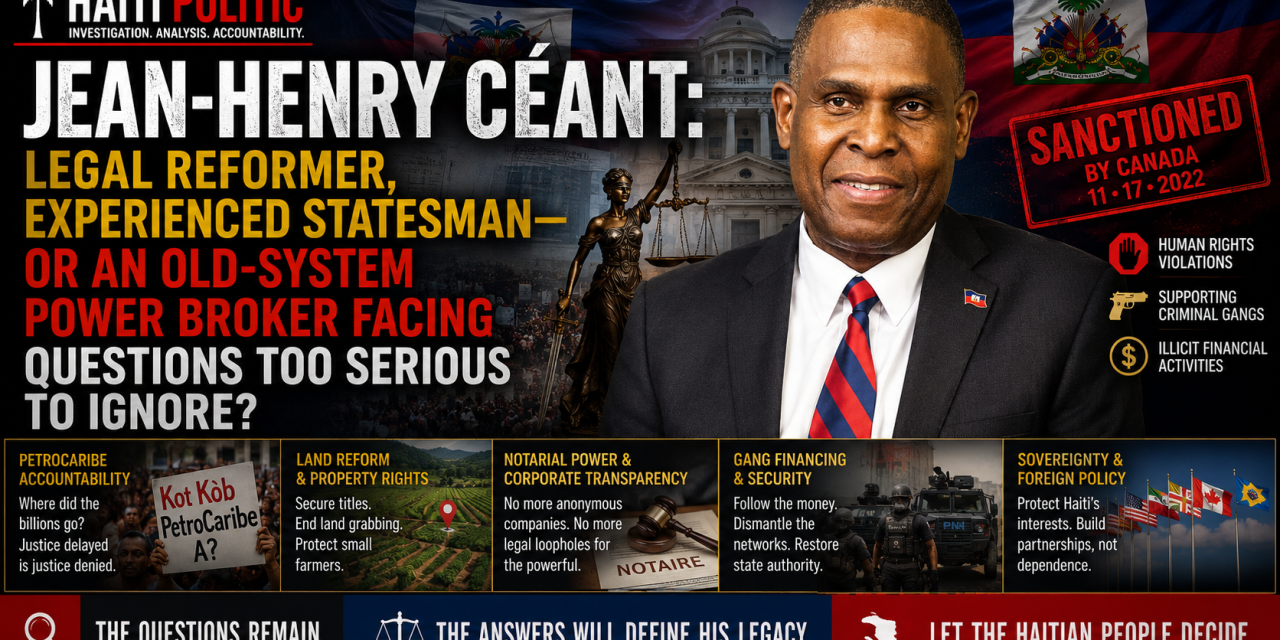
🇭🇹 Notary. Lawyer. Property-law specialist. Educator. Presidential candidate. Founder of Renmen Ayiti. Former Prime Minister. Sanctioned political figure.
Few Haitian political figures combine the legal, commercial and executive experience of Jean-Henry Céant.
For decades, Céant operated in a profession sitting at the intersection of some of Haiti’s most sensitive questions:
land, property, inheritance, mortgages, corporate transactions and legal documentation.
He later moved directly into electoral politics, campaigning for the presidency before becoming Prime Minister under President Jovenel Moïse in 2018.
His government lasted only about six months.
Then came another chapter that cannot responsibly be treated as a footnote.
In November 2022, Canada added Céant to sanctions imposed under its Special Economic Measures (Haiti) Regulations. Canadian government material identifies him among former political officials sanctioned under a regime targeting people Canada says finance, support or benefit from armed-gang activities.
That designation is a Canadian government action and allegation framework—not a criminal conviction by a Canadian court. Any serious examination therefore has to distinguish between what Canada alleges, what has been independently established, and what Céant says in response.
That distinction matters.
Because the fundamental question is not simply:
CAN JEAN-HENRY CÉANT RETURN TO POLITICS?
It is:
WHAT WOULD HE HAVE TO PROVE TO HAITIANS BEFORE ASKING THEM TO TRUST HIM WITH POWER AGAIN?
This is not an endorsement.
It is not a conviction by social media.
It is an examination of the record, the unresolved questions and the policies Céant should be required to explain.
Then—
🇭🇹 LET THE HAITIAN PEOPLE DECIDE.
👨🏾⚖️ WHO IS JEAN-HENRY CÉANT?
Before becoming Prime Minister, Céant spent decades building a substantial legal career.
He studied law at Haiti’s State University and became a notary in Port-au-Prince in 1986. His professional biography also includes teaching property law at Université Quisqueya and teaching at Haiti’s National School of Financial Administration.
He also developed a public legal-education profile.
Through “Dwa Pou Tout Moun” — “Law for Everyone”—Céant sought to explain legal rights and responsibilities to ordinary Haitians.
That experience is politically relevant.
Because one of Haiti’s biggest problems is not an absence of laws.
It is the enormous distance between:
THE LAW ON PAPER
and
THE LAW IN REAL LIFE.
🏠 TEST #1 — THE LAND QUESTION
If there is one policy area in which Céant should be expected to know more than an ordinary presidential candidate, it is property law.
His background includes decades as a notary and experience teaching property law. Contemporary profiles also describe his involvement with Haiti’s national cadastre.
That makes the question unavoidable:
WHY DOES HAITI STILL HAVE SUCH AN INSECURE PROPERTY SYSTEM?
For generations, Haitians have confronted:
conflicting titles;
unclear boundaries;
informal transfers;
inheritance disputes;
missing documents;
fraud;
weak cadastral records;
land grabbing;
and extraordinarily slow litigation.
These are not technical inconveniences.
They obstruct development.
🌾 LAND IS ECONOMIC INFRASTRUCTURE
Imagine a farmer owns land but cannot produce an indisputable title.
Can the farmer mortgage it?
Can a bank safely lend against it?
Can the farmer attract an investor?
Can children inherit it without a decade-long dispute?
Can the government determine its taxable value?
Can an entrepreneur confidently build a factory there?
Property insecurity converts potentially productive assets into dead capital.
So Céant’s expertise creates a higher standard.
Don’t merely tell Haiti the land system is dysfunctional.
SHOW US HOW YOU WOULD REBUILD IT.
🗺️ TEST #2 — THE NATIONAL DIGITAL CADASTRE
President Céant:
Would every parcel in Haiti receive a unique digital identification number?
Would boundaries be georeferenced?
Would historical deeds be digitized?
Would notarized transfers automatically update the cadastre?
Would courts access the same database?
Would DGI records connect to it?
Would municipalities?
Would mortgage lenders?
Would citizens be able to verify title status online?
Would unauthorized changes trigger alerts?
Would every modification leave a permanent audit trail?
And critically:
Who would control access?
A digital land registry could transform Haiti.
It could also digitize old fraud if corrupt or inaccurate titles are simply uploaded without verification.
Technology is not enough.
⚖️ TEST #3 — PROTECT THE SMALL LANDOWNER
Any Céant land-reform plan should explain what happens when:
a wealthy corporation produces one title;
a peasant family produces another;
the family has occupied the property for generations;
local authorities disagree;
and the court case could take ten years.
Who gets protected while the dispute is adjudicated?
Would Haiti create specialized land courts?
Free legal assistance?
Temporary anti-eviction protections?
Accelerated mediation?
Independent surveyors?
Title insurance?
A compensation fund?
Property reform cannot simply make transactions easier for investors.
It must also protect Haitians who lack powerful lawyers.
🏢 TEST #4 — NOTARIES AND CORPORATE TRANSPARENCY
Céant’s professional background creates another important line of questioning.
Notaries occupy important positions in property and commercial transactions.
So voters should ask what financial-compliance standards Céant believes Haiti needs today.
Should companies be required to disclose their beneficial owners?
Should notaries verify identities electronically?
Should politically exposed persons receive enhanced due diligence?
Should suspicious transactions be reportable?
Should companies be prohibited from hiding ownership behind layers of nominees?
Should property transactions above a threshold require traceable banking payments?
Haiti cannot fight money laundering while allowing anonymous ownership structures to flourish.
And because Céant knows this legal architecture firsthand, voters should demand specifics.
🗳️ FROM NOTARY TO PRESIDENTIAL CANDIDATE
Céant eventually transformed his public profile into electoral politics through Renmen Ayiti.
He competed for the presidency in multiple electoral cycles before entering government. Available biographical records document presidential candidacies in 2010, 2015 and the rerun 2016 cycle.
His political identity emphasized inclusion.
One slogan associated with his movement was:
“Tout Moun Ladan l.”
Everybody included.
But running for president is different from governing.
In 2018, Céant finally entered the center of executive power.
🏛️ PRIME MINISTER JEAN-HENRY CÉANT
President Jovenel Moïse selected Céant as Prime Minister in August 2018 following the resignation of Jack Guy Lafontant.
His government formally began in September.
But the political environment was already explosive.
Haiti was facing:
economic deterioration;
fuel pressures;
political polarization;
growing insecurity;
and increasingly intense anger surrounding PetroCaribe.
Six months later, Céant’s government was effectively finished.
The Chamber of Deputies passed a motion of no confidence against his government by 93 votes to 6 on March 18, 2019.
That is not a minor political defeat.
It deserves examination.
🔥 TEST #5 — WHY DID THE GOVERNMENT COLLAPSE?
President Céant:
Why could you not maintain a governing coalition?
Was the conflict fundamentally between you and President Moïse?
Parliament?
PHTK-aligned legislators?
Opposition groups?
Business interests?
Street movements?
Were your reform objectives politically impossible?
Were mistakes made in cabinet selection?
Did you underestimate Parliament?
Did Parliament undermine constitutional governance?
What decisions would you make differently today?
A former Prime Minister seeking renewed influence should not simply explain why everybody else was responsible.
Leadership requires a postmortem.
💰 TEST #6 — PETROCARIBE
Céant assumed office while the PetroCaribe movement was transforming public anger into a national political force.
The essential demand was extraordinarily simple:
KOTE KÒB PETWOKARIBE A?
Where did the PetroCaribe money go?
For Haiti, the question became larger than one financing program.
It represented generations of frustration with:
opaque contracting;
unfinished projects;
political impunity;
weak audits;
and public money disappearing without equivalent public infrastructure.
Céant’s government inherited that crisis.
So:
What exactly did his administration accomplish on accountability?
⚖️ TEST #7 — WHY DIDN’T PETROCARIBE PRODUCE PROSECUTIONS?
Céant should provide a timeline.
What investigations did his government facilitate?
Which files were transmitted to prosecutors?
Which contracts were reviewed?
Which institutions resisted?
What authority did the Prime Minister legally possess?
What information was referred to the judiciary?
What information could not legally be released?
Did Céant encounter political pressure to stop investigations?
From whom?
Did he refuse?
And if he possesses evidence today, will he make it available to competent judicial authorities?
The objective is not political theater.
It is institutional accountability.
🔒 THEN CAME “PEYI LÒK”
The 2018–2019 period saw increasingly severe demonstrations and shutdowns.
Businesses closed.
Transportation stopped.
Schools suffered.
Government activity became difficult.
For ordinary Haitians, the political confrontation carried enormous economic costs.
But here the investigation must be disciplined.
It would be irresponsible to simply assert that Céant negotiated with armed actors without documentary evidence.
Instead, the question should be put directly to him:
WHO DID YOUR GOVERNMENT NEGOTIATE WITH?
Political parties?
Civil-society organizations?
Business associations?
Protest organizers?
Community leaders?
Religious figures?
Individuals connected to armed neighborhoods?
If so, in what capacity?
Were concessions offered?
Were public funds involved?
Were agreements documented?
Publish the record.
🚨 THEN COMES THE ISSUE THAT CHANGES EVERYTHING
CANADIAN SANCTIONS.
Canada’s Special Economic Measures (Haiti) Regulations were established in November 2022 amid the country’s gang crisis.
Canadian authorities said the sanctions framework targets Haitian political and economic elites who provide illicit financial or operational support to armed gangs.
The measures can prohibit dealings with designated individuals and effectively freeze assets they may hold in Canada.
Canadian government documentation identifies Jean-Henry Céant among the former Haitian officials sanctioned in November 2022.
That is established.
But precision is essential.
⚠️ WHAT CANADA’S ACTION DOES—AND DOES NOT—PROVE
A sanctions designation is a serious governmental action.
It is not the same thing as a criminal conviction after trial.
Canada’s public statements about this sanctions regime say it had reason to believe designated former or current officials used their status to protect or enable illegal gang activity, including through corruption and money laundering.
Therefore Haiti Politic should not write:
“Jean-Henry Céant financed gangs.”
as though a court judgment established that proposition.
The defensible formulation is:
CANADA SANCTIONED CÉANT UNDER A REGIME TARGETING PEOPLE IT SAYS SUPPORT, FINANCE OR BENEFIT FROM ARMED-GANG ACTIVITY.
That distinction protects the integrity of the investigation.
But it does not make the issue disappear.
It makes Céant’s answers even more important.
🇨🇦 TEST #8 — PRESIDENT CÉANT, ANSWER CANADA
Céant should be asked:
What exactly does Canada allege against you?
What portions do you dispute?
Have Canadian authorities provided you with supporting evidence?
Have you formally requested delisting?
Have you filed an administrative challenge?
A judicial challenge?
Have your lawyers submitted evidence?
What was submitted?
What happened?
Are proceedings still pending?
Will you authorize publication of the filings?
Will you disclose your relevant financial interests?
Will you submit them to an independent forensic audit?
These questions have answers.
Publish them.
💵 TEST #9 — FOLLOW THE MONEY
If Céant wants to return to national leadership while subject to Canadian sanctions, financial transparency becomes essential.
Not selective transparency.
Extraordinary transparency.
Publish:
assets;
corporate interests;
real-estate holdings;
major liabilities;
trusts;
relevant foreign accounts where legally disclosable;
campaign donors;
party financing;
and beneficial ownership of companies connected to him.
Then retain a reputable independent forensic accounting firm.
Let auditors examine the records.
If the sanctions are unjustified, evidence helps Céant.
If there are unexplained transactions, Haitians deserve to know.
🌎 TEST #10 — CAN A SANCTIONED LEADER CONDUCT FOREIGN POLICY?
This is not theoretical.
Canada is an important Haitian partner.
The United States dominates regional banking infrastructure.
Haiti depends on correspondent banking relationships.
CARICOM matters diplomatically.
International financial institutions matter.
Diaspora investment matters.
Foreign investors conduct compliance checks.
So Céant should answer:
HOW WOULD YOUR SANCTIONS STATUS AFFECT HAITIAN DIPLOMACY?
Could it restrict meetings?
Could it complicate financial relationships?
Would foreign banks treat transactions involving his administration as higher risk?
Would Haiti’s diplomatic agenda become partially consumed by his personal sanctions dispute?
Would he separate his personal legal defense from Haitian state diplomacy?
These are legitimate governance questions.
🇭🇹 TEST #11 — HAITIAN SOVEREIGNTY AND FOREIGN SANCTIONS
There is also another side.
Should foreign governments effectively determine which Haitian politicians remain politically viable?
That question deserves serious debate.
Sanctions can target corruption and gang financing without waiting for dysfunctional domestic courts.
But sanctions can also create serious due-process concerns when evidence is not fully public.
So a future Haitian government should develop a coherent doctrine:
Cooperate with foreign investigations.
Demand evidence.
Strengthen Haitian prosecutions.
Protect due process.
Investigate sanctioned Haitians domestically.
Never automatically treat a foreign designation as a substitute for Haitian justice.
That would be sovereignty through institutions—not slogans.
⚖️ TEST #12 — WOULD CÉANT SUPPORT INVESTIGATING HIMSELF?
This may be the ultimate test.
Suppose Céant returned to power.
Would he authorize Haitian institutions to investigate the allegations underlying his own foreign sanctions?
Would he cooperate?
Would he provide records?
Would he waive appropriate confidentiality protections?
Would he permit an independent prosecutor to operate without executive interference?
Would he accept the result?
RULE OF LAW BECOMES MEANINGFUL WHEN IT APPLIES TO THE PERSON IN POWER.
🏘️ TEST #13 — TURN PROPERTY REFORM INTO ECONOMIC POLICY
Céant’s legal expertise could potentially become economically important.
Imagine Haiti creating a reliable property system.
A farmer with verified title could access credit.
A homeowner could obtain a mortgage.
A municipality could collect property taxes.
A business could purchase land without years of litigation.
A diaspora investor could verify ownership remotely.
Banks could reduce title risk.
Infrastructure planners could identify rights-of-way.
The government could distinguish public from private land.
That would have enormous consequences.
So why hasn’t a politician with Céant’s specialized background made national land reform the centerpiece of a governing program?
That is a question worth asking him.
🏦 TEST #14 — PROPERTY TAXES AND MUNICIPAL GOVERNMENT
A modern cadastre could also transform decentralization.
Imagine local governments receiving predictable property-tax revenue.
Communes could finance:
roads;
sanitation;
markets;
street lighting;
drainage;
local clinics;
and public spaces.
Port-au-Prince would no longer have to absorb everything.
But then another question emerges:
Would Haiti’s wealthy property owners actually pay?
Would luxury homes be reassessed?
Commercial properties?
Vacant speculative land?
Would exemptions become public?
Would politicians pay the same rates?
Land reform becomes politically meaningful when powerful people lose privileges.
🌾 TEST #15 — AGRARIAN SECURITY
Property reform also intersects with Haiti’s food crisis.
Farmers will not make long-term investments in:
irrigation;
orchards;
greenhouses;
storage;
or soil improvement
if they fear losing their land.
So a Céant agricultural strategy could connect:
secure titles + agricultural credit + irrigation + insurance + local processing + roads + market access.
That would be a more sophisticated economic agenda than merely announcing agricultural subsidies.
🏛️ TEST #16 — RENMEN AYITI
Céant’s political vehicle has been Renmen Ayiti.
But Haiti needs stronger institutions, not simply organizations constructed around individual leaders.
So voters should demand:
How many active members does Renmen Ayiti currently have?
How many departmental organizations?
How are leaders elected?
How are candidates selected?
How are disputes resolved?
Who finances the organization?
Are annual accounts audited?
Is there a term limit for party leadership?
Can Renmen Ayiti survive without Jean-Henry Céant?
A party that cannot survive its founder is not yet a strong institution.
🔫 TEST #17 — THE SECURITY PLAN
No legal reform survives if armed groups control territory.
Property rights become meaningless if a gang can seize a house.
Business contracts become meaningless if kidnapping determines commerce.
Court judgments become meaningless if judges cannot safely work.
So Céant must explain:
How many additional PNH officers?
What salary?
What vetting?
What intelligence structure?
What anti-gang financial unit?
What border strategy?
What weapons-interdiction system?
What witness-protection program?
What prison reforms?
What anti-corruption safeguards?
And crucially:
HOW DO YOU DISMANTLE THE POLITICAL-BUSINESS-GANG FINANCING NETWORK?
That question carries particular weight given Canada’s sanctions designation.
💰 FOLLOW THE GANG ECONOMY
Haiti will not defeat gangs simply by arresting young men carrying rifles.
Follow:
bank accounts;
property;
shell companies;
fuel transactions;
kidnapping payments;
weapons purchases;
customs records;
telephone metadata under lawful process;
business intermediaries;
political financiers;
and cross-border networks.
Then prosecute whoever appears in the evidence.
Poor.
Rich.
Politician.
Businessman.
Former minister.
Current minister.
Nobody exempt.
🌎 NOW FOREIGN POLICY
Haiti has spent decades moving between two damaging extremes:
excessive dependence on foreign governments
and
nationalist rhetoric without sufficient domestic capacity.
Neither produced sovereignty.
Céant’s legal background could potentially support another model:
RULE-BASED HAITIAN DIPLOMACY.
Treat international relations like serious negotiation.
Define Haitian interests.
Write agreements.
Set measurable obligations.
Create enforcement mechanisms.
Audit results.
Renegotiate failures.
🇺🇸 TEST #18 — WASHINGTON
A Céant foreign policy would have to address:
weapons trafficking;
migration;
diaspora rights;
trade;
banking;
security assistance;
anti-money-laundering cooperation;
and sanctions.
The United States is too important to ignore.
But dependency is not strategy.
Céant should identify:
Where should Haiti cooperate with Washington?
Where should Haiti negotiate harder?
What are Haiti’s red lines?
What does Haiti offer in return?
Foreign policy requires reciprocal interests.
🇨🇦 TEST #19 — OTTAWA
Canada presents an even more complicated situation because Céant himself is sanctioned.
Would a Céant government negotiate Haitian policy toward Canada while he simultaneously contests Canada’s actions against him?
That presents at least the appearance of a conflict between:
personal interest
and
national interest.
So:
Would he delegate Canada policy?
Would he create an ethics firewall?
Would his lawyers operate completely separately from Haitian diplomats?
Would Haitian public funds ever finance his personal sanctions challenge?
The answer to the last question should be explicit.
🇩🇴 TEST #20 — THE DOMINICAN REPUBLIC
A serious Haitian government needs a permanent Dominican strategy.
Not occasional outrage.
Not Twitter diplomacy.
A strategy.
Border trade.
Migration.
Deportation protocols.
Water.
Agriculture.
Weapons trafficking.
Labor.
Customs.
Documentation.
Transportation.
Céant’s legal background could be useful in negotiating enforceable bilateral mechanisms.
But what exactly would he propose?
🌎 TEST #21 — CARICOM AND THE HAITIAN QUESTION
Haiti should also ask whether CARICOM can become more than a diplomatic emergency room.
Could Haiti pursue:
regional agricultural supply chains?
Caribbean security intelligence?
university exchanges?
renewable energy partnerships?
digital payments?
disaster insurance?
joint tourism?
maritime security?
pharmaceutical procurement?
A successful Haitian foreign policy should diversify partnerships rather than depend overwhelmingly on a handful of powerful states.
🌍 TEST #22 — ECONOMIC DIPLOMACY
Every Haitian embassy should eventually be judged partly by measurable outcomes.
How much investment did it attract?
How many Haitian exports did it facilitate?
How many scholarships?
How many diaspora businesses?
How many technology partnerships?
How many tourists?
How many professional exchanges?
Céant should explain whether he supports transforming Haitian diplomacy from primarily political representation into an instrument of economic development.
📊 THE JEAN-HENRY CÉANT TEST
| AREA | DOCUMENTED EXPERIENCE / POTENTIAL ASSET | QUESTION TO RESOLVE |
|---|---|---|
| Law & Notarial Practice | Decades of legal and notarial experience | Why has land reform not been central to his national agenda? |
| Property Law | Taught property law and worked around cadastral issues | Can he produce a credible national digital-title system? |
| Public Education | Promoted legal literacy through Dwa Pou Tout Moun | Can civic education become institutional reform? |
| Electoral Politics | Multiple presidential campaigns through Renmen Ayiti | Can the movement become a durable national institution? |
| Executive Experience | Prime Minister under Jovenel Moïse, 2018–2019 | Why did his governing coalition collapse so quickly? |
| PetroCaribe Era | Governed during intense anti-corruption mobilization | What measurable accountability outcomes did his government produce? |
| Canadian Sanctions | Canada lists Céant under its Haiti sanctions framework | What evidence can he present publicly to contest the designation? |
| Security | Experience governing during severe instability | What is his operational plan for dismantling gang financing? |
| Foreign Policy | Executive and legal negotiating experience | How would his personal Canadian sanctions affect diplomacy? |
| Decentralization | Property expertise could support municipal taxation | Would powerful property owners actually be required to pay? |
⚖️ THE CASE HIS SUPPORTERS CAN MAKE
Céant’s supporters can point to genuine experience.
He spent decades practicing law before becoming Prime Minister.
He possesses specialized knowledge of property and notarial law that could be useful in modernizing one of Haiti’s most dysfunctional institutional systems.
He has taught law.
He has promoted public legal education.
He has competed nationally for office.
And unlike candidates who have never managed the executive branch, Céant has actually served as Prime Minister.
Supporters could therefore argue:
Haiti needs someone who understands how the system actually works before trying to change it.
That argument deserves consideration.
🚨 THE CASE HIS CRITICS CAN MAKE
Critics have serious questions too.
His government survived only months before suffering an overwhelming parliamentary no-confidence vote.
He was part of Haiti’s political establishment during the PetroCaribe-era crisis.
And most importantly, he remains associated with a Canadian sanctions action serious enough that it cannot simply be dismissed as irrelevant to his political viability. Canadian authorities explicitly built the sanctions regime around alleged financial and operational support for armed gangs.
Critics can therefore reasonably ask:
Is Céant the experienced institutional reformer Haiti needs—or too deeply connected to the very political and economic networks Haiti is trying to escape?
That question also deserves consideration.
🔥 30 QUESTIONS JEAN-HENRY CÉANT SHOULD ANSWER
1. What specifically does Canada allege against you?
2. Do you categorically deny supporting or financing armed gangs?
3. What evidence have you submitted challenging the sanctions?
4. Have you formally sought removal from Canada’s sanctions list?
5. Will you publish your relevant legal submissions?
6. Will you submit your finances to an independent forensic audit?
7. Will Renmen Ayiti disclose major political donors?
8. What did your government accomplish during its six months in power?
9. Why did Parliament remove your government?
10. What mistakes did you personally make as Prime Minister?
11. What did you accomplish concerning PetroCaribe accountability?
12. What prevented prosecutions during your tenure?
13. Who did your government negotiate with during Peyi Lòk?
14. Did your government ever negotiate directly or indirectly with armed actors?
15. What anti-money-laundering procedures should Haitian notaries follow?
16. Should beneficial ownership of Haitian corporations become publicly searchable?
17. What is your five-year national land-registration plan?
18. Would every Haitian parcel receive a digital cadastral number?
19. How would you protect peasants from fraudulent land claims?
20. Would Haiti establish specialized land courts?
21. Would wealthy property owners face modernized property taxation?
22. How would municipal governments receive more independent revenue?
23. What is your plan for dismantling gang financing?
24. Would you support an independent Haitian investigation into allegations underlying your own sanctions?
25. Would you cooperate fully with that investigation?
26. How would your Canadian sanctions affect Haiti-Canada relations if you returned to power?
27. Would Haitian taxpayer money ever finance your personal sanctions challenge?
28. What are your five principal foreign-policy objectives?
29. What would you do differently from the Moïse-era political system in which you served?
And finally:
30. WHY SHOULD HAITIANS TRUST JEAN-HENRY CÉANT WITH POWER AGAIN?
🇭🇹 THE CENTRAL QUESTION
Jean-Henry Céant presents Haitians with an unusually complicated political case.
His strongest argument may also be his greatest vulnerability:
HE KNOWS THE SYSTEM.
He knows property law.
He knows business transactions.
He knows political negotiations.
He knows Parliament.
He knows presidential campaigns.
He knows the Prime Minister’s office.
He knows how Haiti’s institutions operate from inside.
That knowledge could be used to reform the system.
Or voters could conclude that decades of proximity to that system make genuine transformation less credible.
Then there is Canada.
Foreign sanctions should neither be ignored nor automatically converted into a domestic criminal verdict.
Canada should be held to evidence and due process.
Céant should be held to transparency.
And Haiti should build institutions capable of investigating these questions itself rather than permanently outsourcing accountability to Ottawa, Washington or the United Nations.
That may actually be the larger lesson.
HAITI CANNOT CLAIM SOVEREIGNTY WHILE DEPENDING ON FOREIGN GOVERNMENTS TO IDENTIFY ITS ALLEGED CORRUPTION AND GANG FINANCIERS.
Build Haitian investigators.
Build Haitian financial intelligence.
Build independent prosecutors.
Build functioning courts.
Build transparent land registries.
Build accountable political parties.
Build institutions powerful enough to investigate everyone.
Including former Prime Ministers.
Including current Presidents.
Including wealthy businessmen.
Including gang leaders.
Including political opponents.
And including the people controlling the institutions themselves.
So don’t simply ask:
IS JEAN-HENRY CÉANT EXPERIENCED?
He clearly is.
Ask:
WHAT DID THAT EXPERIENCE PRODUCE?
Don’t simply ask:
WAS JEAN-HENRY CÉANT SANCTIONED?
Canada lists him under its Haiti sanctions framework.
Ask:
WHAT IS THE EVIDENCE, WHAT IS HIS RESPONSE, AND WILL BOTH SIDES WITHSTAND INDEPENDENT SCRUTINY?
Don’t simply ask whether he knows Haiti’s system.
Ask the question that matters more:
IF JEAN-HENRY CÉANT KNOWS EXACTLY HOW THE SYSTEM WORKS, WHY SHOULD HAITIANS BELIEVE HE CAN NOW CHANGE IT?
Then—
🇭🇹 LET THE HAITIAN PEOPLE DECIDE.
Pa sèlman mande si Céant konnen lalwa.
Mande kijan li pral fè lalwa mache pou moun ki pa gen pouvwa.
Pa sèlman pale de sanksyon yo.
Mande pou prèv, transparans ak pwosedi legal.
Pa sèlman mande si li konnen sistèm nan.
Mande kisa li pral kraze, kisa li pral rebati, epi kijan li pral fè sa.
🇭🇹 HAITI POLITIC — Investigation. Accountability. Debate.