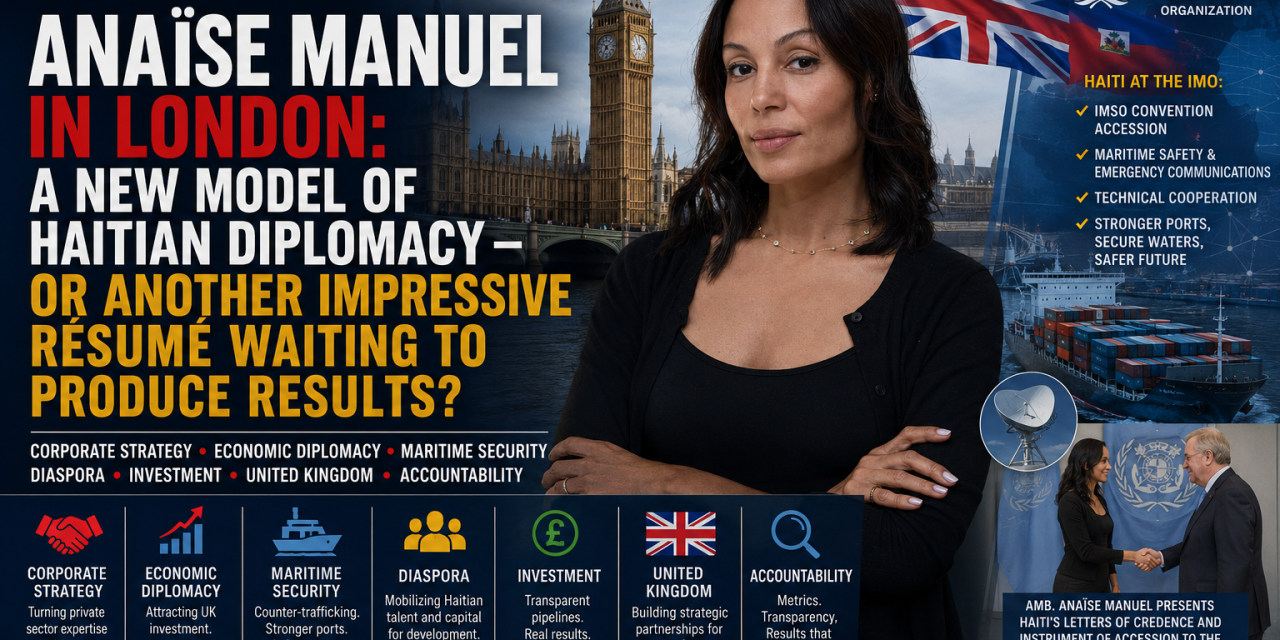
Corporate strategy. Economic diplomacy. Maritime security. Diaspora. Investment. United Kingdom. Accountability.
Haiti Politic Investigative Profile | August 2026
The purpose of this profile is not to endorse, oppose, rank, or politically assess Anaïse Manuel against any other Haitian official or political figure. It examines publicly documented information, separates verified achievements from ambitions and unanswered questions, and leaves the judgment to the public.
Haiti has maintained embassies, ambassadors and diplomatic missions around the world for generations.
The harder question is:
What has Haitian diplomacy actually delivered for Haiti?
That question becomes particularly interesting in London, where Anaïse Manuel now serves as Haiti’s Ambassador Extraordinary and Plenipotentiary to the United Kingdom and as Haiti’s Permanent Representative to the International Maritime Organization (IMO).
Haiti’s Ministry of Foreign Affairs currently identifies Manuel as the country’s ambassador in the United Kingdom. Her appointment was on the Haitian Council of Ministers’ agenda on August 20, 2025.
Unlike the stereotypical career diplomat, Manuel brings significant private-sector strategy experience into foreign affairs. The Haitian Embassy describes her previous experience as including Ernst & Young (EY) and service in the commercial section of Haiti’s Consulate in Miami. An independent Haitian diaspora organization lists an MBA from American University, a BA from George Washington University and additional project-management training.
That combination raises an important question:
Can Haiti turn diplomacy from representation into measurable national leverage?
🔎 WHO IS ANAÏSE MANUEL?
Manuel’s career appears to cross three worlds that do not always intersect in Haitian public administration:
corporate strategy → diaspora/community engagement → diplomacy.
Public biographical material describes her as having worked in Strategy and Transactions at EY, where her experience included strategic initiatives and transaction-oriented analysis. In discussing that experience, Manuel herself has said that strategy and M&A taught her to examine the whole picture and apply due diligence before making decisions.
The Haitian Ladies Network also documents experience involving EY, Haiti’s Consulate General and the National Institutes of Health, along with community and entrepreneurial engagement.
This matters.
Foreign policy is increasingly about more than protocol.
A modern embassy can potentially function as an economic-development platform—connecting governments, investors, universities, technology companies, diaspora professionals and multilateral organizations.
And Manuel’s own embassy identifies trade, investment, education, cultural exchange, sustainable development and diaspora engagement among its priorities.
But priorities are not accomplishments.
The real test is measurable execution.
⚓ THE MOST CONCRETE RESULT SO FAR: HAITI’S IMSO ACCESSION
One development deserves particular attention because it is independently documented.
On November 28, 2025, Haiti became the 112th party to the Convention of the International Mobile Satellite Organization (IMSO).
And Manuel personally deposited Haiti’s instrument of accession with IMO Secretary-General Arsenio Dominguez. Haiti’s maritime delegation also included SEMANAH Director General Eric Prévost and maritime-environment adviser Carlo Cérôme.
That is an actual diplomatic action—not simply a meeting or communiqué.
Haiti’s delegation also participated in the 34th IMO Assembly, including the election of the IMO Council for 2026–27. The embassy says IMSO accession strengthens Haiti’s participation in the international maritime-safety and emergency-communications architecture and creates opportunities for technical assistance.
But this creates the next investigative question:
What happens after accession?
Joining an international convention is one thing.
Turning membership into equipment, training, communications capability and improved maritime governance in Haitian waters is another.
The public should eventually be able to ask:
What did Haiti receive? What did Haiti implement? What changed?
🚢 CAN LONDON DIPLOMACY HELP PROTECT HAITI’S COASTLINE?
This may become one of the most important dimensions of Manuel’s posting.
Haiti faces enormous challenges involving ports, customs enforcement, maritime safety and transnational trafficking.
And London happens to host the International Maritime Organization.
That gives Haiti’s ambassador an unusual multilateral platform.
But expectations should remain realistic.
An ambassador does not command Haiti’s Coast Guard, police, customs administration or port authorities.
Nor does accession to IMSO automatically mean that satellites are suddenly monitoring Haiti’s coastline on Haiti’s behalf.
The available official IMSO announcement establishes Haiti’s accession; it does not document the delivery of specific surveillance hardware, a new Haitian maritime command center or a UK-Haiti intelligence-sharing system.
That distinction is important.
Diplomatic access must not be confused with operational capacity.
The next phase should therefore be measured through implementation.
📊 HAITI POLITIC — MARITIME DIPLOMACY ACCOUNTABILITY TEST
| Area | Publicly documented | What remains to be demonstrated |
|---|---|---|
| IMO representation | Manuel serves as Permanent Representative | Concrete Haitian regulatory outcomes |
| IMSO | Haiti became the 112th Convention party | Operational implementation in Haiti |
| Emergency communications | Membership creates an international framework | Equipment, training and deployment |
| Maritime security | Diplomacy can facilitate cooperation | Measurable interdiction/security results |
| Port modernization | Potential area for technical cooperation | Funded projects and implementation |
| UK cooperation | Bilateral relationship exists | Specific agreements producing Haitian capacity |
The distinction matters:
Diplomacy creates opportunities. Haitian institutions must convert them into results.
💷 THE EY QUESTION: CAN CORPORATE STRATEGY BECOME ECONOMIC DIPLOMACY?
Manuel’s corporate background may ultimately be more consequential than the ceremonial aspects of her position.
Her embassy publicly emphasizes investment and business partnerships as part of its mission.
That creates an opportunity to test a different model of Haitian diplomacy.
Instead of asking only:
How many diplomatic meetings occurred?
Ask:
How much investment did those meetings generate?
Instead of:
How many business forums were organized?
Ask:
How many companies subsequently invested?
Instead of:
How many diaspora professionals attended embassy events?
Ask:
How much capital, expertise or technology ultimately reached Haiti?
A corporate-strategy background could be useful here because investors evaluate risk, governance, return, compliance and execution.
But Haiti’s security crisis creates an obvious limitation.
No ambassador can simply market away kidnapping risk, infrastructure deficiencies, political instability or weak contract enforcement.
Economic diplomacy can open doors.
Domestic governance determines whether investors walk through them.
🇬🇧 WHERE ARE THE UK-HAITI INVESTMENT RESULTS?
This is where public accountability becomes essential.
The embassy describes economic partnership and investment promotion as priorities.
The next step should therefore be publication of measurable indicators.
How many UK companies has the mission approached?
How many qualified investment leads have resulted?
Which sectors are being targeted?
Agriculture?
Textiles?
Tourism?
Renewable energy?
Technology?
Ports and logistics?
Creative industries?
And most importantly:
How much actual capital has reached Haiti?
Without those measurements, “economic diplomacy” risks remaining a slogan rather than a development instrument.
🌎 THE DIASPORA QUESTION
Manuel’s background also places diaspora engagement near the center of her profile.
The embassy explicitly describes itself as a bridge between Haiti and Haitians living in the United Kingdom and identifies diaspora service as an institutional priority.
That matters because Haiti’s diaspora possesses enormous financial and intellectual resources.
But Haiti has historically treated diaspora engagement largely through:
remittances, ceremonies, cultural events and political rhetoric.
A more ambitious diplomatic model would ask:
Can diaspora capital become productive capital?
Could London facilitate regulated diaspora investment vehicles?
Could Haitian-British doctors establish hospital partnerships?
Could engineers participate in infrastructure programs?
Could British universities partner directly with Haitian universities?
Could Haitian entrepreneurs obtain UK market access?
Could diaspora investors receive better information about Haitian projects and their risks?
These would be measurable forms of diplomacy.
🎓 CULTURAL DIPLOMACY: TELLING HAITI’S STORY DIFFERENTLY
There are also signs that Manuel’s mission is pursuing cultural diplomacy.
Recent embassy activity includes engagement with the International Slavery Museum in Liverpool, with an emphasis on ensuring that Haiti’s history is represented accurately and with participation from Haitian artists, scholars and experts.
That may appear secondary beside security.
It isn’t necessarily.
Haiti suffers not only from institutional weakness but from an international image overwhelmingly associated with disaster, violence and humanitarian emergency.
Cultural diplomacy can challenge that narrative.
But again, the accountability principle should remain:
visibility should eventually produce relationships, tourism, academic partnerships, cultural markets or investment opportunities.
⚠️ AN IMPORTANT FACT-CHECK
Some biographical material currently published online about Manuel is internally inconsistent.
For example, one embassy webpage claims she has served as ambassador since 2020 and describes earlier Ministry of Foreign Affairs positions.
That conflicts with stronger contemporaneous documentation showing her appointment process in 2025, including the August 20, 2025 Council of Ministers record and a Haitian Foreign Ministry diplomatic bulletin stating that she presented copies of her credentials in July 2025.
Therefore, Haiti Politic would not treat the 2020 date or the accompanying career chronology on that webpage as established fact without additional primary documentation.
This illustrates exactly why diplomatic biographies should be independently verified rather than repeated.
🔥 THE QUESTIONS AMBASSADOR MANUEL SHOULD ANSWER
These are accountability questions, not accusations.
- IMSO: What concrete technical benefits has Haiti obtained since joining the IMSO Convention—training, systems, funding or communications capacity?
- Maritime security: Has the embassy negotiated any formal UK-Haiti framework concerning maritime intelligence, trafficking, customs enforcement or coastal surveillance? If yes, what can legally be disclosed?
- Ports: What specific IMO technical-assistance programs has Haiti requested for SEMANAH, port authorities and other maritime institutions?
- Investment: How much UK investment has the embassy facilitated since Manuel assumed the post—not expressions of interest, but projects reaching financing or implementation?
- Diaspora: Is the embassy developing a formal mechanism for converting Haitian-British savings and expertise into transparent investment projects in Haiti?
- Trade: Which Haitian products is the embassy actively attempting to place in British markets, and what regulatory barriers have been identified?
- Metrics: Will the embassy publish an annual performance report showing meetings, agreements, investments, technical assistance, consular performance and project outcomes?
- Security: What can an embassy realistically deliver internationally while Haitian institutions struggle to implement agreements domestically?
- Accountability: What does Manuel consider a successful London mandate by the end of her posting—and which numerical indicators should Haitians use to judge it?
📑 FORMAL REQUEST FOR INFORMATION
To: H.E. Anaïse Manuel
Ambassador Extraordinary and Plenipotentiary of Haiti to the United Kingdom
Subject: Request for documented performance indicators concerning Haiti-UK relations and maritime diplomacy
Your Excellency,
In the interest of public transparency and informed discussion concerning Haiti’s diplomatic representation abroad, we respectfully request information regarding measurable outcomes achieved by the Embassy of Haiti in London during your tenure.
In particular, we invite the Mission to provide documentation, where disclosure is legally permissible, concerning UK-Haiti trade and investment initiatives; IMO and IMSO technical cooperation; maritime-safety capacity building; diaspora investment initiatives; educational and cultural partnerships; and agreements or programs involving British institutions.
We would additionally welcome publication of quantitative performance indicators allowing Haitian citizens to distinguish diplomatic activity from completed outcomes.
Such disclosure would contribute substantially to a fact-based national conversation about the modernization of Haitian foreign policy.
Respectfully,
Haiti Politic — Diplomatic Accountability Series
🧭 THE BIGGER QUESTION: WHAT SHOULD HAITIAN FOREIGN POLICY ACTUALLY DO?
This investigation ultimately extends beyond Anaïse Manuel.
Haiti must decide what it expects from its diplomatic corps.
Is an ambassador primarily there to represent the country ceremonially?
Or should every major embassy operate almost like a national development office abroad?
Imagine publishing an annual diplomatic dashboard showing:
Investment attracted | exports facilitated | scholarships obtained | security cooperation negotiated | technology transferred | diaspora projects mobilized | international financing unlocked | consular cases resolved.
Then Haitians could evaluate diplomacy through evidence rather than prestige.
🇭🇹 ANAÏSE MANUEL’S LONDON TEST
There are already documented elements worth watching.
A private-sector strategy background.
Experience in diaspora/community networks.
Representation at the IMO.
Haiti’s accession to the IMSO Convention.
An embassy agenda emphasizing investment, diaspora engagement and bilateral relations.
But Manuel has occupied the ambassadorial role for only about a year, so sweeping conclusions about success or failure would be premature.
The more meaningful investigation begins now.
Can access become agreements?
Can agreements become implementation?
Can corporate experience become investment?
Can IMO membership strengthen maritime institutions?
Can diaspora engagement produce productive capital?
Can London deliver something measurable to Port-au-Prince, Cap-Haïtien, Jacmel, Les Cayes and Haiti’s coastal communities?
And ultimately:
CAN ANAÏSE MANUEL HELP DEMONSTRATE THAT HAITIAN DIPLOMACY CAN PRODUCE RESULTS PEOPLE AT HOME CAN ACTUALLY SEE?
That question cannot be answered by a résumé.
It cannot be answered by photographs at diplomatic receptions.
And it cannot be answered by political rhetoric.
It has to be answered with results.
THE DOCUMENTS SHOULD SPEAK. THE RESULTS SHOULD BE MEASURABLE. THE PEOPLE SHOULD DECIDE.
#HaitiPolitic #AnaiseManuel #Haiti #UnitedKingdom #HaitianDiplomacy #ForeignPolicy #IMO #IMSO #MaritimeSecurity #Diaspora #EconomicDiplomacy #Accountability
Source note: This article uses third-party and official web material to document facts and identify questions for further investigation. It does not compare, rank, endorse or recommend Anaïse Manuel or any political candidate, party or faction.