Can Christian-democratic politics help rebuild Haiti—or must MOCHRENA prove that moral language can become effective, inclusive government?
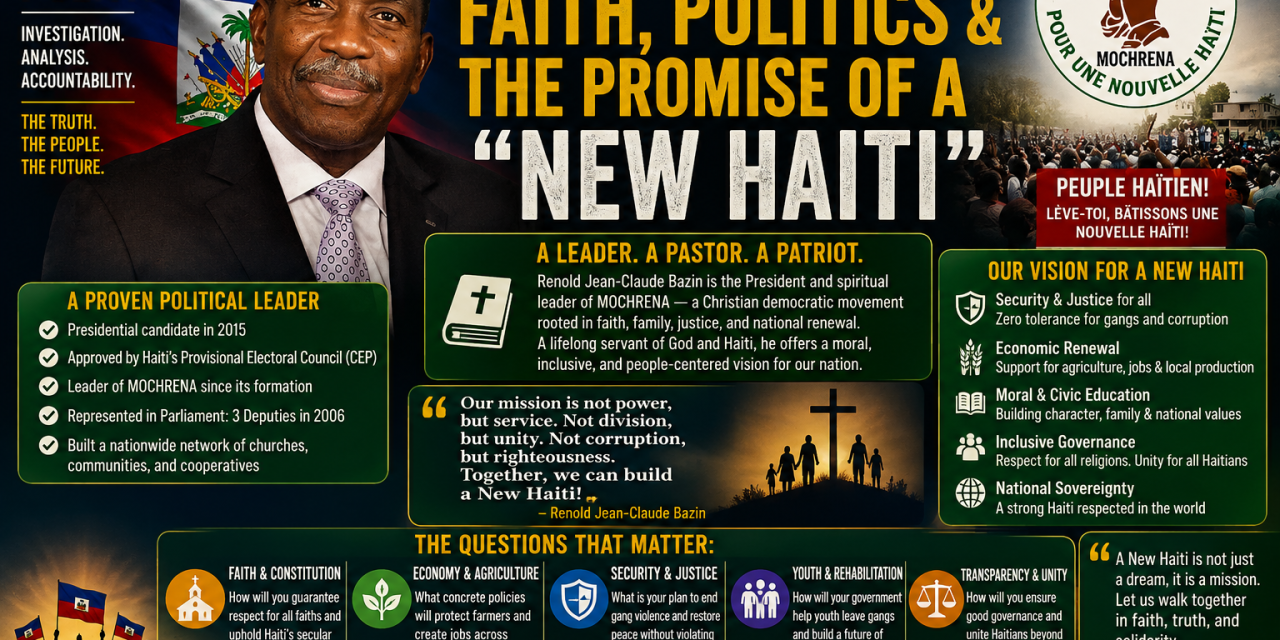
As Haiti searches for a path out of institutional breakdown, insecurity, economic dependence and repeated political transitions, Renold Jean-Claude Bazin offers a political identity different from the country’s better-known populist, business and technocratic movements: a politics explicitly associated with Christian democracy and MOCHRENA — Mouvement Chrétien pour une Nouvelle Haïti.
But an investigation of Bazin also requires separating documented history from campaign mythology.
Available electoral records confirm that Renold Jean-Claude Bazin was MOCHRENA’s approved presidential candidate in Haiti’s 2015 election. The CEP’s registration records also identify him as the party’s legal representative that year.
And MOCHRENA itself predates his presidential candidacy. Historical sources describe it as a movement emerging from Haiti’s evangelical Protestant community and designed in part to mobilize that constituency politically. An OAS election-observation report documented MOCHRENA fielding 81 parliamentary candidates in the 2000 electoral process, demonstrating that the organization was more than a symbolic presidential vehicle.
That history raises a larger question:
What happens when a movement built around religious values attempts to govern an extraordinarily diverse republic?
🔎 WHO IS RENOLD JEAN-CLAUDE BAZIN?
Bazin served as president of MOCHRENA and represented the movement in national political discussions. In an interview published by International IDEA, he described the organization as a movement intended to include Protestants, Catholics and Vodou practitioners, arguing that Haiti belongs to all its citizens. That documented statement complicates any simplistic description of MOCHRENA as exclusively Protestant.
MOCHRENA nevertheless has unmistakably evangelical origins. Historical reporting describes the organization as Christian-democratic or center-right and rooted in evangelical churches. The movement developed a genuine electoral presence: sources record three seats in Haiti’s Chamber of Deputies following the 2006 elections.
In 2015, Bazin took that political tradition into the presidential contest. But his national electoral support was limited: published results credit him with 3,570 votes, approximately 0.23%.
That number matters.
It demonstrates the central political challenge facing Bazin and MOCHRENA: an established organization and recognizable ideological identity have not yet translated into broad presidential support.
⚖️ THE CENTRAL TEST: CHRISTIAN DEMOCRACY IN A PLURAL HAITI
Religious conviction is not itself a governing program.
A president must govern Haitians who are Protestant, Catholic, Vodou practitioners, followers of other faiths and citizens who want no religious doctrine determining public policy.
Bazin’s own past description of MOCHRENA as inclusive provides an important starting point. But presidential leadership would require turning that principle into enforceable guarantees.
🎤 QUESTIONS BAZIN SHOULD ANSWER
1️⃣ Where does faith end and constitutional government begin?
Would a Bazin administration guarantee that religious belief never determines access to public employment, education, justice, government contracts or social services?
And when Christian doctrine conflicts with the constitutional rights of citizens, which authority prevails?
💰 FROM MORAL GOVERNMENT TO FUNCTIONING GOVERNMENT
Haiti’s crisis cannot be solved by ethics alone.
A functioning government must collect revenue, operate customs, build roads, maintain hospitals, regulate banks, administer schools, prosecute corruption and create conditions for private investment.
Church organizations can mobilize volunteers and community resources.
The Haitian state cannot operate on volunteerism.
So Bazin faces a fundamental test:
What is the MOCHRENA economic model?
Would it prioritize agricultural protection, SMEs, cooperatives, private investment, social programs, free-market competition—or some combination?
More importantly:
Where are the numbers?
How much revenue would the program require?
Which taxes would rise?
Which expenditures would fall?
What would happen during the first 100 days?
Without answers, “moral reconstruction” remains a philosophy rather than a national budget.
🚨 SECURITY: MORAL AUTHORITY DOESN’T RETAKE TERRITORY
Any serious Haitian presidential platform eventually reaches the same brutal question:
How does the state restore its monopoly on legitimate force?
Bazin should therefore be pressed beyond general promises of peace.
2️⃣ What is his operational security doctrine?
How many additional PNH officers would Haiti require?
How would they be vetted?
How would police salaries, intelligence, armored mobility, communications and ammunition be financed?
What would be the respective roles of the PNH and FAD’H?
And what safeguards would prevent counter-gang operations from producing indiscriminate violence against civilians?
👦🏿 WHAT HAPPENS TO CHILDREN RECRUITED BY ARMED GROUPS?
Security cannot consist solely of arrests and armed operations.
Haiti eventually must decide what to do with young people recruited, coerced or economically absorbed into criminal organizations.
A Christian-democratic movement emphasizing redemption faces a particularly important philosophical test here.
Would a Bazin government establish rehabilitation programs combining:
education + trauma treatment + vocational training + family reunification + supervised reintegration?
And where would the line between rehabilitation and prosecution be drawn?
That question deserves a detailed answer.
🌾 CAN A CHURCH NETWORK BECOME AN ECONOMIC NETWORK?
MOCHRENA’s history demonstrates organizational endurance. But claims that its affiliated religious networks constitute a nationwide system of successful agricultural cooperatives or microfinance institutions require stronger public documentation than we found.
That distinction matters.
Political movements should be evaluated on verifiable institutional accomplishments, not simply claims repeated during campaigns.
If MOCHRENA proposes church-linked cooperatives as a development model, Bazin should publish measurable evidence:
How many cooperatives?
How many farmers?
What annual production?
What repayment rates?
What employment?
What audited financial results?
Show the receipts.
🌎 THE FOREIGN-POLICY QUESTION
This may ultimately be Bazin’s least-developed public dimension—and potentially one of the most important.
Haiti has repeatedly depended on foreign governments, international organizations, NGOs, humanitarian financing and externally supported security initiatives.
A president cannot simply promise “sovereignty.”
He must define it.
3️⃣ What would a Bazin Doctrine look like?
Would Haiti continue relying heavily on Washington, Ottawa, Paris and multilateral institutions?
Would his government deepen relations with CARICOM?
What diplomatic strategy would address weapons trafficking?
How would Haiti negotiate international assistance while preventing foreign organizations from effectively substituting themselves for Haitian institutions?
And perhaps most importantly:
How would a faith-oriented president prevent foreign religious organizations from exercising disproportionate influence over Haitian public policy?
That question deserves particular scrutiny.
🗳️ THE ELECTORAL REALITY CHECK
MOCHRENA possesses something many Haitian political organizations lack: historical continuity.
It has participated in Haitian politics for decades, competed for legislative representation and survived multiple political eras.
But longevity and presidential viability are different things.
Bazin’s roughly 0.23% showing in the 2015 presidential election illustrates the enormous distance between maintaining an organized political movement and assembling a national presidential majority.
That produces perhaps the most important campaign question:
What has changed since 2015?
Where are the new voters?
Where are the youth organizations?
Where are the municipal candidates?
Where is the economic team?
Where is the security team?
And what coalition could transform MOCHRENA from an enduring political institution into a nationally competitive governing movement?
📊 HAITI POLITIC ASSESSMENT
| AREA | DOCUMENTED STRENGTH | QUESTION STILL UNANSWERED |
|---|---|---|
| Political Organization | MOCHRENA has participated in Haitian electoral politics for decades. | Can its organization generate broad national support? |
| Christian-Democratic Identity | Clear ideological identity distinguishes it from many personality-centered movements. | Can religious values produce inclusive secular governance? |
| Electoral Experience | Bazin was an approved 2015 presidential candidate. | How does he expand beyond his very small 2015 vote share? |
| Institutional Inclusion | Bazin publicly described MOCHRENA as encompassing Protestants, Catholics and Vodou practitioners. | What legal guarantees would translate that rhetoric into policy? |
| Foreign Policy | Faith networks could potentially create unusual international civic connections. | A detailed Bazin foreign-policy doctrine needs to be demonstrated publicly. |
| Security | Moral reconstruction may contribute to prevention and community mobilization. | Haiti requires an operational, financed security strategy—not simply moral appeals. |
🔥 THE HAITI POLITIC QUESTION
Renold Jean-Claude Bazin offers Haiti a proposition: that political renewal must begin with moral renewal.
But Haiti has heard promises of renewal before.
The harder test is whether MOCHRENA can translate Christian-democratic principles into secular constitutional government, professional security forces, economic growth, accountable institutions and an independent foreign policy.
That case cannot be established by faith alone.
It requires plans, numbers, institutions, measurable results and accountability.
🇭🇹 THE PEOPLE SHOULD DECIDE.
Does Renold Jean-Claude Bazin represent a different model of leadership—or does MOCHRENA still have to prove that a durable religious political movement can become a modern governing coalition?
👇 Debate the record. Challenge the platform. Demand evidence.
HAITI POLITIC
Investigation. Analysis. Accountability.