Investigation • Accountability • Foreign Policy • Governance • Elections
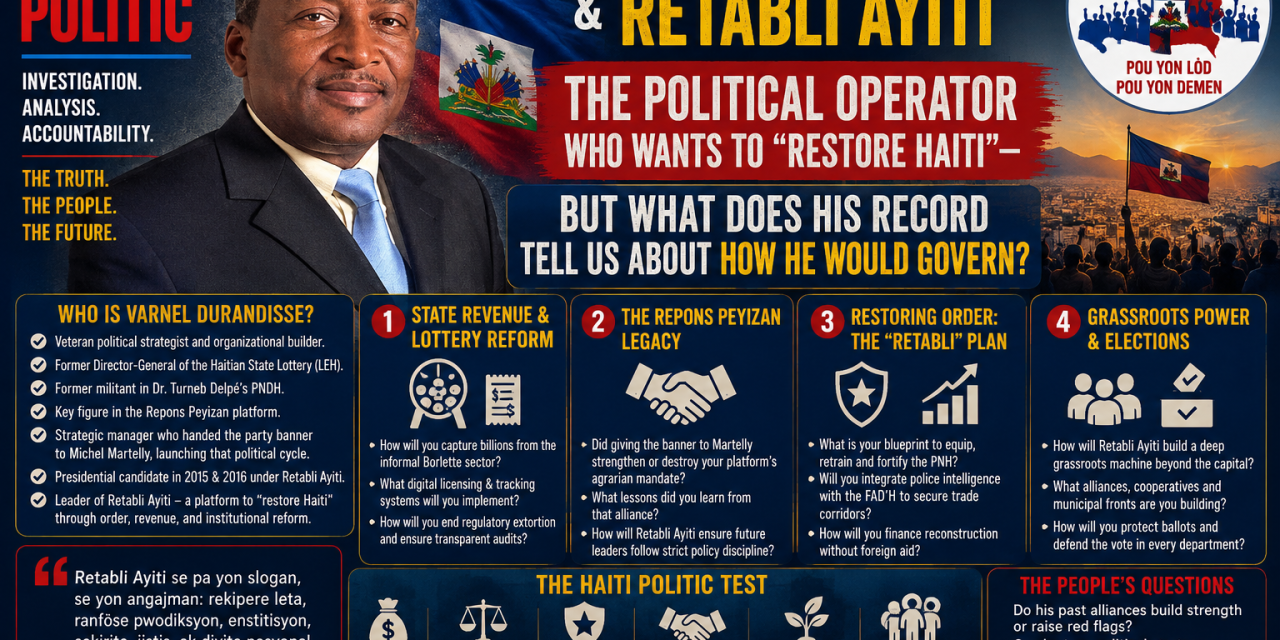
Haiti has heard the word reconstruction countless times. Joseph G. Varnel Durandisse offers another formulation: Retabli Ayiti — Restore Haiti.
But restoration is not a slogan. It raises measurable questions.
Restore which institutions? With what money? Under what constitutional authority? With what security strategy? And, crucially, what in Durandisse’s documented record demonstrates that he could turn political organization into effective national governance?
Haiti Politic reviewed publicly available material on Durandisse. Some elements of the biography circulating online are much easier to substantiate than others. His presidential candidacy and leadership of Retabli Ayiti are documented; several more detailed claims about earlier government and party roles require stronger primary-source documentation before they should be presented as established fact.
So rather than campaigning for or against him, we put the record—and the unanswered questions—before the public.
🔎 WHO IS JOSEPH G. VARNEL DURANDISSE?
Durandisse was an officially approved presidential candidate representing Retabli Ayiti in the 2015 electoral process. Public electoral reporting also records him returning under Retabli Ayiti during the rerun of the presidential election.
The numbers establish something important about his electoral history.
In the disputed 2015 first round, reporting cited by HaitiLibre placed Durandisse 23rd with 2,811 votes, approximately 0.18%. When the presidential election was rerun in November 2016, the published final results gave him 881 votes, approximately 0.08%.
Those results don’t determine whether his ideas are good or bad. But they create an unavoidable political question:
Can Retabli Ayiti transform itself from a small electoral organization into a genuinely national movement?
🏛️ WHAT EXACTLY IS RETABLI AYITI?
A 2015 publication attributed to Durandisse’s campaign describes Retabli Ayiti not simply as one conventional party, but as a political platform bringing together several parties and socioeconomic organizations. Its stated objectives included pooling resources for elections, contributing to political, economic and social development, and pursuing political participation through legal and democratic means.
That coalition structure could potentially be useful in Haiti’s extremely fragmented party system.
But it creates another question:
Can a coalition remain disciplined once government appointments, budgets and political power are at stake?
More recently, a December 2023 report identified Durandisse as president of Retabli Ayiti and recorded him discussing corruption, insecurity, Haitian-Dominican relations and domestic agricultural production.
That suggests his political activity did not simply disappear after the 2016 election.
🌎 FOREIGN POLICY: WHAT WOULD “RETABLI AYITI” ACTUALLY CHANGE?
This may be the most important unanswered part of Durandisse’s political project.
Haiti doesn’t simply need more international relationships. It needs a coherent doctrine explaining what Haiti expects from those relationships.
Durandisse’s 2023 comments provide at least one window into his thinking. During discussion of the Ouanaminthe canal dispute, he emphasized Haitian agricultural production and portrayed the controversy within the broader economic relationship between Haiti and the Dominican Republic.
But a presidential foreign policy requires considerably more.
Durandisse should therefore tell Haitians where he stands on the United States, Dominican Republic, CARICOM, Canada, France, African partners, Taiwan and China, multilateral lenders, international security assistance and the enormous NGO economy operating inside Haiti.
The central question:
Would a Durandisse presidency fundamentally change Haiti’s relationship with foreign powers—or simply renegotiate the same dependency?
💰 1. THE STATE, REVENUE & THE INFORMAL ECONOMY
Biographical accounts supplied in political discussions describe Durandisse as having experience connected to Haiti’s state lottery.
However, the sources located for this investigation did not independently establish enough primary documentation about the dates, authority, financial results and accomplishments of that tenure to responsibly characterize it as either a success or failure.
That distinction matters.
If Durandisse wants management of public revenue to become part of his presidential résumé, voters deserve the numbers.
Questions for Durandisse: What measurable revenue increases occurred under his management? Were audited financial statements published? How much gaming revenue actually reached the Treasury? What reforms did he personally implement?
And looking forward: would a Retabli Ayiti government introduce electronic licensing for borlette operators? Could municipalities receive part of gaming revenues? Would operators and regulators appear in searchable public databases?
A candidate claiming fiscal competence should be able to provide auditable evidence rather than biography alone.
⚖️ 2. CORRUPTION: WILL “RESTORATION” INCLUDE HIS OWN GOVERNMENT?
Durandisse publicly discussed corruption as a national problem in 2023.
The more difficult question is what happens when anti-corruption institutions investigate political allies.
Would a President Durandisse guarantee operational independence for the ULCC, UCREF and CSCCA?
Would ministers publish asset declarations?
Would major government contracts, beneficial owners, contract amendments and payments become searchable online?
Would political allies lose government positions while credible corruption investigations proceed?
And would Retabli Ayiti disclose its own campaign donors?
Anti-corruption becomes meaningful when the rules apply to the president’s friends too.
🚨 3. “RETABLI” WHAT? THE SECURITY QUESTION
The name Retabli Ayiti implies restoration of public authority.
That makes security perhaps the toughest test of the brand.
Haitians should demand specifics rather than promises of toughness.
How many additional police officers would a Durandisse administration recruit annually? What would they cost? How would officers be vetted? How would police intelligence be rebuilt? How would ports and borders be monitored for weapons trafficking?
What would be the respective roles of the PNH and FAD’H?
And after territory is recovered, who holds it—the police, municipalities, courts or military?
Because clearing territory temporarily is not the same as restoring government permanently.
🌾 4. ECONOMIC SOVEREIGNTY & THE DOMINICAN REPUBLIC
Durandisse’s comments concerning the Ouanaminthe canal indicate an emphasis on restoring Haitian agricultural production.
That idea deserves serious examination.
Would Retabli Ayiti protect Haitian agriculture with tariffs?
If so, on which products and at what rates?
Would protections be phased in to prevent sudden food-price increases?
Would farmers receive irrigation, agricultural credit, storage facilities, crop insurance and guaranteed purchasing arrangements?
And regarding the Dominican Republic:
Can Durandisse construct a policy that vigorously protects Haitian economic interests while maintaining workable diplomatic, commercial and border relations with Haiti’s only land neighbor?
National sovereignty and diplomatic effectiveness are not necessarily opposites. A president would need both.
🗳️ 5. THE ELECTORAL REALITY RETABLI AYITI CANNOT IGNORE
Durandisse’s previous electoral performance presents perhaps his clearest political weakness.
The final 2016 results credited him with 881 votes—0.08% nationally.
That does not invalidate his ideas.
It does mean Retabli Ayiti has a substantial burden of proof.
Where is its national organization today?
How many communes have functioning committees?
Where are its candidates for Senate, Chamber of Deputies and municipal government?
Who finances the organization?
How are candidates selected?
And what has changed since 2016 that would produce a dramatically different electoral outcome?
A presidential movement cannot govern through the presidency alone.
Without parliamentary and municipal organization, even an elected president can become politically isolated.
🔥 6. THE QUESTION OF HIS POLITICAL PAST
The background supplied for this investigation attributes significant involvement by Durandisse in earlier political organizations and particularly in political maneuvering surrounding Repons Peyizan and Michel Martelly.
Those are potentially important claims.
But the web sources located in this review did not provide sufficient independent documentation to confidently repeat the detailed version of that history as established fact.
Haiti Politic would therefore put the issue directly to Durandisse:
What exactly was your role inside Repons Peyizan?
Did you participate in the process that brought Michel Martelly under its presidential banner?
What decisions did you personally make?
What did you believe that political alliance would accomplish?
And looking at Haiti afterward, what would you do differently today?
If documentary evidence is produced, voters can judge the record themselves.
🌐 7. A DURANDISSE FOREIGN-POLICY TEST
Before asking Haitians for another presidential mandate, Retabli Ayiti should be able to answer five straightforward questions.
What is Haiti’s national-interest doctrine?
What relationships should Haiti maintain with Washington without becoming politically dependent on Washington?
What should change in Haitian-Dominican relations?
Should foreign NGOs be required to publish their Haiti budgets, contractors and results?
What conditions should Haiti impose on international security assistance?
And finally:
How does Haiti move from being the object of international policy to becoming the author of its own foreign policy?
That is the real sovereignty test.
📊 HAITI POLITIC — PUBLIC ASSESSMENT
Documented political experience: Durandisse has participated in presidential politics and has maintained an identifiable political organization over multiple years.
Coalition-building potential: Retabli Ayiti’s founding material describes a coalition bringing together several political and socioeconomic organizations rather than relying solely on a single traditional party structure.
Major unanswered question: His previous presidential results demonstrate extremely limited electoral reach, making national organization a critical issue.
Foreign-policy opportunity: His public emphasis on domestic production and Haitian-Dominican economic relations provides a starting point—but not yet a complete presidential foreign-policy doctrine.
Accountability challenge: Several impressive claims circulating about his earlier institutional and party roles need stronger documentary evidence before voters should treat them as demonstrated accomplishments.
🇭🇹 THE PEOPLE MUST DECIDE
Joseph G. Varnel Durandisse has already participated in Haiti’s presidential arena.
He has experienced political organization.
He has experienced electoral defeat.
And Retabli Ayiti remains present in political discussion years later.
But Haiti’s next political chapter cannot be judged by slogans.
“Retabli Ayiti” is a promise.
The electorate has every right to ask for the blueprint.
How will the state be restored?
How will security be restored?
How will production be restored?
How will justice be restored?
How will Haiti’s diplomatic independence be restored?
And perhaps most importantly:
JOSEPH G. VARNEL DURANDISSE: HE WANTS TO “RESTORE HAITI”—BUT HAS HE SHOWN HOW TO TURN POLITICAL EXPERIENCE INTO STATE POWER THAT ACTUALLY WORKS?
We investigate. You question. The people decide.
HAITI POLITIC 🇭🇹
Accountability before personality. Evidence before promises.
#HaitiPolitic #VarnelDurandisse #RetabliAyiti #Haiti #PolitiqueHaitienne #HaitiElections #ForeignPolicy #Gouvernance #Corruption #PNH #Diplomatie #Ayiti #Accountability