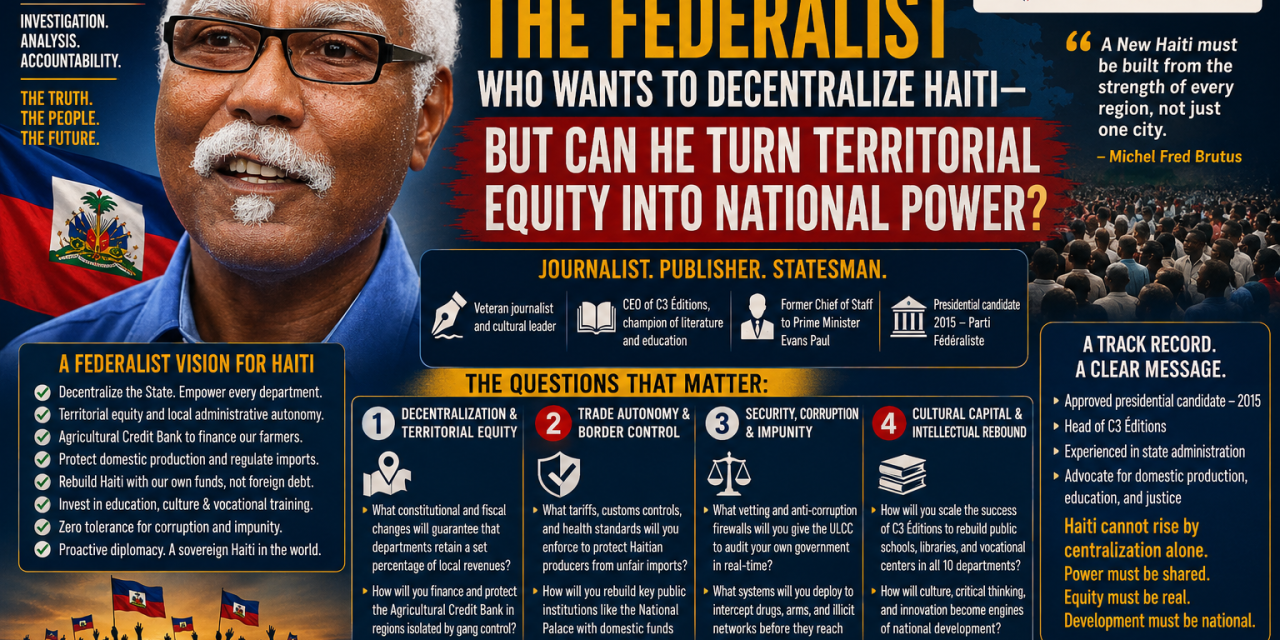
Journalist. Publisher. Former senior government administrator. Presidential candidate. Federalist.
Michel Fred Brutus entered Haiti’s 2015 presidential race with an argument that remains strikingly relevant: Haiti cannot develop while virtually everything—political authority, money, institutions and opportunity—is concentrated in Port-au-Prince.
His answer was a more decentralized state, stronger domestic production, agricultural credit, vocational education and what he described as an “intelligent” and strategic state. Contemporary reporting confirms that Brutus was the Parti Fédéraliste’s approved presidential candidate in 2015 and publicly campaigned on decentralization and “territorial equity.”
But more than a decade later, Haiti Politic asks the harder question:
Was Brutus diagnosing Haiti correctly—and did he ever demonstrate that his federalist prescription could actually work?
🔎 WHO IS MICHEL FRED BRUTUS?
Brutus was born in Gonaïves in 1953 and studied at Haiti’s INAGHEI. A 2015 candidate profile described a career spanning journalism, publishing and government administration, including work connected to the Interior and Commerce ministries and service as chief of staff to Prime Minister Evans Paul in 2015.
He was also known as the head of C3 Éditions, giving him an unusual profile in Haitian politics: part political operator, part journalist, part cultural entrepreneur. Le Nouvelliste likewise identified him as the head of C3 Éditions while covering his presidential campaign.
That background matters.
Unlike candidates whose principal credentials come from business, policing, law or street mobilization, Brutus approached politics partly through ideas, communication and institutional administration.
But experience around government is not the same thing as successfully governing it.
That distinction should remain at the center of his evaluation.
🏛️ THE BRUTUS DOCTRINE: DECENTRALIZE HAITI
Brutus argued during the 2015 campaign that the Haitian state had become excessively centralized in Port-au-Prince. His program called for decentralization in pursuit of territorial equity, while supporting national production and farmers.
The diagnosis deserves serious attention.
Haiti has spent generations discussing decentralization while political power and state administration remain overwhelmingly concentrated in the capital.
So the question for Brutus isn’t:
“Do you support decentralization?”
Almost everyone says they do.
The question is:
What power are you actually willing to transfer?
Would departments and communes receive guaranteed shares of national tax revenue?
Would municipalities control meaningful portions of property taxation?
Would regional governments receive independent development budgets?
Would Cap-Haïtien, Les Cayes, Jacmel, Gonaïves and Hinche receive greater authority over infrastructure and economic development?
And how would the system prevent decentralization from simply producing ten smaller versions of Port-au-Prince corruption?
🌾 THE AGRICULTURAL CREDIT BANK
One of Brutus’s clearest 2015 proposals was creation of an Agricultural Credit Bank, accompanied by technical assistance for farmers.
It was an important proposal because Haitian agriculture doesn’t suffer only from insufficient production.
Farmers face problems involving credit, irrigation, transportation, storage, security, market access and competition from imports.
But the proposal needs a second layer.
🎤 QUESTION #1
Where would the bank’s capital come from?
Would it be financed by the central bank, commercial banks, diaspora bonds, international development institutions or national tax revenue?
Who decides which farmers receive loans?
What prevents political allies from capturing the credit?
How would loans work in territories where insecurity prevents lenders from enforcing contracts or farmers from transporting crops?
A development bank without governance can become another patronage machine.
Brutus should explain the safeguards.
🇩🇴 HAITI–DOMINICAN REPUBLIC: A REAL FOREIGN-POLICY RECORD TO EXAMINE
This is where Brutus becomes particularly interesting.
His 2015 platform didn’t simply discuss abstract diplomacy. It called for redefining relations with the Dominican Republic and pursuing what was described as proactive diplomacy.
During the Dominican Republic’s contentious migrant-regularization process in 2015, Brutus traveled there and publicly addressed the treatment and documentation of Haitians. He acknowledged the Dominican Republic’s authority to regulate foreigners while criticizing Haiti’s own failure to provide documentation efficiently to its nationals.
That position is politically revealing.
Rather than presenting every bilateral problem solely as foreign hostility, Brutus placed some responsibility on Haitian state capacity.
That leads to one of the strongest questions for him today:
🎤 QUESTION #2
What would a modern Brutus doctrine toward the Dominican Republic actually be?
Haiti needs trade with its neighbor.
It simultaneously needs effective customs enforcement, migration diplomacy, border security and protection of Haitian citizens.
Can Brutus construct a relationship based neither on dependency nor permanent confrontation?
And can Haiti demand respect abroad while failing to provide basic documentation and government services to its own citizens?
📦 PROTECTING HAITIAN PRODUCTION—WITHOUT MAKING FOOD UNAFFORDABLE
Brutus proposed controlling what he regarded as abusive imports of consumer goods from the Dominican Republic because of their effects on Haitian production and concerns about product quality.
Protection of domestic production sounds attractive.
But protectionism creates difficult trade-offs.
Raise tariffs too quickly and imported food becomes more expensive.
Restrict imports before Haitian producers can replace them and shortages can follow.
Protect industries indefinitely and politically connected companies may become inefficient monopolies.
🎤 QUESTION #3
What exactly would Brutus protect—and for how long?
Rice?
Eggs?
Poultry?
Construction materials?
Textiles?
Processed food?
And what measurable production targets would determine when tariffs rise or fall?
Economic sovereignty requires production capacity, not merely border taxes.
💰 “REBUILD IT WITH OUR OWN MONEY”
Brutus also proposed rebuilding Haiti’s National Palace using national funds rather than depending on external financing.
Symbolically, the argument was powerful:
Haitians should demonstrate that the Haitian state can build something important with Haitian resources.
But symbolism raises another question.
Where does the money come from?
Customs?
Income taxes?
Property taxes?
Corporate taxation?
Diaspora bonds?
Spending reductions?
A politician promising financial sovereignty should publish the arithmetic behind it.
🚨 SECURITY: THE 2015 PROGRAM MEETS THE HAITI OF TODAY
Brutus’s 2015 platform supported a professional remobilized Haitian military and promised action against corruption, drug trafficking, impunity, terrorism and violence.
Today’s security environment makes those broad commitments insufficient.
🎤 QUESTION #4
What does federalism mean for national security?
Would police remain completely centralized?
Would departments have regional commands?
Would municipalities receive expanded policing authority?
Who controls intelligence?
Who controls weapons?
Who controls the military?
A decentralized Haiti still requires a national state capable of exercising legitimate authority throughout its territory.
Brutus must therefore demonstrate that decentralization strengthens the republic rather than fragments it.
⚖️ CORRUPTION: “I’LL APPOINT HONEST PEOPLE” ISN’T ENOUGH
During the 2015 campaign, Brutus said he would surround himself with honest officials and that corrupt members of his administration would face the law.
That principle is admirable.
But Haiti’s problem isn’t simply finding honest personalities.
It is constructing institutions that make corruption difficult even when dishonest people obtain power.
So Haiti Politic would ask:
🎤 QUESTION #5
Would every minister publish assets before entering office?
Would government contracts become searchable online?
Would beneficial owners of companies receiving state contracts be disclosed?
Would procurement records be published?
Would ULCC investigations remain independent when they target presidential allies?
Would departmental governments face identical transparency requirements?
Integrity needs architecture.
📚 THE PUBLISHER’S CHALLENGE: CAN CULTURE BECOME DEVELOPMENT POLICY?
Brutus’s association with publishing distinguishes him from much of Haiti’s political class.
His 2015 program also promised additional vocational schools.
That combination raises a potentially compelling national-development proposition:
Books + vocational education + regional universities + digital access + local industry.
But Haiti needs scale.
A serious Brutus education plan should therefore specify how many vocational centers would be established, where they would operate, which industries they would serve and how graduates would move directly into employment.
Publishing books builds intellectual capital.
Government must build systems.
🗳️ THEN COMES THE ELECTORAL REALITY
Brutus was one of the officially approved candidates in Haiti’s extraordinarily crowded 2015 presidential field.
Reported results gave him 3,177 votes—about 0.20% nationally.
That cannot simply be ignored in an assessment of presidential viability.
A candidate proposing radical decentralization must explain why that idea did not produce a significant national electoral constituency in 2015.
🎤 QUESTION #6
What has changed?
Has the Parti Fédéraliste developed municipal organizations?
Departmental leadership?
Youth chapters?
Agricultural associations?
Diaspora financing?
Candidates for Parliament?
Because a president cannot federalize or substantially decentralize Haiti by presidential declaration.
He would need political power beyond the presidency.
🌎 COULD BRUTUS BRING SOMETHING DIFFERENT TO HAITIAN FOREIGN POLICY?
Potentially.
His old platform explicitly envisioned proactive diplomacy, reconsideration of relations with the Dominican Republic and engagement with a changing international order.
His public intervention in the Dominican migration controversy also demonstrated willingness to discuss Haiti’s own institutional failures, rather than attributing every bilateral problem exclusively to outsiders.
But Haiti’s next foreign policy needs to go much further.
It must connect diplomacy directly to:
security → weapons trafficking → trade → migration → diaspora investment → agriculture → climate financing → ports → sovereignty.
The essential question is therefore whether Brutus has updated his 2015 thinking for the radically different Haiti of today.
📊 HAITI POLITIC ASSESSMENT
| AREA | WHAT THE RECORD SHOWS | THE TEST |
|---|---|---|
| Decentralization | Territorial equity was central to his 2015 platform. | Publish the actual fiscal and constitutional architecture. |
| Agriculture | Proposed an Agricultural Credit Bank and technical support for farmers. | Explain financing, governance and security. |
| Government Experience | Profiles document cabinet-level administrative experience, including service under PM Evans Paul. | Show measurable results from that experience. |
| Culture & Media | Journalist/publisher associated with C3 Éditions. | Translate intellectual leadership into scalable public policy. |
| Foreign Policy | Advocated proactive diplomacy and rethinking Dominican relations. | Produce a modern doctrine for security, trade and sovereignty. |
| Electoral Strength | Won about 0.20% in the reported 2015 presidential results. | Demonstrate that a genuine national federalist constituency now exists. |
🔥 THE HAITI POLITIC VERDICT? THERE ISN’T ONE.
That’s the point.
Michel Fred Brutus presented ideas worth debating: territorial equity, agricultural credit, domestic production, vocational education, stronger institutions and a more deliberate foreign policy.
But ideas must survive contact with budgets, Parliament, corruption, gangs, institutional weakness and electoral reality.
So the question belongs to Haitians:
🇭🇹 MICHEL FRED BRUTUS: THE FEDERALIST WHO WANTS TO BREAK PORT-AU-PRINCE’S GRIP—BUT CAN DECENTRALIZATION ACTUALLY REBUILD HAITI?
Would federalism distribute opportunity—or distribute dysfunction?
Could stronger regions finally unlock Haiti’s economic potential—or would weakening the center make an already fragile state harder to govern?
👇 THE PEOPLE DECIDE.
HAITI POLITIC
Investigation. Analysis. Accountability.