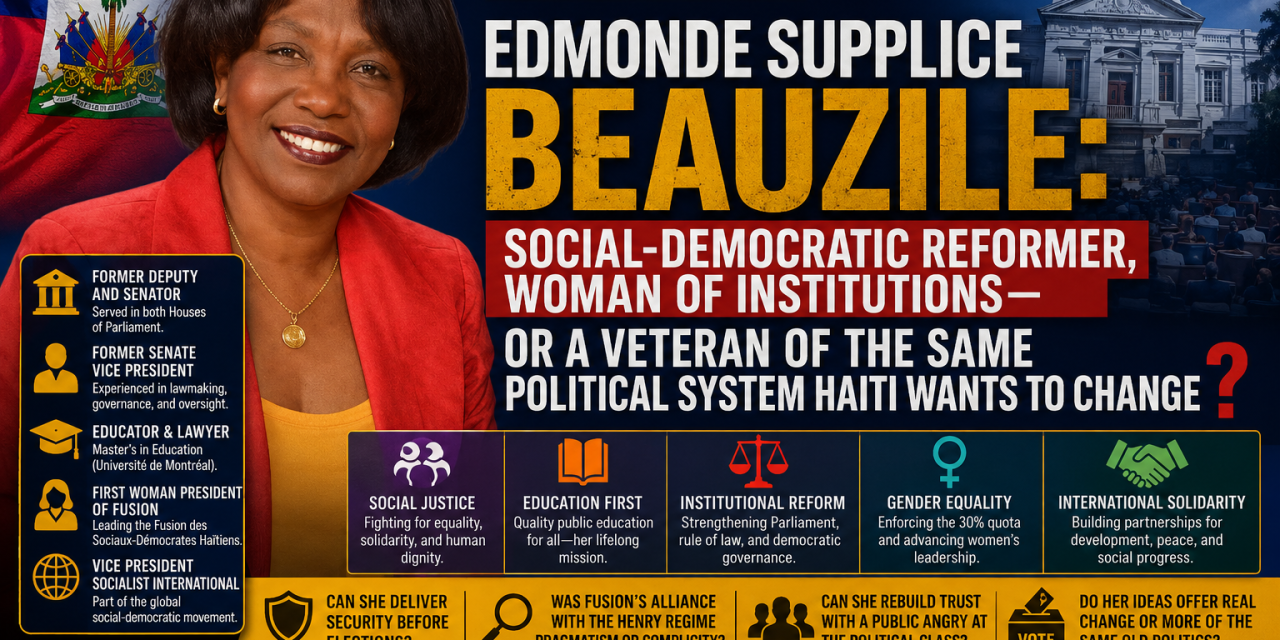
🇭🇹 Educator. Lawyer. Former Deputy. Former Senator. Former Senate Vice President. Presidential candidate. Former president of FUSION. International social-democratic leader.
Edmonde Supplice Beauzile has something increasingly rare in Haitian politics:
a long political résumé built primarily inside civilian democratic institutions.
She has served in both houses of Parliament. She has helped lead the Senate. She became the first woman elected to lead the Fusion des Sociaux-Démocrates Haïtiens (FUSION), according to the party’s own history.
And her international political profile is substantial. She was elected a Vice-President of the Socialist International in 2022 and remains listed in its current presidium representing Haiti.
But longevity creates its own political problem.
Beauzile cannot campaign merely against Haiti’s political establishment.
She has been part of that establishment.
And FUSION’s participation in transitional political arrangements—including the period surrounding Ariel Henry—means any serious examination must consider not only what Beauzile proposes today, but what her party supported when it already possessed political influence.
That creates the central Haiti Politic question:
CAN EDMONDE SUPPLICE BEAUZILE USE DECADES OF INSTITUTIONAL EXPERIENCE TO REFORM HAITI—
OR DOES HER LONG RECORD MAKE HER TOO CONNECTED TO THE SYSTEM SHE SAYS MUST CHANGE?
This is not an endorsement.
It is not a condemnation.
It is an examination.
Then—
🇭🇹 LET THE HAITIAN PEOPLE DECIDE.
👩🏾🏫 WHO IS EDMONDE SUPPLICE BEAUZILE?
Beauzile comes from an educational and legal background rather than Haiti’s traditional military or commercial elite.
Published biographies describe her as having studied education, law and educational administration, including graduate study at the Université de Montréal.
She subsequently entered electoral politics.
Her career has included service in the Chamber of Deputies, election to the Senate, and service as Vice-President of the Senate.
In September 2011, FUSION’s national congress elected Beauzile president of the party. The party itself records her election as a milestone in its institutional history.
That résumé matters.
Haiti frequently produces presidential aspirants with limited legislative experience.
Beauzile has the opposite problem.
SHE KNOWS THE SYSTEM.
The question is what she did with that knowledge—and what she would change.
🏛️ TEST #1 — WHAT DID SHE ACTUALLY ACCOMPLISH IN PARLIAMENT?
Political longevity is not itself an accomplishment.
A legislator should ultimately be judged by:
laws introduced;
laws passed;
budgets influenced;
constituents served;
institutions strengthened;
corruption challenged;
and measurable policy outcomes.
So Beauzile should publish a legislative report card.
Which laws bear her fingerprints?
Which amendments did she introduce?
Which budgets did she influence?
Which government expenditures did she oppose?
Which investigations did she demand?
Which reforms remain in force today?
Haitians should not have to rely on campaign biographies.
SHOW THE LEGISLATIVE RECORD.
🏛️ TEST #2 — WHAT DID BEING SENATE VICE PRESIDENT TEACH HER?
Beauzile has seen Haiti’s political machinery from inside Parliament.
That means she understands:
committee negotiations;
executive-legislative bargaining;
budget politics;
appointments;
quorum manipulation;
party switching;
parliamentary immunity;
and legislative obstruction.
That experience could be an enormous presidential advantage.
Or evidence that she belongs to the old political class.
The difference depends on her answers.
What practices did she witness that should never be permitted again?
Which parliamentary rules encourage corruption?
How should lawmakers’ finances be audited?
Should votes and attendance be published automatically?
Should parliamentary immunity be narrowed?
Should legislators be required to disclose beneficial business interests?
A politician claiming institutional experience should be able to tell Haitians exactly where the institution is broken.
🗳️ TEST #3 — IS FUSION A REAL POLITICAL PARTY?
This question goes beyond Beauzile.
Haiti has repeatedly produced parties built around individual personalities.
When the leader disappears, the organization disappears.
FUSION has survived considerably longer than many such electoral vehicles.
It also belongs to the international social-democratic family. Socialist International records identify FUSION as a Haitian member party and Beauzile as one of its representatives.
Good.
Now show Haitians the organization.
How many active members?
How many communal sections?
How many departmental offices?
How are candidates selected?
How are party leaders elected?
Who finances FUSION?
Are contributions audited?
Are donors disclosed?
How many women occupy leadership positions?
How many members are under 35?
HAITI NEEDS INSTITUTIONS, NOT ELECTORAL LOGOS.
If FUSION is different, prove it.
🌹 TEST #4 — WHAT DOES “SOCIAL DEMOCRACY” ACTUALLY MEAN IN HAITI?
FUSION identifies itself with social democracy.
But ideology matters only when translated into budgets.
European social democracy historically combines:
private enterprise;
regulated markets;
organized labor;
progressive taxation;
universal public services;
and substantial social protection.
Haiti presents a radically different environment.
The tax base is tiny.
Informality is enormous.
State capacity is weak.
Public services are limited.
Security consumes scarce resources.
So President Beauzile:
HOW DO YOU FINANCE A SOCIAL-DEMOCRATIC STATE WHEN THE STATE CAN BARELY COLLECT TAXES?
That may be the most important economic question she must answer.
💰 TEST #5 — WHO PAYS?
A serious social-democratic program would require money.
Healthcare.
Schools.
School meals.
Teacher salaries.
Public transportation.
Housing.
Pensions.
Social assistance.
Municipal services.
So where does revenue come from?
Customs modernization?
Property taxes?
Higher taxes on luxury consumption?
Corporate taxation?
Telecommunications?
Mining?
Diaspora investment?
Formalization of businesses?
Reduced exemptions?
Fighting customs fraud?
A wealth tax?
Which taxes rise?
Which taxes fall?
Which exemptions disappear?
How much additional revenue does each reform generate?
Political philosophy without arithmetic is campaign rhetoric.
📚 TEST #6 — EDUCATION SHOULD BE BEAUZILE’S HOME FIELD
Few potential presidential candidates can claim an educational background as central to their professional identity as Beauzile.
That means expectations should be higher.
Haiti does not merely need more children enrolled in school.
It needs a completely different educational system.
The Constitution places responsibility for education on the state and territorial collectivities and guarantees the right to education.
But constitutional language and everyday reality remain far apart.
So what would President Beauzile actually do?
🏫 THE NATIONAL SCHOOL TEST
Would she commit to a ten-year national education program built around:
one public primary-school standard;
one teacher-certification framework;
national curriculum benchmarks;
school meals;
digital student identification;
regional vocational schools;
teacher payroll audits;
and
department-by-department performance reporting?
Then publish the numbers.
How many classrooms?
How many teachers?
What teacher salary?
What percentage of GDP?
What percentage of the national budget?
How many years?
DON’T PROMISE EDUCATION.
SHOW THE EDUCATION BUDGET.
👩🏾 TEST #7 — THE 30% QUESTION
Beauzile’s political career gives her particular credibility to discuss women’s participation.
But Haiti already has constitutional language.
Article 17-1 recognizes the principle of at least 30% representation of women at all levels of national life, notably in public services.
Article 31-1-1 applies the 30% principle to political-party structures and functioning.
The problem is enforcement.
So President Beauzile:
What happens when a political party ignores the quota?
No public financing?
No candidate accreditation?
No electoral registration?
Financial penalties?
Rejected party lists?
And would those rules apply to FUSION itself?
A QUOTA WITHOUT ENFORCEMENT IS A SLOGAN.
👩🏾⚖️ TEST #8 — WOULD SHE GO BEYOND 30%?
Beauzile could propose something much more ambitious:
A gender-balanced cabinet.
Not 30%.
Near parity.
Finance.
Justice.
Interior.
Defense.
Foreign Affairs.
Public Works.
Agriculture.
Planning.
Not simply ministries traditionally assigned to women.
And then extend the principle to:
ambassadors;
departmental delegates;
state-company boards;
regulatory authorities;
and senior public administration.
Would she?
That would convert representation into executive power.
🚨 TEST #9 — BUT NONE OF THIS WORKS WITHOUT SECURITY
Schools cannot operate if neighborhoods are controlled by armed groups.
Women cannot participate politically if candidates cannot campaign safely.
Businesses cannot pay taxes if extortion replaces taxation.
Elections cannot be credible if voters cannot reach polling stations.
So Beauzile’s insistence on connecting elections with security deserves scrutiny.
The key question is not whether security matters.
Everyone knows it does.
The harder question is:
HOW MUCH SECURITY IS ENOUGH TO HOLD AN ELECTION?
Complete elimination of gangs?
Probably unrealistic as a prerequisite.
Control of polling centers?
Secure transportation corridors?
Candidate access?
Freedom of assembly?
Protection of CEP personnel?
Voter registration access?
Beauzile should define measurable thresholds.
🗳️ TEST #10 — SECURITY CANNOT BECOME AN EXCUSE FOR PERMANENT TRANSITION
This is critical.
If politicians say:
“No elections until Haiti is completely secure,”
then armed groups effectively gain veto power over democracy.
A gang only needs to maintain instability to prevent elections indefinitely.
On the other hand, holding elections in territories where candidates cannot campaign and citizens cannot vote freely creates another form of illegitimacy.
So Beauzile should answer:
What percentage of polling centers must be operational?
What percentage of registered voters must have reasonable access?
What security standard must each department meet?
Who independently certifies those conditions?
What happens in temporarily inaccessible districts?
This requires a formula—not simply a declaration.
🤝 TEST #11 — THE ARIEL HENRY QUESTION CANNOT BE AVOIDED
This may be the most politically difficult part of Beauzile’s record.
FUSION participated in the political architecture surrounding the September 11 Accord during Ariel Henry’s transitional period.
Critics therefore argue that political organizations supporting that arrangement share some responsibility for its failures.
Supporters may counter that participation in transitional coalitions was necessary to avoid an even deeper institutional vacuum.
Both positions should be examined.
But Beauzile should answer directly:
WHY DID FUSION SUPPORT THAT POLITICAL ARRANGEMENT?
What did the party expect?
What did it obtain?
What policies did it influence?
What warnings did it issue privately?
When did Beauzile conclude that the arrangement was failing?
Why didn’t FUSION leave sooner—or, if it did distance itself, what specifically triggered that decision?
⚖️ TEST #12 — WHAT DOES SHE ACCEPT RESPONSIBILITY FOR?
Political accountability becomes meaningful when leaders identify their own errors.
Not only everybody else’s.
So ask Beauzile:
What did you personally get wrong about the Ariel Henry transition?
Not Washington.
Not the Core Group.
Not Henry.
Not gangs.
Not rival politicians.
YOU.
What assumption proved false?
What alliance was a mistake?
What should FUSION have done differently?
A candidate who cannot identify past errors gives voters little reason to believe future errors will be corrected.
🌎 TEST #13 — HER INTERNATIONAL NETWORK IS REAL
This part of Beauzile’s profile can be independently documented.
At its 2022 Madrid congress, the Socialist International elected Beauzile as one of its vice-presidents for the Americas and Caribbean.
The organization’s current presidium continues to list her as a Haitian vice-president.
That places her in a political network containing parties and leaders across Europe, Latin America, Africa and elsewhere.
The question is:
WHAT HAS HAITI RECEIVED FROM THAT NETWORK?
🌍 TEST #14 — TURN DIPLOMATIC CONNECTIONS INTO NATIONAL ASSETS
International conferences are not foreign policy.
Photographs with foreign leaders are not foreign policy.
Membership cards are not foreign policy.
Results are foreign policy.
So Beauzile should publish what her international relationships have produced:
Scholarships?
Teacher exchanges?
Municipal partnerships?
Trade-union training?
Women’s leadership programs?
Election expertise?
Public-administration assistance?
Development financing?
University agreements?
If little has resulted so far, say so.
Then explain how a presidency would change that.
🇭🇹 TEST #15 — SOCIAL-DEMOCRATIC FOREIGN POLICY
A Beauzile foreign policy could theoretically distinguish itself by placing human development at its center.
Instead of diplomacy focused almost entirely on:
security missions;
political transitions;
humanitarian emergencies;
and migration,
Haiti could negotiate around:
teacher training;
universal healthcare;
labor mobility;
climate financing;
agriculture;
women’s economic participation;
vocational education;
and municipal development.
That would be a meaningful shift.
But again:
Which countries?
Which institutions?
Which agreements?
Which dollar amounts?
🇺🇸 TEST #16 — WASHINGTON
Every Haitian president must manage Washington.
There is no serious alternative.
The United States affects Haiti through:
trade;
migration;
banking;
security assistance;
diaspora relationships;
sanctions;
development assistance;
and diplomacy.
Beauzile must therefore explain her doctrine.
Would she maintain close alignment?
Seek greater strategic autonomy?
Push Washington toward institution-building instead of endless crisis management?
Challenge U.S. policy publicly when Haitian interests diverge?
What are her red lines?
DIPLOMATIC INDEPENDENCE DOES NOT REQUIRE DIPLOMATIC HOSTILITY.
But it does require a definition of national interest.
🇩🇴 TEST #17 — THE DOMINICAN REPUBLIC
Haiti’s most consequential bilateral relationship may ultimately be the Dominican Republic.
Trade.
Migration.
Border security.
Agriculture.
Water.
Deportations.
Customs.
Labor.
Contraband.
Environmental management.
Beauzile should therefore propose something larger than reactive diplomacy.
A permanent Haiti–Dominican bilateral commission with published agendas and outcomes.
Put technical experts at the table.
Economists.
Hydrologists.
Customs officials.
Migration specialists.
Agricultural experts.
Security officials.
Municipal authorities.
Diplomacy cannot consist exclusively of presidential disputes.
🌎 TEST #18 — CAN HER INTERNATIONAL LEFT-WING NETWORK HELP HAITI DIVERSIFY?
Beauzile’s Socialist International connections create another possibility.
Haiti historically depends heavily on a relatively narrow group of international actors.
Could she diversify relationships toward democratic governments in:
Latin America;
the Caribbean;
Africa;
and Europe?
Could Haitian diplomacy pursue South-South cooperation without turning foreign policy into ideological alignment?
That’s important.
HAITI SHOULD HAVE PARTNERS—NOT PATRONS.
A social-democratic president should be able to cooperate with conservative, liberal and socialist governments alike when Haitian interests require it.
💼 TEST #19 — WHAT ABOUT THE PRIVATE SECTOR?
Social democracy is not the abolition of capitalism.
So Beauzile must explain her relationship with Haitian business.
Would she:
raise corporate taxes?
strengthen competition law?
attack monopolistic practices?
expand labor protections?
raise the minimum wage?
formalize employment?
require social insurance contributions?
At the same time:
How does she prevent capital flight?
How does she encourage investment?
How does she make Haiti attractive to manufacturers?
How does she protect SMEs from both government bureaucracy and established monopolies?
SOCIAL JUSTICE WITHOUT PRIVATE INVESTMENT CAN PRODUCE STAGNATION.
PRIVATE INVESTMENT WITHOUT SOCIAL JUSTICE CAN PRODUCE OLIGARCHY.
Her challenge is balancing both.
👷🏾 TEST #20 — LABOR RIGHTS
A genuine Haitian social-democratic agenda should have something substantial to say about workers.
Not only government employees.
Factory workers.
Domestic workers.
Construction workers.
Agricultural workers.
Drivers.
Informal merchants.
Would Beauzile support:
collective bargaining?
occupational-safety enforcement?
unemployment insurance?
portable pensions?
maternity protections?
formal contracts?
labor courts?
What happens when labor protections increase production costs?
Again:
show the economics.
🛒 TEST #21 — THE INFORMAL ECONOMY
Millions of Haitians survive outside formal employment.
A social-democratic state cannot finance itself indefinitely while most economic activity escapes taxation and regulation.
But aggressive taxation could destroy fragile livelihoods.
So perhaps the bargain becomes:
REGISTER → RECEIVE BENEFITS.
A street merchant registers.
Gets a digital business identity.
Pays a tiny simplified tax.
In return receives:
microcredit eligibility;
health coverage;
pension contributions;
legal protection;
and access to public procurement.
That is how formalization can become an incentive instead of punishment.
Would Beauzile support it?
🏥 TEST #22 — HEALTHCARE
Education may be Beauzile’s strongest professional territory.
But social democracy inevitably raises healthcare.
Would she establish a national insurance system?
Tax-funded universal care?
Regional public hospitals?
Public-private contracting?
How much would it cost?
How would Haiti retain nurses and physicians?
How would pharmaceuticals be purchased transparently?
How would government stop medical procurement from becoming another corruption market?
These questions need numbers.
🏘️ TEST #23 — DECENTRALIZATION
Beauzile’s political history includes national institutions.
But Haiti desperately needs functioning local government.
Municipalities should not need Port-au-Prince authorization for every meaningful decision.
Would she transfer:
property-tax revenue;
business-license revenue;
infrastructure budgets;
education responsibilities;
sanitation budgets;
and local development authority
to municipalities?
If yes, what prevents local corruption?
Decentralization without auditing simply decentralizes corruption.
⚖️ TEST #24 — PARLIAMENTARY IMMUNITY
Beauzile has served inside Parliament.
So she should be especially precise here.
Parliamentary immunity exists to protect legislators from political persecution.
It should not become protection against legitimate criminal investigation.
Would she support constitutional or statutory reforms distinguishing:
POLITICAL SPEECH → PROTECTED
from
CORRUPTION / MONEY LAUNDERING / VIOLENT CRIME → INVESTIGABLE?
That could become one of the most consequential institutional reforms of a future Parliament.
🧾 TEST #25 — POLITICIANS SHOULD DISCLOSE THEIR MONEY
A Beauzile reform agenda should require:
asset declarations before taking office;
annual updates;
beneficial ownership disclosure;
campaign donors;
foreign financial interests;
government contracts involving relatives;
and post-office declarations.
Then make them public.
Would Beauzile voluntarily publish hers before requiring anyone else to do so?
LEADERSHIP CAN BEGIN BEFORE ELECTION DAY.
👩🏾💼 TEST #26 — WOMEN IN POLITICS NEED MORE THAN QUOTAS
Women candidates face particular obstacles:
campaign financing;
security;
harassment;
sexual violence;
party gatekeeping;
and unequal media exposure.
So Beauzile could propose a Women’s Democratic Participation Fund.
Parties receive public campaign financing partly according to genuine female representation.
Not placeholder candidates.
Not relatives placed on lists.
Candidates who actually receive:
resources;
staff;
security;
media access;
and competitive districts.
That would make the constitutional principle measurable.
🧑🏾🎓 TEST #27 — CAN SHE REACH YOUNG HAITIANS?
This may be Beauzile’s greatest electoral challenge.
Her résumé is formidable.
But it belongs to a political generation many young Haitians associate with decades of institutional failure.
Young voters may ask:
Where were these experienced politicians while the state collapsed?
Why should the people who participated in yesterday’s coalitions become tomorrow’s reformers?
Beauzile cannot answer that with biography.
She needs generational renewal.
How many FUSION candidates will be under 40?
How many leadership positions?
How many young policy directors?
Would she establish party primaries?
Would she relinquish control to a younger generation?
A PARTY CANNOT PROMISE NATIONAL RENEWAL WHILE REFUSING INTERNAL RENEWAL.
📊 THE EDMONDE SUPPLICE BEAUZILE TEST
| AREA | DOCUMENTED ASSET / EXPERIENCE | QUESTION FOR VOTERS |
|---|---|---|
| Legislative experience | Former Deputy, Senator and Senate leader | What measurable reforms resulted? |
| Party leadership | Elected FUSION president in 2011 | Is FUSION institutionally stronger than personality-driven parties? |
| International diplomacy | Socialist International vice-president | What tangible benefits have those relationships produced for Haiti? |
| Education | Education-centered professional background | Can expertise become a financed national school system? |
| Women’s representation | Major female figure in national party politics | How would she enforce Haiti’s constitutional 30% principle? |
| Gender policy | Constitution recognizes at least 30% female participation | Will she impose consequences for noncompliance? |
| Social democracy | FUSION participates in the international social-democratic movement | How does Haiti pay for expanded social services? |
| Transitional politics | FUSION participated in major political negotiations | What responsibility does the party accept for failed transitions? |
| Security | Argues credible elections require adequate security | What measurable threshold makes elections possible? |
| Foreign policy | Extensive international political network | Can relationships become investment, education and institutional partnerships? |
⚖️ THE CASE SUPPORTERS CAN MAKE
Supporters can point to something Haitian politics desperately lacks:
institutional experience.
Beauzile has worked inside the legislature rather than merely criticizing it from outside.
She has led a durable political organization.
FUSION has maintained relationships with an established international political network, and Beauzile currently holds senior standing in the Socialist International.
She also represents something still strikingly uncommon in Haiti:
A WOMAN WHO REACHED THE TOP OF A MAJOR NATIONAL POLITICAL ORGANIZATION.
Her educational background could provide intellectual foundations for a government focused on human capital rather than political spectacle.
And social democracy potentially offers a middle path between laissez-faire oligarchy and revolutionary economic nationalism.
Those are legitimate arguments for voters to examine.
🚨 THE CASE CRITICS CAN MAKE
Critics can respond with an equally legitimate question:
After decades in Haitian politics, where are the transformative results?
Experience cuts both ways.
Beauzile served in Parliament.
Led a major party.
Participated in national political negotiations.
Worked within international political networks.
Therefore she cannot credibly present herself as entirely external to the political class that governed while Haiti’s institutions deteriorated.
FUSION’s alliances during transitional governments create particularly important accountability questions.
Critics may therefore ask:
IS EDMONDE SUPPLICE BEAUZILE A REFORMER WITH ENOUGH EXPERIENCE TO FIX THE SYSTEM—
OR AN EXPERIENCED OPERATOR WHO HAS SPENT TOO LONG INSIDE IT?
The answer should come from evidence, not slogans.
🔥 30 QUESTIONS EDMONDE SUPPLICE BEAUZILE SHOULD ANSWER
1. What are the five most consequential laws or reforms you personally advanced as a legislator?
2. What did you accomplish as Vice-President of the Senate?
3. Which parliamentary practices should be abolished?
4. Will you publish your complete legislative record?
5. Will you publish your personal asset declaration?
6. Will FUSION publish its donors and audited finances?
7. How many active members does FUSION have?
8. How many departmental and communal organizations?
9. What percentage of FUSION leadership is female?
10. What percentage is under 40?
11. What exactly does Haitian social democracy mean economically?
12. Which taxes would you raise?
13. Which taxes would you reduce?
14. How much would universal public education cost?
15. Where would that money come from?
16. Would you guarantee near gender parity in your cabinet?
17. What penalty should parties face for violating the constitutional 30% principle?
18. What security conditions must exist before elections can proceed?
19. Can elections proceed if some gang-controlled districts remain inaccessible?
20. How do you prevent insecurity from becoming justification for endless transition?
21. Why did FUSION participate in the Ariel Henry political arrangement?
22. What tangible policy achievements resulted from that participation?
23. What did you personally get wrong about that transition?
24. At what point should FUSION have changed course?
25. What has your Socialist International leadership tangibly produced for Haiti?
26. What would your foreign policy toward Washington change?
27. What is your strategy toward the Dominican Republic?
28. How would you balance worker protections against Haiti’s need for private investment?
29. How would you formalize the informal economy without destroying small merchants?
And finally:
30. AFTER DECADES INSIDE HAITI’S POLITICAL INSTITUTIONS, WHY SHOULD HAITIANS BELIEVE YOU CAN NOW TRANSFORM THE SYSTEM THOSE INSTITUTIONS FAILED TO PROTECT?
🇭🇹 THE CENTRAL QUESTION
Edmonde Supplice Beauzile presents Haiti with a different political archetype.
Not the military strongman.
Not the celebrity outsider.
Not primarily the businessman.
Not the revolutionary street leader.
She represents:
THE INSTITUTIONAL POLITICIAN.
Teacher.
Lawyer.
Legislator.
Senator.
Party leader.
International political negotiator.
That could be exactly what Haiti needs.
Or exactly what frustrated voters no longer trust.
Her strongest case would not be:
“I have experience.”
Haitians have experienced too many experienced politicians.
Her case must be:
“HERE IS WHAT MY EXPERIENCE TAUGHT ME TO CHANGE.”
Show the legislation.
Show the budget.
Show the education plan.
Show the security benchmarks.
Show FUSION’s finances.
Explain the Ariel Henry alliance.
Identify the mistakes.
Explain what the Socialist International relationships have actually produced.
Define the foreign-policy doctrine.
Publish the gender targets.
And most importantly—
SHOW WHERE EDMONDE SUPPLICE BEAUZILE IS WILLING TO REFORM THE VERY POLITICAL SYSTEM THAT MADE EDMONDE SUPPLICE BEAUZILE A NATIONAL POLITICAL FIGURE.
Because Haiti’s next political transformation cannot simply change the people sitting inside the institutions.
It must change how those institutions work.
Pa sèlman mande si Edmonde Supplice Beauzile gen eksperyans.
Mande kisa eksperyans sa a pwodwi.
Pa sèlman mande si li se yon fanm ki rive wo nan politik.
Mande kijan li pral louvri pòt la pou plizyè milye lòt fanm.
Pa sèlman mande si FUSION se sosyal-demokrat.
Mande pou bidjè a, refòm yo ak rezilta yo.
And above all:
🇭🇹 LET THE HAITIAN PEOPLE DECIDE.
HAITI POLITIC — Investigation. Analysis. Accountability. Debate.