Investigation • Accountability • Economy • Foreign Policy • Governance
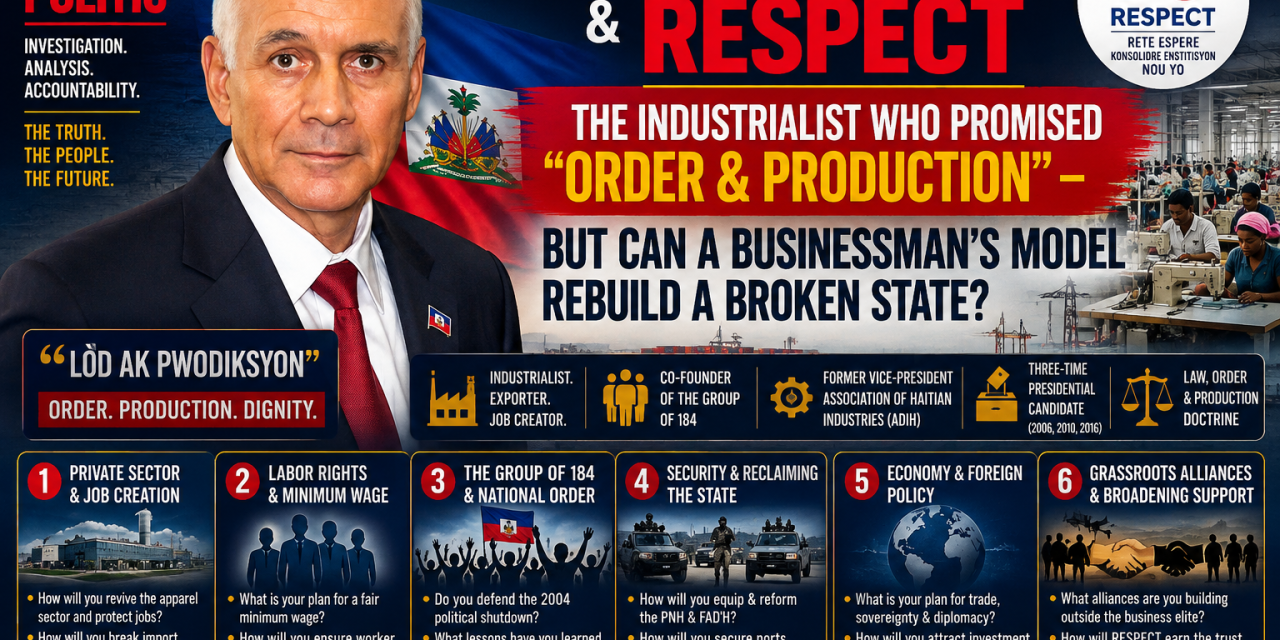
Charles Henri Baker—widely known as “Charlito”—is not a newcomer asking Haitians to judge him without a record.
He has managed businesses, participated in industrial organizations, helped lead a major civil-society opposition movement, founded a political identity around RESPECT/RESPÈ, and competed repeatedly for Haiti’s presidency.
That history gives Baker something many aspiring candidates lack: a record that can actually be interrogated.
It also gives him political baggage.
For supporters, Baker represents management, production, private investment and institutional discipline. For detractors, he represents an economic elite whose interests have not always aligned with those of Haiti’s poorest workers—and a political movement associated with one of the most controversial ruptures in Haiti’s recent democratic history.
Haiti Politic therefore asks a different question from “Do you like Charles Baker?”
What does the evidence tell us about what a Baker government might actually do?
🔎 WHO IS CHARLES HENRI BAKER?
Baker was born in Port-au-Prince in 1955 and developed a career in agriculture and manufacturing before becoming a national political figure. A biographical profile from Polytechnique Montréal says that after returning to Haiti, he acquired Pantalons Boucaniers, which grew from roughly 450 employees to about 990 as PB Apparel, producing garments for export to the United States. The same profile says he became vice-president of the Association des Industries d’Haïti (ADIH) in 2001.
That industrial experience is important.
Baker has not merely studied employment, exports and manufacturing. He has participated directly in the system.
But experience inside that system also means voters can ask him harder questions about wages, working conditions, taxation, competition and the enormous imbalance between owners and workers.
🗳️ THREE PRESIDENTIAL CAMPAIGNS—AND A CHANGING ELECTORAL BASE
Baker emerged as a major candidate in Haiti’s 2006 election.
He received 159,683 votes—8.24%—finishing third, behind René Préval and Leslie Manigat.
Four years later, the picture changed dramatically.
In the disputed 2010 election, Baker received 25,512 votes, or 2.38%, placing sixth in the preliminary results reported by Haiti-Référence.
His 2015 performance fell much further. Reporting surrounding his eventual 2016 withdrawal from the rerun says Baker had received 2,784 votes—about 0.18%—in the annulled 2015 contest. He subsequently withdrew rather than participate in the rerun.
That trajectory deserves examination.
8.24% → 2.38% → approximately 0.18%.
It doesn’t tell voters whether Baker’s ideas are right or wrong.
But it creates a legitimate political question:
What happened to the coalition that once made Charles Baker one of Haiti’s strongest opposition candidates?
🏭 1. “ORDER AND PRODUCTION”: THE ECONOMIC TEST
Baker’s strongest argument for executive office has traditionally been straightforward:
He understands production because he has actually managed production.
That matters in a country where politicians routinely promise jobs without having managed businesses employing hundreds of people.
But Haiti’s manufacturing crisis today is far larger than factory management.
Factories need electricity.
They need ports.
They need functioning roads.
They need customs.
They need access to finance.
Workers need transportation.
And investors need security.
So Baker should answer:
What is the 2026 version of an industrialization strategy for Haiti?
Would he rebuild manufacturing primarily around low-cost apparel assembly?
Or would RESPECT move toward higher-value industries—agro-processing, construction materials, pharmaceuticals, technology services and Haitian-owned manufacturing?
And perhaps most importantly:
Can Haiti become competitive without making cheap Haitian labor its principal competitive advantage?
💵 2. THE MINIMUM-WAGE QUESTION CANNOT BE AVOIDED
This is one of the areas where Baker deserves particularly rigorous questioning.
Labor organizations have historically criticized major Haitian industrialists—including Baker—over minimum-wage policy. A 2017 Haïti en Marche report, for example, described union allegations that Baker and other business figures opposed a wage adjustment.
That is an allegation from labor representatives, not by itself proof of every characterization made about Baker’s position.
But the underlying policy dispute is real and remains extremely relevant.
A Haitian president cannot simply choose between:
“Raise wages.”
and
“Protect factories.”
The actual challenge is accomplishing both.
So Baker should publish a measurable formula.
Should Haiti’s minimum wage automatically adjust with inflation?
Should different sectors have different wage floors?
Should employers receive tax incentives for transportation, meals, childcare and health insurance?
Should productivity bonuses supplement base wages?
Should government subsidize worker transportation rather than forcing employees to spend much of their wages commuting?
And what is the minimum standard of dignity that no foreign investor should be allowed to negotiate away?
Baker’s experience gives him credibility to discuss the problem.
His position within the employer class gives workers every reason to scrutinize his answer.
🏦 3. WOULD A BUSINESS PRESIDENT CONFRONT THE BUSINESS ELITE?
This could be the defining credibility test of a Baker presidency.
Haiti does not merely need a president who understands business.
It needs a president willing to distinguish between competitive capitalism and politically protected privilege.
Would Baker support public disclosure of beneficial ownership for companies receiving government contracts?
Would he eliminate politically connected customs exemptions?
Would RESPECT strengthen competition laws?
Would government contracts be published online?
Would politically connected importers face exactly the same customs enforcement as ordinary Haitian entrepreneurs?
Would monopolistic concessions be reviewed?
And would his government prosecute tax evasion by powerful business interests—even people from his own social and commercial circles?
Being pro-business and being pro-competition are not necessarily the same thing.
Voters deserve to know which one Charles Baker means.
🔥 4. THE GROUP OF 184: THE HISTORY BAKER CANNOT ESCAPE
Before becoming a presidential candidate, Baker was a prominent figure in the Group of 184, the broad civil-society and private-sector coalition opposing President Jean-Bertrand Aristide.
Contemporary and academic sources identify Baker among its important business leaders. An EU election-observation report later described the Group of 184 as having played a major role in the political process surrounding Aristide’s removal.
This history remains intensely contested.
Supporters of the movement viewed it as organized civil resistance against an increasingly dysfunctional and abusive government.
Critics contend that elite-led opposition helped undermine an elected government and contributed to a political rupture whose consequences Haiti endured for years afterward. Academic criticism has been especially severe about the private-sector leadership and tactics of the coalition.
Rather than pretending that dispute is settled, Baker should confront it directly.
Mr. Baker: knowing what happened to Haiti after February 2004, would you make the same political choices again?
If yes—why?
If no—what did you learn?
And what should opposition parties do when they believe an elected government is violating democratic norms?
That answer could tell Haitians more about Baker’s democratic philosophy than another campaign speech.
🚨 5. ORDER WITHOUT AUTHORITARIANISM
“Order” sounds attractive when kidnapping, extortion and territorial control by armed groups have devastated communities.
But democratic government requires defining exactly what order means.
Would Baker prioritize the PNH or FAD’H?
How many police officers should Haiti ultimately field?
How would they be vetted?
What intelligence capabilities would be rebuilt?
How would weapons trafficking through ports and borders be attacked?
How would recovered neighborhoods be held after security operations?
And what independent authority would investigate police or military abuses?
A credible security policy needs two commitments simultaneously:
The state must defeat armed criminal power.
The state itself must remain under the law.
🌎 6. WHAT WOULD A BAKER FOREIGN POLICY LOOK LIKE?
This is where Baker’s international business experience could potentially distinguish him—but where a comprehensive doctrine needs to be articulated.
Haiti has spent decades responding to foreign initiatives rather than defining long-term national interests.
A Baker administration would need to explain its policies toward:
Washington. Santo Domingo. CARICOM. Canada. France. The European Union. Taiwan and China. The African Union. International financial institutions. The Haitian diaspora.
Would foreign policy become primarily investment diplomacy?
Would embassies receive measurable export and investment targets?
Would Haiti seek trade agreements protecting Haitian production?
Would foreign NGOs be required to coordinate programs with Haitian ministries?
Would Haiti demand greater international action against overseas weapons suppliers?
And regarding international security assistance:
Where does partnership end and Haitian sovereignty begin?
🇩🇴 7. THE DOMINICAN REPUBLIC TEST
No Haitian foreign-policy doctrine is complete without a Dominican strategy.
The two countries share an island, an extensive commercial relationship and recurring disputes involving migration, trade, border security and natural resources.
A Baker administration should therefore answer:
Would Haiti impose stricter product standards on Dominican imports?
Would customs infrastructure become fully digital?
How would contraband be reduced?
How would Haitian exporters gain better access to Dominican markets?
What migration arrangements would Baker negotiate?
Would border markets be expanded or restricted?
The objective cannot simply be hostility or accommodation.
The objective must be advancing Haiti’s national interest.
🌾 8. CAN “PRODUCTION” INCLUDE THE COUNTRYSIDE?
Baker’s public identity is strongly connected with industrial production.
But Haiti cannot manufacture its way out of crisis while abandoning agriculture.
What would RESPECT offer farmers?
Agricultural credit?
Crop insurance?
Irrigation?
Cold storage?
Regional processing plants?
Import protections?
Land-title modernization?
If “production” means only factories around Port-au-Prince, Haiti remains centralized.
If it means agriculture + manufacturing + regional infrastructure + exports, it becomes something closer to a national economic strategy.
Baker should specify which model he supports.
📊 THE HAITI POLITIC ASSESSMENT
Demonstrated strength — Private-sector management: Baker has substantial documented experience in manufacturing and industrial organization.
Major policy test — Labor: His industrial background gives him expertise but also creates an unavoidable conflict-of-interest question around wages and employer power. Labor criticism of his minimum-wage stance deserves a direct, evidence-based response.
Major historical controversy — 2004: His prominent involvement with the Group of 184 ties him to one of modern Haiti’s most divisive political confrontations. Different sources interpret that movement very differently, making Baker’s own retrospective explanation important.
Electoral challenge — shrinking support: Baker’s presidential vote share declined substantially between 2006, 2010 and the annulled 2015 election.
Potential governing proposition — Order & Production: His managerial background provides an identifiable governing thesis. The unresolved question is whether it can expand beyond private-sector management into security, agriculture, social protection, institutional reform and diplomacy.
🎙️ TEN QUESTIONS HAITI POLITIC WOULD PUT DIRECTLY TO CHARLES HENRI BAKER
- What did you learn from the Group of 184 and the political rupture of 2004?
- What minimum wage should a Haitian factory worker earn, and how should it be calculated?
- Would you investigate and prosecute tax evasion by members of Haiti’s business elite?
- Which monopolies or anti-competitive practices would you dismantle?
- How many formal jobs would your economic program create in five years—and how would that number be independently measured?
- What percentage of Haiti’s electricity should come from domestic renewable generation?
- What is your operational strategy for recovering gang-controlled territory while protecting civilians?
- What specific trade policy would you pursue toward the Dominican Republic?
- How would your foreign policy reduce Haiti’s dependence on external political decision-making?
- Why did your electoral support decline so sharply after 2006, and what evidence demonstrates that RESPECT now has a genuinely national constituency?
🇭🇹 LET THE PEOPLE DECIDE
Charles Henri Baker presents an unusual political proposition.
He is neither an unknown outsider nor a conventional career bureaucrat.
He has managed businesses. Organized politically. Confronted governments. Contested elections. Won significant support. Lost significant support. And accumulated both admirers and determined critics.
That makes him easier—not harder—to investigate.
Haiti should not elect someone simply because he is a businessman.
Nor should Haitians reject someone simply because he is wealthy or comes from the private sector.
The relevant questions are about policy, institutions, conflicts of interest, results and accountability.
Can Baker create jobs while protecting workers?
Can he promote business while confronting monopolies?
Can he impose order while respecting civil liberties?
Can he protect Haitian production without isolating Haiti economically?
Can he transform international business connections into sovereign foreign policy?
And can a candidate whose political high point came two decades ago build a coalition for the Haiti of today?
CHARLES HENRI BAKER: THE INDUSTRIALIST WHO PROMISES “ORDER & PRODUCTION”—BUT CAN HE BUILD AN ECONOMY THAT WORKS FOR THE WORKER AS WELL AS THE OWNER?
Haiti Politic does not choose the candidate.
We investigate the record. We ask the questions. The Haitian people decide. 🇭🇹
#HaitiPolitic #CharlesHenriBaker #CharlitoBaker #RESPECT #Haiti #Ayiti #HaitiElections #HaitiEconomy #ForeignPolicy #MinimumWage #Production #PNH #Groupe184 #Accountability