Security and elections are the stated priorities. The numbers show a state stretched thin, leaning on donors and borrowing to keep going.
By Haiti Politic | October 1, 2026
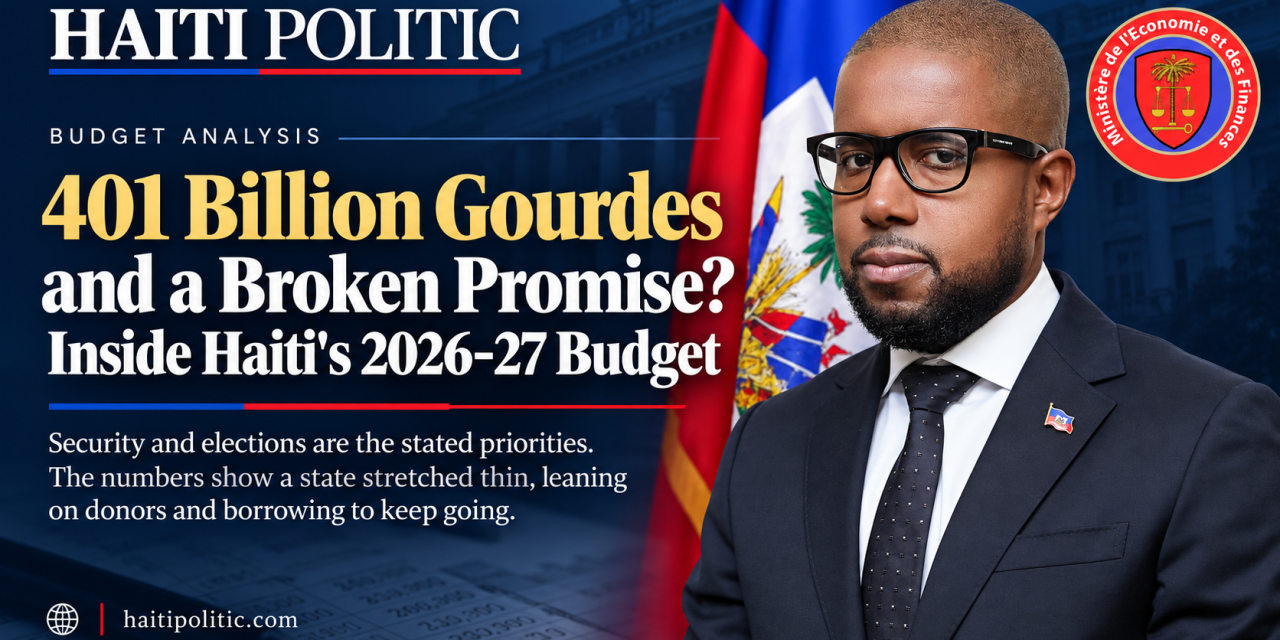
On Wednesday, September 30, 2026, the last day of the fiscal year, the government adopted the 2026-27 budget. The headline message was that security and elections come first. But the balance table and the Prime Minister’s own framework letter, sent August 10, tell a more complicated story. This article reads the two documents side by side.
1. The budget at a glance
The budget balances at 401.2 billion gourdes. I checked the table’s arithmetic and it adds up.
| Where the money comes from | Billion HTG | Where it goes | Billion HTG |
|---|---|---|---|
| Domestic resources | 262.9 | Current spending | 232.6 |
| Internal revenue | 187.5 | Salaries | 121.6 |
| Customs | 72.5 | Goods and services | 77.8 |
| Other | 2.9 | Transfers and subsidies | 26.6 |
| Grants (dons) | 89.8 | Interest | 6.6 |
| Financing (borrowing) | 48.5 | Capital spending | 168.6 |
| Treasury bills | 35.2 | Programs and projects | 147.0 |
| Project loans | 4.7 | Fixed assets | 5.1 |
| Other internal project financing | 4.45 | Debt principal repayment | 16.5 |
| BRH (central bank) loan | 4.2 |
The basic balance, domestic resources minus current spending, is a surplus of 30.3 billion.
2. A budget shaped by shrinkage
The framework letter is blunt about the economy. Real GDP growth was -4.2% in 2023-24 and -2.7% in 2024-25, and is estimated at -1.5% for 2025-26. The projection for 2026-27 is +0.2%, then 0.5% in each of the next two years.
Real GDP fell from about 658 billion gourdes in 2018 to about 544 billion in 2026, roughly 17% lower. Even at 2.6% annual growth, which the letter compares with the post-2010 earthquake recovery, getting back to the 2018 level would take about eight years, to around 2034. The letter itself says the trajectory is a gradual stabilization rather than a robust recovery.
Inflation is projected to ease from 17.3% to 15.8%, still high enough to keep eroding household purchasing power. The tax burden is only 4.4% of GDP, a very low level for any state.
3. What changed from last year
The 2025-26 budget was 345.5 billion gourdes, with 213.5 billion for current spending, 131.9 billion for investment and a payroll of 112 billion. By my comparison with this year’s table:
- Total budget: up about 16%
- Current spending: up about 9%
- Salaries: up about 8.6%
Last year’s forecasts also missed. The 2025-26 budget assumed 0.3% growth and 23.4% inflation, while the letter now estimates growth at -1.5%.
4. The promises: what the government says it will do
The framework letter lists seven priorities:
- Security and defense as “the central priority”: police and army capacity, securing major roads, fighting gangs, equipment, and rehabilitating security infrastructure.
- Elections and institutional restoration, with a cost estimated at $120 million, plus funds for a new Parliament and Presidency after the vote.
- Economic recovery, including a relaunch plan for the Grand Nord and at least three “flagship” projects with public progress reporting.
- Food security, health, education and social protection, including support for displaced people.
- Rule of law and anti-corruption, including courts, prisons and pretrial detention.
- Tax and customs modernization, including a revision of the income tax scale unchanged since 2005.
- Better planning and spending efficiency.
5. The problems
⚠️ Problem 1: A “zero monetary financing” pledge, and a central bank loan in the table
The letter calls a return to zero monetary financing “an essential condition of macroeconomic stability.” It explains that money-financed deficits feed inflation expectations, raise demand for foreign currency and pressure the exchange rate. Its own projection table puts monetary financing at 16.5 billion HTG in 2025-26 and 0.0 from 2026-27 on.
Yet the balance table lists “Emprunt BRH”: 4.2 billion gourdes. If that is an advance from the Banque de la République d’Haïti to the Treasury, it contradicts the pledge. If it is something else, the decree should say what. This is the most important question the budget leaves open.
⚠️ Problem 2: Heavy reliance on Treasury bills
With monetary financing off the table, the state must borrow domestically. The letter projects 33.1 billion in net Treasury bills every year through 2028-29, and the table shows 35.2 billion for 2026-27. The difference may be gross versus net, but the direction is the same: a permanent, large draw on the local credit market.
By my reconstruction, the Treasury’s own contribution to projects (50.8 billion) is funded about 77% by Treasury bills and the BRH loan (39.4 billion). In other words, domestic borrowing pays for the state’s own investment.
⚠️ Problem 3: A big nominal increase that is roughly flat in real terms
A 16% increase sounds large. With inflation forecast at 15.8%, it means almost no real expansion. Salaries up 8.6% against that inflation would be a real pay cut for public workers if the comparison is like-for-like.
⚠️ Problem 4: Payroll and operating costs consume most of the revenue
By my calculation:
- Salaries take 46% of domestic resources.
- Salaries plus goods and services take 76%.
- Debt service (interest 6.6 billion plus principal 16.5 billion) takes about 9%.
Little is left for domestic investment. The letter acknowledges that recruitment and integration of new police and army promotions drive up current spending.
⚠️ Problem 5: Investment depends on donors
Grants are 22% of the budget, and about 62% of program and project spending (91.75 of 147 billion) comes from donor grants and project loans. The letter itself calls for “reinforced follow-up” to speed up actual disbursements, and lists difficulty executing the Public Investment Program among its main risks. Haiti has a long record of announced projects that are not delivered.
⚠️ Problem 6: Elections are only partly funded
The government and the electoral council settled on a $120 million budget for the elections, $130 million below the council’s original $250 million proposal. The letter says the Basket Fund, which pays for election activities, held about $48 million, with arrangements in the amended 2025-26 budget to reach about $90 million by September 30. That still leaves roughly $30 million to find.
The electoral decree of July 2, 2026 and the electoral calendar remain in force through 2026-27, and ministries are told to hand over documents promptly, stay neutral, and keep state resources out of campaigns. But the balance table has no visible election line, nor lines for the new Parliament and Presidency the letter says must be budgeted.
⚠️ Problem 7: The revenue forecast is optimistic
The budget needs 262.9 billion in domestic resources, including 72.5 billion from customs (27.6% of the total). Gangs have disrupted ports and major roads in the past, which are exactly the channels customs depends on. The letter’s own risk list includes revenue falling below forecast. It also orders a revision of the personal income tax scale, which will likely cost the Treasury money unless offset by wider tax collection, better withholding and digitization. The anti-smuggling equipment at borders is meant to raise revenue, but the letter asks customs to measure whether it actually does.
⚠️ Problem 8: Presentation choices that flatter the numbers
- “Capital spending” includes debt repayment. Of the 168.6 billion, 16.5 billion (about 10%) is principal repayment, not investment. Real investment is about 152 billion.
- The 30.3 billion “basic surplus” is not a true surplus. It excludes debt repayment and capital spending, and it is fully absorbed by them.
- A non-cash item among funding sources. “Annulation dette FMI” (1.026 billion) appears among project funding. Cancelled debt does not bring in cash, so its place there needs an explanation.
- A one-gourde balance. The total is exactly 401,200,000,001, which suggests the figures were adjusted to hit a round number.
⚠️ Problem 9: Priorities not itemized
The letter demands that security investments show clear needs, costs, financing and execution schedules. The public table shows none of that. Health, education, social protection and justice are also missing as lines. The 2025-26 budget gave health 5.7% and agriculture 4% of spending, so readers can’t even compare the new priorities with last year’s.
⚠️ Problem 10: Very little democratic scrutiny
The budget was adopted on the final day of the fiscal year, with no sitting Parliament to debate it. The letter itself talks about funding Parliament and the Presidency after the next elections, which shows how far the country is from normal institutional oversight.
⚠️ Problem 11: External risks the budget can’t control
The letter names slowing global growth, energy and food prices, climate shocks, and uncertainty over Temporary Protected Status (TPS) for Haitians in the United States. Remittances from the diaspora are a major source of foreign currency for Haitian households and the economy, so a change in TPS would be felt well beyond the budget.
6. A short historical context
Four patterns have run through Haitian budgets for decades:
- Dependence on foreign aid for much of the investment budget.
- Late adoption, often at the last minute.
- Weak execution of capital projects compared with what is promised on paper.
- Central bank financing of deficits, which has been tied to past rounds of currency depreciation and high inflation.
The 2026-27 budget touches all four.
7. What to watch
- The full decree: the breakdown for security, elections, health, education and justice.
- The 4.2 billion BRH loan: is it monetary financing or not?
- Customs and tax collection in the first two quarters of the fiscal year.
- Donor disbursements: does the 91.75 billion actually arrive?
- Inflation against the 15.8% forecast. If it overshoots, every line shrinks in real value.
- The $30 million election gap and publication of a final electoral calendar.
- The three flagship projects the letter promises to report on publicly.
Bottom line
On paper, this is a balanced budget with clear priorities. In practice, it is a stretched one. It leans on grants, Treasury bills and a central bank loan to finance investment, while most domestic money goes to payroll and operating costs. It promises no money printing while listing a BRH loan. It names elections as a priority but leaves a funding gap and no visible line. Whether security and elections really come first will be settled by what gets spent, not by what was adopted.