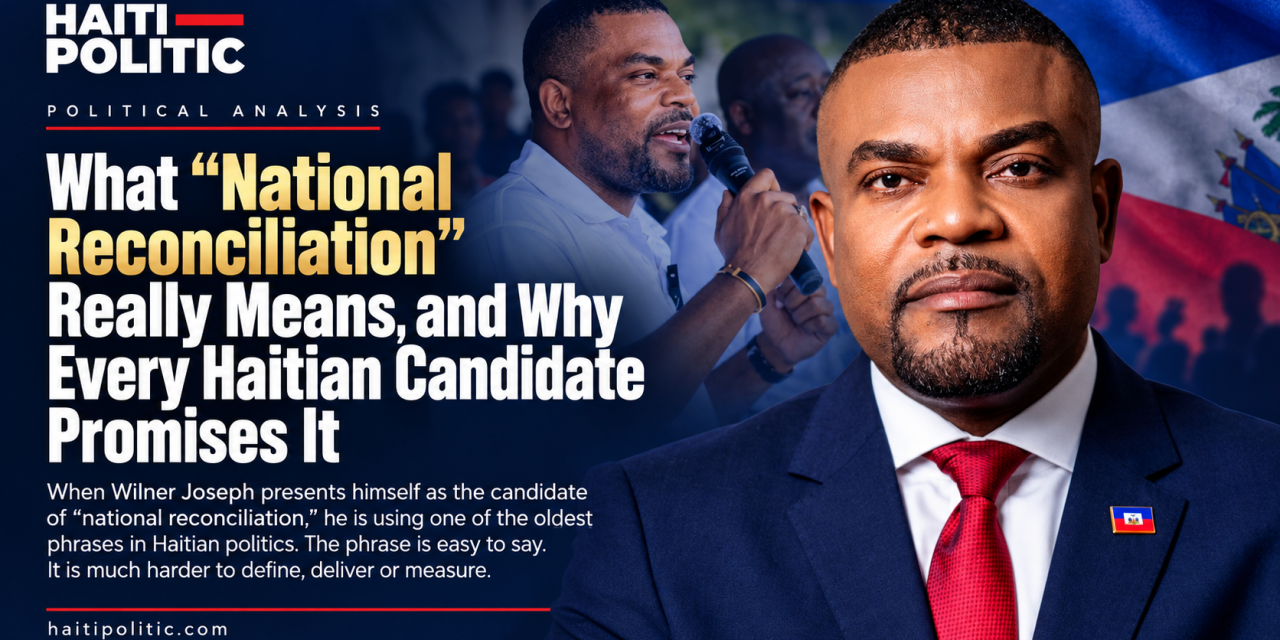
When Wilner Joseph presents himself as the candidate of “national reconciliation,” he is using one of the oldest phrases in Haitian politics. The phrase is easy to say. It is much harder to define, deliver or measure. This article explains what it means, why it keeps coming back, and what voters should ask anyone who invokes it.
What national reconciliation means
The term covers three different things, and candidates often blur them:
- Political reconciliation: agreeing on the rules of competition, sharing power fairly, and accepting results so that losing is not a threat to survival.
- Social reconciliation: repairing trust between groups divided by class, color, region, language, religion and the divide between those at home and the diaspora.
- Reconciliation through justice: establishing the truth about past crimes, holding perpetrators accountable and compensating victims.
The tension between the third and the first two is the central problem. Reconciliation without justice can look like impunity: forgive and move on, while victims get nothing. Justice without reconciliation can look like revenge: the new winners prosecute the old ones, and the cycle repeats.
Why Haitian politics returns to it again and again
1. The country was founded in division. After independence in 1804, Haiti’s leaders fought over who would hold power and on what terms. Dessalines was killed in 1806, the country split between a northern state under Christophe and a southern republic under Pétion, and tensions between the descendants of the free and the formerly enslaved, between color and class, and between urban elites and the rural majority became part of political identity. Each generation has inherited unfinished business.
2. Power has changed hands through rupture, not routine. Coups, forced departures, interim arrangements and disputed elections have been more common than orderly handovers. In a winner-take-all system, losing means exile, prosecution or worse, so each side fights harder to avoid losing. Appeals to reconciliation are a promise to break that logic.
3. The wounds were never settled. The Duvalier dictatorship, the 1991 coup and its aftermath, the 2004 departure of Aristide, and later massacres in neighborhoods like La Saline left victims who have not seen accountability. After the return of constitutional rule in 1994, a National Commission for Truth and Justice produced a report in 1996, but its recommendations were largely left unimplemented. That unfinished work keeps the theme alive.
4. Elections have been contested. The disputed results of 2000, 2010-11 and 2015-16 all showed how quickly a vote can turn into a crisis of legitimacy. Candidates who promise reconciliation are speaking to voters who fear that the next vote will end the same way.
5. It is politically cheap and broadly appealing. Reconciliation costs nothing to promise, offends no large group, and sounds statesmanlike. It also allows a candidate to avoid specifics. That is why parties have literally adopted it as a name, such as the Independent Movement for National Reconciliation (MIRN), which ran a presidential candidate in 2006, and why a 2026 platform called REKONSILYE has endorsed its own presidential candidate.
6. Gang violence has made it urgent and controversial. Over a million Haitians are displaced, and armed groups control large areas. Whether to negotiate, offer amnesty, or demobilize and reintegrate fighters is now part of the reconciliation debate. Many Haitians see any deal with gang leaders as a betrayal of victims, which makes the word more loaded than ever.
7. International partners ask for it. Foreign governments and regional bodies have repeatedly pressed Haitian actors for inclusive dialogue and consensus transitions, from the 2021 Montana Accord to the 2022 consensus arrangement and the 2026 national pact. Candidates know that “reconciliation” is the language that diplomats and donors expect.
Who is Wilner Joseph?
Wilner Joseph is a former Secretary of State for Population who ran for deputy in 2016 and is now seeking the presidency under the Viktwa grouping. Viktwa chose him in an internal primary on September 10, in which he won 39 of 43 votes cast by member parties, and he registered with the electoral council on September 15. At a rally in Pétion-Ville, he named security, national reconciliation, jobs, agriculture and the return of displaced people among his main themes, saying power must return to the people.
A candidate has every right to call for reconciliation. The test is whether he can explain who it includes, what it costs and how it would be done.
Five questions for Wilner Joseph
- Who is included? When you say national reconciliation, who exactly are you reconciling, and does it include armed gangs? Are you open to negotiations, amnesty or demobilization for gang members, and where is your red line?
- What about justice? How would you handle victims of massacres, kidnappings and political killings, including the assassination of President Moïse? Would you support a truth commission, a special tribunal or reparations, and would any amnesty be off the table?
- Why you? You served in a previous government and are described as an adviser to the current prime minister. How can a candidate tied to the political establishment credibly represent reconciliation, and which opponents would you invite into your government?
- What happens to the displaced? Over a million people have lost their homes. What concrete steps and timeline would you set for their safe return, and how would you ensure they can register and vote on December 13 and beyond?
- How will we measure it? In your first 100 days, what institution would lead reconciliation, how would it be funded, and what public indicators would you publish so that voters can judge whether it is working?
The bottom line
Reconciliation is not a slogan. It is a set of choices about who sits at the table, how past crimes are addressed and what rules everyone agrees to follow. Voters should welcome candidates who raise it, then press them for answers on all five questions above, not only on the first.