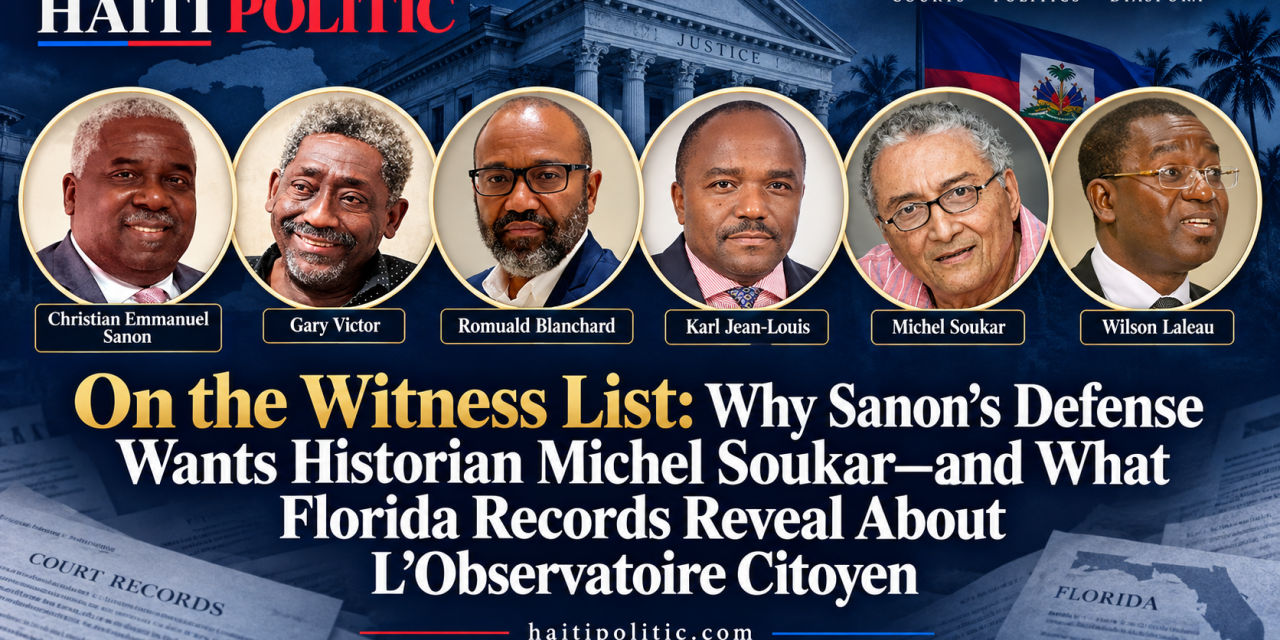
Soukar’s political past, Jean-Louis’s development work and Sanon’s humanitarian background add context to the story. The records distinguish documented encounters and civic associations from unproven claims about the assassination conspiracy.
A familiar Haitian historian has become a potential witness in one of the country’s most consequential criminal cases. According to Miami Herald reporting, lawyers defending Christian Emmanuel Sanon in Miami’s federal trial said they intended to call Michel Soukar. Sanon is accused in the conspiracy that culminated in President Jovenel Moïse’s assassination on July 7, 2021. The defense disputes his responsibility.[1]
In an interview with Wendell Théodore on Radio Télé Métropole’s Le Point, Soukar explained his limited contact with Sanon. Separately, a Florida corporate record lists Soukar among the officers of L’OBSERVATOIRE CITOYEN, INC. The important detail is its status: the supplied Sunbiz record identifies an inactive corporation, administratively dissolved on September 23, 2011.[2] [3]
The story therefore involves three different questions: what Soukar personally knows about Sanon; how the defense might use that knowledge; and what the historical nonprofit actually did. A witness listing or an old corporate title does not answer all three.
Soukar’s account: books, discussions and limited contact
According to the supplied interview transcript, Soukar described meeting a diaspora reader who wanted to acquire his books and discuss Haiti. He placed the encounters around April–May 2021 and described roughly two or three meetings. Their exchanges, in his account, concerned Haitian history, reform of the state and the country’s future.
Soukar recalled questions about political leadership and institutional reform. He said he recommended reading that could help Sanon better understand Haiti, including Placide David’s L’Héritage colonial. He characterized these exchanges as the sort of discussions he regularly has with readers and diaspora professionals.
Asked whether Sanon mentioned Jovenel Moïse or an assassination plan, Soukar denied that such a plan was discussed with him. That is Soukar’s account of his own conversations. It does not establish what Sanon said to other people, or what happened at meetings Soukar did not attend.
Soukar also said he had learned through a Florida contact and reporting that his name was being mentioned as a potential defense witness. At the time of the interview, he said he had received no formal communication. He expressed a desire for justice for Moïse and concern that the proceedings could be used for political score-settling.[2]
Why the defense might want him
Sanon’s lawyers are seeking to separate their client’s political ambitions from criminal responsibility for the assassination. Miami Herald coverage of opening statements describes the defense placing those ambitions within Haiti’s political turmoil, while prosecutors presented Sanon as an active participant in the violent plot. These are competing arguments; a jury must assess the evidence.[4]
Soukar could potentially contribute in two ways. First, he could recount what he personally heard and observed during their meetings. Second, the defense might seek his perspective on the political environment in which Sanon was discussing leadership and reform. His public reputation as a historian may help explain why his name attracted attention.
That explanation is an inference, not a confirmed account of the defense’s examination plan. The materials reviewed do not include an authenticated defense witness filing describing his proposed testimony, an expert disclosure or a ruling allowing him to testify as an expert.
The distinction matters. A factual witness speaks about matters within personal knowledge. Expert testimony has separate requirements concerning qualifications, reliable methods and usefulness to the jury. Being a respected historian does not automatically establish an expert role in a particular case.[5]
Soukar’s account could support an argument that Sanon presented himself to him as a reader interested in reform. Its limit is equally clear: not hearing about a crime during a few conversations cannot establish that no criminal agreement existed elsewhere. Nor does appearing on a potential witness list mean that Soukar has endorsed Sanon’s innocence or has himself been charged.
What the Florida record actually shows
The Florida Sunbiz identifies the following historical corporate information:[3]
| Item | Recorded information |
|---|---|
| Legal name | L’OBSERVATOIRE CITOYEN, INC. |
| Entity type | Florida not-for-profit corporation |
| Document number | N10000003937 |
| Filed / effective | April 20, 2010 / April 15, 2010 |
| Principal and mailing location | Miami, Florida |
| Status / last event | INACTIVE / administrative dissolution for annual report |
| Dissolution event date | September 23, 2011 |
| Annual reports | No annual reports filed |
| FEI/EIN field | NONE |
The record lists Gary Victor as president (“P”), Michel Soukar as vice president (“VP”), Karl Jean Louis under “EX D,” consistent with executive director, and Romuald Blanchard as an officer (“OFF”) and registered agent.
These are titles in the historical filing. Without later reports or other evidence, they should not be presented as a verified current leadership team. The registered agent is the person designated to receive legal notices; that designation alone does not establish ownership, control of donations or responsibility for every activity.
Florida’s Division of Corporations explains that annual reports update or confirm corporate information; they are not financial statements. Failure to file can trigger administrative dissolution. Florida law generally limits an administratively dissolved nonprofit to winding up and liquidating its affairs unless it is reinstated. The supplied record shows no reinstatement.[6]
Administrative dissolution is not, by itself, a finding of fraud. Similarly, “NONE” in Sunbiz’s EIN field establishes what that state record displays, not that an EIN was never obtained. State nonprofit incorporation also does not establish IRS recognition as a 501(c)(3) charity. No IRS determination letter or federal return was reviewed for this corporation.[7]
What did the organization do?
The records reviewed do not establish a current Florida business operation for this corporation. They identify a historical nonprofit registration, but provide no verified present-day staff, budget, grants, contracts, paid services or operating program.
There is, however, a documented civic background. A statement reproduced in April 2010 by journalist Cyrus Sibert’s Réseau Citadelle identified an observatory known as OCAPH, created after the January earthquake to monitor aid and the actions of public authorities, international agencies and NGOs. It called for greater transparency, reconstruction planning and support for Haiti’s accountability institutions. Gary Victor, Michel Soukar, Anthony Pascal/Konpè Filo and Karl Jean Louis were listed beneath the statement.[8]
Le Nouvelliste also reported in July 2010 on the observatory’s criticism of insufficient transparency in humanitarian aid. In 2017, the University of Miami documented OCAPH’s involvement in disseminating research on recovery after Hurricane Matthew, identifying Karl Jean Louis as a participant.[9]
Those sources describe civic oversight, advocacy and public-policy engagement. The overlap of three names with the Florida filing suggests a connection to that network. It does not establish that every OCAPH activity was legally or financially conducted through L’OBSERVATOIRE CITOYEN, INC. The original articles, organizational records and financial documentation would be needed to establish that relationship.
OCAPH should also not be confused with OCID, the Observatoire Citoyen pour l’Institutionnalisation de la Démocratie. OCID describes itself as a consortium established in 2015. Similar names do not make organizations the same legal entity.[10]
The four people listed in the Florida filing
Gary Victor — president
Victor is a prominent Haitian novelist. His publisher, Mémoire d’encrier, places his birth in Port-au-Prince in 1958 and lists works including Saison de porcs, Maudite éducation, Nuit albinos and Le violon d’Adrien. His literary recognition includes the 2008 Prix littéraire des Caraïbes for Les Cloches de la Brésilienne.[11]
His appearance on the 2010 observatory statement documents civic engagement alongside Soukar and Jean Louis. The Florida filing establishes his listed presidency; it does not establish how frequently he supervised the corporation, whether he was paid or whether he retained a role after dissolution.
Michel Soukar — vice president
Soukar’s author website describes him as a historian, political analyst, writer and journalist born in Haiti in 1955. His published work spans history, poetry, theatre and fiction. His publisher lists Cora Geffrard, La Prison des jours and La Dernière Nuit de Cincinnatus Leconte among his books.[12]
His public work helps explain why readers seek his interpretation of Haiti and why a defense team might consider him useful. His listed nonprofit title establishes a separate historical civic association. Neither fact establishes involvement in an assassination plot.
Soukar’s political past: what the new interview adds
The second supplied Le Point interview, about his book and political journey, adds a different dimension to this biography. In the accompanying transcript, Soukar describes joining opposition to the Duvalier dictatorship as a young man, around nineteen or twenty. A later passage specifically identifies Jean-Claude Duvalier and 1975. He recounts clandestine struggle, danger, and the assistance of Catholic priests and Christian solidarity networks. These are his recollections, not independently established findings about particular underground operations.[15]
That account presents Soukar as someone whose interest in Haitian politics comes partly from personal experience. His discussion of priests, liberation theology and resistance also broadens the picture of religious engagement in Haitian public life. It should not be confused with Jean-Louis’s later work for World Vision: the interview does not establish a connection between those networks.
At approximately 8:20 in the book interview, Soukar distinguishes fighting the Duvalier system from targeting Duvalier as an individual. His reference to “killing” concerns ending the political system, not killing Duvalier as a person. The passage should therefore be understood as an account of opposition to a dictatorship, rather than presented as an admission of intent to assassinate Duvalier.[15]
Could Soukar’s political history have interested Sanon? That is a question worth putting to them, but the materials reviewed do not establish Sanon’s motive for approaching him. They do not show that Sanon knew this particular account, discussed it with Soukar or asked for help with violence. Soukar’s separate account of their 2021 encounters concerns books and Haiti’s future and denies discussion of an assassination plan.
This distinction also changes the proposed connection to Sanon. A statement about dismantling Duvalierism supplies no evidence that Sanon sought Soukar out for assistance with an assassination. Establishing Sanon’s reasons for their meetings would require evidence about their actual exchanges, such as messages, meeting records or testimony.
Karl Jean Louis — listed under “EX D”
Jean Louis has a documented record in civic advocacy and investment policy. Métropole reported his installation as director of Haiti’s Centre de Facilitation des Investissements in 2012, following his work as executive director of the presidential advisory council on economic development and investment.[13]
The University of Miami’s 2017 account places him in OCAPH’s work sharing hurricane-recovery research with people able to influence policy. This is evidence of activity in the broader civic network after the Florida corporation’s dissolution. It is not evidence that the Florida corporation remained active or that it financed those initiatives.
His publicly indexed LinkedIn profile identifies DEG entreprisesLTD and lists University of Florida studies from 1988 to 1994. It also contains his announcement that he was joining World Vision as Chief of Party for its GOLD program in Senegal. These are self-reported professional details; the visible education entry does not establish a particular degree.[16]
The profile describes volunteer work as Haiti program coordinator for MedShare–COADHA beginning in January 2002, including coordinating supplies and medical assistance with organizations such as World Vision and CARE. It separately lists mission outreach coordination for a church spelled “Calvery Chapel,” beginning in April 2000, involving humanitarian missions to Haiti. Those entries document his own account; their ongoing dates and claimed donation values were not independently audited.
World Vision provides independent confirmation of his later program leadership. Its December 3, 2024 account identifies Karl Jean-Louis as Chief of Party of Governance for Local Development Plus, or GoLD+, in Senegal. The USAID-funded program was designed to help local governments raise resources and provide accessible, equitable public services. “Chief of Party” means the leader of a development project, rather than the head of a political party.[17]
World Vision describes itself as a Christian humanitarian organization working against poverty and injustice and serving people regardless of religion. Jean-Louis’s documented role is in development-program management. Employment by that organization does not establish personal religious beliefs or a relationship with every pastor engaged in Haitian relief.[18]
Who put Jean-Louis in charge of the CFI in 2012?
The confirmed answer concerns his installation: Commerce and Industry Minister Wilson Laleau installed Karl Jean-Louis at the CFI in February 2012, during President Michel Martelly’s administration and Prime Minister Garry Conille’s government. HaitiLibre’s February 15 report places the ceremony the previous day, February 14. Jean-Louis replaced Guy Lamothe and had previously led the presidential advisory council on economic development and investment.[19]
Installation and formal appointment are different steps. The reports reviewed name the minister who installed him, but do not reproduce Jean-Louis’s signed appointment decree. Consequently, they do not establish the decree’s date, signatories or who formally appointed him. The publishable formulation is that he took office under the Martelly–Conille administration and was installed by Laleau.
A separate August 2012 report, citing the prime minister’s communication office, explicitly says Martelly appointed Georges Andy René by an August 9 decree to replace Jean-Louis. That establishes the reported appointment of his successor; it cannot substitute for Jean-Louis’s own appointment document.[20]
Romuald Blanchard — officer and registered agent
Blanchard is documented in Miami’s Haitian community and cultural programming. A 2012 Center for Haitian Studies profile identified him as its administrator. Lobey Art & Travel’s website credits him with organizing the exhibition Symbols of Freedom: The Power of Revolution at the Little Haiti Cultural Complex.[14]
Lobey’s published contact address matches the Miami address on the supplied nonprofit record, providing an additional point of identification. His cultural and community work helps explain the Florida connection. These separate activities should not be presented as the programs or revenue of L’OBSERVATOIRE CITOYEN, INC. without records establishing that relationship.
Sanon’s relief work: a parallel background, not a proven partnership
TIME reported in July 2021 that Sanon worked on church-related humanitarian projects and served as president of Organisation Rome Haiti. Its account cited Tampa local news describing the nonprofit’s work sending supplies after Haiti’s 2010 earthquake. This supplies relevant background about his public service identity; it does not establish a partnership with Jean-Louis, World Vision or L’Observatoire Citoyen.[21]
Accordingly, the relief-work account above is attributed to TIME rather than presented as something verified directly from that footage. Organisation Rome Haiti and L’OBSERVATOIRE CITOYEN, INC. must remain separate organizations in the reporting unless records establish a relationship.
The distinction is straightforward: two people can have worked in humanitarian aid without working together. Shared references to churches, Haiti or disaster relief do not establish a common project, a funding relationship or involvement in a criminal plan. The reviewed sources provide no such documented link.
The questions that remain
The useful next questions are specific: Will Soukar actually testify, and in what capacity? Can his meetings with Sanon be dated through messages, book inscriptions or other records? What did the nonprofit’s original articles say its purpose was? Did the corporation receive funds, and where are the records of their use?
For now, the evidence supports a measured account. Sanon’s defense has identified Soukar as a potential witness. Soukar describes limited, book-centered encounters and denies hearing an assassination plan. Florida records show a nonprofit registered in 2010 and dissolved in 2011, with four named officers and connections to an older civic network.
The materials reviewed do not establish that the nonprofit funded Sanon, organized his political project or participated in the conspiracy. The task for the court is to assess testimony and evidence about Sanon’s alleged conduct. The task for readers is to keep personal encounters, historical corporate associations and criminal responsibility distinct.
Sources and reporting limits
The interview account is based on the supplied machine-generated transcript, which contains substantial recognition errors and repeated text. It is paraphrased here; no uncertain passage is presented as a verbatim quotation. The meeting date and number are Soukar’s approximate recollection as represented in that transcript. The uploaded video was not independently transcribed for this article. The precise broadcast date was not established from the supplied transcript.
This revision also reviews the supplied transcript accompanying the book interview. The interpretation of the passage at approximately 8:20 incorporates the supplying reader’s clarification that Soukar referred to ending the Duvalier system, not killing Duvalier as a person. This is a paraphrase, not an independently authenticated verbatim quotation. LinkedIn details were obtained from publicly indexed profile content; direct profile retrieval failed. World Vision independently corroborates the December 2024 program role, but that dated account does not verify Jean-Louis’s current employment in October 2026. Jean-Louis’s original CFI appointment decree and the supplied Tampa YouTube report were not retrieved.
The supplied Sunbiz printout was captured October 1, 2026. Live access encountered a security-verification block; the original incorporation image was not retrieved. The corporate-purpose clause, IRS exemption, financial records, current operations and precise proposed court testimony remain unverified. No interviews with the officers or defense counsel were conducted for this article.
- Jacqueline Charles, Miami Herald, September 28, 2026, syndicated by ArcaMax: trial and intended defense witnesses.
- Supplied transcript of Michel Soukar’s interview with Wendell Théodore on Le Point, Radio Télé Métropole.
- Supplied Florida Division of Corporations/Sunbiz printout: L’OBSERVATOIRE CITOYEN, INC., document N10000003937, captured October 1, 2026.
- Jacqueline Charles, Miami Herald, September 30, 2026, syndicated by AOL: competing opening statements.
- Federal Rule of Evidence 602; Federal Rule of Evidence 702.
- Florida Division of Corporations: annual reports; Florida Statutes §617.1421.
- IRS: applying for tax-exempt status.
- Réseau Citadelle, April 26, 2010: reproduced observatory statement.
- Le Nouvelliste, July 14, 2010: humanitarian-aid transparency; University of Miami, June 29, 2017: Hurricane Matthew research and OCAPH.
- OCID organizational description.
- Mémoire d’encrier: Gary Victor.
- Michel Soukar’s author biography; Mémoire d’encrier: Michel Soukar.
- Métropole: Karl Jean Louis takes charge of the CFI, 2012.
- Center for Haitian Studies profile, May 2012; Lobey Art & Travel: exhibition organizer and contact information.
- Supplied book-interview video and accompanying TurboScribe transcript: Une plongée dans le nouvel ouvrage de Michel Soukar et le récit d’un parcours politique singulier, Métropole, Le Point. Passage at approximately 8:20: distinction between ending the Duvalier system and killing an individual, clarified by the reader who supplied the video.
- Karl Jean-Louis’s publicly indexed LinkedIn profile: self-reported education, professional announcement and volunteer work.
- World Vision, December 3, 2024: GoLD+ launch in Senegal and Karl Jean-Louis’s program role.
- World Vision: Christian humanitarian identity and service regardless of religion.
- HaitiLibre, February 15, 2012: Laleau’s installation of Jean-Louis and the Martelly–Conille administration.
- Parlons Affaires, August 12, 2012: reported August 9 appointment of successor Georges Andy René.
- TIME, July 2021: Sanon’s church-related relief projects and Organisation Rome Haiti; user-supplied Tampa news video, not independently retrieved.