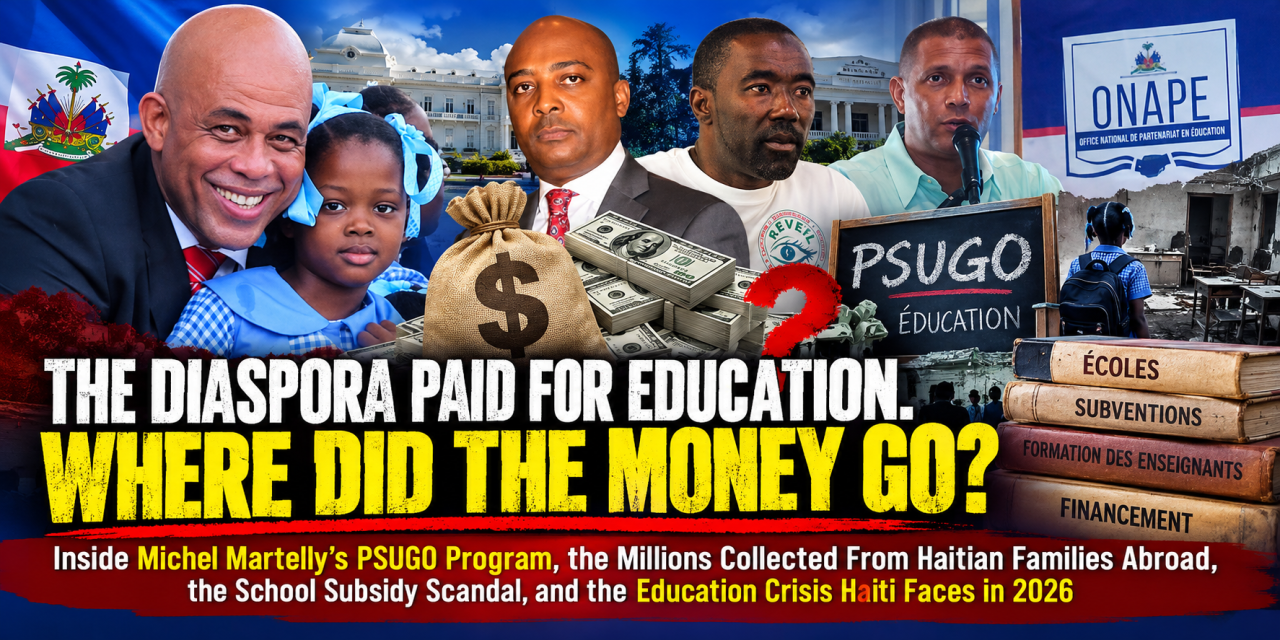
Inside Michel Martelly’s PSUGO Program, the Millions Collected From Haitian Families Abroad, the School Subsidy Scandal, and the Education Crisis Haiti Faces in 2026
HAITI POLITIC | SPECIAL INVESTIGATION
Published: October 30, 2026
By Haiti Politic Investigative Desk
A Promise of Free Education, Financed by Haitians Abroad
In 2011, President Michel Joseph Martelly made education one of the central promises of his administration. His government introduced the Programme de Scolarisation Universelle, Gratuite et Obligatoire (PSUGO), an ambitious initiative intended to expand access to free and compulsory schooling for Haitian children.
For a country where poverty had long prevented families from sending their children to school, the announcement carried considerable significance.
But behind the promise was a financing arrangement that would reach far beyond Haiti’s borders.
Haitians living in the United States, Canada, France, the Dominican Republic, and elsewhere were already sending money home to support their families. These remittances helped pay for food, housing, medical expenses, and school tuition.
The Martelly administration introduced additional charges associated with international money transfers and telephone calls, presenting them as a way to finance education.
The charges included US$1.50 per international money transfer and US$0.05 per minute on incoming international telephone calls.
The money was intended to support a national education initiative that promised to help disadvantaged children attend school.
Fifteen years later, the fundamental questions remain:
How much money was collected? Who controlled it? How much reached Haiti’s schools? And what lasting educational results can be demonstrated?
These questions are particularly urgent in 2026, when armed violence, displacement, and economic hardship have left hundreds of thousands of Haitian children without reliable access to education.
An examination of International Monetary Fund reports, Haitian government audit findings, published central-bank figures, and federal court proceedings in New York reveals a complicated financial history.
The available evidence documents substantial revenue collections and reported education expenditures. It also identifies weaknesses in financial oversight, school-subsidy verification, and public accountability.
What it does not provide is a complete, independently audited reconciliation of every dollar collected and spent throughout the program’s history.
That distinction is central to this investigation.
1. How Michel Martelly Turned Diaspora Transactions Into Education Revenue
The PSUGO initiative was announced shortly after Martelly assumed office in May 2011.
Its objective was to expand free access to basic education, particularly for children from disadvantaged households.
Rather than finance the program exclusively through Haiti’s national budget, the government established additional revenue mechanisms.
According to the IMF’s 2015 report on Haiti’s public finances, the education fund was designed around two principal charges:
The remittance charge: A US$1.50 fee associated with international money transfers entering or leaving Haiti, collected through financial institutions and transferred to the Banque de la République d’Haïti (BRH).
The telecommunications charge: A US$0.05 surcharge on each minute of incoming international telephone calls, collected through Haiti’s telecommunications regulatory system, CONATEL.
The IMF reported that the government’s initial projection anticipated approximately US$360 million in collections over five years, with roughly equal contributions expected from the two sources.
That figure was a revenue projection, not a verified accounting of money collected.
The distinction matters because the $360 million estimate has sometimes been discussed as though it represented money already received.
The actual amount must be established through financial records.
The Diaspora’s Role
Consider a Haitian worker in Miami sending money to a relative in Port-au-Prince.
The transfer might help a family purchase food, pay rent, or cover school expenses.
Under the education-financing arrangement, the transaction could also generate an additional charge intended to support public education.
The same principle applied to international telephone calls.
This created an unusual arrangement in which diaspora families contributed to education in two ways: directly through private family support and indirectly through fees collected under government policy.
For many Haitian families, education was already one of the reasons they sent money home.
The public-policy question was whether the additional collections were managed transparently and used effectively.
2. The First Financial Question: How Much Money Was Actually Collected?
The strongest starting point is the IMF’s examination of the PSUGO education fund.
In its 2015 Selected Issues report, the IMF documented revenues and estimated expenditures for the program.
The report included a financial table covering 2012 through 2015.
PSUGO Fund: Reported Revenue and Estimated Expenditure
| Fiscal year | Telephone fees | Transfer fees | Other contributions | Total annual revenue | Estimated expenditure |
|---|---|---|---|---|---|
| 2012 | 1.113 billion | 295 million | 467 million | 1.875 billion | 1.795 billion |
| 2013 | 1.015 billion | 861 million | — | 1.876 billion | 1.704 billion |
| 2014 | 818 million | 495 million | — | 1.313 billion | 1.460 billion |
| 2015 | 725 million | 1.087 billion | — | 1.812 billion | 1.812 billion |
Amounts are in Haitian gourdes. The 2015 figures reflect budget projections and partial-year execution information, not final audited results. Estimated expenditures are based partly on changes in fund balances.
Source: International Monetary Fund, Haiti: Selected Issues, Country Report No. 15/158, Table 5.
The figures require careful interpretation.
The IMF’s table tracks fund resources, including opening balances and revenue from different sources.
The figures above separate annual revenue from opening balances to avoid counting the same money twice.
The 2015 estimates also cannot be treated as final spending records.
Nevertheless, the data establish that the fund was receiving significant resources during Martelly’s presidency.
What Happened to the Money?
The IMF reported that the fund’s operations were largely outside Haiti’s ordinary budget-execution system.
The resources were deposited into a special account at the BRH.
Changes in those deposits affected government financing, but the fund’s revenues and expenditures were not fully recorded as corresponding entries in the standard budget-execution tables.
That arrangement created a transparency problem.
A government may collect and spend money through a special account while still using the funds for legitimate public purposes.
But without complete financial statements, supporting payment records, and independent audits, the public cannot readily verify every transaction.
The IMF’s findings therefore raise questions about the quality of financial reporting.
They do not establish that all or any particular portion of the money was stolen.
3. The Remittance Money: A Separate Accounting of Diaspora Contributions
The remittance charge deserves particular attention because it directly affected international money transfers involving Haitian families.
Published figures attributed to the BRH provide the following breakdown.
Revenue Reportedly Collected Through the US$1.50 Transfer Charge
| Reporting period | Amount collected |
|---|---|
| July 2011–June 2012 | US$11.146 million |
| July 2012–June 2013 | US$12.469 million |
| July 2013–June 2014 | US$13.117 million |
| July 2014–June 2015 | US$16.392 million |
| July 2015–June 2016 | US$18.297 million |
| Five-period total | US$71.421 million |
These figures were reproduced in a published analysis citing the BRH’s financial-control service.
They indicate that approximately US$71.4 million was reportedly collected from remittance-related charges over five reporting periods substantially overlapping Martelly’s presidency.
However, the final reporting period extended beyond February 7, 2016, when Martelly left office.
Consequently, the entire five-period total should not be attributed exclusively to his presidency without monthly collection records.
The amounts also exclude revenue from the international telephone surcharge.
What the Records Still Need to Establish
A complete investigation should identify the total number of transfers subject to the charge, the amounts collected by each participating institution, the sums transferred to BRH accounts, and the amounts subsequently disbursed.
It should also establish whether the reported collections reconcile with the records of Western Union, CAM, Unitransfer, MoneyGram, and other participating financial institutions.
The central question is not merely whether money entered a government-controlled account.
It is whether the complete financial trail can be followed from the original transaction to the final educational expenditure.
4. The $300 Million Allegation: What the Federal Lawsuit Actually Said
On December 24, 2018, a group of plaintiffs filed a lawsuit in the U.S. District Court for the Eastern District of New York.
The case was titled Celestin et al. v. Martelly et al., Case No. 1:18-cv-07340-LDH-PK.
The defendants included former Haitian presidents Michel Martelly, Jocelerme Privert, and Jovenel Moïse, the Government of Haiti, and several telecommunications and money-transfer companies.
The plaintiffs challenged the legality of the remittance and telephone charges.
They alleged that the charges had been presented as financing for education but were part of an unlawful arrangement involving government officials and private companies.
The complaint also alleged that at least US$300 million had been collected.
That amount requires qualification.
The plaintiffs’ estimate was based on reported annual collections of approximately US$40 million to US$50 million, extrapolated over several years.
It was not the result of a completed forensic audit establishing that $300 million had been collected or misappropriated.
What the Courts Decided
The district court initially dismissed the lawsuit.
In March 2022, the U.S. Court of Appeals for the Second Circuit reversed or vacated significant portions of that dismissal and returned the case for further proceedings.
The appellate court concluded that the legal doctrines relied upon by the district court had not been properly applied.
That ruling allowed further litigation; it did not establish that the plaintiffs’ allegations were true.
Subsequent proceedings narrowed the claims.
The district court later dismissed the remaining claims, including the Communications Act claim against Digicel Haiti in March 2025.
In September 2025, a magistrate judge imposed a US$5,000 Rule 11 monetary sanction on plaintiffs’ counsel in connection with the litigation.
The federal proceedings did not establish that Michel Martelly or the other defendants stole the diaspora’s education contributions.
The case nevertheless remains relevant to the historical record because it documents a legal challenge to the charges and identifies the institutions involved.
The broader public-finance question must be answered through accounting records and independent audits rather than allegations alone.
5. PSUGO’s Reported Results: Did Haitian Children Benefit?
The IMF’s 2015 education assessment provides evidence that PSUGO financed substantial reported educational activity.
Between 2011 and 2014, the program reported progress in school enrollment, teacher recruitment, and educational support.
PSUGO: Targets Compared With Reported Results
| Program component | Target | Reported result |
|---|---|---|
| Teachers and education professionals recruited | 11,000 | 8,725 |
| Disadvantaged children identified | 100,551 | 94,513 |
| Children covered by private-school subsidies | 860,250 | 785,674 |
| Children covered through elimination of public-school fees | 639,750 | 680,300 |
| Schools audited | 10,000 | 9,552 |
| Teaching professionals targeted for training | 10,000 | 7,495 |
| Monitoring and evaluation reports | 15 | 5 |
Source: IMF Country Report No. 15/158, using government information and IMF staff estimates.
These figures indicate that PSUGO supported a substantial expansion of reported school-access activities.
They also reveal uneven implementation.
The program exceeded its target for children covered through elimination of public-school fees.
But it fell short in teacher recruitment, teacher training, private-school subsidy coverage, and monitoring.
Most notably, only five of fifteen planned monitoring and evaluation reports were completed.
This matters because monitoring is how governments establish whether public money is producing the intended results.
The Difference Between Enrollment and Learning
Paying for a child’s enrollment is not the same as guaranteeing a quality education.
An effective education program must also establish whether children attend classes, receive instruction from qualified teachers, acquire literacy and mathematics skills, complete school years, and continue their education.
The IMF emphasized the need to improve educational quality, teacher qualifications, private-school regulation, and the availability of education statistics.
Without those measurements, reported enrollment totals provide only a partial assessment of the program’s success.
6. The School Subsidy Scandal: 263 Schools Excluded
In January 2016, Haiti’s Ministry of National Education announced that 263 schools in the West Department had been excluded from PSUGO following an internal audit.
The ministry reported that the schools had declared student enrollment figures exceeding justified levels by at least 50%.
The announcement followed an examination of approximately 3,000 participating schools.
The ministry indicated that cases would be referred for legal follow-up and that improperly received funds would have to be recovered.
This was a significant development.
PSUGO relied heavily on subsidizing children attending nonpublic schools.
Under such a system, the government must establish that the schools exist, that their students are eligible, and that the number of students receiving subsidies is accurate.
If a school exaggerates enrollment, the government may pay for students who are not actually receiving the subsidized service.
Who Approved the Payments?
The 2016 findings raise questions about the administrative chain.
Which officials approved the participating schools?
Who inspected the schools before subsidies were paid?
Were student lists checked against attendance records?
Did the government use independent verification?
How much money was paid to schools later excluded?
How much was recovered?
Were school administrators prosecuted?
And did any public officials face disciplinary proceedings?
The announcement of school exclusions is documented.
But the total amount improperly paid, the sums recovered, and the final legal outcomes require additional documentary verification.
It would be inaccurate to treat every excluded school as the subject of a completed criminal conviction.
The distinction between administrative findings and judicially established wrongdoing must be preserved.
7. Government Auditors Had Identified Problems Earlier
Concerns about PSUGO’s administration were not limited to the 2016 school exclusions.
An earlier review by Haiti’s Inspection Générale des Finances identified weaknesses in program procedures and financial management.
The audit raised concerns about administrative documentation, internal controls, school selection, contractual procedures, and financial oversight.
Those findings are important because they suggest that weaknesses existed during the program’s early implementation.
The question is what the government did in response.
Were corrective measures adopted?
Were the ministry’s procedures revised?
Were financial controls strengthened?
Did later audits demonstrate improvement?
A credible assessment must examine both the original findings and the government’s documented responses.
The existence of an audit finding does not automatically establish personal criminal responsibility.
But it does establish that the responsible institutions had been alerted to weaknesses requiring attention.
8. Three Education Ministers Under Michel Martelly: Who Was Responsible for What?
PSUGO was a presidential initiative, but its implementation involved successive education ministers.
The responsibilities of those ministers must be examined according to their actual periods in office and documented administrative decisions.
Reginald Paul: The Program’s Launch
Reginald Paul served as education minister during the early period of Martelly’s administration.
His tenure coincided with PSUGO’s initial implementation.
The key questions concern the procedures used to identify eligible children, select participating schools, authorize payments, and coordinate the program with MENFP.
The early government audit findings should be examined against the decisions and administrative structures established during this period.
Vanneur Pierre: Program Expansion
Vanneur Pierre served during a period of significant PSUGO activity.
The IMF’s reported enrollment and expenditure figures overlap his tenure.
His administration’s records should be examined for school subsidies, teacher recruitment, payment authorization, and monitoring.
The investigation must distinguish activities approved during his tenure from decisions made before or afterward.
Nesmy Manigat: Oversight and School Exclusions
Nesmy Manigat became education minister in 2014.
His tenure included efforts to strengthen oversight and the January 2016 announcement excluding 263 schools from PSUGO.
That development provides an important opportunity to examine the effectiveness of administrative controls.
What led to the discovery of the irregularities?
What happened to the excluded schools?
Were improperly paid subsidies recovered?
Did the ministry publish a final accounting?
And were stronger verification procedures adopted?
Presidential Responsibility Versus Ministerial Responsibility
The Martelly administration established the overall PSUGO policy and financing framework.
Individual ministers were responsible for particular administrative decisions within their authority.
Financial institutions and government agencies also had distinct roles.
Accountability requires tracing decisions to the officials and institutions that actually made them.
Holding a minister responsible for an expenditure requires evidence of that minister’s authority, involvement, or supervisory obligation—not merely evidence that the expenditure occurred during the same administration.
9. The National Education Fund: Why the Legal Framework Matters
The Fonds National de l’Éducation (FNE) became central to the financing arrangements associated with PSUGO.
But the IMF reported that, as of its 2015 assessment, the fund was operating without its intended statutory framework.
The lower house of Parliament had approved legislation in 2012, but the legislative process had not been completed.
Meanwhile, the government continued collecting the charges.
The IMF also documented that fund operations were largely outside ordinary budget-execution reporting.
This combination raised important governance questions.
Who was legally authorized to manage the fund?
Which institution approved expenditures?
What financial reporting requirements applied?
Who was responsible for independent auditing?
And how could the public verify the use of resources?
The FNE’s legislative framework was subsequently established in 2017.
That development makes it necessary to examine the financial arrangements separately before and after the law’s adoption.
A later statutory framework does not, by itself, resolve every question about the authority and procedures used during earlier years.
The applicable legal instruments and official records must be examined for each period.
HAITI’S EDUCATION SYSTEM IN 2026: WHAT REMAINS OF THE PROMISE?
10. A New Crisis: Schools Closed by Armed Violence
The historical PSUGO investigation takes on additional significance when compared with Haiti’s current educational emergency.
In 2011, the government promised to expand access to schooling.
In 2026, many children cannot attend school because their communities are affected by armed violence.
According to UNICEF’s 2026 reporting, more than 1,600 schools were closed during the 2024–2025 academic year.
Those closures affected approximately 7,500 teachers and deprived more than 240,000 students of learning opportunities.
UNICEF also reported that approximately 1.5 million people had been internally displaced by early June 2026, with children representing a substantial share of the displaced population.
An estimated 2.8 million Haitian children required humanitarian assistance.
These figures reflect the reporting periods identified by UNICEF; they should not be presented as a newly verified October 2026 school census.
The Consequences for Children
Armed violence has disrupted the education system in multiple ways.
Schools have been attacked, looted, damaged, or forced to close.
Some educational buildings have been used as shelters for displaced families.
Teachers have been unable to reach classrooms.
Parents have lost income.
Children have been separated from their communities and support networks.
The consequences extend beyond lost instructional time.
Children who remain out of school face greater risks of exploitation, recruitment by armed groups, and long-term educational disadvantage.
Haiti’s education crisis is therefore both an immediate humanitarian emergency and a long-term development challenge.
11. Why Haiti Still Struggles to Build a Strong Public Education System
One of Haiti’s longstanding educational challenges is its dependence on nonpublic schools.
Private, religious, and community institutions provide a large share of educational services.
That structure developed over decades and predates Martelly’s presidency.
PSUGO attempted to address the affordability problem partly by subsidizing students in nonpublic schools.
The approach could expand access without requiring the government to construct an entirely new public-school network immediately.
But subsidies do not automatically create permanent public educational capacity.
A sustainable system also requires trained teachers, safe school buildings, reliable public financing, effective regulation, accurate student records, and measurable learning outcomes.
The 2016 subsidy irregularities demonstrated why verification is essential when public funds are distributed through private institutions.
The current security crisis demonstrates why education planning must also account for physical access and institutional resilience.
Both problems require attention.
12. Teacher Training: What Happened to the Investment?
Teacher training was among PSUGO’s stated objectives.
The IMF reported that 7,495 teaching professionals were covered by training-related activities against a target of 10,000 during the period it examined.
But the report also identified a substantial gap between planned and reported training expenditures.
That discrepancy raises questions about the scope and implementation of the training activities.
Were participants receiving short seminars or formal professional development?
Were qualifications verified?
Did the training improve classroom instruction?
Were teachers subsequently employed in schools where they could apply their skills?
These questions matter because educational quality depends heavily on teachers.
In 2026, the challenge has become even more difficult.
School closures and displacement have disrupted the work of thousands of educators.
Some teachers cannot safely reach their workplaces.
Others face interruptions in income or must relocate.
A sustainable education strategy must therefore address both professional development and the ability to retain qualified teachers.
13. Can PSUGO Be Blamed for Haiti’s Education Crisis Today?
The evidence does not support attributing Haiti’s current educational emergency solely to PSUGO or the Martelly administration.
Haiti faced significant educational challenges before 2011.
These included poverty, limited public-school capacity, weak infrastructure, unequal access, and the effects of the devastating 2010 earthquake.
PSUGO addressed an important problem by seeking to reduce the financial barriers preventing children from attending school.
The program reported substantial educational activity.
But audits and financial assessments also identified weaknesses in administration, transparency, and oversight.
Today’s crisis involves additional factors, especially armed violence, displacement, and the disruption of public services.
The more useful question is whether the educational investments made between 2011 and 2016 strengthened Haiti’s institutions sufficiently to produce lasting improvements.
That question requires evidence about school infrastructure, teacher qualifications, educational outcomes, public financing, and institutional continuity.
THE UNFINISHED ACCOUNTING
14. The Institutions That Must Explain the Money
A comprehensive accounting should cover the entire financial chain.
Diaspora payments → Financial institutions and telecommunications operators → BRH and CONATEL → Education-fund accounts → Government education programs → Schools, teachers, and students.
Each institution has a different responsibility.
The BRH should provide collection and transfer records.
CONATEL should provide telecommunications-fee records.
The Ministry of Economy and Finance should provide relevant budget and treasury documentation.
The FNE should provide financial statements, expenditure reports, and audit findings.
MENFP should provide school-subsidy registers, teacher-training records, enrollment-verification documents, and educational performance data.
The Cour Supérieure des Comptes et du Contentieux Administratif should make relevant audit findings available.
The objective is to determine whether the amounts collected can be reconciled with authorized expenditures and documented educational results.
15. Ten Questions the Haitian Public and Diaspora Deserve Answered
1. How much money was collected through the US$1.50 remittance charge during Michel Martelly’s presidency?
The answer should be supported by monthly BRH records, not estimates alone.
2. How much money was collected through the five-cent international telephone surcharge?
The figures should be reconciled with CONATEL and telecommunications-operator records.
3. Who controlled the education-fund accounts between 2011 and 2016?
The public should know which officials and institutions had authority to approve transfers and expenditures.
4. Why did the fund operate before its intended legislative framework was completed?
The legal basis for the charges and financial arrangements should be documented.
5. How much money was spent on private-school subsidies?
The government should identify participating schools, verified student numbers, payment dates, and amounts.
6. What happened to the 263 schools excluded from PSUGO in January 2016?
Were funds recovered, and what were the results of any administrative or judicial proceedings?
7. How many teachers received verified professional training?
The answer should distinguish training attendance from certification and demonstrated classroom improvement.
8. Were independent audits completed and published?
If audits were commissioned, their findings and recommendations should be available to the public.
9. What lasting educational improvements can be attributed to PSUGO?
Evidence should include student retention, learning outcomes, school completion, and institutional improvements.
10. What is the current status of the education-financing mechanisms introduced in 2011?
The government should clarify which charges remain applicable, how revenues are administered, and what educational expenditures they support.
CONCLUSION: THE DIASPORA CONTRIBUTED. THE ACCOUNTING MUST BE PUBLIC.
Michel Martelly’s PSUGO initiative began with an ambitious promise: expand access to free and compulsory education for Haiti’s children.
The government established financing mechanisms that collected additional revenue from international remittances and telephone calls.
Haitians abroad became part of the financing system.
The historical record demonstrates that substantial funds were collected and that PSUGO financed significant reported educational activities.
It also documents serious weaknesses in financial transparency, program oversight, and the verification of school subsidies.
The IMF identified problems with the fund’s budgetary treatment and legal framework.
Government auditors raised concerns about administrative controls.
MENFP excluded hundreds of schools following findings of enrollment irregularities.
And a federal lawsuit challenged the legality of the charges, although the proceedings did not establish the plaintiffs’ allegations of financial misconduct.
These findings justify a comprehensive accounting of the program.
They do not establish that every dollar collected was misappropriated.
Today, Haiti faces a different but deeply connected challenge.
Armed violence has disrupted education on a massive scale. Hundreds of thousands of children have lost access to regular instruction, and many families are struggling simply to survive.
The crisis makes it especially important to examine what previous education investments accomplished.
Did PSUGO expand access? The available reporting indicates that it did.
Did the program operate with weaknesses in oversight and administration? Government and IMF findings indicate that it did.
Did the money collected from diaspora-related charges produce lasting educational improvements? That question requires more complete evidence.
Haiti Politic’s central demand is for an independently verifiable accounting of the money collected, the institutions that controlled it, the schools and students that benefited, and the educational outcomes achieved.
That accounting should cover the Martelly administration and the governments that followed.
It should distinguish projected revenue from actual collections, estimated expenditure from audited spending, and reported enrollment from verified learning.
Because public accountability does not end when a president leaves office.
And because Haiti’s children deserve more than promises.
The diaspora helped finance education. The Haitian public deserves to know precisely how that money was used—and what it accomplished.