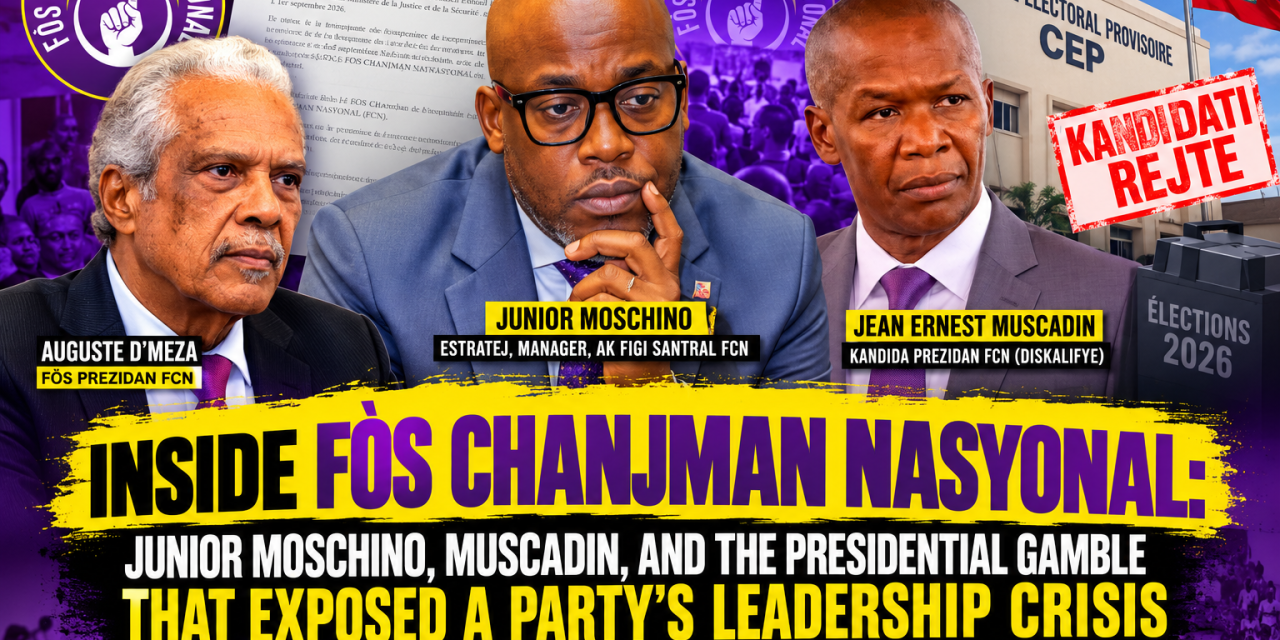
A founding president walks away, an entertainment-industry figure becomes central to the party’s political strategy, and a controversial prosecutor emerges as its presidential choice. Haiti Politic examines the leadership questions, electoral uncertainties, and political contradictions confronting Fòs Chanjman Nasyonal.
HAITI POLITIC | SPECIAL INVESTIGATION
October 30, 2026
By Haiti Politic Investigative Desk
INTRODUCTION — CAN A PARTY PROMISING NATIONAL CHANGE MANAGE ITS OWN TRANSITION?
Haiti has no shortage of political organizations promising change.
For decades, political movements have appeared with ambitious slogans, familiar personalities, and declarations of national renewal.
But the country’s political history raises an uncomfortable question: How many of these organizations have developed the institutional structures necessary to govern?
Fòs Chanjman Nasyonal (FCN) now faces that question.
The organization publicly promotes a vision of national reconstruction, institutional legitimacy, and greater opportunities for Haitian youth.
Its political materials feature the slogan Nou Ka Alèz Lakay Nou—an expression of the desire for Haitians to live securely and with dignity in their own country.
Yet the party’s recent history presents a series of developments requiring closer examination.
Professor Guy Philippe Auguste D’Meza, publicly identified as its founding president, issued a notice announcing his resignation.
Jean Junior Rémy, also known as Junior Moschino, became a prominent figure in the organization’s political activities.
Jean Ernest Muscadin, the government commissioner of Miragoâne, emerged as the party’s presidential choice.
And questions have arisen about the documentation and legal requirements governing Muscadin’s entry into the presidential race.
These developments do not, by themselves, establish misconduct.
But they create legitimate questions about FCN’s leadership, internal decision-making, candidate selection, and preparedness for national office.
Is FCN building a political institution capable of surviving beyond individual personalities, or is it attempting to transform Muscadin’s public recognition into political power?
That is the central question of this investigation.
PART I — AUGUSTE D’MEZA AND THE DEPARTURE OF FCN’S FOUNDING PRESIDENT
1. The Professor Who Promised Institutional Renewal
In the political materials reviewed by Haiti Politic, Professor Guy Philippe Auguste D’Meza appears as an important figure in FCN’s original public identity.
One party graphic presents him under the name Auguste D’Meza, also known as Gougouss.
The message accompanying his portrait criticizes Haiti’s repeated political transitions and their failure to restore institutional legitimacy.
It calls for younger generations to participate in rebuilding the nation’s dignity.
This was consistent with FCN’s broader public messaging.
The party presented itself as an organization interested in national reconstruction, youth participation, and the restoration of confidence between citizens and the state.
These are significant objectives.
But they also create a standard against which the party’s own conduct should be examined.
An organization calling for institutional legitimacy should be able to demonstrate legitimate internal leadership.
A movement promising transparency should be transparent about its major decisions.
And a party advocating political renewal should explain how it manages changes within its own leadership.
2. The September 29 Resignation Notice
Haiti Politic received a copy of a document titled Note Publique de Démission, bearing the name Guy Philippe Auguste D’Meza.
The notice is dated September 29, 2026, in Port-au-Prince.
It states that D’Meza’s resignation from FCN took effect on September 1, 2026.
The document announces his permanent withdrawal from the organization and indicates that he no longer assumes administrative, political, or moral responsibilities for the party’s activities.
The distinction between the effective date and the signing date is important.
According to the document, D’Meza considered his departure effective nearly four weeks before the notice was dated.
However, Haiti Politic has not independently authenticated the signature, obtained proof of the document’s delivery to FCN, or reviewed the party’s internal records concerning the resignation.
The notice therefore establishes what the document purports to communicate, not every administrative step that may have followed.
Why Did D’Meza Leave?
The document does not provide a detailed explanation.
It does not establish that D’Meza resigned because of Muscadin.
It does not prove a conflict with Junior Moschino.
It does not establish that the party experienced an internal power struggle.
Those possibilities should not be confused with verified facts.
Nevertheless, the resignation raises important institutional questions.
Who received the notice?
Did FCN formally accept it?
Was a successor appointed or elected?
Were party members informed?
Did the departure affect the party’s presidential nomination process?
And what role, if any, did D’Meza retain in the organization’s political decisions after September 1?
The answers matter because the resignation concerned a figure publicly associated with the party’s founding identity.
A political organization cannot demand accountability from the Haitian state while leaving basic questions about its own leadership unanswered.
PART II — JUNIOR MOSCHINO: FROM ENTERTAINMENT TO NATIONAL POLITICS
3. Who Is Jean Junior Rémy?
Jean Junior Rémy, publicly known as Junior Moschino, has been associated with entertainment promotion and artist-related business activities.
His emergence in FCN places him in a different arena.
The political responsibilities of organizing a national party are substantially different from those involved in promoting entertainment events.
Entertainment promotion often depends on public visibility, marketing, audience engagement, and relationships with recognizable personalities.
Political leadership requires additional capabilities.
These include managing an organization under its statutes, developing public policy, ensuring financial accountability, complying with electoral law, and establishing credible internal decision-making procedures.
Experience in one industry does not automatically disqualify someone from participating in politics.
Haiti’s democratic system should remain open to citizens from different professional backgrounds.
But public office and political leadership require scrutiny of qualifications, judgment, and institutional competence.
The FCN Promotional Material
A party graphic supplied to Haiti Politic identifies Rémy as Junior Remy.
The image includes a statement emphasizing the importance of learning from national history to prepare for the future.
The material associates him directly with FCN’s political identity.
It does not, however, establish his precise legal authority within the organization.
To determine that authority, Haiti Politic would need the party’s current statutes, leadership resolutions, and relevant administrative filings.
4. What Is Junior Moschino’s Actual Position Inside FCN?
Moschino has been publicly associated with FCN’s leadership and the political effort surrounding Muscadin.
But the party’s formal leadership structure deserves clarification.
Is Moschino the secretary general?
Is he serving as acting president?
Was he elected to either position?
Who authorized him to negotiate or announce presidential arrangements?
What powers does he exercise under the party’s statutes?
These questions are particularly important following D’Meza’s resignation.
Political authority should not depend exclusively on public visibility.
It should be traceable to a recognized internal process.
If FCN has appointed or elected new leadership, publishing the relevant decision would help resolve these questions.
PART III — WHY JEAN ERNEST MUSCADIN?
5. The Political Value of a Recognizable Prosecutor
Jean Ernest Muscadin became nationally prominent through his work as government commissioner in Miragoâne, in Haiti’s Nippes department.
His public reputation developed during a period of severe insecurity.
As armed groups expanded their territorial influence and state institutions struggled to protect civilians, Muscadin became associated with an uncompromising security posture.
His supporters view him as a public official willing to confront criminal violence.
His critics question whether some of the methods attributed to him comply with legal and human-rights standards.
Regardless of these competing assessments, his name carries national recognition.
That recognition has potential political value.
For a relatively new party, recruiting a widely discussed public figure can generate attention that would otherwise require years of organization-building.
But political visibility and governing competence are not the same thing.
A Strategic Calculation
FCN’s association with Muscadin raises two competing interpretations.
One possibility is that party leaders genuinely believe his approach to security aligns with their political program.
Another is that they view his popularity as a means of expanding FCN’s electoral relevance.
Both possibilities could influence a party’s decision simultaneously.
The available documentary record does not establish the private motivations of Moschino or other FCN leaders.
That is why the party should explain its selection process.
Was Muscadin chosen through an internal vote?
Were alternative candidates considered?
Was there a written agreement?
Did he formally adopt FCN’s political platform?
Was the party’s membership consulted?
These are ordinary questions for any organization seeking national political power.
PART IV — THE PRESIDENTIAL CANDIDACY AND THE UNANSWERED ELECTORAL QUESTIONS
6. From Political Recruitment to Presidential Ambition
FCN’s public association with Muscadin indicates an effort to present him as its presidential candidate.
A report published by Fact Checking News on October 1 described his appearance on the CEP’s registration platform under the party’s banner. That reporting provides a lead, but Haiti Politic has not independently obtained the underlying CEP registration record.
The distinction matters.
An expression of presidential ambition is not equivalent to a formally accepted candidacy.
An initial registration is not necessarily equivalent to final electoral approval.
And a dispute over documentation is not automatically equivalent to permanent disqualification.
The official electoral record must establish the legal status of a candidacy.
The Documents Haiti Politic Still Needs
To establish precisely what occurred, the investigation requires the relevant CEP registration record, Muscadin’s formal application, any written notice identifying missing documents, and any decision issued by the competent electoral authority.
The applicable electoral decree and any amendments must also be examined to determine which rules governed the application at the time it was submitted.
Until those documents are obtained, the article should not declare that Muscadin has been permanently excluded from the presidential race.
Nor should it state as an established fact that he failed to pay taxes, failed to resign, or deliberately withheld required documents.
Such conclusions would go beyond the evidence independently verified for this investigation.
7. Why Electoral Preparation Matters
The uncertainty surrounding Muscadin’s application raises a broader issue about political management.
A presidential campaign requires more than a popular candidate.
It requires competent legal advisers, clear administrative responsibilities, and a detailed understanding of the applicable electoral framework.
FCN should therefore explain who was responsible for reviewing Muscadin’s eligibility and preparing the required documentation.
Did the party obtain a formal legal opinion?
Did it review the requirements applicable to government prosecutors?
Did it establish a timeline for any necessary administrative action?
Were all supporting documents checked before submission?
If a dispute occurred, what official remedy was pursued?
The purpose of these questions is not to presume wrongdoing.
It is to evaluate whether the party demonstrated the administrative discipline expected of an organization seeking to govern Haiti.
PART V — MUSCADIN’S PUBLIC RECORD AND THE RULE OF LAW
8. The Security Reputation That Made Him Politically Attractive
Security remains one of Haiti’s most urgent national concerns.
Armed groups have displaced communities, disrupted economic activity, attacked public institutions, and undermined citizens’ ability to live normal lives.
The United Nations Integrated Office in Haiti reported that at least 1,408 people were killed and 656 injured during the second quarter of 2026.
In such an environment, it is understandable that some citizens are attracted to public figures who promise decisive action.
Muscadin’s reputation must be understood against that background.
However, a president cannot govern solely through personal determination.
Effective security policy requires functioning police institutions, an independent judiciary, accountable command structures, professional investigations, and lawful prosecution.
The question is not simply whether Muscadin is willing to confront armed groups.
It is whether he can demonstrate a national security program that operates within the law.
9. United Nations Allegations and the Need for Due Process
Muscadin’s public record includes serious allegations involving the use of lethal force.
United Nations human-rights reporting has documented allegations of summary or extrajudicial executions associated with his activities.
These allegations require careful examination.
They should not be dismissed simply because Muscadin has supporters.
But they also must not be presented as criminal convictions.
The available official United Nations reporting does not, by itself, constitute a judicial determination of his criminal responsibility.
In its reporting on the fourth quarter of 2025, BINUH continued to emphasize the need for accountability for alleged summary executions and other serious violations.
The principles involved are fundamental.
A prosecutor has a responsibility to enforce the law.
A suspect has a right to due process.
A criminal accusation does not automatically authorize punishment without judicial proceedings.
And a public official accused of misconduct is entitled to a fair examination of the evidence.
What Muscadin Must Explain
If Muscadin wishes to become president, he should address the allegations directly.
What is his account of the incidents documented by international observers?
What legal authority governed the use of force?
Were the deaths investigated?
What role did police officers, prosecutors, or other state agents play?
Would he cooperate with an independent judicial examination?
These questions are relevant to presidential qualifications because the presidency carries responsibility for protecting constitutional rights.
10. Financial Integrity: What Is Established and What Is Not?
Haiti Politic has not independently established that Muscadin has been convicted of financial corruption.
The investigation has not verified a criminal judgment finding him guilty of bribery, embezzlement, or misappropriation of public funds.
It would therefore be inappropriate to portray him as financially corrupt without supporting evidence.
Nevertheless, presidential candidates should be prepared to comply with applicable financial-disclosure and campaign-finance requirements.
FCN should also be transparent about the funding of its political activities.
That includes identifying the procedures used to record contributions, authorize expenditures, and prevent conflicts of interest.
Transparency is not a punishment reserved for politicians accused of wrongdoing.
It is a basic expectation of public accountability.
PART VI — CAN FCN GOVERN BEYOND MUSCADIN’S POPULARITY?
11. The Difference Between a Political Party and a Political Vehicle
A political party should represent an organized body of ideas, members, procedures, and policy commitments.
A political vehicle may exist primarily to promote the ambitions of a particular individual.
The distinction is important.
FCN’s original messaging emphasized national change, institutional reform, and youth participation.
Its association with Muscadin places considerable attention on security and the prosecutor’s personal reputation.
But what happens to the party’s broader political program?
What are its proposals for economic development?
How would it reform education?
What would it do about healthcare?
How would it finance infrastructure?
What is its strategy for agriculture, energy, and job creation?
How would it approach relations with foreign governments?
And what role would Haitians living abroad play in national development?
A presidential candidate must answer these questions.
So must the party nominating him.
12. What Happens If Muscadin Cannot Run?
FCN should have a political identity that does not depend entirely on the eligibility or popularity of one candidate.
If Muscadin cannot participate in the election, does FCN have an alternative?
Would the party nominate another candidate?
Would its members continue supporting the organization?
Would its policy platform remain unchanged?
Would the leadership remain united?
These questions are not predictions of failure.
They are tests of institutional durability.
A political party capable of governing should also be capable of managing setbacks.
13. What Does D’Meza’s Resignation Mean for the Party’s Future?
D’Meza’s departure remains one of the most significant unanswered issues.
The founding president was publicly associated with FCN’s original political message.
His resignation created a need for a transparent leadership transition.
If FCN completed that transition according to its statutes, it should be able to demonstrate how.
If disagreements occurred, the party should explain their nature without violating legitimate confidentiality obligations.
What matters is whether FCN’s leadership derives its authority from recognized organizational procedures.
A party cannot build lasting public confidence through personalities alone.
It must demonstrate institutional continuity.
PART VII — TEN QUESTIONS FOR JEAN ERNEST MUSCADIN
1. Why FCN? What persuaded you to pursue the presidency under the banner of Fòs Chanjman Nasyonal rather than another political organization?
2. What agreement did you reach with Junior Moschino? Was there a written agreement concerning your nomination, campaign responsibilities, financing, or future political appointments?
3. What did you know about D’Meza’s resignation? Were you informed of the founding president’s departure before committing to FCN?
4. What is the official status of your presidential application? Can you publish the relevant CEP registration record, submission receipt, and any formal decision affecting your candidacy?
5. What is your response to the United Nations allegations? Will you address the incidents documented by international observers and support lawful independent examination of the evidence?
6. What is your national security plan? How would you strengthen the police and judiciary while protecting constitutional rights?
7. What is your position on foreign security deployments? Under what conditions, if any, would you support foreign security personnel operating in Haiti?
8. What is your economic program? How would you create employment, restore agricultural production, improve infrastructure, and increase domestic investment?
9. Will you disclose your campaign financing? What commitments will you make concerning transparency, conflicts of interest, and compliance with electoral requirements?
10. Would you accept constitutional limits on presidential power? How would you guarantee judicial independence, due process, freedom of expression, and accountability for state officials?
PART VIII — TEN QUESTIONS FOR JUNIOR MOSCHINO AND FCN
1. Who currently leads FCN? What official party document establishes the organization’s current president, secretary general, and executive leadership?
2. Why did Auguste D’Meza resign? Can the party explain the circumstances of his departure and whether any internal disagreements preceded it?
3. Who initiated Muscadin’s recruitment? Was the decision made by Junior Moschino, the executive committee, or another party body?
4. Was Muscadin selected through a formal process? Did FCN’s members or authorized representatives vote on his nomination?
5. Is there a written political agreement? What commitments were made between FCN and Muscadin?
6. Who was responsible for electoral compliance? Which officials or legal advisers reviewed the requirements governing Muscadin’s candidacy?
7. What official documents establish the status of his application? Will FCN publish the relevant CEP correspondence and decisions?
8. Did FCN examine Muscadin’s public record? How did the party evaluate the United Nations allegations before supporting his presidential ambitions?
9. How is FCN financed? What accounting procedures govern contributions, campaign spending, and financial oversight?
10. Can FCN survive without Muscadin? What national political program, organizational structure, and alternative leadership strategy would remain if he were unable to participate in the election?
CONCLUSION — HAITI NEEDS POLITICAL INSTITUTIONS, NOT JUST POPULAR PERSONALITIES
Fòs Chanjman Nasyonal entered Haiti’s political debate promising change.
Its original public messaging emphasized national dignity, institutional reform, and the participation of younger generations.
But the party’s recent developments have raised questions about its own institutional foundations.
Its founding president announced his resignation.
Junior Moschino emerged as a prominent political figure within the organization.
Jean Ernest Muscadin became associated with its presidential ambitions.
And the official status of his candidacy requires clearer documentary verification.
None of these developments automatically proves misconduct.
But together they create a legitimate test of FCN’s readiness for national leadership.
Muscadin’s popularity may attract attention.
Moschino’s experience in promotion may help the party communicate its message.
D’Meza’s original political vision may continue to influence its identity.
Yet none of these elements can substitute for transparent leadership, sound administration, constitutional accountability, and a credible governing program.
The Question FCN Must Answer
Did Junior Moschino and FCN recruit Jean Ernest Muscadin because they had developed a national governing program he could implement—or because his public recognition offered the party a shortcut to political relevance?
The evidence currently available does not establish the private motivations behind the arrangement.
That is precisely why FCN should provide an explanation.
Haitians deserve political organizations capable of surviving leadership changes, managing electoral requirements, disclosing their finances, and presenting realistic solutions to national problems.
They deserve candidates who can demonstrate competence beyond personal popularity.
And they deserve institutions that respect the law even when the law imposes inconvenient limits.
Before Fòs Chanjman Nasyonal asks Haitians to trust it with the presidency, it should demonstrate that it can manage its own leadership, explain its candidate-selection process, and account for its political decisions.
Haiti needs security.
Haiti needs economic opportunity.
Haiti needs constitutional government.
Above all, Haiti needs political institutions strong enough to serve the country beyond the ambitions of any single individual.
DOCUMENTARY BASIS AND SOURCES
1. Haiti Politic — Original FCN Investigation
Fòs Chanjman Nasyonal: A Real Political Party, or a Small Circle Looking for a Bigger Stage?
An earlier Haiti Politic examination of the party’s political identity and organizational development.
2. FCN Public Promotional Materials
Images supplied to Haiti Politic featuring Professor Auguste D’Meza, Jean Junior Rémy, and Jean Ernest Muscadin.
These materials establish how the organization publicly presented these individuals. They do not independently establish formal appointments, internal votes, or electoral eligibility.
3. Public Resignation Notice Attributed to Guy Philippe Auguste D’Meza
Document dated September 29, 2026, stating an effective resignation date of September 1, 2026.
The document’s authenticity and administrative receipt have not been independently verified.
4. United Nations Integrated Office in Haiti (BINUH)
Official human-rights reports concerning security conditions, the use of force, and allegations of unlawful killings.
5. Electoral Documentation Requiring Independent Verification
CEP registration records, relevant electoral-decree provisions, Muscadin’s application documents, and any formal decision concerning his eligibility.
These documents should be obtained directly from the competent authorities before definitive conclusions are published.