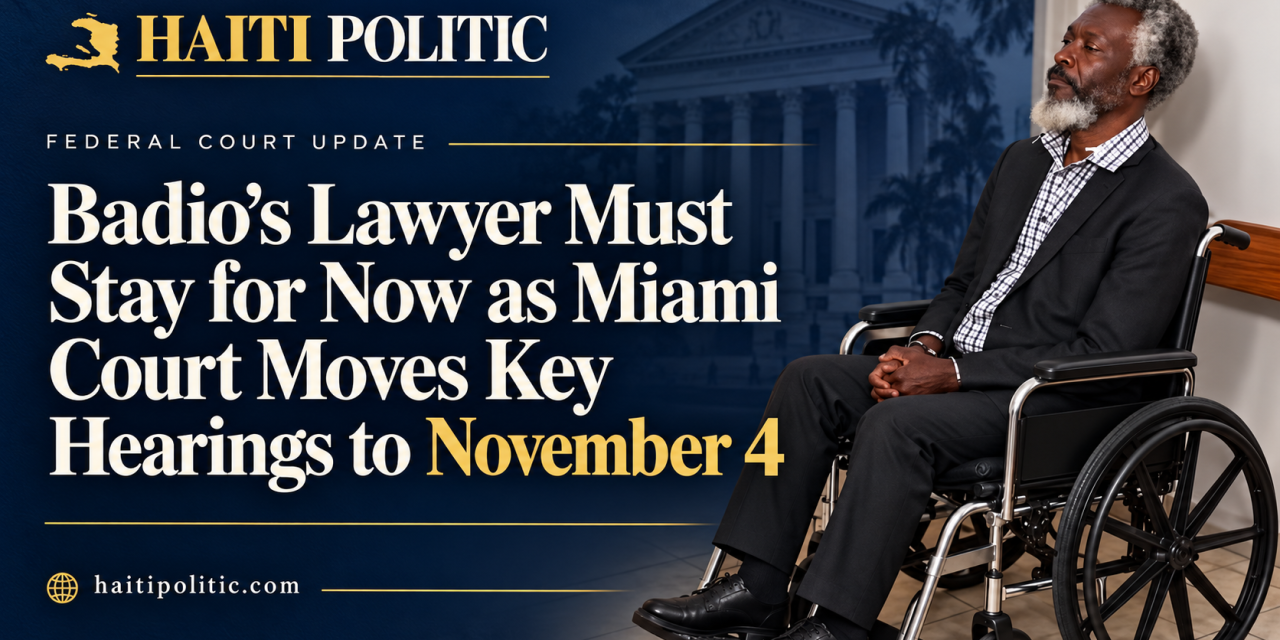
Judge Jacqueline Becerra denied counsel’s withdrawal request without prejudice. A separate order postponed arraignment, detention and financial-eligibility proceedings while the defense gathers more information about Badio’s finances.
MIAMI — Joseph Felix Badio’s appointed lawyer remains in the case after a federal judge declined to permit her withdrawal, while three significant preliminary proceedings have been pushed to November 4, according to the supplied federal docket printed October 15, 2026, at 3:22 p.m.
The developments concern representation, access to counsel, detention procedure and the unresolved question of who can pay for Badio’s defense. They do not decide his guilt or resolve the allegations in the broader prosecution concerning the assassination of Haitian President Jovenel Moïse.
Withdrawal denied, with the possibility of a renewed request
The clearest new ruling is docket entry 2142, entered October 14. U.S. District Judge Jacqueline Becerra denied Lauren Field Krasnoff’s motion to withdraw as Badio’s attorney, ECF 1929, without prejudice.
That means the request was refused at this stage without foreclosing a renewed application. The docket continues to list Krasnoff, of Markus Moss PLLC, as Badio’s lead attorney under a Criminal Justice Act appointment. The withdrawal motion was filed September 23, two days after her September 21 appointment.
The court held a hearing on October 13, recorded at ECF 2137. Its written ruling refers to reasons stated on the record at that hearing; those reasons are not reproduced in the docket report. Without the withdrawal motion and hearing transcript, the record supplied does not establish a conflict of interest, a breakdown in the attorney-client relationship, nonpayment or any other particular explanation for the request or its denial.
Three proceedings reset for November 4
In a separate October 14 proceeding, U.S. Magistrate Judge Enjolique A. Lett granted a defense request to continue Badio’s arraignment, detention hearing and status conference concerning partial indigency and CJA payment. Docket entry 2145 resets all three for November 4, 2026, at 10 a.m., in the Miami Division before the duty magistrate judge.
| Proceeding | Issue to be addressed |
|---|---|
| Arraignment | The formal proceeding for responding to the charges, ordinarily including entry of a plea. |
| Detention hearing | Whether Badio should remain detained pending further proceedings or may be released under appropriate conditions. |
| Partial-indigency/CJA-payment review | His financial eligibility for appointed representation and whether a contribution toward defense costs is appropriate. |
The November 4 setting replaces the October 14 schedule reflected earlier in the docket. It is not a trial date or sentencing date. The supplied entries do not record a completed arraignment or plea at the October 14 proceeding.
The minute order states that Badio was “not present.” It does not explain why. That notation is not, by itself, evidence that he refused to attend, escaped or committed a failure-to-appear offense. No such finding is recorded in the supplied entry. Krasnoff appeared, and a Haitian Creole interpreter was present.
The court has not yet determined indigency
Entry 2145 explicitly states: “There have been no findings on Indigency of defendant.” It directs defense counsel to provide additional information about his financial status.
This is a live financial-eligibility question, not a finding that Badio concealed assets or falsely claimed poverty. The docket does not identify the additional information sought, assess a property’s value or impose a specific payment amount.
The distinction matters because a CJA appointment does not, by itself, settle every financial question. Federal judiciary guidance calls for timely representation, provides for financial inquiry and allows a contribution when a defendant has some funds but cannot afford the full cost of qualified counsel. It also contemplates correcting eligibility determinations as information develops.
For now, the documented position is that Badio has appointed counsel while the court requires more information before making an indigency finding. Nothing in this report resolves the value, ownership or availability of any particular asset.
The detention issue remains open in the supplied record
Earlier entries describe temporary pretrial detention following Badio’s September 21 initial appearance. The September 28 proceedings were continued at his request to October 14; the October 14 proceedings were then continued to November 4.
The latest entries do not show a release order or a final detention ruling following a completed contested detention hearing. The record therefore supports reporting continued temporary detention pending the scheduled hearing, rather than claiming that bail was finally denied after a full merits determination. It also does not establish a present-day custody location through an independent detention-facility lookup.
In-person attorney access at FDC Miami
The October 13 hearing produced another concrete ruling. According to ECF 2137, Krasnoff orally requested that Badio adopt co-defendant Andela’s unopposed motion, ECF 2023, seeking an order instructing FDC Miami to facilitate an in-person attorney-client visit.
The court granted that oral request and stated that an order would follow. This addresses counsel’s access to the defendant, an important practical part of preparing a defense. The docket entry does not establish that a visit has already occurred or provide the operational terms of the anticipated order.
Protective order, third-party correspondence and the Sanon transcript request
Several developments in the broader case also appear on Badio’s docket. On October 13, Judge Becerra entered a protective order, ECF 2131. The docket summary directs readers to a separate document for its terms; that document was not supplied. Its exact disclosure and handling restrictions cannot be reconstructed from the title alone.
A separate notice, ECF 2135, says the court received correspondence from a third party and provided it to the government with the intention that prosecutors produce it to the defense under the protective order. The sender, contents and significance are not disclosed. The entry does not confirm that defense production has already been completed. It is not a basis for labeling the correspondence a confession, threat or breakthrough.
The government also filed a response to the standing discovery order, ECF 2136, on October 13. A docket title alone cannot establish what evidence that response contains or whether discovery obligations have been fully satisfied.
On October 12, a joint motion, ECF 2124, sought access to daily transcripts from Christian Emmanuel Sanon’s trial. The entry lists Badio among the affected defendants and gives October 26 as the response deadline. No ruling granting the request appears in the supplied report. Access could assist defense preparation in the wider case, but the request is not evidence that Badio has testified, agreed to cooperate or adopted another defendant’s account.
What the docket’s headings do not establish
The report’s first-page summary lists no pending counts in its administrative table. That display should not be read as a dismissal or exoneration: the entries continue to identify Badio as defendant 13, include him in the notice concerning a sixth superseding redacted indictment, ECF 1900, and schedule an arraignment.
The report is a docket summary, not the text of that indictment. It therefore cannot independently establish every count, statutory element or penalty applicable to Badio. Likewise, restricted and sealed-entry notices do not reveal the contents of the underlying filings.
The immediate milestones are now clear: Krasnoff remains counsel unless the court later permits withdrawal; additional financial information is required; and the arraignment, detention hearing and financial-status review are scheduled for November 4. None of these procedural developments is a finding that Badio committed the charged conduct. He remains presumed innocent.