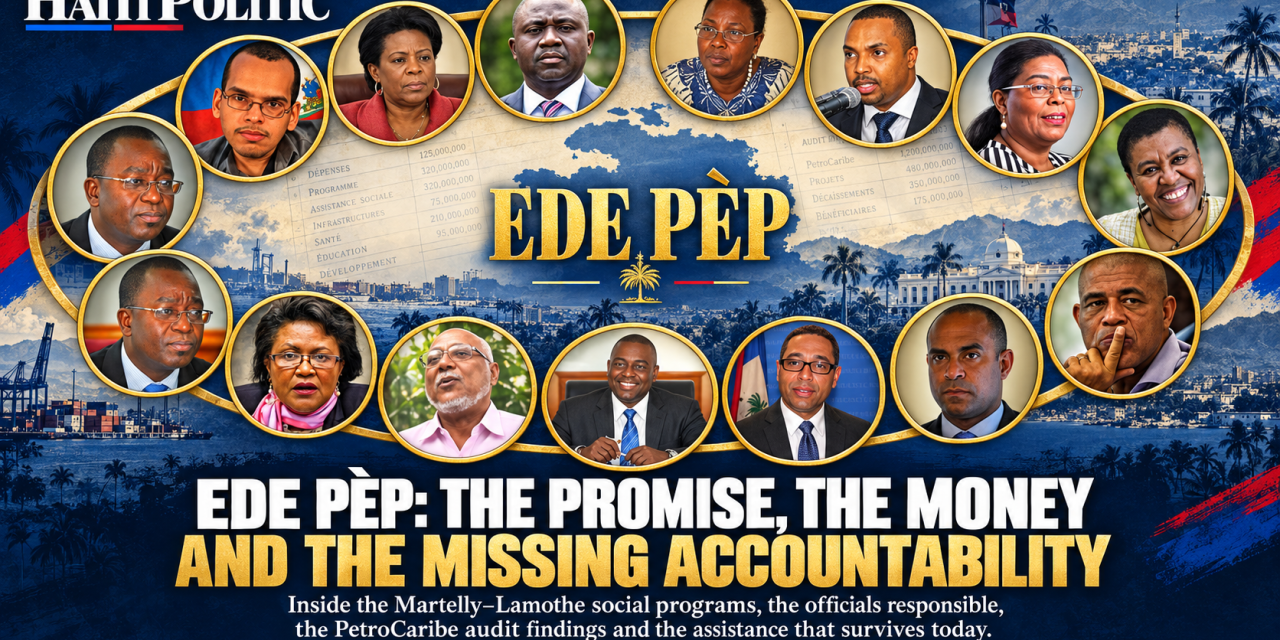
Inside the Martelly–Lamothe social programs, the officials responsible, the PetroCaribe audit findings and the assistance that survives today
Haiti Politic | Public-records investigation and analysis
October 29, 2026
A mother keeping her children in school. A person with a disability struggling to meet basic expenses. A farmer needing seeds. A woman seeking capital for a small business.
Ede Pèp promised a state response to these everyday needs. Under President Michel Martelly and Prime Minister Laurent Lamothe, the initiative brought cash assistance, food distributions and economic-support projects under a highly visible political umbrella.
Its record is now inseparable from the PetroCaribe scandal. Yet neither the original assistance nor its later versions can be understood through slogans alone. The central questions are who controlled the funds, what payments can be verified, and whether today’s assistance has been accompanied by an accounting for yesterday’s spending.
This investigation brings together public budgets, program descriptions, audit findings and later operational reporting. It identifies documented responsibilities, not a finding that everyone named committed wrongdoing.
WHAT THE PROGRAMS PROMISED
Program | Intended assistance
Ti Manman Cheri | Cash assistance to poor mothers linked to children’s schooling; announced monthly benefits of 400, 600 or 800 gourdes according to the number of eligible children.
Kore Moun Andikape | Financial support for vulnerable people with disabilities. At launch in June 2013, officials announced 800 gourdes every two months for one year.
Bon Solidarité / Bon Dijans | Cash assistance for vulnerable households and emergency hardship; the labels are grouped in several financial records.
Panye Solidarite | Food baskets for vulnerable households.
Kantin Mobil | Prepared hot meals delivered through mobile food assistance.
Kore Peyizan | Agricultural inputs and livelihood assistance, including seeds and fishing equipment.
Kredi Pou Fanm Lakay | Microcredit for women’s income-generating activities, especially in rural areas. Unlike a grant, the credit was intended to be repaid.
Kore Etidyan | Cash support for eligible public-university students, included here because it also features prominently in the audit.
These were different interventions, not interchangeable benefits. The broader Ede Pèp framework also encompassed additional social and education measures. This article focuses on the seven programs originally discussed and the associated student-transfer audit. [1–4]
WHO HELD RESPONSIBILITY
There was no single office controlling every stage. Political sponsorship, financing instructions, transfers, implementation and sector oversight involved different institutions.
Official | Documented responsibility during the relevant period
Michel Joseph Martelly | President; political sponsor of the administration’s social-policy agenda.
Laurent Salvador Lamothe | Prime minister, May 2012–December 2014; promoted Ede Pèp and also held the Planning and External Cooperation portfolio.
Klaus Eberwein | FAES director general during 2012–2015; central implementing-agency leader during the rollout.
Paul Moïse Gabriel | FAES deputy director general identified in the official account of the disability program’s launch.
Michael/Michaël Lecorps | BMPAD director general, 2008–early 2015; headed the agency administering PetroCaribe resources.
Marie-Carmelle Jean-Marie | Economy and finance minister, May 2012–April 2013, then April 2014–January 2015.
Wilson Laleau | Economy and finance minister, April 2013–April 2014; returned in January 2015 after Lamothe’s departure.
Marie-Carmelle Rose Anne Auguste | Minister delegate responsible for human rights and the fight against extreme poverty; prominent in program coordination and promotion.
Josefa Raymond Gauthier | Social affairs minister during part of 2012 until January 2013.
Charles Jean-Jacques | Succeeded Gauthier at Social Affairs in January 2013; held the portfolio through the remainder of Lamothe’s government.
Marie Mimose Félix | Minister delegate for the promotion of the peasantry; publicly associated with Kore Peyizan distributions.
Thomas Jacques | Agriculture minister; relevant to the broader agricultural-support package.
Yanick/Yannick Mézile | Minister for Women’s Affairs and Women’s Rights; associated with Kredi Pou Fanm Lakay.
Gérald Oriol Jr. | Secretary of state for the integration of people with disabilities; his office supported Kore Moun Andikape.
Vanneur Pierre and Nesmy Manigat | Education ministers successively during 2012–April 2014 and from April 2014, respectively; relevant to education-related programs and agreements.
The ministerial sequence is supported by cabinet and installation records. Program-specific accounts identify Gabriel, Oriol, Félix and Mézile. Contemporary credit reporting also names Julio Julien as the project official at Women’s Affairs and Jean Pierre Hertelou as FAES’s deputy poverty-program coordinator. This is a roster of principal officials identified in the records reviewed, not every employee, signatory or contractor. [2–7]
Sophia Martelly helped publicly launch Ti Manman Cheri alongside Lamothe in May 2012. That promotional role should not be confused with a documented appointment as FAES director or proof that she personally authorized a particular payment. [8]
BUDGET PROMISES VERSUS REPORTED EXPENDITURE
The government’s poverty-reduction plan and a CEPAL expenditure table permit a comparison. All amounts below are millions of Haitian gourdes; expenditure figures are rounded to three decimal places.
Program | FY2013–2014 planned budget | FY2013–2014 reported expenditure
Ti Manman Cheri | 921.600 | 348.088
Kore Moun Andikape | 258.336 | 8.576
Bon Dijans / Bon Solidarité | 128.400 | 37.784
Panye Solidarite | 362.880 | 325.076
Kantin Mobil | 84.000 | 194.487
Kore Peyizan | 507.000 | 192.439
Kredi Fanm Lakay | No directly comparable annual allocation established | 11.901
The planned Kore Peyizan figure combines FAES and Agriculture Ministry interventions; the FAES agricultural-input component was 222 million gourdes. The plan also lists a broader Ti Kredi line, which should not automatically be substituted for Kredi Fanm Lakay. [9]
For women’s credit, FAES announced 60 million gourdes over three years in July 2013—a different time basis from an annual expenditure figure. [4]
The expenditure column comes from CEPAL’s Table 29, citing MAST, FAES and MEF. It is reported expenditure, not a verified total received by households. A figure exceeding a planning target is a reconciliation question, not automatic proof of theft: scope changes, revisions and accounting periods must be checked. Nor do these two years establish a cumulative total for the entire administration. [10]
WHERE THE MONEY CAME FROM
PetroCaribe was a major source. Venezuela supplied oil on concessional financing terms; domestic sales generated public resources, while the financed portion of the oil bill created a debt obligation. BMPAD managed those resources for the Haitian government. This was not simply a pool of unrestricted donations. [11]
World Bank records identify PetroCaribe financing for several social programs. Other accounts identify Treasury financing through FAES. Those descriptions can coexist: one may identify the underlying financing and another the government payment channel. [12]
FAES also administered projects supported by other development partners. Its wider institutional financing cannot be used to claim that every donor paid for every Ede Pèp component.
THE AUDIT THAT UNDERMINED THE GOVERNMENT’S ACCOUNT
The May 2019 CSC/CA audit identified serious indicators of misuse in FAES’s Ede Pèp operations. It found:
• An unreliable beneficiary database;
• 15,861 Ti Manman Cheri beneficiaries classified as fictitious for 2012–2013 and 4,989 for 2013–2014;
• 60,757 Bon Solidarité/Bon Dijans recipients classified as fictitious in the payment comparison;
• Inconsistent student figures under Kore Etidyan;
• Food-basket, meal and agricultural-intervention claims without sufficient corroboration;
• Spending disconnected from program objectives and weak sector-ministry oversight.
The fictitious-beneficiary calculations arose from discrepancies between reported payments and identifiable records. They should be attributed to the auditors, not presented as independently verified identities. The findings justify investigation but do not establish a criminal conviction against every named official. [13]
Fondasyon Je Klere’s July 2019 legal analysis separately criticized delegation agreements and argued for accountability. It named Rose Anne Auguste, Charles Jean-Jacques, Vanneur Pierre, Yanick Mézile, Réginald Delva, Nesmy Manigat, Marie-Carmelle Jean-Marie and Wilson Laleau in its discussion of the challenged agreements. That is the foundation’s legal assessment; it is not a final criminal judgment. Delva’s Interior Ministry role is relevant here through that analysis, rather than as a demonstrated day-to-day administrator of all seven programs. [14]
LECORPS’S DEFENSE AND THE LIMITS OF “FOLLOWING INSTRUCTIONS”
Lecorps told the Senate inquiry that BMPAD disbursed on written finance-minister instructions and was not responsible for supervising the financed projects. The commission challenged that account by pointing to projects BMPAD itself executed. Lecorps later publicly rejected the commission’s allegations as inadequately supported. [15]
This dispute makes transaction records indispensable. Who requested the transfer? Who signed it? Which account received it? Which institution checked delivery? Holding office establishes institutional responsibility; personal liability requires examination of the person’s acts and the applicable duties.
A November 2018 report identified an order to bring Lecorps and other former BMPAD directors before the authorities. That procedural step was not a conviction; this review does not establish the proceedings’ current disposition. [16]
EBERWEIN’S DEATH AND THE UNSUPPORTED CLINTON CLAIM
Eberwein died in South Florida on July 11, 2017. Contemporary reporting attributed a suicide classification to the Miami-Dade Medical Examiner’s Office. He had been expected before the Haitian Senate’s PetroCaribe inquiry the following week. This article does not independently examine the medical or police files. [17]
A subsequent story claimed he was about to expose Clinton Foundation corruption. Fact-checking found no supporting evidence: the documented inquiry concerned PetroCaribe, and an anti-foundation quotation had been wrongly attributed to him. No substantiated link between the foundation and the Ede Pèp payment irregularities was established in the material reviewed. [18]
Likewise, the records reviewed did not establish that Lecorps held a formal position in Fondation Rose et Blanc. Association with an administration is not proof of foundation membership.
WHAT REMAINS IN 2026
The assistance did not disappear uniformly.
Program | Status supported by the records reviewed
Ti Manman Cheri | UNESCO’s policy profile, citing the IMF, says the original program ended in 2018. A 2019 government announced revival. Regular nationwide payments under the original name were not verified for 2026.
Kore Moun Andikape | Disability assistance persists within the broader social-protection system, but continuity of the original FAES scheme and payment rules was not verified.
Bon Solidarité | Still listed within FAES’s PUM cash-transfer framework; current nationwide payment frequency was not established.
Panye Solidarite | Still listed in FAES’s anti-hunger framework; newer food-kit operations are also documented.
Kantin Mobil | Confirmed active: FAES reported preparing 3,000 meals for displaced families on May 18, 2026.
Kore Peyizan | Documented beyond Lamothe’s tenure in the 2017–2018 procurement plan; nationwide operation under the original name was not verified in 2026.
Kredi Fanm Lakay | Current operation, loan recoveries and remaining revolving funds were not established.
An absence of current documentation is not proof of formal closure. Conversely, a program remaining on a website is not proof of continuous delivery. [19–22]
NEW ARRANGEMENTS, NEW FUNDING
Current assistance rests on several financing channels:
• PUM: MEF-hosted FAES reporting identifies Haitian Treasury funding for FY2024–2025. This does not trace every 2026 distribution.
• Kore Pèp Taiwan: FAES explicitly identifies Taiwan as financier of its February 2026 food-kit distribution.
• Klere Chimen: a separate MAST program launched in 2022, supported by the World Bank and Swiss Cooperation, providing cash transfers and accompanying services.
• HA-J0007: an IDB-supported food-security and resilience project implemented through FAES.
These arrangements should not be presented as identical successors to every original Ede Pèp component. SIMAST, the ministry’s social registry, supports beneficiary targeting; registration itself is not a payment. [23–26]
THE ACCOUNTS STILL NEEDED
The enduring issue is whether assistance can become reliable while past spending is reconciled.
For the original programs, the missing public accounting includes final payment reconciliations, supplier balances, asset transfers and women’s-credit recoveries. For current programs, the relevant measures include actual transfers, verified recipients, procurement results, complaints resolved and independent audit follow-up.
It is possible for assistance to have reached real families while other payments or expenditures were irregular. It is also possible for newer programs to operate without resolving the old accounts. Neither possibility excuses replacing evidence with political branding.
Ede Pèp promised support to citizens living with poverty. The obligation to explain what happened to the money belongs to the institutions and officials who approved, transferred, spent and supervised it.