Former presidential candidate. Political coalition figure. Representative of the Cohésion Nationale des Partis Politiques Haïtiens (CONAPPH).
Daniel Dupiton has appeared on Haiti’s presidential ballot promising something the country’s political system has repeatedly struggled to produce: cohesion.
But before presenting Dupiton as a major coalition architect, reformer, or prospective statesman, Haiti Politic must distinguish between what can be independently documented and what still requires answers from Dupiton himself.
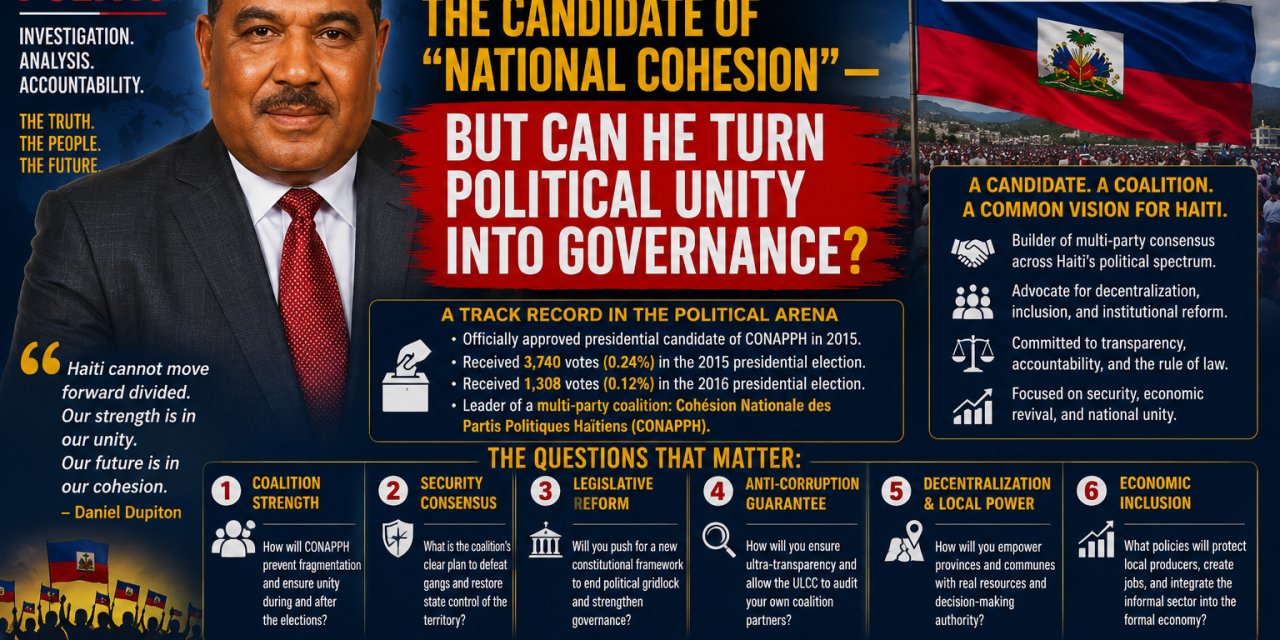
The historical record is clear on several points. Haiti’s Provisional Electoral Council recognized the Cohésion Nationale des Partis Politiques Haïtiens (CONAPPH) as an approved political grouping for the 2015 electoral process; the CEP document identified Asnel Alexandre, not Dupiton, as its legal representative.
Daniel Dupiton was nevertheless officially approved as CONAPPH’s presidential candidate in 2015. Contemporary reporting says he received 3,740 votes, approximately 0.24%, in the disputed 2015 presidential contest and subsequently confirmed his participation in the rerun.
In the November 2016 election, preliminary results reported 1,308 votes, or about 0.12%, for Dupiton.
Those are verifiable political credentials.
What is much harder to find publicly is a detailed record establishing the extensive coalition machinery, administrative accomplishments, foreign-policy program, or national governing experience described in some political profiles of Dupiton.
That absence of easily accessible documentation is itself an investigative question.
🔎 1 | WHO IS DANIEL DUPITON BEYOND THE BALLOT?
Dupiton has already achieved something concrete: he qualified to compete for Haiti’s presidency in an exceptionally crowded political environment.
But qualification for office is not the same thing as a governing record.
Before voters evaluate another presidential campaign, Dupiton should provide a comprehensive public résumé:
What institutions has he managed? What budgets has he administered? What legislation or public programs has he helped produce? What private-sector, civil-society or governmental organizations has he led? What measurable accomplishments demonstrate executive capacity?
These questions are especially important because available election records tell us considerably more about Dupiton the candidate than about Dupiton the administrator.
🤝 2 | “COHÉSION NATIONALE”: SLOGAN OR POLITICAL ARCHITECTURE?
CONAPPH’s name makes an ambitious proposition:
Cohésion Nationale des Partis Politiques Haïtiens.
Haiti has repeatedly suffered from extreme party fragmentation, short-lived coalitions, personality-centered movements and alliances that collapse when power or government appointments are distributed.
Dupiton therefore needs to explain exactly what “cohesion” means.
How many parties currently constitute the coalition?
Which ones?
Do they share a written national platform?
Are coalition members required to disclose campaign financing?
How are candidates selected?
What happens when member parties disagree?
Does CONAPPH have departmental organizations throughout Haiti?
And perhaps most importantly:
Is CONAPPH an enduring political institution—or principally an electoral vehicle?
Publish the organizational structure and let citizens examine it.
🗳️ 3 | HIS ELECTORAL RECORD DESERVES SCRUTINY
Numbers matter.
Contemporary reporting placed Dupiton 20th in the earlier 2015 contest, with approximately 3,740 votes and 0.24%.
When Haitians returned to presidential elections in November 2016, preliminary results reported 1,308 votes—approximately 0.12%—for Dupiton and CONAPPH.
That does not determine whether his ideas are good or bad.
It does raise a straightforward political question:
What has changed?
If Dupiton again seeks national leadership, what new organization, constituency, policy agenda or public record would allow CONAPPH to move from a very small electoral constituency to a national governing coalition?
That answer should be measurable.
🏛️ 4 | CAN HE ACTUALLY REDUCE HAITI’S POLITICAL FRAGMENTATION?
This could be Dupiton’s most interesting political proposition.
Haiti does not necessarily need another political personality.
It needs institutions capable of surviving personalities.
So Haiti Politic would ask:
Would CONAPPH support reducing political fragmentation through tougher requirements for party registration and continued legal recognition?
Should parties have minimum membership thresholds?
Should their financing be publicly disclosed?
Should audited financial statements be mandatory?
Should parties demonstrate organizations across several departments before receiving national status?
Would CONAPPH support public campaign financing tied to transparency requirements?
A movement built around political cohesion should be willing to propose concrete rules for achieving it.
💰 5 | WHO FINANCES THE COALITION?
This question should be asked of every Haitian presidential candidate.
Who pays?
Who are CONAPPH’s principal donors?
What percentage of campaign money comes from businesses?
From diaspora contributors?
From candidates themselves?
Would Dupiton publish contributions above a defined threshold?
Would donors receiving government contracts be prohibited from financing the governing party?
Would ministers and senior officials be required to declare assets before and after holding office?
Political cohesion becomes dangerous when it simply means distributing ministries among coalition partners.
Dupiton should explain how he would prevent a coalition government from becoming a federation of patronage networks.
⚖️ 6 | CONSTITUTIONAL REFORM: WHAT EXACTLY WOULD HE CHANGE?
Dupiton’s coalition-building philosophy makes the executive-legislative relationship particularly important.
Haiti has repeatedly experienced political conflict surrounding presidents, prime ministers and Parliament.
So broad promises of “institutional reform” are insufficient.
Would Dupiton retain Haiti’s semi-presidential architecture?
Would he strengthen presidential authority?
Strengthen Parliament?
Change the procedure for appointing a prime minister?
Introduce a constructive vote of no confidence, requiring legislators seeking to remove a government to simultaneously agree on its replacement?
Reform the electoral calendar?
Clarify succession rules?
The public should demand proposed constitutional language—not simply promises of reform.
🔫 7 | NATIONAL COHESION MEANS NOTHING WITHOUT NATIONAL TERRITORY
A coalition cannot govern territory the state does not effectively control.
Dupiton therefore needs a security doctrine.
How would his administration divide responsibilities between the Haitian National Police and Armed Forces of Haiti?
How many officers would be recruited?
What vetting system would prevent gang infiltration?
How would police salaries, equipment and insurance be financed?
How would ports and customs facilities be secured against weapons trafficking?
What is his position on international security assistance?
And an especially difficult question:
Negotiation or prosecution?
If armed groups seek negotiations, what conduct—if any—would qualify for demobilization programs?
Who is categorically excluded?
What happens to minors recruited into gangs?
What happens to financial sponsors?
What happens to political officials implicated in supporting armed organizations?
“Security” must become policy rather than rhetoric.
🌾 8 | CAN POLITICAL DECENTRALIZATION BECOME ECONOMIC DECENTRALIZATION?
If CONAPPH truly represents regional political interests, its economic program should reflect that.
Haiti’s decentralization cannot consist simply of moving politicians around.
Municipalities need resources.
Dupiton should explain whether he supports allowing communes and departments to retain a larger share of locally generated revenue.
Would agricultural municipalities receive dedicated infrastructure financing?
Would cooperatives receive affordable credit?
Would Haiti gradually protect strategic domestic agricultural production from unfair import competition?
Would provincial ports and airports receive greater administrative autonomy?
And how would those reforms be implemented without creating ten new centers of local corruption?
🌎 9 | WHAT WOULD “DUPITON FOREIGN POLICY” ACTUALLY BE?
This is where Dupiton’s public record appears particularly thin.
A Haitian presidential candidate should be able to articulate a foreign-policy doctrine independent of campaign slogans.
Haiti Politic would ask him to identify his government’s priorities toward:
The Dominican Republic, CARICOM, the United States, Canada, France, the African Union, Latin America, Taiwan/China, international financial institutions and the Haitian diaspora.
Then come the harder questions.
What does Haiti want from each relationship?
Trade access?
Weapons interdiction?
Agricultural investment?
Police training?
Infrastructure financing?
Migration agreements?
Climate financing?
Technology transfer?
Foreign policy becomes serious when Haiti stops asking simply:
“What will the international community give us?”
and starts asking:
“What are Haiti’s interests, and how will Haiti negotiate for them?”
🇩🇴 10 | THE DOMINICAN REPUBLIC TEST
Every Haitian president inherits the most consequential bilateral relationship in the country’s immediate neighborhood.
Dupiton should present a detailed Dominican policy covering:
border security, migration, trade, customs modernization, agricultural commerce, trafficking, documentation and diplomatic protection for Haitian nationals.
Nationalism alone will not manage this relationship.
Neither will diplomatic passivity.
The challenge is defending Haitian interests while managing the unavoidable economic and geographic interdependence of Hispaniola.
🌐 11 | WHERE DOES THE DIASPORA FIT?
A movement claiming “national cohesion” must answer a basic question:
Does “national” include Haitians living abroad?
Would Dupiton support meaningful diaspora political participation?
Would he advocate mechanisms for overseas voting?
Would qualified diaspora Haitians be permitted broader access to elected or senior public office under constitutional reform?
Would his government establish independently audited diaspora infrastructure bonds?
Could diaspora investors finance specific projects rather than sending money into an opaque central treasury?
National cohesion cannot stop at Haiti’s borders when millions of Haitians and descendants of Haitians live outside them.
🧾 12 | THE DOCUMENTATION CHALLENGE
Here is perhaps the most important investigative question surrounding Daniel Dupiton.
Haiti Politic could verify his presidential candidacies and CONAPPH’s electoral existence. The CEP’s records confirm both CONAPPH’s approved status and Dupiton’s candidacy.
But the searches conducted for this profile did not uncover sufficient reliable documentation to substantiate several stronger characterizations in the supplied material—such as describing Dupiton as an exceptional master of coalition diplomacy, establishing that CONAPPH commands an extensive nationwide network of regional political machines, or declaring him completely untouched by every major corruption controversy.
Those claims should therefore not be presented as established facts without additional evidence.
Instead, Dupiton has an opportunity:
Publish the evidence.
Party membership.
Coalition agreements.
Financial statements.
Professional biography.
Previous employment.
Public-service record.
Policy documents.
Major donors.
Organizational chart.
Departmental coordinators.
International-policy team.
Then voters can investigate the movement themselves.
📊 HAITI POLITIC | DANIEL DUPITON RECORD CHECK
| AREA | WHAT WE CAN ESTABLISH | WHAT VOTERS STILL NEED |
|---|---|---|
| Political affiliation | CONAPPH was approved for the 2015 electoral process. | Current membership and organizational structure |
| Presidential experience | Dupiton was an officially approved presidential candidate. | What executive experience accompanied the candidacy? |
| 2015 performance | Contemporary reporting: roughly 3,740 votes / 0.24%. | What did the movement learn and change? |
| 2016 performance | Preliminary results: 1,308 votes / 0.12%. | How would CONAPPH build a national constituency today? |
| Coalition building | Coalition identity is central to CONAPPH’s name and structure. | Which parties currently participate, under what rules? |
| Governance | Electoral participation is documented. | Detailed executive/administrative accomplishments |
| Foreign policy | No comprehensive Dupiton doctrine was located in the sources reviewed. | Publish a concrete foreign-policy program |
| Security | No detailed current operational doctrine was established from the sources reviewed. | Personnel, budget, command and implementation plan |
🔎 HAITI POLITIC: NO ENDORSEMENT. NO CONDEMNATION. SHOW THE RECORD.
Daniel Dupiton’s presidential candidacy is documented.
CONAPPH’s participation in Haiti’s electoral system is documented.
But the much larger question remains unanswered:
What has Daniel Dupiton built that demonstrates his ability to govern Haiti?
Can a coalition of political organizations become something more than another electoral alliance?
Can cohesion survive disagreements over ministries, money and power?
Can Dupiton present a credible security strategy?
Can he articulate a Haitian foreign policy based on national interests rather than dependency?
Can he demonstrate measurable accomplishments beyond appearing on a presidential ballot?
And can CONAPPH show Haitians—not merely tell them—that it represents a fundamentally different model of political organization?
Those questions deserve documentation, debate and direct answers from the candidate.
🇭🇹 HAITI POLITIC — INVESTIGATION. ANALYSIS. ACCOUNTABILITY. THE PEOPLE DECIDE.
#HaitiPolitic #DanielDupiton #CONAPPH #Haiti #HaitiElections #HaitiPolitics #ForeignPolicy #Governance #Security #Diaspora #Accountability