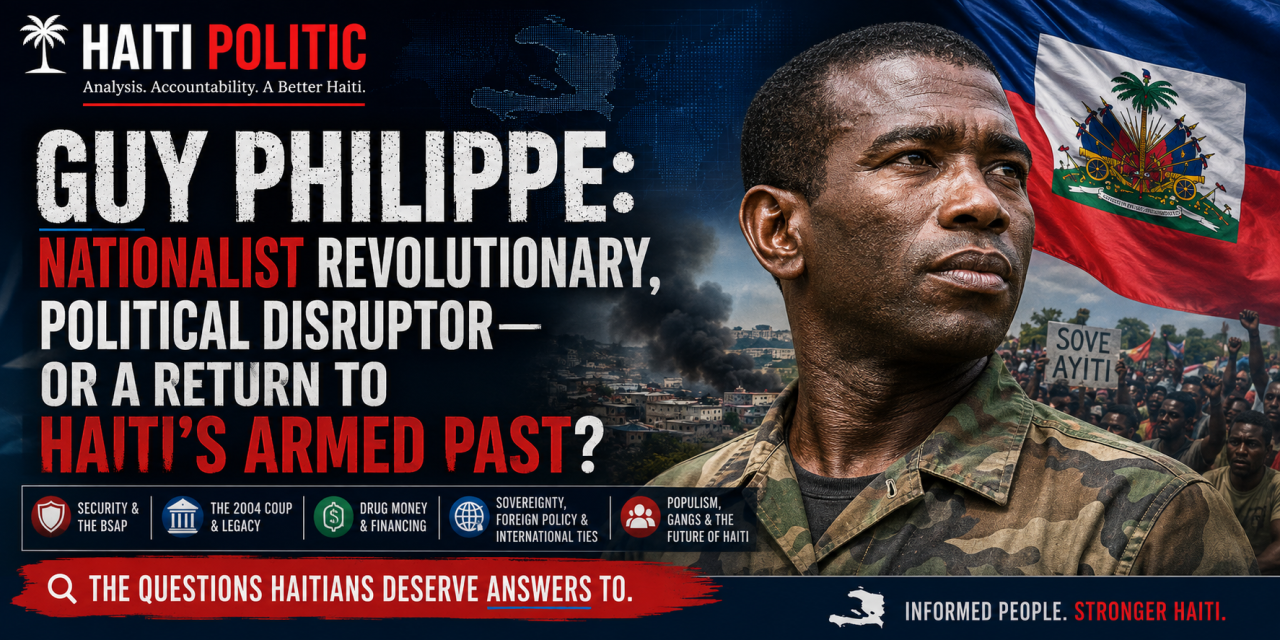
🇭🇹 Former police officer. Rebel commander. Presidential candidate. Elected senator. Convicted money launderer. Populist political figure.
Few Haitian political figures carry a résumé as controversial—or as consequential—as Guy Philippe.
His supporters see a nationalist willing to confront gangs, political elites and foreign influence.
His critics see something very different:
a former armed rebel whose career demonstrates the danger of replacing weak institutions with personal force.
Today, as Haiti again searches for political leadership, Philippe presents voters with a profound question:
Can someone who once helped overthrow an elected government become a credible defender of constitutional government?
This is not an endorsement.
It is not a condemnation.
It is an examination of the public record—and of the questions Guy Philippe should answer before Haitians decide whether his return represents national renewal or another cycle of instability.
🇭🇹 WHO IS GUY PHILIPPE?
Guy Philippe was born in Pestel, Grand’Anse, in 1968.
His early career was built in security rather than business or academia.
He received police or military training in Ecuador and later served in several senior positions within Haiti’s emerging post-army security structure, including assignments in Ouanaminthe, Delmas and Cap-Haïtien. Contemporary reporting also places him inside the presidential security apparatus during René Préval’s first administration.
His trajectory then changed dramatically.
In 2000, after accusations that he was involved in an attempted coup against President René Préval, Philippe fled to the Dominican Republic. He denied those accusations.
Four years later, he returned to Haiti as one of the most prominent military leaders of the armed rebellion against President Jean-Bertrand Aristide.
That rebellion ultimately contributed to Aristide’s departure from power in February 2004.
It made Guy Philippe a national political figure.
It also permanently connected his name to one of the most controversial ruptures in Haiti’s democratic history.
⚔️ 2004: LIBERATOR OR DESTABILIZER?
To supporters of the rebellion, Philippe confronted an authoritarian and collapsing government.
To critics, the armed uprising demonstrated a disastrous principle:
If politicians cannot defeat a government through institutions, they can defeat it with weapons.
That question matters today because Haiti’s greatest weakness is precisely its inability to establish rules stronger than individual political actors.
Philippe must therefore answer something larger than whether he believes the 2004 rebellion was justified.
What precedent did 2004 establish?
If armed rebellion was legitimate then, why should another group not use armed rebellion against a future President Guy Philippe?
That is the constitutional paradox at the center of his political career.
🗳️ FROM REBEL COMMANDER TO ELECTORAL POLITICIAN
Philippe did eventually participate in electoral politics.
He ran for president in 2006, receiving only a small share of the national vote.
Years later, in 2016, voters in Grand’Anse elected him to the Haitian Senate.
That victory is politically significant.
It demonstrated that Philippe possessed a genuine regional constituency rather than merely an armed following.
But he never took his Senate seat.
Shortly after receiving certification of his election, Haitian authorities arrested him and transferred him to U.S. custody to face long-standing federal charges.
💵 THE FEDERAL CONVICTION CANNOT BE TREATED AS A FOOTNOTE
This part of Philippe’s record is not allegation.
It is documented in federal court proceedings.
In April 2017, Guy Philippe pleaded guilty to conspiracy to commit money laundering involving proceeds derived from narcotics trafficking.
According to the U.S. Department of Justice, Philippe admitted that while serving as a senior Haitian police official between approximately 1999 and 2003, he received between $1.5 million and $3.5 million in bribes from drug traffickers in exchange for helping protect narcotics shipments and proceeds entering Haiti.
Federal prosecutors said he shared some of those payments with other Haitian police and security officials.
He was sentenced to 108 months—nine years—in federal prison, together with a $1.5 million monetary judgment.
That history creates a political problem that rhetoric about sovereignty cannot erase.
💰 TEST #1 — WHO FINANCES GUY PHILIPPE TODAY?
Philippe returned to Haiti in late 2023 after completing his U.S. sentence.
Almost immediately, he began mobilizing politically.
He toured parts of the country.
He called for a national “revolution,” sometimes describing it as nonviolent.
He attracted supporters frustrated by Ariel Henry’s government, gang control and years of foreign-backed transitional arrangements.
Political mobilization costs money.
Vehicles cost money.
Security costs money.
Rallies cost money.
Communications cost money.
Organizers cost money.
So Guy Philippe should answer:
Who finances your political movement?
Which Haitian businesses?
Which diaspora groups?
Which foreign donors?
Which political organizations?
Which individuals?
Would he publish every major donor?
Would he submit campaign accounts to an independent audit?
Would he disclose the beneficial owners of companies financing his political activities?
Given his federal conviction, financial transparency should not be optional.
It should be central to his claim for renewed political legitimacy.
🔫 TEST #2 — BSAP AND THE PARALLEL-ARMED-POWER QUESTION
After his return, Philippe became publicly associated with members of the Brigade de Sécurité des Aires Protégées—BSAP.
BSAP began as a state-linked environmental security unit.
But analysts and Haitian observers have increasingly described portions of it as functioning like an armed paramilitary structure.
During political mobilizations in 2024, armed BSAP members were seen accompanying Philippe, and InSight Crime reported that some BSAP members had ties to former soldiers who fought alongside him in 2004.
That creates one of the most serious questions surrounding his political project.
Who commands the guns?
If Philippe believes the Haitian National Police is weak, corrupt or politically manipulated, does that justify mobilizing armed forces outside the constitutional chain of command?
If the answer is yes, Haiti risks reproducing the very problem it is trying to escape:
multiple armed organizations answering to political personalities instead of the state.
So:
Mr. Philippe, do you support one national chain of command—or multiple armed movements competing to define national legitimacy?
⚠️ CLAIMS OF GANG ALLIANCES REQUIRE CAREFUL DISTINCTION
Some Haitian human-rights figures have accused Philippe and allied actors of relationships with gangs.
Those allegations are serious.
But they should not be presented as established fact without evidence.
InSight Crime reported that Philippe himself characterized his contacts with gangs as “not deep,” while also noting that the extent of any current relationships between Philippe and criminal networks remains publicly unclear.
That uncertainty itself demands scrutiny.
Have you or your representatives communicated with leaders of armed gangs?
If yes, for what purpose?
Negotiation?
Intelligence?
Political coordination?
Ceasefire arrangements?
Would you publicly reject any political alliance with gang federations?
And would you authorize prosecution of gang leaders who support you politically?
Those answers matter because no Haitian leader can credibly dismantle criminal rule while maintaining hidden channels of political dependence on armed groups.
⏱️ TEST #3 — THE “90 DAYS” PROMISE
In early 2024, Philippe publicly claimed that he could solve Haiti’s gang problem in approximately 90 days.
He argued that the PNH and Haitian Armed Forces could defeat armed groups if the country had the necessary political will.
That is an extraordinary promise.
So it deserves extraordinary specificity.
Day 1 to Day 30: What happens?
Which territories are prioritized?
Which police units lead?
Which military units assist?
How are gang-held neighborhoods entered without producing mass civilian casualties?
Day 31 to Day 60: What happens?
How are ports and highways secured?
How are weapons flows interrupted?
How are gang finances frozen?
How are kidnapped territories restored to civilian administration?
Day 61 to Day 90: What happens?
Who governs liberated neighborhoods?
How do schools reopen?
How are courts restored?
What prevents another gang from filling the vacuum?
A 90-day promise without an operational blueprint is political theater.
A 90-day promise with command structure, funding and measurable objectives becomes a policy that can be evaluated.
Haitians deserve to know which one this is.
🧠 THE EXPERIENCE ARGUMENT
There is an argument Philippe’s supporters can legitimately make.
Unlike many conventional politicians, he understands security institutions from the inside.
He has police experience.
He understands territorial command.
He has organized men under extremely difficult conditions.
He has demonstrated an ability to mobilize people outside Port-au-Prince.
And he retains political appeal in parts of rural Haiti that often feel ignored by the capital.
Those are real political assets.
But they produce an equally important question:
Is commanding armed followers the same as building a professional security institution?
A functioning republic depends on depersonalizing force.
The police must obey law—not Guy Philippe.
The army must obey civilian institutions—not Guy Philippe.
BSAP must obey a lawful chain of command—not Guy Philippe.
That distinction determines whether security produces a republic or another armed political order.
🌾 THE RURAL POPULIST APPEAL
Philippe’s political appeal differs from many Port-au-Prince politicians.
His strongest identity has historically been tied to Grand’Anse and provincial Haiti.
That matters.
Many Haitians outside the capital believe political institutions, foreign embassies, NGOs and national elites have consistently treated rural Haiti as an afterthought.
Philippe’s anti-establishment rhetoric taps directly into that anger.
He presents himself as someone willing to confront:
foreign influence,
urban political elites,
corruption,
economic exclusion,
and political paralysis.
That may explain part of his resilience.
But populism is not an economic program.
What exactly would a Philippe government do for rural Haiti?
Farm credit?
Irrigation?
Rural roads?
Port infrastructure?
Agricultural processing?
Electricity?
Fishing cooperatives?
Land reform?
Regional universities?
Municipal revenue autonomy?
Provincial Haiti deserves something more concrete than revolutionary language.
🌎 TEST #4 — FOREIGN POLICY AND SOVEREIGNTY
This may be where Philippe’s political message resonates most strongly.
Haiti has experienced repeated international interventions.
UN missions.
Foreign-supported transitions.
International security missions.
Externally designed political agreements.
Donor-driven development programs.
And yet Haiti remains profoundly unstable.
That record has created understandable frustration.
Philippe has benefited politically from that frustration by emphasizing sovereignty and rejecting what he considers excessive foreign control.
The question is:
What replaces it?
Opposing foreign intervention is not itself a foreign policy.
A government must still negotiate.
🇺🇸 THE UNITED STATES PROBLEM
A Guy Philippe presidency would immediately confront an unusually complicated relationship with Washington.
The United States imprisoned him.
Its federal courts documented his money-laundering conviction.
At the same time, the United States remains Haiti’s most consequential external partner in areas including:
trade,
migration,
banking,
security,
sanctions,
development assistance,
and diplomatic pressure.
So what would Philippe do?
Break relations?
Normalize them?
Demand a reset?
Would U.S. authorities regard his administration as a reliable security partner?
Could Haitian banks and government entities operate normally through the international financial system?
How would his government reassure international banks that public funds satisfy stringent anti-money-laundering requirements?
National sovereignty does not eliminate financial interdependence.
🏦 TEST #5 — CAN HAITI REMAIN CONNECTED TO THE INTERNATIONAL BANKING SYSTEM?
This question deserves far more attention.
Haiti depends on:
remittances,
international correspondent banking,
imports,
foreign investment,
development finance,
and access to U.S.-dollar transactions.
A president carrying a federal money-laundering conviction would need extraordinary safeguards to prevent concerns among banks, regulators and international partners from affecting Haiti itself.
So would President Philippe establish:
an independent financial-intelligence authority?
strengthened anti-money-laundering enforcement?
public beneficial-ownership registries?
politically independent customs oversight?
mandatory asset declarations?
outside auditing of presidential finances?
Those measures would not simply protect his reputation.
They would protect Haiti’s access to international finance.
🇩🇴 TEST #6 — THE DOMINICAN REPUBLIC
Philippe has stated that Haiti and the Dominican Republic share an island and must live peacefully.
That is a useful principle.
But peaceful coexistence requires policy.
Border tensions include:
migration,
deportations,
trade,
smuggling,
weapons,
agriculture,
water,
informal commerce,
and sovereignty.
So what would his government actually propose?
A permanent bilateral border commission?
Joint anti-smuggling operations?
Modern customs facilities?
Biometric border controls?
Formalized cross-border markets?
Migration agreements?
Water negotiations?
Protection protocols for Haitian migrants?
A nationalist foreign policy must eventually become diplomatic machinery.
🚢 TEST #7 — HOW DO YOU SECURE PORTS, AIRPORTS AND BORDERS WITHOUT FOREIGN SUPPORT?
If Philippe opposes international security deployments, the financial question becomes unavoidable.
Modern security requires:
surveillance,
communications,
intelligence,
armored vehicles,
weapons tracing,
maritime patrols,
border technology,
air support,
digital forensics,
and reliable salaries.
Where does the money come from?
Higher taxation?
Customs revenue?
Diaspora bonds?
Defense agreements?
Reallocation from other ministries?
International military cooperation with different partners?
A president cannot simply say:
“Haitians will solve Haiti’s problem.”
The next question is:
With what equipment, budget, institutions and timetable?
🏛️ TEST #8 — DOES GUY PHILIPPE BELIEVE IN CONSTITUTIONAL SUCCESSION?
This may be the central political question.
Haiti has spent decades changing governments through:
coups,
forced resignations,
assassination,
transitional councils,
street uprisings,
international pressure,
and constitutional improvisation.
The country urgently needs boring politics.
Elections.
Terms of office.
Peaceful succession.
Courts.
Legislatures.
Procedures.
Rules.
Can Guy Philippe—whose political biography includes armed rebellion—commit himself to that kind of system?
Would he accept electoral defeat?
Would he permit hostile opposition parties to organize?
Would he tolerate demonstrations against his government?
Would he allow journalists to investigate him?
Would courts be allowed to rule against him?
Would the army remain politically neutral?
These questions matter more than campaign speeches about sovereignty.
⚖️ TEST #9 — THE RULE OF LAW AND HIS OWN PAST
Philippe’s defenders can argue that he served his federal sentence.
That matters.
A criminal conviction does not mean someone loses all civil or political relevance forever.
But anyone seeking national power after such a conviction must accept heightened scrutiny.
So Philippe should explain:
What did you learn from your conviction?
Does he dispute the admissions contained in his guilty plea?
Does he accept responsibility for receiving criminal proceeds?
Would he apologize to Haitians for corruption inside institutions he once served?
Would he support prosecution of police commanders who today commit similar crimes?
The answer would tell Haitians whether he views his past as:
a political persecution,
a legal mistake,
a personal failure,
or simply a closed chapter.
🧨 TEST #10 — REVOLUTION OR REPUBLIC?
Philippe repeatedly invoked the language of revolution following his return.
That language appeals to people who believe Haiti’s institutions are beyond repair.
But revolutions create another problem.
Who decides when the revolution ends?
If Philippe’s followers remove a government through mass mobilization or armed pressure, who writes the next rules?
Who appoints the government?
Who prevents political revenge?
Who prevents armed supporters from becoming a permanent political militia?
Who protects opposition politicians?
Who guarantees elections?
Every revolutionary eventually faces this question:
Can you build institutions strong enough that your own movement no longer controls them?
That is the difference between replacing rulers and rebuilding a state.
📊 THE GUY PHILIPPE TEST
| AREA | POTENTIAL APPEAL | SERIOUS RISK TO EXAMINE |
|---|---|---|
| Security experience | Former police commander with operational experience | Security leadership has repeatedly overlapped with armed political mobilization |
| Rural support | Strong provincial identity and anti-establishment appeal | Mobilization may depend more on personality than durable institutions |
| National sovereignty | Resonates with Haitians frustrated by repeated foreign interventions | Isolation could weaken security financing, trade and diplomacy |
| Anti-establishment image | Not identified with Port-au-Prince’s conventional political class | His own career spans coups, rebellion and traditional electoral politics |
| Gang policy | Promises aggressive action and a 90-day solution | Operational details remain unclear |
| Financial integrity | Can argue he completed his sentence and returned to political life | Federal conviction involved laundering proceeds linked to narcotics trafficking |
| Political courage | Demonstrated willingness to challenge powerful governments | Political force outside institutions can further weaken constitutional government |
| Foreign policy | Could articulate a stronger sovereignty-first doctrine | Major questions remain about Washington, international banks and security partners |
⚖️ THE ARGUMENT HIS SUPPORTERS WILL MAKE
Guy Philippe may represent exactly the disruption Haiti’s failed political system needs.
He has lived outside traditional elite circles.
He can mobilize rural populations.
He speaks openly about national sovereignty.
He understands police and military realities.
He is willing to confront politicians whom many Haitians distrust.
He rejects the idea that foreign actors should permanently decide Haiti’s political future.
And unlike many technocratic candidates, he projects force.
In a country where the state has nearly disappeared from entire communities, some voters may consider that strength an advantage.
🚨 THE ARGUMENT HIS CRITICS WILL MAKE
The problem is that Haiti does not merely need a stronger man.
It needs a stronger state.
Philippe’s history includes armed rebellion against governments.
His post-2023 political mobilization has intersected with armed BSAP elements.
His financial record includes a serious U.S. federal conviction involving narcotics-derived proceeds.
And nationalist politics can become dangerous if institutional checks are dismissed as foreign obstacles.
Haiti has repeatedly replaced one powerful actor with another.
The republic remains weak.
That is precisely the cycle voters must decide whether Philippe would break—or repeat.
🔥 20 QUESTIONS GUY PHILIPPE SHOULD ANSWER BEFORE HAITI DECIDES
1. Do you believe the 2004 armed rebellion created a dangerous precedent for Haitian democracy?
2. Under what circumstances, if any, is armed rebellion against an elected government legitimate?
3. Would you accept electoral defeat and peacefully transfer power?
4. Do you support one constitutional chain of command for every armed state unit, including BSAP?
5. Would you disarm political supporters who refuse to obey that chain of command?
6. What is the complete operational plan behind your 90-day gang-security promise?
7. Would you negotiate with gang leaders?
8. Have your political representatives communicated with gang federations?
9. Who finances your current political movement?
10. Will you publish major donors and campaign accounts?
11. How do you explain your 2017 guilty plea to Haitians today?
12. Would you strengthen Haiti’s anti-money-laundering laws even if they target allies?
13. What is your doctrine toward the United States?
14. Would you retain any international security assistance?
15. How would Haiti finance security if foreign missions leave?
16. What is your strategy toward the Dominican Republic?
17. What economic program do you offer rural Haiti beyond nationalist rhetoric?
18. Would journalists and opposition parties remain completely free under your government?
19. What constitutional limits on presidential power would you voluntarily accept?
And finally:
20. Why should Haitians believe that a man who once changed political power through armed rebellion would now defend political change exclusively through institutions?
🇭🇹 THE CENTRAL QUESTION
Guy Philippe cannot be evaluated like an ordinary candidate.
His record is too consequential.
He has been:
a police official,
a rebel commander,
a presidential candidate,
an elected senator,
a federal prisoner,
and now once again a national political actor.
Supporters see toughness.
Critics see danger.
Supporters see sovereignty.
Critics see isolation.
Supporters see revolution.
Critics see another armed cycle.
Both sides should be required to confront the complete record.
Because Haiti does not merely need someone capable of taking power.
Haiti needs someone capable of making power obey institutions.
So the defining question is not:
Can Guy Philippe defeat Haiti’s enemies?
It is:
Can Guy Philippe build a republic strong enough that neither he nor anyone else can stand above its laws?
That answer belongs neither to his supporters nor to his critics.
Guy Philippe should answer it with policies, financial disclosures, constitutional commitments, security plans and measurable deadlines.
Then:
🇭🇹 LET THE HAITIAN PEOPLE DECIDE.
Pa sèlman mande si yon lidè fò.
Mande si enstitisyon yo ap pi fò pase lidè a.
🇭🇹 HAITI POLITIC — Investigation. Accountability. Debate.
The hardest facts in this profile are unusually well documented: Philippe’s 2017 guilty plea and nine-year federal sentence come directly from the U.S. Department of Justice, including his admissions concerning narcotics-derived bribes; his 2004 role and earlier police career are documented in contemporary international reporting; and his post-return political mobilization, BSAP associations and 90-day security claim have been reported by InSight Crime and Haitian media. Claims about current gang alliances, however, remain allegations or unresolved reporting and should be presented that way rather than as established fact.