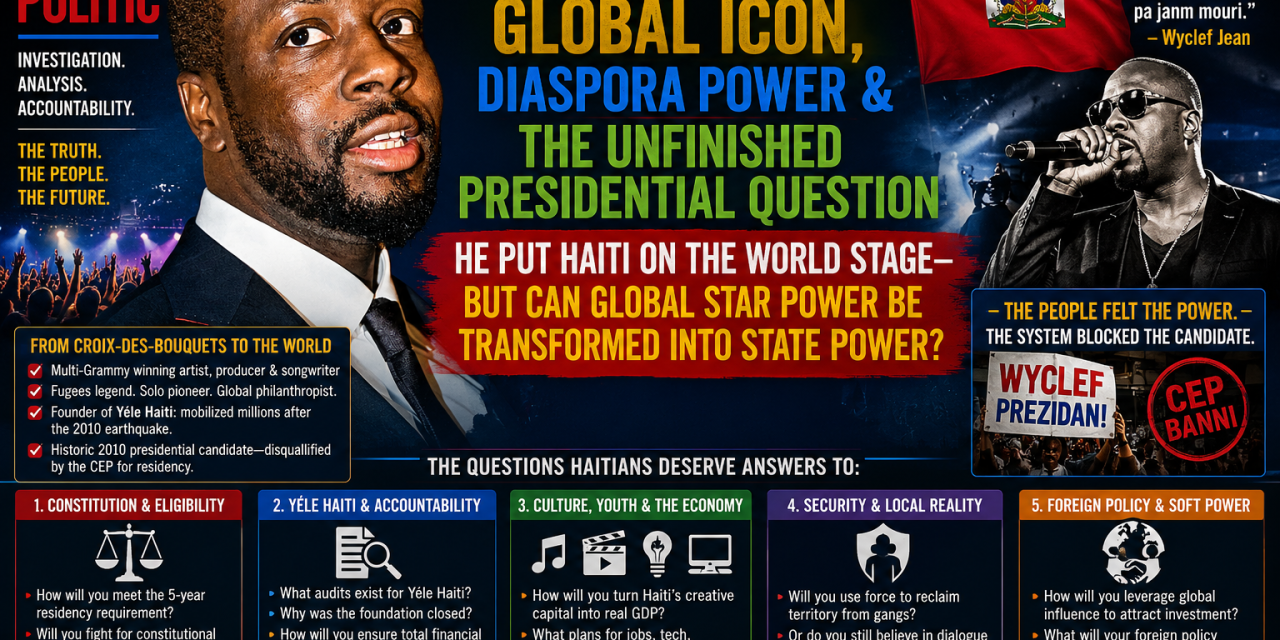
Few Haitians possess the international name recognition of Wyclef Jean.
From Croix-des-Bouquets to New Jersey, from the Fugees to Grammy-winning international success, Jean built something few Haitian public figures have achieved: global cultural influence capable of putting Haiti into conversations far beyond traditional diplomacy. Haiti’s embassy biography credits The Score with reaching No. 1 on Billboard and winning two Grammys, while the Recording Academy documents Jean’s extensive Grammy-winning and nominated work.
And his international relevance has not disappeared. In August 2026, Wyclef remains an active global cultural figure; he is scheduled to headline the September 2026 Global Citizen Festival with Lauryn Hill, alongside major international artists.
But celebrity is not governance.
In 2010, Jean attempted one of the most dramatic transitions imaginable: international entertainer to President of Haiti.
He didn’t make it onto the ballot.
Today, the unanswered question remains fascinating:
Could Wyclef Jean’s extraordinary cultural and diaspora power ever become a credible political project capable of governing Haiti?
Haiti Politic examines the record—and lets the public decide.
🎤 1 | FROM CROIX-DES-BOUQUETS TO GLOBAL CULTURAL POWER
Wyclef Jean was born in Croix-des-Bouquets in 1969 and moved to the United States as a child. He eventually joined Lauryn Hill and Pras Michel in the Fugees, whose 1996 album The Score transformed the group into international stars.
His solo debut, The Carnival, followed in 1997 and became an influential cross-cultural hip-hop project. Grammy.com describes the album as expanding hip-hop’s boundaries through its use of Caribbean musical influences.
Jean subsequently collaborated with artists ranging from Santana and Shakira to Whitney Houston, Celia Cruz and Michael Jackson.
That matters politically for one reason:
Wyclef possesses something Haiti has historically struggled to manufacture through conventional diplomacy—soft power.
A President cannot run a country through concerts.
But cultural influence can open doors.
Could Jean use those relationships to attract tourism, creative-industry investment, international partnerships and diaspora capital?
Could Haiti’s music, fashion, film, visual arts, cuisine and intellectual property become actual export industries?
Those are legitimate foreign-policy questions.
🏛️ 2 | THE PRESIDENTIAL CAMPAIGN THAT NEVER REACHED THE BALLOT
In 2010, following the devastating earthquake, Wyclef Jean sought Haiti’s presidency.
The Provisional Electoral Council rejected his candidacy.
Contemporary reporting indicates that the central dispute concerned the constitutional residency requirement. Jean argued that his role as a Haitian ambassador-at-large and his work in Haiti should satisfy the requirement; the electoral authorities did not permit him onto the ballot.
This distinction is important.
Wyclef did not lose the 2010 presidential election.
He was not permitted to contest it.
That means his actual electoral potential was never tested at the ballot box.
But it also means any future Wyclef political project would have to begin with constitutional eligibility—not popularity.
🎤 QUESTIONS FOR WYCLEF
If you still have presidential ambitions, do you currently satisfy every constitutional qualification required to become President?
If not, would you seek constitutional reform?
Would you support broader political rights for Haitians living abroad regardless of whether those reforms personally benefited you?
And would those reforms be enacted through constitutional institutions rather than political pressure?
Before debating a Wyclef presidency, voters deserve a definitive answer to the simpler question:
Could Wyclef legally become president?
💰 3 | YÉLE HAITI: THE QUESTION HIS POLITICAL FUTURE CANNOT ESCAPE
Any serious investigation of Wyclef Jean as a potential national leader must examine Yéle Haiti.
Jean founded the organization to support projects in Haiti. The World Economic Forum described its work as including education, sports, arts, environmental initiatives, food distribution and emergency relief.
But Yéle subsequently became the subject of serious financial scrutiny.
In January 2010, The Washington Post examined its tax filings and reported questions about administrative expenses and payments to businesses associated with Jean and a board member.
The organization ultimately closed in 2012 amid continuing scrutiny; contemporary reporting described an investigation by the New York attorney general into its finances.
Those facts should neither be exaggerated into unsupported criminal conclusions nor dismissed because Jean is a beloved cultural figure.
They should produce questions.
🎤 WYCLEF SHOULD ANSWER:
What went wrong institutionally at Yéle?
Who controlled expenditures?
What auditing procedures existed?
What reforms would he implement today?
Would he release historical audits and financial documentation necessary to address lingering questions?
And perhaps most importantly:
Why should Haitians trust someone with a national budget if questions remain about the financial governance of his signature humanitarian organization?
That is not an accusation.
It is precisely the accountability test that should apply to every presidential aspirant.
🌎 4 | COULD WYCLEF BUILD A DIFFERENT HAITIAN FOREIGN POLICY?
This is where a hypothetical Wyclef candidacy becomes particularly interesting.
Haiti traditionally conducts foreign policy through presidents, foreign ministers, ambassadors, multilateral organizations and relationships with Washington, Ottawa, Paris, CARICOM and other governments.
Wyclef operates in another universe.
Music.
Entertainment.
Philanthropy.
Global corporations.
Diaspora networks.
International celebrities.
Media.
Major cultural institutions.
That network could theoretically become an unconventional diplomatic asset.
But access is not policy.
🎤 QUESTIONS:
What would a Wyclef Doctrine actually contain?
Would Haiti continue depending heavily on traditional donor relationships?
How would he renegotiate Haiti’s relationship with international NGOs?
What would his policies toward the United States, Dominican Republic, CARICOM, African states and Latin America be?
Could he convert celebrity relationships into actual foreign direct investment?
And how would his government prevent foreign investors from receiving privileged access simply because they belong to his international network?
Soft power can open the meeting room.
It cannot substitute for negotiating the treaty once everyone sits down.
🎧 5 | HAITI’S CREATIVE ECONOMY: HIS MOST NATURAL POLICY TERRITORY
Here Wyclef could enter a national debate with genuine professional experience.
Haiti produces enormous cultural capital.
Music.
Fashion.
Painting.
Film.
Dance.
Literature.
Design.
Cuisine.
Digital entertainment.
Yet cultural production rarely functions as a coherent national export industry.
Wyclef has spent decades inside the international music economy.
So voters should demand specifics.
Would his government modernize copyright enforcement?
Create digital royalty infrastructure?
Build recording and film-production zones?
Establish creative-industry investment funds?
Develop international distribution platforms?
Create vocational academies for sound engineering, animation, filmmaking and software production?
Could Jacmel become a Caribbean film and arts center?
Could Cap-Haïtien develop a larger heritage-tourism industry?
Could Haitian artists reliably collect royalties internationally?
The challenge is turning culture into capital without turning government into an entertainment agency.
👨🏿💻 6 | CAN HE TURN YOUTH POPULARITY INTO YOUTH EMPLOYMENT?
Wyclef’s cultural connection to younger Haitians has historically been central to his political appeal.
But enthusiasm is not employment.
A serious Wyclef economic program would need to move beyond concerts and entrepreneurship slogans.
What would happen to a 22-year-old Haitian without capital?
Would young entrepreneurs receive startup financing?
Would technical schools teach coding, audiovisual production, solar installation and industrial trades?
Would business registration become digital?
Could informal businesses receive temporary tax exemptions while entering the formal economy?
Would diaspora investors receive protections for investing in youth enterprises?
And where would the government find the money?
That final question matters.
Every inspirational political promise eventually becomes a budget line.
🚨 7 | CITE SOLEIL: PEACEBUILDING MEETS THE REALITY OF 2026
Wyclef has historically associated his Haiti activism with disadvantaged communities and grassroots intervention.
But today’s security environment is radically more severe.
BINUH reported at least 1,642 people killed and 745 injured during just the first quarter of 2026, while warning that violence was spreading beyond Port-au-Prince into Artibonite and the Centre.
International assistance also remains part of the security architecture. In June 2026, the OAS and European Union announced a project supporting the Haitian National Police through five forward operating bases in Port-au-Prince.
This creates the hardest question for a celebrity-humanitarian candidate:
What happens when dialogue fails?
Would President Wyclef authorize major police operations?
What role would FAD’H play?
Would foreign forces remain?
Would his administration negotiate with armed groups?
Which individuals would qualify for demobilization programs?
What happens to gang leaders accused of massacres, kidnappings and sexual violence?
How would recruited children be separated from adult commanders?
And who controls neighborhoods after security forces retake them?
A peace concert can bring enemies onto the same stage.
A government has to control the territory after the stage disappears.
👔 8 | THE BIGGEST QUESTION: CAN A CELEBRITY MANAGE A STATE?
Wyclef has demonstrated artistic entrepreneurship, international networking, fundraising ability and extraordinary communication skills.
Those aren’t meaningless qualifications.
But Haiti’s presidency requires something different.
A president must supervise ministries.
Negotiate budgets.
Manage Customs.
Appoint administrators.
Work with Parliament.
Respect courts.
Coordinate police.
Conduct diplomacy.
Manage public procurement.
Build institutions that continue functioning when the president leaves office.
There is limited public evidence from Wyclef’s career demonstrating comparable management of a large governmental bureaucracy.
That doesn’t automatically disqualify him politically.
It creates a burden of proof.
Who would be on his governing team?
Who would run Finance?
Justice?
Foreign Affairs?
Interior?
Agriculture?
Planning?
Would appointments be based on expertise—or celebrity relationships and political loyalty?
Personnel would tell Haitians more about a Wyclef government than another campaign anthem ever could.
📊 HAITI POLITIC | INVESTIGATIVE ASSESSMENT
| AREA | DOCUMENTED ASSET | QUESTION TO INVESTIGATE |
|---|---|---|
| Global visibility | Extraordinary international cultural recognition and continuing access to global platforms. | Can visibility produce investment and diplomatic leverage? |
| Creative industries | Decades of firsthand experience in international music, production and intellectual property. | Can cultural expertise become national industrial policy? |
| Diaspora connection | Haitian-born global figure whose career was largely built in the United States. | Can diaspora mobilization translate into durable domestic institutions? |
| Political experience | Attempted presidential candidacy in 2010. | He has not demonstrated presidential or ministerial governing experience. |
| Constitutional eligibility | His 2010 candidacy was rejected amid the residency dispute. | Any future candidacy would require current eligibility to be established under applicable law. |
| Humanitarian record | Yéle operated programs in Haiti and mobilized international attention and donations. | Financial-management controversies require serious examination. |
| Security | Community activism gives him experience communicating beyond traditional elites. | There is no demonstrated record comparable to commanding national police, military or intelligence institutions. |
| Foreign policy | Potentially exceptional cultural soft power. | Soft power still needs a coherent diplomatic, trade and security doctrine. |
⚠️ WHAT SHOULD NOT BE ASSUMED
Wyclef’s fame should not be treated as evidence that he would be an effective president.
His Yéle controversies should not automatically be treated as proof that he would be a corrupt president.
His 2010 disqualification should not automatically determine his eligibility in a future election; that would have to be assessed under the applicable constitutional and electoral rules at that time.
And massive cultural popularity should never be confused with demonstrated electoral support.
Those distinctions are essential to a credible investigation.
🇭🇹 THE QUESTION FOR HAITI
Wyclef Jean has already accomplished something extraordinary.
He carried Haitian identity onto some of the world’s largest cultural stages.
His career demonstrates creativity, communication, entrepreneurship and global reach. His attempted presidential candidacy demonstrated political ambition. Yéle Haiti, however, created legitimate questions about organizational governance and financial accountability that any renewed political project would have to confront directly.
Meanwhile, Haiti’s situation in 2026 demands much more than symbolism: functioning security institutions, credible courts, economic reconstruction, constitutional legitimacy and a foreign policy capable of accepting international cooperation without surrendering Haitian priorities.
So Haiti Politic’s question is not:
“Do you love Wyclef?”
Nor is it:
“Was Wyclef a great artist?”
The political question is much harder:
WYCLEF JEAN PUT HAITI ON THE WORLD STAGE—BUT CAN THE GLOBAL ICON BUILD A GOVERNMENT THAT WORKS AT HOME?
The record provides evidence.
Wyclef should provide the answers.
The Haitian people can decide.
#HaitiPolitic #WyclefJean #Haiti #Ayiti #HaitiPolitics #Diaspora #ForeignPolicy #CreativeEconomy #Governance #Accountability #HaitiElections