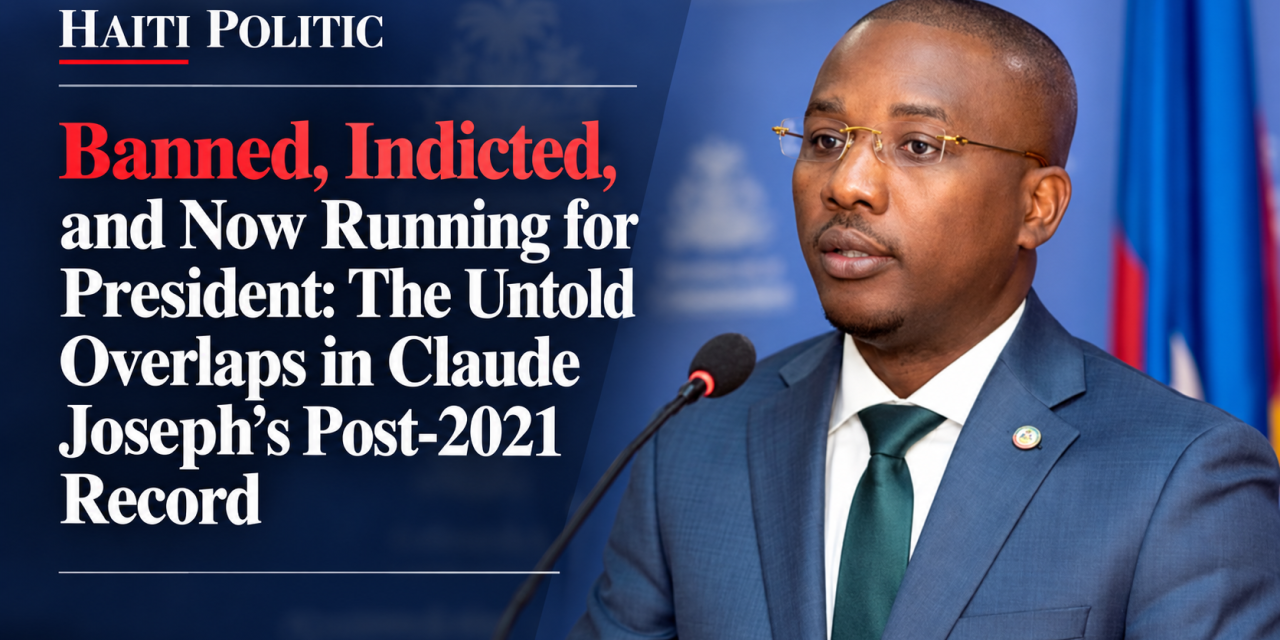
Claude Joseph is presumed innocent in the case that carries the most weight in this story, and he has consistently denied wrongdoing. What follows is a documented account of two distinct chapters in his record since he briefly led Haiti’s government in 2021 — a diplomatic banishment from the Dominican Republic, and a judicial indictment tied to the assassination he was in office when it happened.
Why the Dominican Republic Banned Him
On September 7, 2022, Dominican President Luis Abinader signed an order barring Claude Joseph — Haiti’s former acting prime minister — from entering Dominican territory, placing him on a list alongside 12 named Haitian gang leaders. The order was transmitted directly to Dominican immigration authorities and was invoked under Law 285-04, the country’s immigration statute, which allows the exclusion of foreigners deemed a threat to national security or the interests of the Republic.
The trigger wasn’t a security allegation in the conventional sense — it followed a sustained public feud. Joseph had spent months publicly attacking Abinader, calling him a “hypocrite” who used Haiti “as a last resort to appease ultra-nationalists” in his own country, after the Dominican government declined to regularize undocumented Haitians living there. He had also, notably, called for direct U.S. intervention to restore order in Haiti — a position Abinader’s government read as Joseph speaking for Haiti without a mandate to do so. Joseph’s own reaction was defiant rather than contrite: he called the ban “an honor,” framing it as retaliation for his fight against “anti-Haitianism” and discrimination facing Haitians on Dominican soil, and invoked Dessalines, Toussaint Louverture and Christophe in accepting it. Haitian human rights advocate Pierre Espérance, of the RNDDH, criticized the optics from the other direction — objecting specifically to Joseph’s name appearing on the same list as active gang leaders, regardless of the underlying dispute with Abinader.
Whatever one makes of the politics behind it, the practical effect has held: as of this writing, Joseph remains formally excluded from Dominican territory by presidential order, a genuinely unusual status for a man now seeking Haiti’s presidency and who would, if elected, need to manage the bilateral relationship with the country’s most consequential neighbor.
The Assassination Indictment
The more serious matter is the judicial one. In January 2024, Haitian investigating judge Walther Wesser Voltaire issued an order formally indicting nearly 50 people in the July 2021 assassination of President Jovenel Moïse — including Claude Joseph, alongside Moïse’s widow Martine Moïse and former national police chief Léon Charles. Joseph and Martine Moïse were charged specifically with complicity and criminal association, based on an allegation that the two coordinated so that Martine Moïse could assume the presidency in the aftermath of her husband’s killing. The docket for the case, still active in U.S. federal court in Miami as a related proceeding, separately identifies a figure referred to by the nickname “Ti Klod” in a phone call the day after the assassination — a nickname independently tied to Claude Joseph himself.
Joseph’s response has been consistent and forceful: he has called the indictment a politically engineered “coup d’état,” accusing then-Prime Minister Ariel Henry — his rival for power in the chaotic days after Moïse’s death — of weaponizing Haiti’s justice system against him. He has denied any role across multiple Court of Appeal hearings in 2025, positioned himself as Moïse’s most loyal remaining ally, and called on the court to instead investigate who actually benefited from the killing.
The case’s procedural history complicates any simple reading of guilt or exoneration. The original indictment naming Joseph was annulled on appeal, and the investigation was reopened under a different judge; Joseph was reportedly questioned again as recently as December 2025, meaning his status in the case remains legally unresolved rather than cleared. He does not appear among the defendants in the Sixth Superseding U.S. federal indictment currently moving through trial in Miami — a meaningful distinction between the Haitian domestic case, where he remains a named subject, and the American prosecution, where he is not currently charged.
Where This Leaves Things Now
Joseph is currently the presidential nominee of the EDE party, selected in a process several Haitian outlets have described as a facade primary, ahead of Haiti’s planned December 13, 2026 election. He is asking Haitian voters to make him head of state while carrying two unresolved marks on his public record: a standing Dominican entry ban rooted in his own diplomatic conduct, and a reopened judicial case tied to the murder of the president he served under — one his own 2023 UN Security Council remarks, on record, called for international judicial assistance to fully resolve.
Five Questions for Claude Joseph
- Have you made any attempt, formal or informal, to have the Dominican entry ban lifted or reviewed since 2022 — and if you become president, how do you manage bilateral relations with a neighboring head of state whose government still formally treats you as barred from entering the country?
- The reopened Haitian investigation reportedly questioned you again as recently as December 2025. What is the current status of that questioning, and have you been given any indication of whether new charges will be filed or the case will be closed?
- The case references a “Ti Klod” phone call the day after the assassination. Do you deny having any such conversation with Martine Moïse in that window, and will you voluntarily release your phone records from that period to put the question to rest?
- You’ve called on the court to investigate who “benefited” from the assassination. Whom specifically do you mean, and what evidence have you personally provided investigators to support that claim?
- You asked the UN Security Council in 2023 for international judicial assistance to help Haiti’s justice system resolve this case. Would you, as president, formally request that same international assistance be applied to your own case specifically, to remove any question of political interference either for or against you?