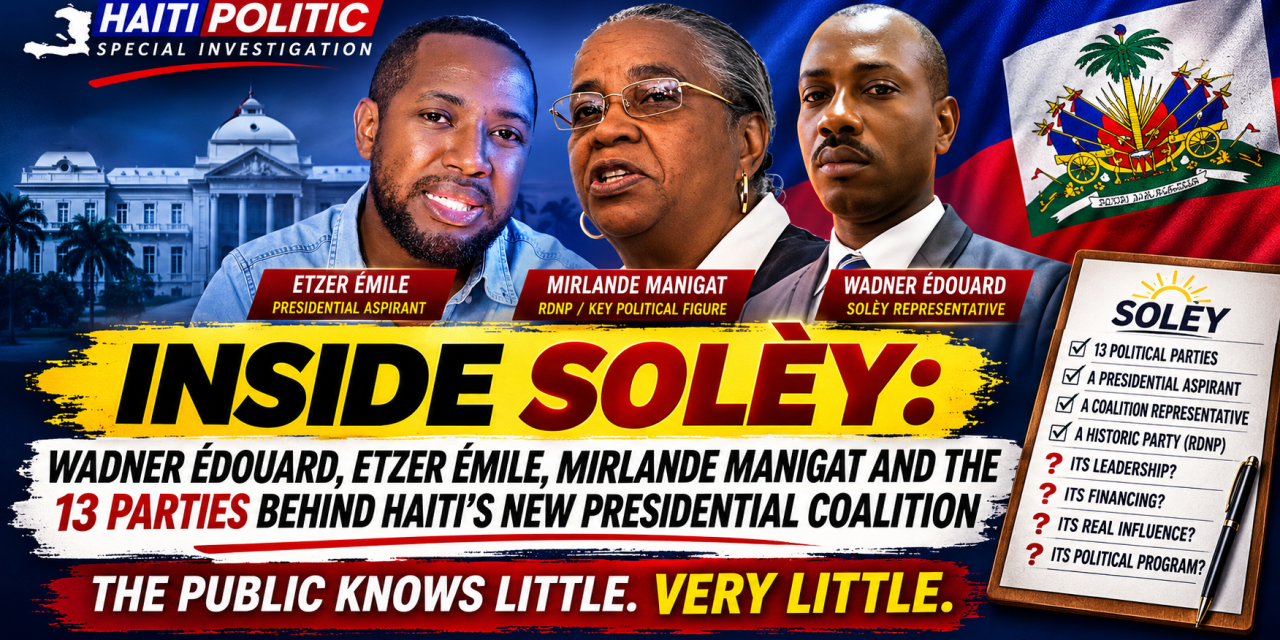
THE PUBLIC KNOWS LITTLE. VERY LITTLE.
An investigation into the political organizations, historical alliances, leadership structures and unanswered questions surrounding the coalition supporting economist Etzer Émile’s presidential ambitions.
HAITI POLITIC | SPECIAL INVESTIGATION
November 5, 2026
THE NEW FACE, THE OLD PARTY, AND THE MAN BEHIND THE COALITION
Haiti has another presidential coalition.
Its name is SOLÈY.
It brings together 13 officially recognized political parties, carries the presidential ambitions of economist Etzer S. Émile, and includes a political organization historically associated with former president Leslie Manigat and former presidential candidate Mirlande Manigat.
Its official representative is Wadner Édouard.
But behind these recognizable names lies a much larger question:
Who are the people and organizations actually controlling SOLÈY, and how much does the Haitian public know about them?
The answer is complicated.
The coalition has a documented electoral registration. It has an identifiable representative. It has attracted candidates for national and local office. And it has a presidential aspirant whose economic commentary has made him familiar to many Haitians.
Yet fundamental questions remain unanswered about the coalition’s constituent parties, their leaders, political histories, finances, and internal decision-making arrangements.
SOLÈY is not merely a name on a political poster. It is an alliance of 13 separate political organizations seeking to participate in the next electoral cycle.
That makes transparency more than a public-relations issue.
It is a question of democratic accountability.
CHAPTER ONE: WADNER ÉDOUARD — THE MAN REPRESENTING THIRTEEN POLITICAL PARTIES
When the Conseil Électoral Provisoire published its August 2026 list of approved political groupings, SOLÈY appeared with Wadner Édouard as its representative.
The coalition’s membership included organizations with names invoking national salvation, patriotic renewal, Christian democracy, political change, and development.
But the public registration document did not provide a biography of the man representing them.
Who is Wadner Édouard?
Where did he begin his political career?
What professional experience does he bring to the coalition?
Which political organizations did he previously lead?
What role did he play in bringing the 13 parties together?
These questions are especially important because Édouard is not simply an observer of SOLÈY’s political activities.
He has publicly spoken on the coalition’s electoral preparations.
During an October 2, 2026, radio appearance, Édouard discussed plans to present candidates at multiple levels of government, criticized the pace of voter registration, and raised concerns about organizing elections in areas affected by insecurity.
He also declined to identify the coalition’s prospective presidential candidate at that time.
Those statements demonstrate an active public leadership role.
They do not, however, establish the full extent of his authority over the coalition’s internal affairs.
Does Wadner Édouard make decisions for SOLÈY, or does he implement decisions made collectively by the 13 parties?
That distinction matters.
A coalition representative may have substantial public visibility without possessing unilateral authority over candidate selection, campaign financing, or party strategy.
The founding agreement and internal statutes would help establish how SOLÈY operates.
Until those documents are examined, the precise distribution of power remains unclear.
THE BIOGRAPHICAL GAP
Haiti Politic’s earlier investigation raised questions about Édouard’s educational background, professional history, political experience, public service, and financial disclosures.
Those questions remain relevant.
The public deserves a documented biography of anyone exercising significant influence over a national electoral coalition.
But limited publicly available information is not evidence that Édouard lacks experience or qualifications.
It means the available record does not yet provide enough information for an independent assessment.
The next step is straightforward: Édouard should be invited to provide his professional résumé, political history, previous public responsibilities, and an explanation of how he became SOLÈY’s representative.
CHAPTER TWO: ETZER ÉMILE — FROM ECONOMIC COMMENTATOR TO PRESIDENTIAL ASPIRANT
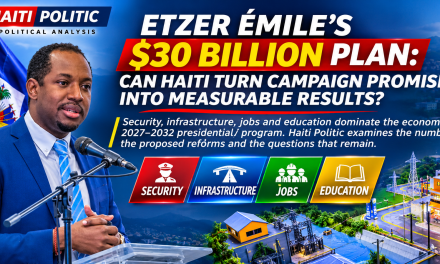
For years, Etzer Émile has been known primarily through economic analysis, teaching, public commentary, and discussions about Haiti’s development challenges.
His public profile is closely associated with questions of economic reform, entrepreneurship, investment, employment, and the country’s structural dependence on imports and remittances.
Now, his role has changed.
On October 31, 2026, Émile registered online as a presidential aspirant under the SOLÈY banner, according to contemporary reporting and electoral-registration trackers.
This was a significant development.
The economist was no longer commenting exclusively on what Haiti’s political leaders should do.
He was seeking an opportunity to exercise political leadership himself.
His stated priorities include security, employment, and social justice.
These are central concerns in Haiti’s present crisis.
But identifying national problems is different from demonstrating how an administration would address them.
THE FIRST QUESTION: WHY SOLÈY?
Why did Etzer Émile choose SOLÈY?
What political negotiations preceded the decision?
Did he approach Wadner Édouard, or did SOLÈY recruit him?
Was he selected through an internal vote involving all 13 parties?
Did the RDNP participate in approving his nomination?
Were other presidential aspirants considered?
And what written agreement defines the relationship between Émile and the coalition?
These questions are not allegations of improper conduct.
They concern the ordinary processes through which political organizations select candidates and establish governing alliances.
A presidential campaign’s internal structure can reveal much about how its leaders intend to govern.
THE SECOND QUESTION: WHERE IS THE GOVERNING PROGRAM?
Émile’s background in economics gives voters a substantial body of public commentary to examine.
But a presidential program requires more than economic diagnosis.
It must explain implementation.
Consider Haiti’s electricity sector.
Would an Émile administration seek to restructure Électricité d’Haïti, expand private-sector participation, introduce new regulatory institutions, or pursue a combination of reforms?
What would those changes cost?
How would the government protect consumers?
Who would supervise procurement?
And how would the administration address the security risks affecting infrastructure?
The same questions apply to agriculture, customs revenue, public administration, education, and healthcare.
Émile has spoken about economic transformation.
The public now needs to see how his proposed policies would be financed, implemented, monitored, and evaluated.
THE THIRD QUESTION: FOREIGN POLICY
Haiti’s security crisis has brought foreign governments, international organizations, and multinational security arrangements into the center of domestic political debate.
What would an Émile administration do differently?
Would it maintain existing international security partnerships?
What conditions would govern the presence of foreign security personnel?
How would it strengthen the Haitian National Police?
What would be the division of responsibilities between Haitian institutions and international partners?
How would the government prevent emergency security arrangements from becoming indefinite commitments?
An economist seeking the presidency must also explain his approach to diplomacy, sovereignty, defense, and constitutional government.
The question is not whether Etzer Émile can explain Haiti’s economic problems. His public career demonstrates that he has spent considerable time discussing them. The question is how his proposed administration would translate those analyses into enforceable government policy.
CHAPTER THREE: MIRLANDE MANIGAT — THE HISTORICAL CONNECTION
Among SOLÈY’s 13 constituent parties, one organization carries a particularly substantial political history.
The Rassemblement des Démocrates Nationaux Progressistes — RDNP.
The party was founded by Leslie François Manigat, who briefly served as Haiti’s president in 1988.
His wife, Mirlande Hyppolite Manigat, later became one of the country’s prominent political figures.
A constitutional law scholar and former presidential candidate, Mirlande Manigat represented the RDNP in the 2010–2011 presidential election.
She advanced to the second round against Michel Martelly.
That history gives the RDNP an established political identity extending far beyond the present electoral cycle.
But its presence inside SOLÈY raises questions that have not been fully answered by the coalition registration documents.
DID MIRLANDE MANIGAT ENDORSE SOLÈY?
The RDNP’s inclusion in SOLÈY does not automatically establish that Mirlande Manigat personally endorsed Wadner Édouard, Etzer Émile, or every decision made by the coalition.
Party affiliation and individual endorsement are different matters.
Haiti Politic has not established, from the documents examined for this investigation, that Manigat personally negotiated the alliance or approved Émile’s presidential candidacy.
That distinction must be preserved.
Nevertheless, the historical relationship between Manigat and the RDNP makes the party’s decision to join SOLÈY politically significant.
Who currently exercises executive authority within the RDNP?
Was the decision approved by its governing bodies?
What policy commitments accompanied the affiliation?
Does the RDNP support Émile’s entire political program?
And what role, if any, does Mirlande Manigat play in the coalition today?
These are questions for the RDNP’s current leadership and Manigat herself.
A CONNECTION TO HAITI’S POLITICAL PAST
The RDNP’s history also invites a broader examination.
Leslie Manigat’s presidency took place during a turbulent period marked by military influence over Haiti’s political institutions.
Mirlande Manigat’s 2010–2011 presidential campaign unfolded during another period of institutional instability, following the devastating 2010 earthquake.
Those historical circumstances should be examined accurately, without treating the RDNP’s present membership as proof that its current leaders share responsibility for every decision made during those periods.
Political continuity can provide institutional experience.
It can also create legitimate questions about how older parties have adapted their policies and leadership structures.
For SOLÈY, the central issue is whether the RDNP’s participation represents a substantive political partnership or a more limited electoral alliance.
Only the parties involved can fully explain the agreement.
CHAPTER FOUR: THE THIRTEEN PARTIES — WHO ARE THEY?
The CEP’s official documentation identifies 13 parties within SOLÈY.
Their names are public.
Their affiliation is documented.
But the depth of independently accessible information about their leadership, organizational histories, and previous electoral accomplishments varies considerably.
1. KONSA — Kolektif Nasyonal Pou Sove Ayiti
KONSA presents itself through a name centered on national rescue.
However, the available coalition documents do not identify its founders, current executive officers, founding date, membership figures, or previous electoral results.
Who leads KONSA?
What political work did it conduct before joining SOLÈY?
What specific policies distinguish it from the other parties?
And who authorized its affiliation?
These are basic questions for an organization seeking political representation.
2. MAPLA — Misyon Ayisyen Pou Libere Ayiti
MAPLA’s name invokes the liberation of Haiti.
But liberation can carry different meanings in political discourse.
Does MAPLA emphasize economic independence, institutional reform, national security, or another political objective?
The coalition registration does not answer that question.
Its founding history, current leadership, organizational structure, and prior electoral participation require independent verification.
3. MANMAN — Mobilizasyon Ayisyen Natif Natal Pou Manbre Avansman Nasyonal
MANMAN appears in official party-registration records.
Its name emphasizes Haitian mobilization and national advancement.
But the available documentation does not establish its membership base or organizational accomplishments.
Who founded MANMAN?
Which communities does it represent?
Has it previously participated in elections?
And what policy commitments brought it into SOLÈY?
4. MACH — Mouvman Angajman pou Chanjman
MACH presents itself as a movement for change.
The immediate documentary question concerns its registered identity and leadership.
Its name has appeared with inconsistent acronym spellings in secondary reporting.
The official registration file should establish the legally recognized designation.
The broader questions concern its founding date, previous candidates, policy platform, and leadership structure.
5. PATRON — Parti Tangible du Regroupement Organisé des Nationalistes
PATRON’s name explicitly references nationalism.
But a party name alone cannot establish its ideology.
Does PATRON advocate economic nationalism, institutional sovereignty, protection of domestic industries, or other policies?
Who founded it?
What is its documented political history?
And how does its program align with Etzer Émile’s economic proposals?
These questions require the party’s actual political platform.
6. PHUSHA — Parti des Haïtiens Unis pour Sauver Haïti
PHUSHA appears in CEP party records.
Its stated identity, reflected in its name, emphasizes Haitian unity and national recovery.
But registration does not reveal how the party is organized.
Who are its officers?
Has it previously presented candidates?
What public activities can be documented?
And what role does it exercise within SOLÈY’s leadership?
7. PAPEH — Parti des Patriotes Engagés pour Haïti
PAPEH is another officially listed constituent organization.
Its name emphasizes patriotic engagement.
However, the available sources do not establish a detailed history of its founders, electoral campaigns, or policy accomplishments.
The party should be asked to identify its current leadership, provide its political program, and document its previous activities.
8. REPAH — Renaissance Patriotique d’Haïti
REPAH invokes patriotic renewal.
But what does that mean in practical terms?
Does the party advocate constitutional reform?
Economic restructuring?
Security-sector reform?
Decentralization?
The registration documents do not establish its specific positions.
Its leadership, founding history, and previous electoral record remain subjects for further investigation.
9. RCMH — Rassemblement des Citoyens en Mouvement d’Haïti
RCMH appears in the official party records and SOLÈY’s membership list.
Its name suggests citizen mobilization.
But the extent of its grassroots organization has not been independently established.
Does RCMH maintain local chapters?
Has it organized public meetings?
Who are its elected officers?
What political activities preceded its coalition membership?
10. RDNP — Rassemblement des Démocrates Nationaux Progressistes
The RDNP has an identifiable historical record, established political figures, and previous national electoral participation.
Its relationship with Leslie and Mirlande Manigat distinguishes it historically from many of the other SOLÈY members.
But its current internal leadership and decision to affiliate with SOLÈY still require examination.
The question is not whether the RDNP has a history.
It does.
The question is what its current leadership agreed to when it joined the coalition.
11. UPDC — Union Patriotique des Démocrates Chrétiens
UPDC’s name identifies a Christian-democratic political orientation.
But Christian-democratic organizations can differ significantly in their economic and social policies.
What does UPDC’s actual program propose?
Who leads it?
Has it previously participated in elections?
And what agreements has it reached with the other SOLÈY parties?
Without its official program and leadership documents, its policy positions should not be assumed.
12. UPADH — Union des Patriotes pour le Développement d’Haïti
UPADH has a potentially useful additional source of public information.
A website using the party’s name and acronym publishes a development-oriented political program addressing education, healthcare, agriculture, security, infrastructure, and public administration.
However, the website’s organizational ownership and relationship to the CEP-registered party should be verified before its contents are treated as the party’s authoritative platform.
Who currently leads UPADH?
Who approved its participation in SOLÈY?
And how does its development program compare with Émile’s presidential proposals?
13. VMS — Voix de la Majorité Silencieuse
VMS has perhaps one of the most politically suggestive names in the coalition.
Voice of the Silent Majority.
But whose voice does it represent?
What is its membership?
Who selected its leaders?
Has it conducted public consultations or participated in previous elections?
The party’s name is not evidence of majority support.
Its actual organization and political record must be examined independently.
CHAPTER FIVE: THIRTEEN PARTIES, BUT HOW MANY POLITICAL MEMBERS?
A coalition containing 13 registered parties can sound substantial.
But the number of constituent organizations is not the same as the number of individual supporters.
A political party may have extensive departmental structures, local committees, and thousands of active members.
Another may have a smaller organizational presence.
The CEP’s coalition list does not provide comparable membership figures for SOLÈY’s 13 parties.
Consequently, it would be misleading to infer the coalition’s popular support directly from the number of registered organizations.
A meaningful assessment would require additional information:
-
Verified membership totals and departmental organization.
-
Current party leadership and internal election procedures.
-
Historical participation in presidential, legislative, and municipal elections.
-
Certified results from previous elections.
-
Public political programs and documented activities.
These records would allow citizens to distinguish formal coalition membership from demonstrated political organization.
The coalition’s existence is documented.
Its membership base remains insufficiently documented in the materials examined.
CHAPTER SIX: THE CANDIDATES ARE APPEARING — BUT THE QUESTIONS REMAIN
SOLÈY’s electoral activity extends beyond Etzer Émile.
A candidate-registration tracker drawing from CEP data reported 440 SOLÈY candidacies across Haiti’s ten departments as of November 3, 2026.
The recorded candidacies included one presidential aspirant, 16 Senate candidates, 69 candidates for deputy, 116 mayoral candidacies, and additional local-government candidates.
Among the individuals associated with SOLÈY’s electoral registrations were musician Jean Jean Roosevelt, seeking a Senate seat in Grand’Anse, and journalist Nancy Lainé Isaac, listed for the Pétion-Ville deputy race.
These registrations demonstrate that SOLÈY is participating in the electoral process beyond the presidential level.
But there is an important limitation.
A preliminary registration is not equivalent to final CEP approval of a candidate.
The candidate list remains subject to the electoral authority’s review.
The larger organizational question also remains unresolved.
Which of SOLÈY’s 13 parties recruited these candidates?
Which party organizations nominated them?
Were candidates selected through local consultations, party executive decisions, or centralized coalition negotiations?
And how will campaign resources be distributed?
A coalition presenting hundreds of candidacies should be able to explain its nomination procedures and governing arrangements.
CHAPTER SEVEN: WHO FINANCES SOLÈY?
Every serious national political campaign requires resources.
Campaign organizations need personnel, transportation, communications, voter outreach, administrative support, and compliance procedures.
A coalition presenting candidates across multiple departments must coordinate those activities.
That raises ordinary but important questions about political financing.
Who pays for SOLÈY’s administrative operations?
Do the 13 parties contribute independently?
Are campaign expenses centralized?
Does the presidential campaign maintain separate accounts?
Who authorizes expenditures?
What financial disclosures are required under the applicable electoral framework?
And what information will be made publicly available?
The documents reviewed for this investigation do not establish SOLÈY’s financial structure or identify its donors.
That is not evidence of improper financing.
It is a gap in the publicly examined record.
Haiti Politic should seek the coalition’s applicable financial filings and request an explanation of its accounting arrangements.
The same standard should apply to all political groupings participating in Haiti’s elections.
CHAPTER EIGHT: THE MANIGAT–ÉMILE QUESTION
There is another issue deserving careful examination.
What does the participation of the RDNP mean for Etzer Émile’s political project?
Émile is presenting himself through a campaign associated with economic reform and a more effective state.
The RDNP brings a history linked to Leslie Manigat’s presidency and Mirlande Manigat’s presidential campaign.
These political histories are different.
But their coexistence inside SOLÈY creates an opportunity to examine the coalition’s ideological foundations.
Does Émile share the RDNP’s constitutional philosophy?
What is the coalition’s position on presidential power?
What role does it envision for Parliament?
Does it support constitutional amendments?
How does it propose to reform Haiti’s judiciary?
And how would its administration address relations between elected officials, security institutions, and foreign governments?
These are questions of political substance.
The presence of an established party does not prove that a presidential candidate has adopted every position historically associated with that organization.
Nor does it establish that Mirlande Manigat personally directs the candidate’s political strategy.
Such claims would require evidence.
The documented connection is organizational: the RDNP belongs to SOLÈY, and Etzer Émile is registered as a presidential aspirant under the SOLÈY banner.
The nature of any direct political relationship between Émile and Mirlande Manigat remains a separate question.
CHAPTER NINE: CAN AN ECONOMIST CHANGE HAITI’S POLITICAL SYSTEM?
Etzer Émile’s transition from economic commentator to presidential aspirant raises a legitimate public-policy question.
What would distinguish his proposed administration from previous governments?
Haiti has experienced administrations led by politicians, technocrats, business figures, and individuals with substantial professional credentials.
Professional expertise can contribute to policymaking.
But implementing policy also requires political coalitions, functioning institutions, public financing, administrative capacity, and accountability.
Émile’s campaign should therefore be examined through specific proposals rather than general expectations.
How would he finance infrastructure development?
What reforms would he introduce to public procurement?
How would he reduce customs fraud?
What institutional safeguards would govern public contracts?
How would he encourage diaspora investment while protecting investors?
What would his administration do to strengthen domestic agricultural production?
And how would it measure progress?
These questions are especially relevant because the candidate’s public identity is closely associated with economic expertise.
His campaign provides an opportunity to compare his previous recommendations with the policies he now proposes to implement.
The public should also examine the political commitments of the 13 organizations supporting his candidacy.
A presidential program is not only the work of an individual candidate.
It is also shaped by the parties, advisers, legislators, and political organizations that support an administration.
CHAPTER TEN: FIFTEEN QUESTIONS SOLÈY SHOULD ANSWER
Haiti Politic invites Wadner Édouard, Etzer Émile, the RDNP leadership, Mirlande Manigat, and representatives of the 13 constituent parties to address the following questions.
1. Wadner Édouard: What is your complete educational, professional, and political background?
2. Wadner Édouard: Who selected you to represent SOLÈY, and what authority does the coalition agreement give you?
3. Etzer Émile: Why did you choose SOLÈY rather than establish an independent political party or seek the nomination of another organization?
4. Etzer Émile: Which party leaders participated in selecting you as the coalition’s presidential aspirant?
5. Mirlande Manigat: Were you personally consulted about the RDNP’s participation in SOLÈY, and do you endorse Etzer Émile’s candidacy?
6. RDNP leadership: Who authorized the party’s affiliation, and what formal agreement governs its participation?
7. SOLÈY leadership: Will you publish the names of the presidents and executive officers of all 13 parties?
8. SOLÈY leadership: What are the founding dates and previous electoral records of each constituent party?
9. SOLÈY leadership: How many verified members does each party have, and how are those figures maintained?
10. SOLÈY leadership: How are campaign contributions received, recorded, and disclosed?
11. Etzer Émile: What specific reforms would you introduce during your first 100 days in office?
12. Etzer Émile: What is your position on foreign security deployments, and what conditions would govern their continuation or termination?
13. SOLÈY leadership: How were the coalition’s legislative and local-government candidates selected?
14. Etzer Émile and the RDNP: What political principles and policy commitments form the basis of your alliance?
15. All 13 parties: What have your organizations accomplished independently before joining SOLÈY, and where can the public examine the supporting records?
THE FINAL QUESTION: A NEW POLITICAL PROJECT OR A NEW ALLIANCE OF EXISTING ORGANIZATIONS?
SOLÈY presents an interesting development in Haiti’s evolving electoral landscape.
Its presidential aspirant is an economist known for public commentary.
Its representative, Wadner Édouard, has emerged as an identifiable coalition spokesman.
Its membership includes the historically established RDNP.
And its candidate registrations indicate participation across national and local electoral contests.
These are documented features of the coalition.
But they do not resolve the questions surrounding its internal organization.
The public still needs a clearer account of who leads the constituent parties, how the coalition was negotiated, how candidates were selected, how political decisions are made, and how campaign resources are managed.
For Wadner Édouard, the unanswered questions concern his professional and political background and the authority he exercises.
For Etzer Émile, they concern the transition from economic analysis to political leadership and the details of his governing program.
For the RDNP and Mirlande Manigat, they concern the party’s current leadership, its decision to enter SOLÈY, and the extent of Manigat’s personal involvement.
For the other 12 parties, they concern basic organizational transparency: founding histories, leadership, electoral participation, membership, and public policy positions.
None of these questions presupposes wrongdoing.
They are questions citizens can reasonably ask of organizations seeking public office.
THE PUBLIC KNOWS LITTLE. VERY LITTLE.
Not because SOLÈY has no documented political activity.
It does.
Not because all 13 parties lack history.
The RDNP plainly has one.
And not because every unanswered question implies something improper.
It does not.
The problem is that the publicly examined record tells Haitians considerably more about SOLÈY’s electoral registration than about the people, institutions, agreements, and resources behind the coalition.
That imbalance deserves attention.
Before any political organization asks citizens to entrust it with national leadership, the public should have access to sufficient information to examine its proposals, leadership, and record.
For SOLÈY, the next stage of public scrutiny should move beyond the names on the CEP registration list.
It should examine the organizations behind those names.
Thirteen parties. One presidential aspirant. One coalition representative. Hundreds of preliminary candidacies.
And a series of important questions that remain unanswered.
Haiti Politic will continue examining SOLÈY’s constituent organizations, candidate-selection procedures, political financing, and leadership records as additional documentary evidence becomes available.
HAITI POLITIC — Independent Political Investigation
Editor’s note: This investigation distinguishes official electoral registration, historical political records, reported candidate activity, and matters that remain unverified. Inclusion in a coalition does not establish personal endorsement by a party’s historical leaders. Preliminary candidate registration does not constitute final CEP approval. Organizations and individuals named in this article should be given an opportunity to respond to questions concerning their activities and governance.