The Announcement
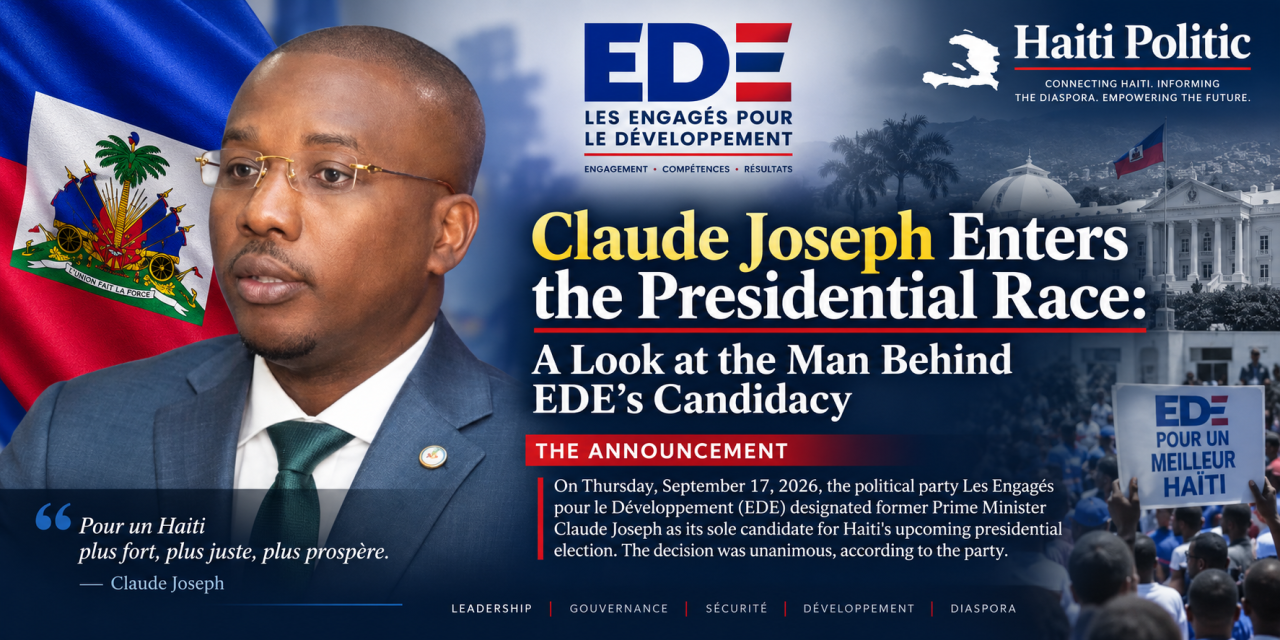
On Thursday, September 17, 2026, the political party Les Engagés pour le Développement (EDE) designated former Prime Minister Claude Joseph as its sole candidate for Haiti’s upcoming presidential election. The decision was taken by the party’s National Political Bureau (BPN) during a meeting at the El Rancho Hotel in Port-au-Prince, and EDE says the choice was unanimous. According to the party, the designation rests “in particular on his resilience” — a message echoed on social media in the clip announcing the news.
The nomination came as something of a surprise to observers: Joseph’s name had not previously circulated as a primary contender within EDE. Coverage of the party’s internal process had instead widely circulated the photo and name of Joseph Harold Pierre as the apparent frontrunner heading into the selection. Joseph’s emergence as the “unique candidate” — bypassing a visible primary contest — has itself become a talking point in early coverage of his candidacy.
The announcement follows a string of recent moves by Joseph to position himself for this race: he registered as a voter on September 11, 2026, accompanied by what he said were more than 1,000 EDE members and supporters, and he has used the run-up to the vote to repeatedly criticize the transitional authorities that have governed Haiti since 2024, calling for elections he describes as “inclusive, credible, transparent and democratic.”
Haiti’s general elections, after repeated delays, are currently scheduled for a first round on December 13, 2026 and a runoff on February 21, 2027 — a vote that would mark the country’s first presidential election in roughly a decade.
Who Is Claude Joseph?
Claude Joseph (born April 4, 1980, according to most public records) is a Haitian politician, former diplomat, and academic who briefly served as Haiti’s acting head of government during one of the most chaotic episodes in the country’s recent history.
Education and academic career. Joseph holds a Master of Public Administration from Long Island University and a PhD in public and urban policy from The New School in New York City, where he received a full merit scholarship and the Isador Lubin Fellowship. Before returning to full-time politics, he taught as a university professor in the United States, including at the University of Connecticut and Long Island University — a background that gave him a technocratic, foreign-policy-oriented profile relatively unusual among Haiti’s political class.
Rise through government. Joseph built a career as a diplomat and public-policy specialist rather than as an elected politician. He was appointed Minister of Foreign Affairs and Worship on March 4, 2020, under the government of Prime Minister Joseph Jouthe during the presidency of Jovenel Moïse. When Jouthe resigned in April 2021, President Moïse appointed Joseph as acting Prime Minister on April 14, 2021 — intended, at the time, as a caretaker appointment ahead of a transfer of power to Ariel Henry, whom Moïse had already designated as the next prime minister but had not yet formally installed.
The Crisis of July 2021
Joseph’s moment in history came on July 7, 2021, when President Moïse was assassinated at his private residence in Pétion-Ville by a commando of mostly Colombian mercenaries. Because Henry’s appointment had not been finalized before the assassination, Joseph — still technically the sitting acting prime minister — asserted control of the government and the Council of Ministers, declared a state of siege, and pledged to find those responsible for the killing.
What followed was a tense, weeks-long power struggle. The Senate, invoking its own reading of the constitution, backed Senate president Joseph Lambert as interim president. Ariel Henry, the prime minister-designate whose appointment Moïse had signed but not fully executed, argued he was the legitimate successor. The United States initially recognized Joseph as acting prime minister, while the “Core Group” of foreign ambassadors and international bodies (including the UN and OAS) ultimately pressed for Henry to take charge. On July 19, 2021, Joseph announced — in an interview with the Washington Post — that he would step aside for Henry, saying he was honoring Moïse’s final wishes, while denying that international pressure had forced his hand. Henry was sworn in the next day; Joseph remained Foreign Minister until he was replaced in November 2021.
Building a Political Party — and a Rivalry
In September 2022, Joseph launched his own political party, Les Engagés pour le Développement (EDE) (“Committed to Development”), positioning himself as an opposition voice against Ariel Henry’s government and, later, against the Transitional Presidential Council (CPT) that took power in 2024. He became a frequent and outspoken critic of the transition, accusing successive interim authorities of clinging to power without organizing elections, and publicly clashed — including in a reported verbal altercation with insults exchanged — with Prime Minister Garry Conille in mid-2024. When Conille was dismissed by the CPT in November 2024, Joseph called it “a new coup” against the political agreement that had established the transition. In mid-2025 he continued to press the CPT to make way for an “alternative” before 2026.
Separately, in September 2022, the Dominican Republic declared Joseph persona non grata, barring him from entering the country, amid the broader deterioration of Haitian-Dominican relations.
Accomplishments Cited by Supporters
- Diplomatic credentials. Supporters point to his advanced academic training and prior role as Foreign Minister as evidence of a technocratic, internationally literate profile — someone who has represented Haiti on the world stage.
- Steadying the state during a constitutional vacuum. Backers credit Joseph with maintaining a functioning executive authority in the immediate, legally ambiguous days after Moïse’s assassination, at a moment when Haiti had no sitting parliament and no clear line of succession.
- Persistent advocacy for elections. Since 2022, Joseph has consistently and publicly pushed for a return to elected government, criticizing multiple unelected transitional arrangements for delaying the vote.
- Party-building. EDE has grown into one of the more visible opposition parties during the transition period, giving Joseph an organized political vehicle and a claim to represent an alternative to both the old PHTK establishment and the CPT-era transitional class.
Controversies
- The legitimacy dispute of July 2021. Joseph’s assumption of executive authority after Moïse’s death was contested from the start — by the Senate, by rival claimant Ariel Henry, and by the international “Core Group” — raising lasting questions about the constitutional basis for his brief hold on power.
- Indictment in the Moïse assassination. In February 2024, an investigating judge indicted Joseph — alongside Moïse’s widow, Martine Moïse, and former police chief Léon Charles — in the assassination case, accusing him of complicity and criminal association, based partly on the speed and manner of his assumption of power after the killing. Joseph rejected the charges as politically motivated, accusing Ariel Henry of orchestrating the case and calling Henry “the main beneficiary” of the assassination. On October 13, 2025, Haiti’s Court of Appeal overturned the indictment against him — but as part of the same ruling, ordered a new investigation into the assassination, meaning the matter has not been definitively closed.
- Persona non grata in the Dominican Republic. His 2022 ban from entering the neighboring country remains a live diplomatic complication for a presidential candidate who would need to manage bilateral relations.
- Older allegations of political violence. Critics — including diaspora advocacy groups — have raised decades-old allegations tying Joseph to political violence in the mid-2000s, including his conduct as a member of a pro-government civilian group during the unrest surrounding the 2004 ouster of President Aristide, and to a violent incident at a 2005 funeral. These allegations, circulated primarily by opposition and activist organizations rather than established in court, have not been adjudicated and should be treated as unproven claims rather than settled fact; they nonetheless continue to surface in criticism of his candidacy.
- Credibility questions around EDE amid the transition. Some commentators have noted the awkwardness of EDE positioning itself as a moral critic of a corruption-tainted CPT while its own leader remained under indictment for much of the transition period.
- The “surprise candidate” question. His selection over the more publicly promoted Joseph Harold Pierre, without a visible primary contest, has already drawn scrutiny over how democratic EDE’s own internal nomination process actually was — a pointed question for a candidate campaigning on democratic legitimacy.
Thirty Questions Haitians Should Ask Claude Joseph Before Voting
On the 2021 crisis and accountability
- Why did you assert control of the government on July 7, 2021, before the question of legal succession had been resolved, and do you still believe that was the correct constitutional path?
- What did you know, and when, about threats to President Moïse’s security in the weeks before his assassination?
- Now that the Court of Appeal has ordered a new investigation into the assassination, will you fully cooperate — including testifying and turning over any relevant documents — even if it reopens scrutiny of your own conduct?
- Do you still maintain that Ariel Henry was “the main beneficiary” of Moïse’s assassination, and if so, what evidence supports that claim?
- Why did you ultimately agree to step aside for Ariel Henry in July 2021, and was that decision driven by domestic consensus, international pressure, or both?
On governance and institutional legitimacy 6. What concrete, verifiable steps will you take to ensure the December 2026 and February 2027 elections are seen as credible by all major political factions, not just your own coalition? 7. How was Claude Joseph — rather than Joseph Harold Pierre, the figure most publicly promoted ahead of EDE’s internal process — actually selected as the party’s “unique candidate,” and can EDE publish the record of that decision? 8. If you criticize the CPT and past transitional governments for lacking democratic legitimacy, what standard of internal party democracy did your own nomination meet? 9. What is your plan for restoring a functioning, elected Parliament, which has not sat since January 2020? 10. Will you commit to term limits and independent oversight mechanisms to prevent any future concentration of executive power, given your own experience holding disputed authority in 2021?
On security and gang violence 11. What is your specific, funded plan to rebuild and professionalize the Haitian National Police, beyond the general calls for “well-trained, well-paid, well-equipped” units you have made in past interviews? 12. How would you address the armed groups that now control large parts of Port-au-Prince and other regions, and what is your position on the role of the multinational security support mission? 13. What accountability measures would you put in place for police or state actors credibly linked to gang collaboration or corruption? 14. As acting head of state in 2021, what specific security failures do you believe occurred under your watch, and what did you personally do to address them?
On the economy and daily life 15. What is your concrete plan to address inflation, currency depreciation, and the cost of basic goods for ordinary Haitians? 16. How do you propose to restore state revenue collection and public services in areas currently outside government control? 17. What is your position on international financial assistance and conditions historically attached to it, including the aid restrictions imposed after the disputed 2000 elections and subsequent crises? 18. What is your plan to create jobs and support Haitian agriculture and small business, particularly outside Port-au-Prince?
On foreign relations 19. Given that you were declared persona non grata by the Dominican Republic in 2022, how do you intend to manage one of Haiti’s most consequential bilateral relationships if elected president? 20. What is your position on Haitian migration policy, deportations from the Dominican Republic and the United States, and protections for Haitians abroad? 21. What relationship do you envision with the United States and the “Core Group” of foreign powers that helped determine the outcome of the 2021 succession crisis? 22. How would you balance sovereignty concerns with the practical need for international security and financial support?
On the corruption and past allegations 23. How do you respond to allegations, raised by diaspora and human rights groups, tying you to political violence in 2004–2005, including the death of student Louvois Petit and the assault at Father Gérard Jean-Juste’s church in 2005? 24. What safeguards would you put in place to ensure your own administration is not compromised by the kind of corruption scandals (such as the BNC affair) that have plagued recent transitional bodies? 25. Will you commit to full financial disclosure of your assets and campaign financing, including any foreign support to EDE?
On leadership style and temperament 26. Reports describe a heated public exchange of insults between you and then-Prime Minister Garry Conille in 2024 — how do you characterize your ability to work constructively with political rivals and coalition partners? 27. What lessons do you draw from your brief, contested tenure as acting prime minister about your own leadership limitations? 28. How would you govern a country as polarized as Haiti without the backing of a sitting, elected Parliament in your early term?
On vision for the country 29. Beyond opposing the transitional authorities, what is the single most important structural reform you would prioritize in a first year in office? 30. If you lose this election, will you commit publicly, now, to accept the result and support a peaceful transfer of power?
This article is intended as a factual overview to inform public debate ahead of Haiti’s 2026–2027 elections. Allegations noted above that have not been proven in a court of law are identified as such and should not be treated as established fact.